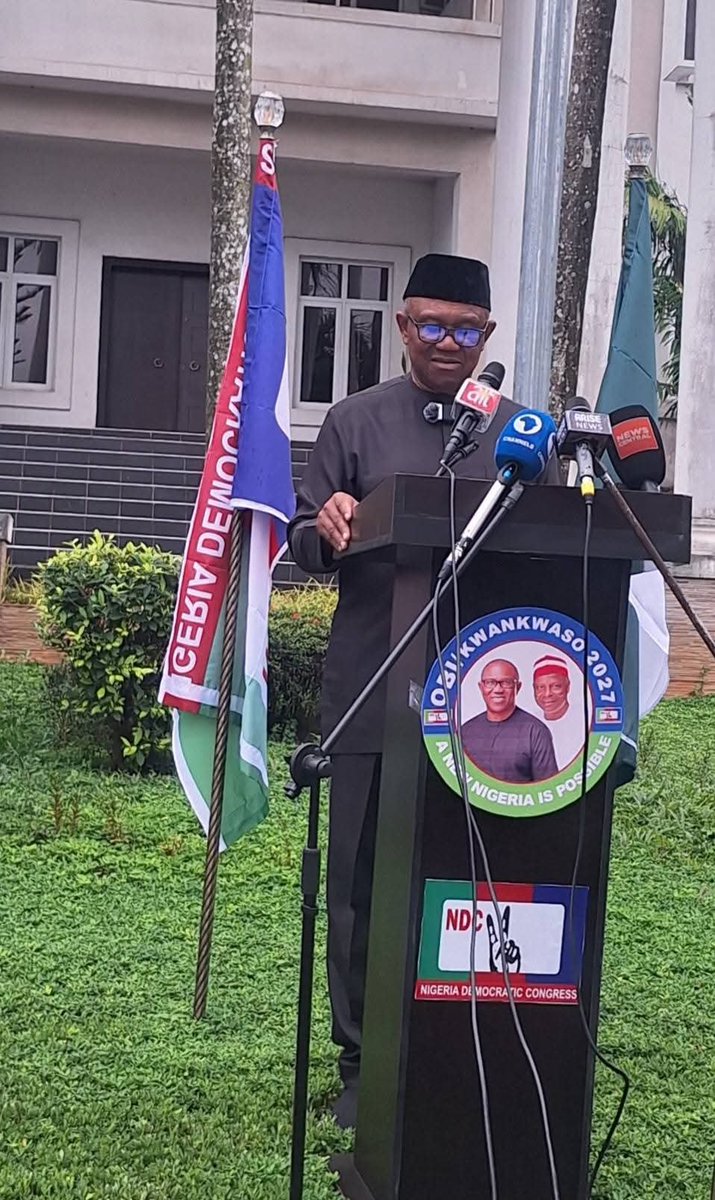
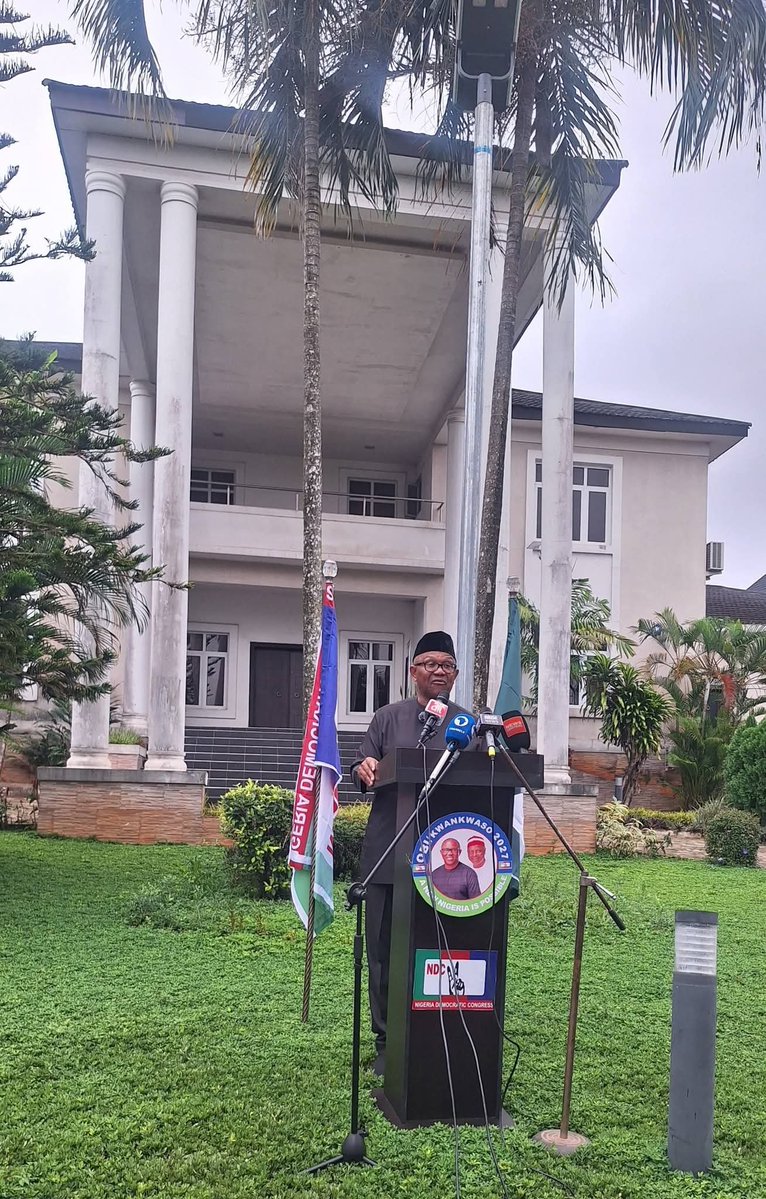
MY ADDRESS TO MARK THE COMMENCEMENT OF THE 2027 PRESIDENTIAL AND NATIONAL ASSEMBLY CAMPAIGNS
21 August 2026
Dear Compatriots,
Members of the Press,
Distinguished ladies and gentlemen,
Wednesday, 19 August 2026, marked the official start of the campaign period for the 2027 Presidential and National Assembly elections.
There is no doubt that this is a defining moment for our democracy. This moment gives Nigerians the opportunity to assess the records, ideas, and plans of those seeking their mandate to lead their country at a time of grave uncertainty in our rapidly changing world.
I consider myself quite privileged to be one of those seeking your mandate to deal with these challenges facing our country.
I enter this contest with one firm conviction: Nigeria can work, and Nigeria must work.
Nigeria faces several serious challenges. Some of them are indeed of existential proportions.
According to the IMF, 63%, or over 140 million Nigerians, live at or below the national poverty line, while humanitarian agencies estimate that 35 million people will need food assistance during the 2026 lean season. About 3.6 million Nigerians remain internally displaced, largely because of conflict and insecurity. Each year, millions of young people enter the labour market, yet too many struggle to find productive opportunities. Weak infrastructure, unreliable power, insecurity, and the excessive cost of doing business continue to burden households and constrain enterprise.
These are more than statistics. They reflect the daily realities of Nigerian families, farmers, workers, students, and businesses.
Yet I do not believe Nigeria lacks the ability to overcome these challenges. We have the people, resources, market, talent, and enterprise. What we must do now is turn these strengths into security, productivity, and shared prosperity.
LEADERSHIP MUST DELIVER RESULTS
My successful private-sector experience, studies in institutions of repute on policy and business matters, and my service as Governor of Anambra State have shaped my understanding of public leadership. Government must manage resources responsibly, set clear priorities, and measure the outcomes of its decisions. Public office is not a reward; it is a responsibility to the people.
In Anambra, I prioritised the foundations of long-term development: education, healthcare, infrastructure, fiscal discipline, and institutional capacity. I do not present that record as perfect, but as an experience from which Nigerians can draw their own conclusions.
Senator Rabiu Musa Kwankwaso brings a different but complementary governing experience.
As Governor of Kano State, he focused strongly on education, technical training, scholarships, infrastructure, and human-capital development. His administration’s investments in education and skills showed an understanding that the people are a state’s most important long-term resource.
Our experiences are different, but our conclusion is the same: Nigeria must invest in its people and manage public resources with discipline.
BUILDING AN ECONOMY THAT WORKS
Nigeria needs more than reactive reforms. We must focus on the questions that matter:
Are Nigerians better off than they were four years ago? Can they afford food, education, and healthcare? Can businesses produce, expand, and create jobs? Can young people find productive work? Can farmers work safely and get their produce to market?
Campaign starts today and this is why I’m supporting Peter Obi.
I will also be supporting and posting various candidates too in the NDC. It will be a marathon race.
Let us all support them.
Osun: When the People Stand, Democracy Wins
I warmly congratulate Governor Ademola Adeleke on his re-election and the good people of Osun State on this important democratic victory. They - Osun people - have spoken with courage and clarity, reaffirming that the power to choose their leaders belongs to the people. Through his commitment to the people, compassion for their needs, and the strength of his work and achievements in office, Governor @AAdeleke_01 has earned their renewed confidence and been entrusted once again with their mandate.
I particularly commend the courageous youths of Osun who rose to the occasion and peacefully defended their democratic mandate. Their vigilance and determination demonstrate that when citizens stand firmly to protect their votes, the forces of good can overcome the forces of darkness.
The lesson from Osun is clear: democracy is strongest when citizens are alert, conscious of their civic responsibility, and determined to ensure that their votes count. Every genuine vote must be respected, and every lawful mandate must be protected.
This is also a clarion call as we approach 2027. Nigerians must remain informed, participate actively, vote, and protect their votes. The Nigerian people are the ones experiencing hunger, deprivation, insecurity, and hardship; therefore, they are also the ones with the power, through their votes, to bring about the change that will end these conditions.
I urge all political actors to place the interests of the people above partisan considerations and to embrace peace, unity, and the rule of law. Elections should never be battles of violence, but contests of ideas, competence, character, and service.
May the Osun experience strengthen our confidence in the democratic process and inspire Nigerians everywhere to remain vigilant and committed to building a just, secure, prosperous, and truly people-centred nation.
A New Nigeria is POssible. -PO
@FabrizioRomano Maresca is the one planning to destroy Chelsea’s season the second time, but it will not work for him. God will punish that ungrateful, bald head
@FabrizioRomano So because Maresca has Enzo in his name, he now thinks that he can lure Enzo Farnandez to Man City? That man should leave Chelsea alone for crying out loud. Hasn’t he hurt Chelsea enough already?
Enough heads have spun over this and enough think pieces written so let me share and educate once again.
I shared Echo and Legion and Coinlist over a year ago on here and our free, educative crypto channel https://t.co/1mtFICKX7h
Most people are reactive, not proactive, they lack patience, barely have foresight and are simply reactionary.
So let me break down how this whole thing actually works and where you can participate. (NFA)
What is an ICO?
A crypto project needs money to build. They sell tokens early at a low price. Early investors get in cheap. If the project succeeds, those tokens explode in value.
The problem? For years only VCs and insiders had access. By the time regular people found out, insiders were already cashing out at your expense.
These platforms exist to fix that and give regular people access 👇🏼
Some of such Platforms:
1) @echodotxyz
Think AngelList for crypto. A credible lead investor finds a deal, opens a pool and you co-invest alongside them at the exact same early price. You’re essentially getting VC-level access with retail-sized capital. Requires KYC via email, wallet and X account.
2) @legiondotcc
No lead investor needed here. Your own reputation earns your allocation. The platform scores your wallet history, on-chain activity and crypto credibility. Better score, better access. Legion also collaborates with Kraken Launch to offer credit-based access. 
3) @CoinList
The OG. CoinList has a strong track record including early raises for Solana, Filecoin and Ondo, with 21 sales in 2025.  No platform token required to participate but expect KYC, regional restrictions and competitive sale formats.
4) @Polkastarter
A long-running launchpad founded in 2020 with over 140 funded projects.  Access is tiered based on how much POLS token you hold. More POLS, better allocation priority. Multi-chain support.
5) @Buidlpad
Emphasizes KYC-driven community participation.  One thing to know, these raises are heavily oversubscribed. Someone committed $5,000 to one raise and only received $270 allocation, with the rest refunded. Manage expectations accordingly.
Now the honest part.
I have personally invested over $20k across these platforms and lost most. Most ICOs don’t make it. Teams disappear or dump at launch. You can lose everything. (I MEAN IT)
Before you move:
•Research who is leading the investment
•Check how long team tokens are locked
•Verify the fully diluted valuation makes sense
•Look for real product usage before the token even exists
•Never rely on one source of information
I’ve been sharing solid calls since 2019. BTC at $3K. BNB under $20 to $1,000. ETH below $100, $TSLA under $25 and so much more. All shared here and all changed thousands of lives.
None of that was luck. It was patience and conviction most people don’t have. I’ve also had my fair share of losses, the market can be brutal and unforgiving especially when you think yourself invincible.
Crypto is not a get rich quick. It never was.
Do your research. Invest wisely. Very important!
Be sure to join the crypto telegram channel for up to date happenings in the digital world
https://t.co/1mtFICKX7h (ALL FREE)
Before you invest, make sure you have enough food at home. 👍🏻
@davido How can Nigeria citizens be able to vote for the candidate of their choice with the current pattern of politics in Nigeria? Why are the APC politicians so scared of a free and fair election. Why would anyone even force himself to the same people that he wants to govern?
A CALL FOR ATTENTION TO PRESIDENT DONALD TRUMP
President Donald Trump, I am calling your attention to the situation in Osun State, Nigeria, as we approach the election.
There are growing concerns about tension and the possibility of violence, intimidation, or disruption of the democratic process. Osun people deserve to exercise their constitutional right to vote freely, peacefully, and without fear.
I appeal to the United States and the international community to pay close attention to the election and encourage all relevant authorities to ensure that every voter is protected and every vote is respected.
We do not want bloodshed. We do not want intimidation. We want peace, transparency, and a free and fair election. @realDonaldTrump
I commend the Catholic Bishops' Conference of Nigeria (CBCN) for demonstrating courage and patriotism by drawing attention to the realities confronting our nation.
Their concerns regarding the rising cost of living, worsening insecurity, declining public confidence, and the hardship faced by millions of Nigerians are neither partisan nor isolated; they reflect the daily experiences of ordinary citizens across every region of our country.
Nigeria is blessed with abundant human and natural resources, yet millions of our people continue to struggle under the weight of economic hardship, unemployment, insecurity, poor access to quality education and healthcare, and diminishing opportunities. These challenges demand urgent, sincere, and people-centred responses from those entrusted with leadership.
I encourage all well-meaning Nigerians to continue constructively engaging the Federal Government and other leaders at all levels whenever the opportunity arises, advocating for good governance, accountability, and policies that prioritise the security, welfare, and prosperity of our people.
It is through such collective commitment and responsible leadership that we can build a more peaceful, united, and prosperous Nigeria.
May Almighty Allah continue to bless the Federal Republic of Nigeria. - RMK
When a Government Declares War on the Truth
President Donald Trump of America recently described Nigeria as “a now disgraced country.” The painful reality is that Nigeria’s challenges continue to deepen. Each passing day reveals deeper signs of decline, especially when a government becomes increasingly intolerant of truth and hostile to those who speak about the suffering of the people.
The Catholic Church has never functioned as an opposition party in Nigeria. Across military regimes and successive democratic administrations, the Catholic Bishops’ Conference of Nigeria (CBCN) has maintained a principled voice on national issues and the nation’s conscience, commending governments when they deserved commendation and speaking the truth whenever national conscience demanded it. Its interventions are driven by a moral obligation, rooted in Christian social teaching, to defend truth, justice, and the common good.
The same applies to Nigeria’s major religious organisations. Bodies such as Jama’atu Nasril Islam (JNI), the Supreme Council for Shari’ah in Nigeria (SCSN), the Christian Association of Nigeria (CAN), and the Nigerian Supreme Council for Islamic Affairs (NSCIA) have repeatedly raised concerns over economic hardship, inflation, and insecurity. Living among the people, religious leaders often encounter the suffering of citizens firsthand. They speak because they witness families struggling with rising food prices, unemployment, and the fear created by kidnappings and insecurity.
As leaders, we should be gracious enough to listen to people and organisations that speak the truth to us and genuinely criticise us when things are not going in the right direction. As Governor, I had the opportunity of working with a very strong Council of Traditional Rulers, led by the Obi of Onitsha, and religious bodies that consistently criticised me and offered suggestions. This contributed greatly to our success in Anambra State, especially in critical areas like education and health.
Against this background, the attacks on the CBCN, and especially on His Eminence, John Cardinal Onaiyekan, are deeply troubling. Even in 1998, when Pope John Paul II visited Nigeria and told General Abacha some hard truths, including about the incarceration of Chief Moshood Abiola, nobody vilified him.
During the inauguration of Pope Leo XIV in Rome, to demonstrate his purported commitment to and respect for the Catholic Church, President Bola Tinubu arrived in Rome days before the event, ahead of most other visiting dignitaries, including Catholics such as the U.S. Vice President, JD Vance. He participated in the liturgy, queued with other world leaders to greet the Holy Father, and displayed deep respect for the moral authority of the Church. Back in Nigeria, however, that posture has now changed completely.
What is playing out today also reveals how political leaders sometimes exploit religion and ethnicity to divide the people. Even when it was obvious that the CBCN was speaking on issues affecting Nigerians across religious and ethnic boundaries, aides to the President immediately reduced it to a “religious affair.” The question is: are insecurity, poverty, inflation, unemployment, and hardship problems exclusive to a particular faith? Do these challenges recognise religious or tribal boundaries?
The bishops merely expressed what millions of Nigerians experience daily: insecurity has worsened, poverty is deepening, inflation is crippling families, businesses are struggling, and hope is fading. These are realities echoed by religious leaders across the country, to whom successive governments gave thanks and promised to look into their observations.
Rather than address these concerns or explain the measures in place to ameliorate them, President Bola Ahmed Tinubu’s aides and supporters responded with vicious attacks, particularly against Cardinal John Onaiyekan, with little regard for his age, stature, and accomplishments.