🧠 Excited to share the results of our placebo-controlled RCT in psychosis: cortical thinning in the first year of illness is very likely not because of antipsychotic medication, but due to the illness itself. Made possible by @AFornito, @PatMcGorry ++ https://t.co/tLvATiK6Iy
1/16 Our work is now published in @Nature.
The psychedelic brain is often described as desynchronised or entropically disordered. That is true, but incomplete.
Beneath the apparent disorder, we found structured brain activity aligned with context.
https://t.co/r8eG5ht2Sj
Thank-you @_TheTransmitter for covering our recent work led by @TrangCao2016 on the reproducibility of MRI phenotypes in psychiatry
Story:
https://t.co/lQMIL1UaOF
Article:
https://t.co/TRkTcRt3AA
@NSB_Lab@turnerinstitute
Our latest out now in @NatureNeuro led by @TrangCao2016 looking at the reproducibility of MRI morphometry phenotypes in psychiatric disorders.
We quantify the reproducibility of grey matter volume and cortical thickness differences in Schizophrenia, Depression, Bipolar Disorder, Autism, and Alzheimer's Disease.
AD findings are reproducible; results for the other disorders are not.
Bootstrapping suggests increased sample sizes can help for schizophrenia, but very large (i.e, N>1k) samples may be needed for other disorders.
Our findings are consistent with a low SNR disease phenotype.
Peep the thread and link for more details!
What mechanisms shape the intricate wiring of the cortex (i.e., its connectome)?
Check out our new paper out in Cell showing how geometry constrains connectome architecture:
https://t.co/vxiwRusGoR
Hello #OHBM2026! NSB Lab (past & present) is presenting a host of fantastic posters, talks & software over the coming few day so keep your eyes peeled 👀 and come find us @AFornito@OHBM@OHBM_Trainees
Details 👇
Our latest, out now in @NatMentHealth led by @IvaIlioska using normative modelling to understand the heterogeneity of atypical FC in autism across different resolution scales:
https://t.co/Tg8mSnXRx5
1️⃣ Pleased to announce our preprint where we introduce a high resolution model of large-scale cortical activity to study how regional heterogeneity shapes wave dynamics and whether these effects are conserved across species: https://t.co/A3pSxCUGk3
@AFornito@jchrispang
Interested in the mechanisms shaping the extraordinary complexity of the connectome?
Then check out our new preprint, lead by @_francisnormand with a stellar team showing how geometry constrains connectome architecture:
https://t.co/xKWm5R6x3N
Peep the 🧵
Interested in Network hubs, cortical hierarchies, and gradients?
Ever wonder where they come from?
Check out our latest review, where we cover different approaches to mapping hubs, models for their evolution, and mechanisms for how they develop:
https://t.co/it10kxSAee
Interested in cortical wave dynamics? Check out our new preprint led by J Cruddas with
@jchrispang where we review the physics and physiology of cortical waves and their implications for psychological function:
https://t.co/jqCdaotkdD
Not sure which measure of network coupling to use in your fMRI analysis?
Peep our latest PP led by K Pavlovich with @jchrispang comparing 10 different FC (+1 DCM) metrics in terms of robustness to motion and sensitivity to brain-behaviour correlations:
https://t.co/2D18UzKmoi
1000s of studies have been published mapping neuroanatomical changes in psychiatric disorders. Can we ever converge on robust disease phenotypes? Our latest PP led by @TrangCao2016 in a huge collab effort investigates this question...
@NSB_Lab
Unlike graph theory, which models binary connectivity between brain regions and disregards the spatial topography, Neural field theory models the brain functional connectome as a continuous field and the geometric modes of the cortex can help to reconstruct them / in the Geometric Resonance Model (GRM) the eigen modes are used to attenuate the contribution of high order modes / not constrained by the resolution of a parcellated atlas
Francis Normand @OHBM #OHBM2025 @AFornito
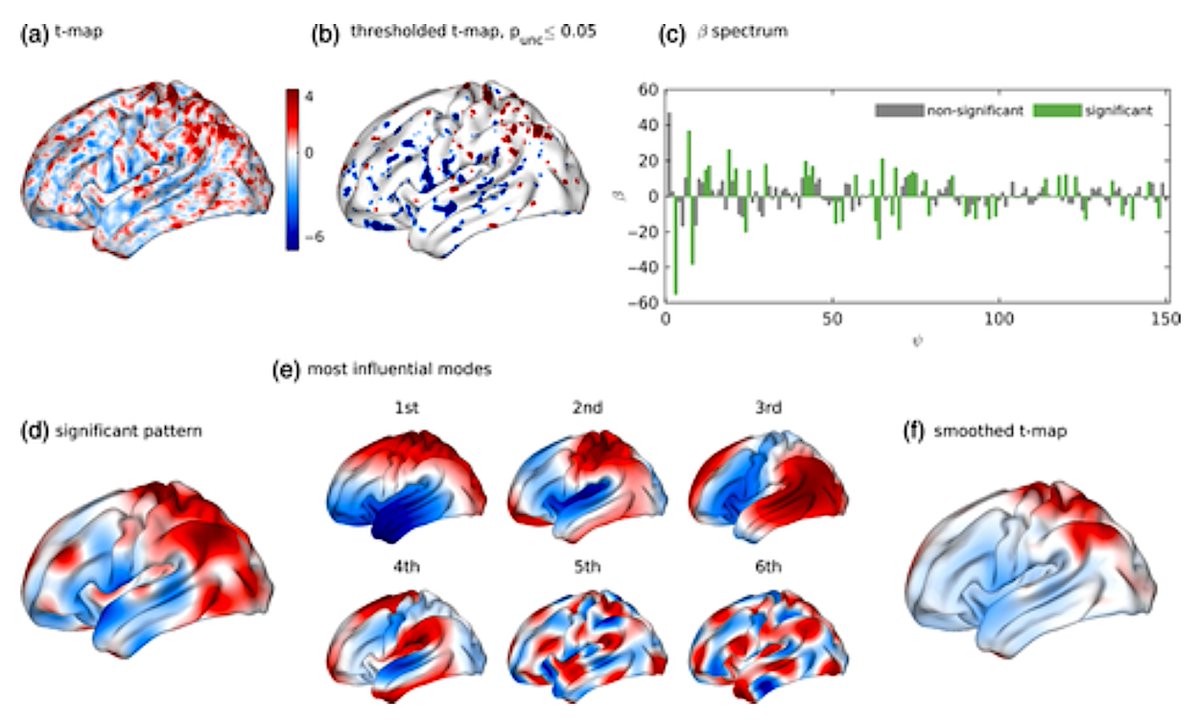
Super cool talk by Trang Cao on her paper on Mode-Based Morphometry (MDM) [1]
MBM projects individual brain morphometry onto eigenmodes of a physical deformation model* to capture anatomical variation across spatial scales
May offer higher sensitivity than traditional morphometry by aligning variation with biophysical modes
Alternative to subtyping and staging, unsupervised clustering, Dan Margulies' or Meike Hettwer/@sofievalk 's or @petra_vertes ' gradients or other spatial projection methods, which of course could be done in the eigenbasis if desired
*like Miller and Grenander's pattern theory [2,3], where the variation comes from PDE operator L encoding physical or regularization constraints, eigenbasis that represents allowed deformations, projection of data onto this basis to interpret variation in terms of the generative physical model (we used to use these spectral bases to compute registrations when computers were slow - it took 24 hours per brain!!!! )
[1] https://t.co/sNndpNmOWD
[2] https://t.co/o06vqODVEt
[3] https://t.co/3MFjRDtbKS
#OHBM2025