Today I'm publishing a new essay, Policy on the AI Exponential. AI is progressing extremely fast—much faster than the policy process was built to handle. The essay lays out where I think the technology is now, and the action needed to close the gap: https://t.co/Lh6PWae178
We’ve added a CLI for Claude Platform to make every API endpoint runnable from your terminal.
Call the Messages API, stand up Claude Managed Agents, pipe results straight into your shell.
The ant CLI is well understood by coding agents (Claude Code) using the claude-api skill.
We’re expanding Project Glasswing. We’ve extended access to Claude Mythos Preview to approximately 150 additional organizations, based in more than fifteen countries.
Read more about this expansion and our future plans for Project Glasswing: https://t.co/QrtHSBdRbh
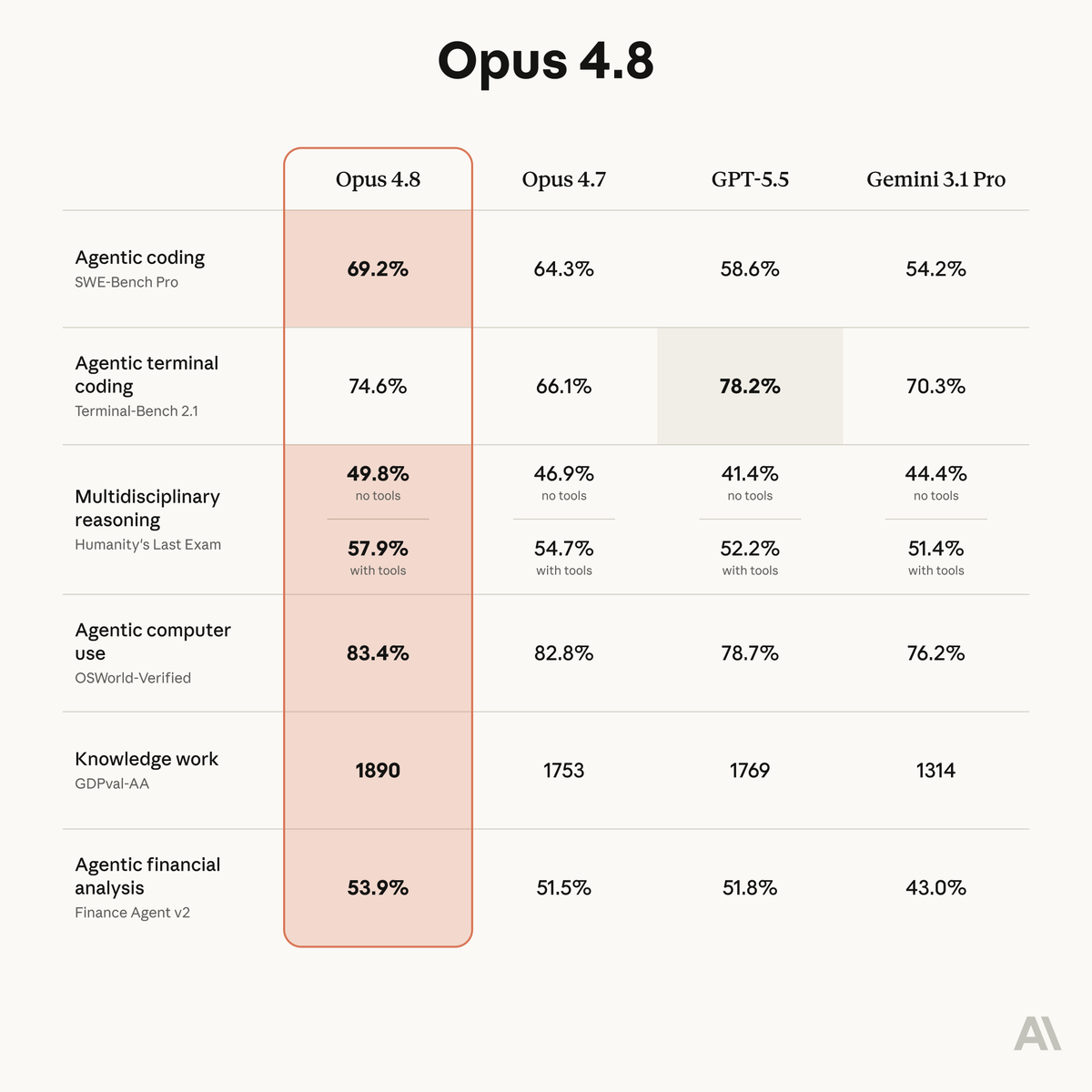
Introducing Claude Opus 4.8: it builds on Opus 4.7 with sharper judgment, more honesty about its own progress, and the ability to work independently for longer than its predecessors.
Available today at the same price.
New Anthropic research: Natural Language Autoencoders.
Models like Claude talk in words but think in numbers. The numbers—called activations—encode Claude’s thoughts, but not in a language we can read.
Here, we train Claude to translate its activations into human-readable text.
A car company sells you a car, the instruction manual says "wear a seatbelt".
You do not wear a seatbelt, and get into a fatal accident.
The car company later adds a feature: the car will not drive if the driver's seatbelt is not fastened.
Is this an admission of guilt?
Are you, the driver, absolved of blame because the car company did not have this feature before, and because other drivers also do not wear seatbelts?
We've published a security blog post on the recent rsETH incident.
The post details what happened, our response, and the design decisions made beforehand that protect USDe.
Read it below.
A ton of this is just completely untrue.
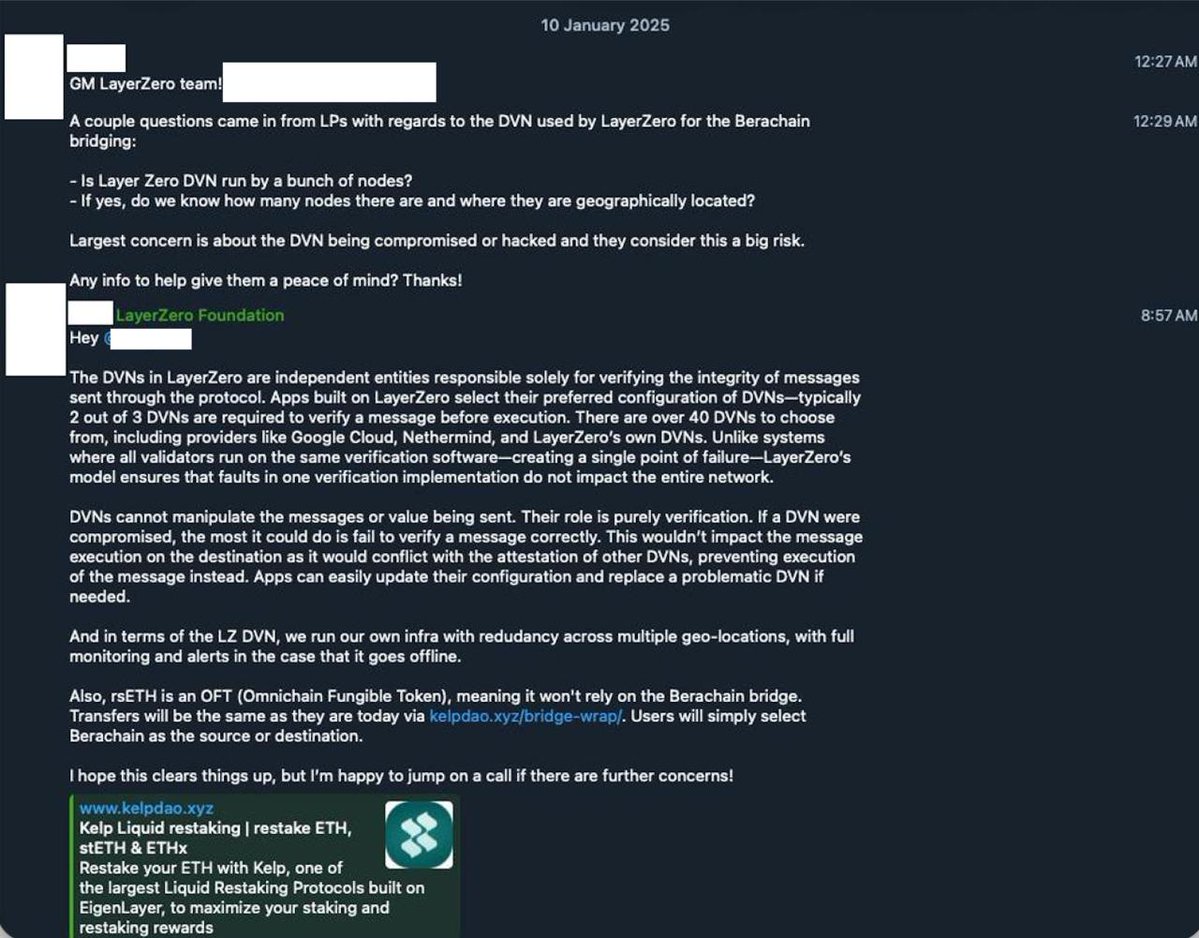
1) Kelp originally used the defaults which were MultiDVN or DeadDVN and manually migrated to a 1/1 config later
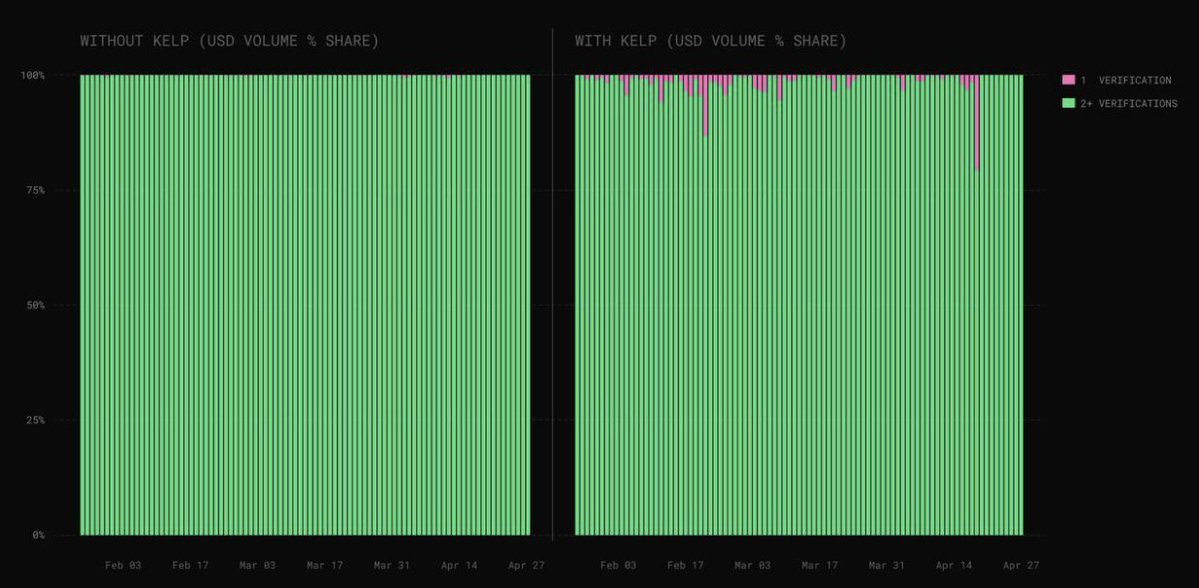
2) Almost 100% of the volume on a 1/1 config was rsETH
3) Not using a 1/1 for production applications is mentioned many times in the documentation.
The defaults Kelp is referencing in their screenshot were multiDVN or DeadDVN, which force-rejects an application using the defaults at all and requires them to manually set configuration.
rsETH was originally configured to use the default LayerZero configuration of a multiDVN setup of LayerZero Labs + Google:
Here are the exact transactions where that happens
Ethereum → Arbitrum:
https://t.co/C2uCxmpBCX
at 2024-02-06 03:09:47 UTC
Ethereum → Optimism:
https://t.co/vuQWxeyUUA
at 2024-02-06 03:09:59 UTC
KelpDAO then manually changed these to 1/1 configs:
For the original Feb 6 Ethereum routes to Arbitrum/Optimism, KelpDAO’s Ethereum contract switched from defaults to manual OApp-scoped config on 2024-04-01:
Send-side manual config:
https://t.co/HKCE8C8n7F
2024-04-01 07:12:11 UTC
Receive-side manual config:
https://t.co/FZTiol0qAp
2024-04-01 07:12:23 UTC
From this point on, Kelp began deploying all of their configurations as 1/1 configs. Here is Kelp’s deployment on Unichain:
Unichain → Ethereum was opened on 2025-04-01 18:55:41 UTC.
Pathway-open / setPeer tx:
https://t.co/0MlFpIxCfA
The manual ULN config followed 6 seconds later in https://t.co/0di0j78zYc.
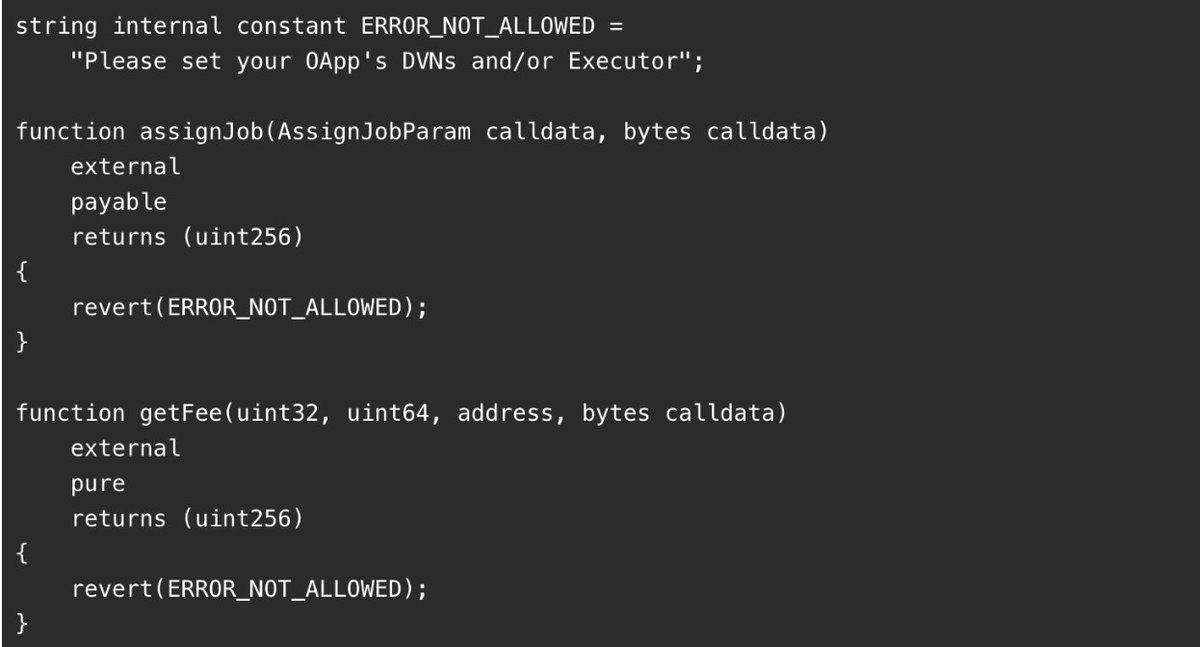
During this time the Unichain -> Ethereum and Ethereum -> Unichain defaults were set to DeadDVN which is a contract which makes it impossible for any application to transact without manually configuring their DVNs, this was not possible on the defaults of this pathway.
Here is the code in the DeadDVN (https://t.co/mAge3W6NhP) that specifically prohibits this.
(Screenshot 1)
This is called out many many times in the docs:
1. Integration Checklist — "Do" list
- Last edited: 2025-11-26 (Nazreen)
- Content: "Do: … Use more than one DVN for each production pathway instead of relying on a single DVN."
- File: v2/tools/integration-checklist.mdx:244
- URL: https://t.co/h9GHby9ynE
2. Integration Checklist — "Don't" list
- Last edited: 2025-11-26 (Nazreen)
- Content: "Don't: … Configure only one DVN for a pathway and treat it as production‑ready."
- File: v2/tools/integration-checklist.mdx:251
- URL: https://t.co/h9GHby9ynE
3. Integration Checklist — Defaults are not safe
- Last edited: 2025-09-25 (Tino Martínez Molina)
- Content: "Do not assume defaults are safe for production. Always check explicitly: getSendLibrary, getReceiveLibrary, and getConfig. If these resolve to defaults, confirm whether the defaults are valid for the intended pathway. Unintentional fallbacks to defaults are a common cause of blocked or failing pathways."
- File: v2/tools/integration-checklist.mdx:126-128
- URL: https://t.co/a6SdjYCbOu
4. Integration Checklist — Default fallback warning
- Last edited: 2026-02-26 (migration; same wording predates it)
- Content: "Warning: If no configuration is set, the OApp will fallback to the default settings set by LayerZero Labs."
- File: v2/tools/integration-checklist.mdx:222-238
- URL: https://t.co/h9GHby9ynE
5. ONFT Quickstart — Production guidance
- Last edited: 2025-02-20 (Radek Sienkiewicz)
- Content: "DVN Settings: Use multiple DVNs in production to ensure message verification is robust."
- File: v2/developers/evm/onft/quickstart.mdx:700
- URL: https://t.co/b8nO2yrEiX
6. ONFT Quickstart — Strong recommendation to configure
- Last edited: 2025-03-10 (Radek Sienkiewicz)
- Content: "We strongly recommend reviewing these settings carefully and configuring your security stack according to your needs and preferences."
- File: v2/developers/evm/onft/quickstart.mdx:366
- URL: https://t.co/WcNuXHLbiG
7. Starknet FAQ — "Should I use multiple DVNs?"
- Last edited: 2026-01-21 (Nazreen)
- Content:
▎ Should I use multiple DVNs?
▎ Recommended for production. Multiple DVNs provide:
▎ - Increased security (multiple independent verifiers)
▎ - Resilience (no single point of failure)
▎ - Trust minimization
- File: v2/developers/starknet/troubleshooting/faq.mdx:290-296
- URL: https://t.co/vtSZUFLZPJ
Here are the exact recommendations we gave KelpDAO when asked about DVNs (typically 2/3)
(Screenshot 2)
Other LayerZero applications speaking on exactly what is advised by the team
https://t.co/0ulWmlTZ2y
https://t.co/vQ2B8YQrw9
For how much volume was actually configured on 1/1 here is the exact data.
(Screenshot 3)
We will publish a complete post-mortem as soon as the external security firms have completed it.
Claude Code can now send push notifications to your phone when a long task finishes or Claude needs your input.
Walk away from the terminal, we'll let you know when it's done.
Durante tres años escuchamos lo mismo: “los LLMs no razonan, solo predicen el siguiente token.”
Acaban de razonar mejor que 60 años de matemáticos sobre un problema abierto de Erdős. 1 hora 20 minutos. Un solo intento.
Y la forma en que lo hizo es la parte que importa: aplicó una fórmula básica que cualquier doctorando conoce, pero que nadie había pensado en usar aquí. No es genialidad nueva. Es genialidad acumulativa. La IA ha leído todas las matemáticas a la vez. Ningún humano puede hacer eso.
O redefinimos qué significa “razonar”, o aceptamos que la IA ya razona.
Lo segundo me parece más honesto.
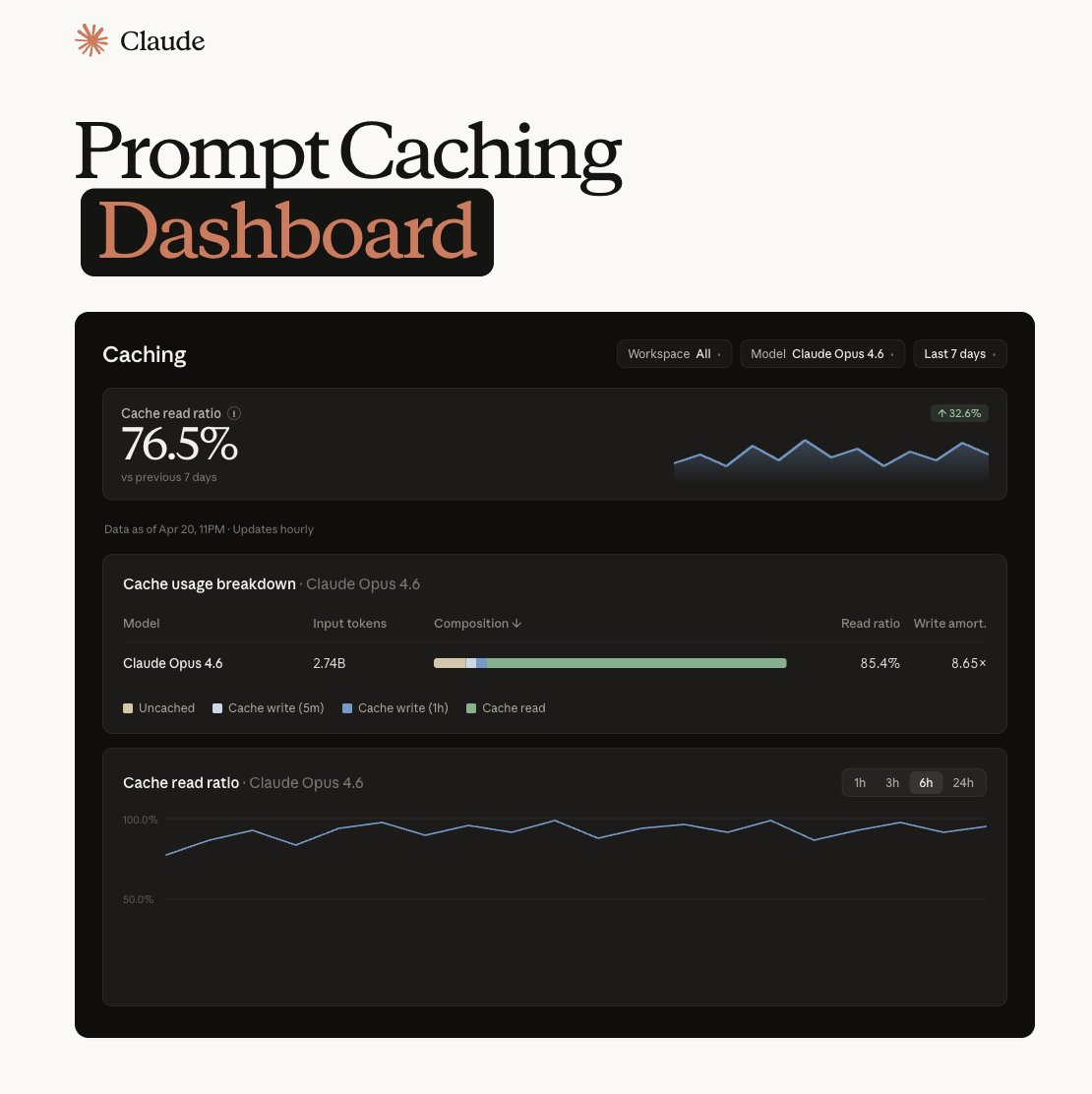
Caching is critical for customers to lower both costs and TTFT.
We’re launching a new dashboard in Claude Developer Console to increase visibility and help customers optimize their usage.
Check it out here: https://t.co/zgBJ4dHXyI
Introducing ChatGPT Images 2.0
A state-of-the-art image model that can take on complex visual tasks and produce precise, immediately usable visuals, with sharper editing, richer layouts, and thinking-level intelligence.
Video made with ChatGPT Images