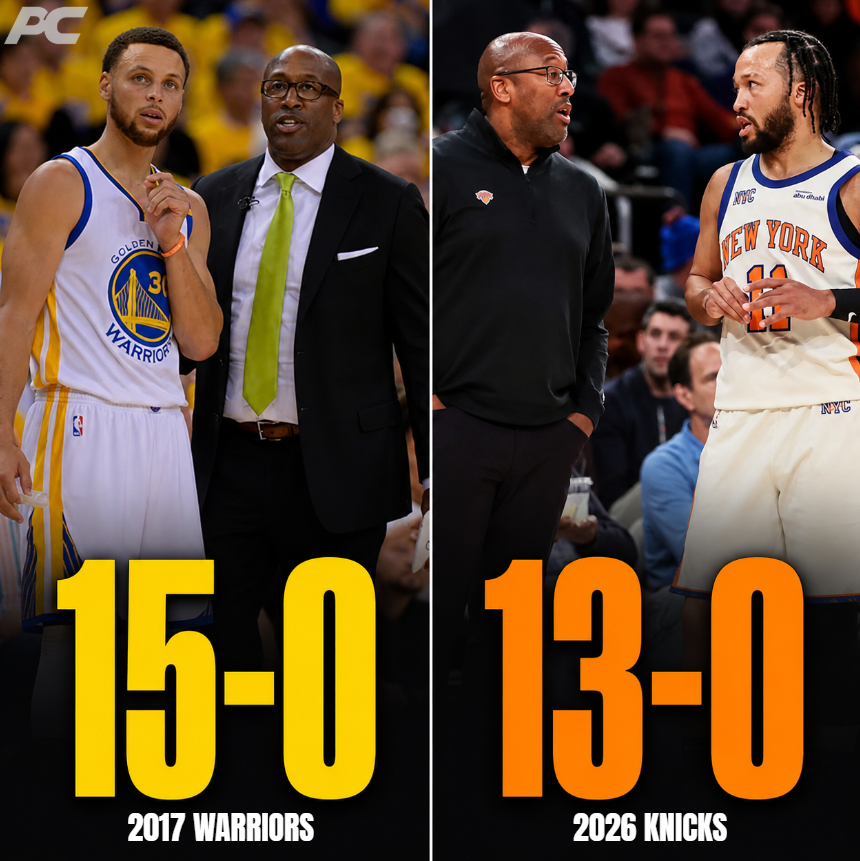
Mike Brown has coached the TOP 2 longest Playoffs win streaks in NBA history🤯
◽️2017 Warriors: 15-0 (Interim Head Coach)
◽️2026 Knicks: 13-0+ (Head Coach)
Where does he rank in terms of all-time coaches?🤔
The 10-year yield rose six basis points on Friday, and the tape traded like it rose sixty. Marvell down 17%, Micron down 13%, the Nasdaq down 4.2%, all on a rate move no discount-rate model can stretch that far.
TL;DR: Friday's drop got pinned on a hot jobs report nudging yields higher, but yields barely moved. The real driver was the most crowded trade in the market, AI chips, unwinding fast, with the jobs print as the excuse.
Start with the spread. The S&P 500 closed down 2.64% at 7,383, the Nasdaq down 4.18%, the Dow down just 1.35%. When the broad index holds and the growth index gives up triple that, the damage is being sorted by valuation and crowding, not delivered evenly by a macro shock.
Now the rate math everyone is citing. The 10-year went from 4.48% to 4.54% after the May payrolls beat, roughly 172,000 jobs against a consensus near 85,000. Six basis points. Semiconductors fell 9 to 17% the same day. There is no discount-rate model where six basis points reprices long-duration cash flows by that much. The jobs number was the catalyst. The positioning was the fuel.
The leaders confirm it. Marvell closed down 16.7%, Micron down 13.3%, AMD down 10.9%, Broadcom down 7.9%, Nvidia down 6.2%, the semis ETF down 9.2%. This group had already absorbed Broadcom's soft AI guidance earlier in the week, so Friday landed on a trade leaning hard one way and lightly hedged.
The fear gauge sizes it. The VIX jumped about 40% to 21.5. That is elevated, and it is also a long way from the 30s that mark a genuine growth scare. Pair it with a Dow down only 1.35% and the read is a sharp derating of the leadership while the rest of the market repriced politely around it. What would change my mind: a second leg that takes the S&P decisively through its 50-day and a 10-year that breaks toward 4.75% and holds. Absent that, Friday was the crowd trying to leave one trade through one door.
A read of the tape, not a directive for your account.
@theaiportfolios
It's official.
MicroStrategy, $MSTR, is now facing its biggest unrealized loss in history, at -$10.8 billion.
In other words, after 6 years of buying Bitcoin, the company is now down -17% on its position.
By comparison, the S&P 500 is up +116% over this same timeframe.
Since MicroStrategy sold 32 Bitcoin at $77,135 per coin, their positions has lost -$11.8 billion in value.
This puts MicroStrategy's stock, $MSTR, down -77% since its record high.
Bear market is an understatement.
$MSTR - STRATEGY'S BITCOIN U-TURN:WSJ
For years, Michael Saylor urged investors to never sell bitcoin—famously saying, “Sell a kidney if you must, but keep the bitcoin.” Now, his company, Strategy, is preparing to sell part of its bitcoin holdings to remain solvent. The irony is hard to miss: Saylor still appears to have both kidneys.
$MSFT CEO Satya Nadella highlighted Microsoft is pushing AI deeper into Windows, silicon, developer tools and data center infrastructure:
• Previewed Cobalt 200 chip
• Introduced Surface RTX Spark Dev Box
• Expanded Windows AI APIs to more PCs
• Announced Aion reasoning & planning models
• Added more data center capacity in 18 months than Azure’s first decade
Great to be back at Microsoft Build today. For us, it is not about any one piece of technology or even the platform.
It is about how we can build a frontier intelligence ecosystem together.
Sharing some of our big announcements today ...
Tom Lee is still calling for a 3-phase market this year.
1. A rally up to 7,700 on the S&P 500
2. Cool off period due to:
-New Fed Chair
-Energy Shock/Petroleum shortage
-Large IPO’s flooding the market
3. Post mid-term election rally
“2027 is a year where we could see some of the best returns in our lifetime”
For the record.
Canada’s recession is not bad luck, it is a policy choice and the blame sits squarely with Tiff Macklem, not Mark Carney.
By keeping monetary conditions too tight for too long into a tariff‑driven slowdown with inflation already essentially anchored, Macklem has replayed John Crow’s late‑1980s mistake of attacking real estate to prove his anti‑inflation credentials, and in the process turned a manageable adjustment into a made‑in‑Canada recession.
Honestly, looking back to late March and early April, the majority of voices on X were loudly calling for a sharp drop in May. Targets like $SPY to 5,800, $PLTR to $60–$100, $NVDA to $82, $TSLA to $280, $ONDS to $2, and $AMD to $120–$160 (mostly based on Elliott Wave counts or gap-fill theories) were all over social media.
In hindsight, it became very clear who the real TA guys are and who the fake ones are. The genuine ones stayed objective, respected the higher-timeframe trend, and didn’t force ultra-bearish counts just to sound smart or chase engagement.
The fake TA crowd, on the other hand, kept recycling the same broken patterns and doomsday scenarios — predictions that have been consistently wrong for years. Had anyone followed those fake calls, they would have completely missed this powerful parabolic rally.
Retail sentiment remains low while a good portion of institutional money is still sitting on the sidelines. This is exactly why I see significant upside ahead. Every dip over the past three years has been a strong buying opportunity — and I believe this will continue. I have been holding and accumulating my winners since Jan 2023, as my research and technical analysis point to much higher prices.
This is not financial advice — always do your own due diligence. But here’s the truth I’ve learned: don’t let the loud permabear noise affect your logic or strategy. The fake TA guys have been wrong for over a decade, and their excuses (recession fears, “it’s different this time,” broken wave counts) are getting weaker with every missed call. The market climbs walls of worry. Real edge comes from filtering out the noise, trusting your own process, and recognizing that fear is often the best contrarian signal.
Stay disciplined, keep studying, and let real analysis — not the loudest voices — guide your decisions.
Canada had a real estate bubble in the late 80's followed by a recession from 1990-1992. Real Estate prices bottomed in 1995-1996.
Yes, that's how it works. Bubble, recession, bottom.