The disease of Canada is an economy that increasingly rewards ownership over invention, connections over competition, and caution over risk-taking. We need to provide the right incentives, get Maslow's hierarchy sorted and get back on track to building this great nation.
We’re reimagining a 50-year-old interface - the mouse pointer - with AI. 🖱️
These experimental demos show how people can intuitively direct Gemini on their screens using motion, speech, and natural shorthand to get things done 🧵
I just had my first ride with HOVR, a Canadian alternative to Uber. They are cheaper and pay their drivers more. They already have over 3000 drivers in the Greater Toronto Area. You can download HOVR in App Store and Google Play using this link 📷 https://t.co/2hYMXAWGw6
INSTEAD OF WATCHING NETFLIX TONIGHT
Spend 30 minutes with this.
A speech by the Head of Anthropic's Coding Agents research team that teaches you more about vibe coding than 100 paid courses ever could.
This is not a tutorial.
This is the person who actually builds the system explaining how it works from the inside.
Most people learning to vibe code are learning the surface.
This goes underneath it.
30 minutes tonight.
The people who watch this will build differently tomorrow.
Completely free.
Bookmark this before you open Netflix 👇
@tbpn@GergelyOrosz He's not wrong. With agents, you have this feeling you need to keep them busy and productive at all times, otherwise your "wasting time" or your monthly credits...
Pragmatic Engineer's @GergelyOrosz is on a "secret email list" of agentic AI coders, and they're starting to report trouble sleeping because agent swarms are "like a vampire."
"A lot of people who are in 'multiple agents mode,' they're napping during the day... It just really is draining."
"This thing is like a vampire. It drains you out. You have trouble sleeping."
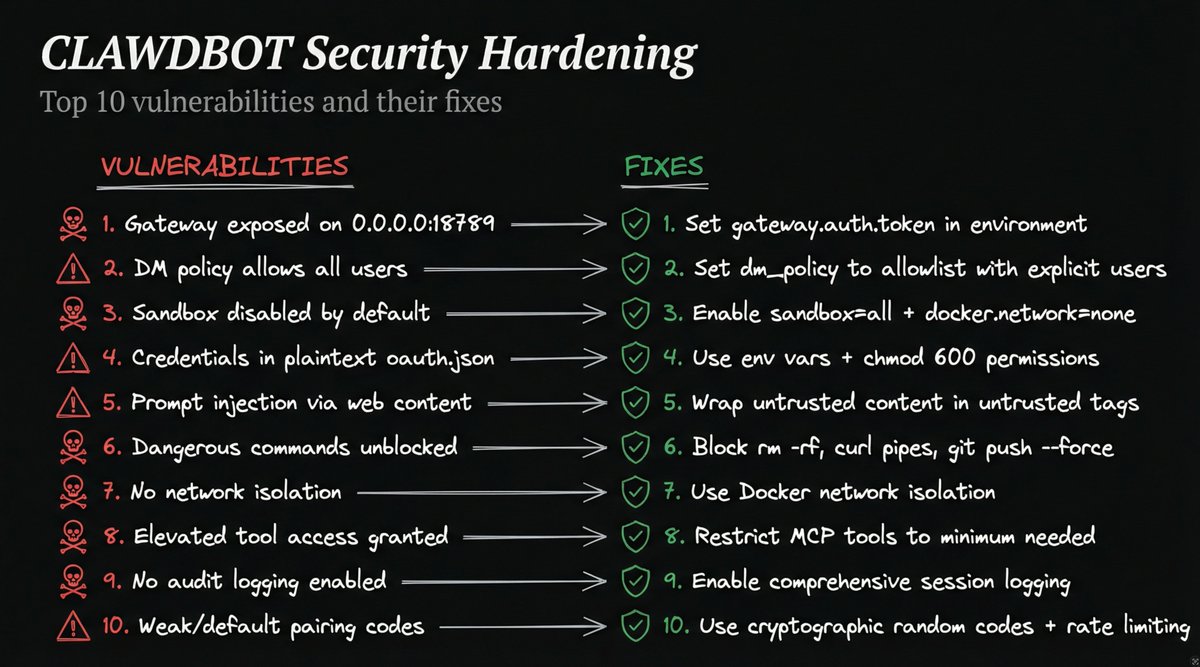
As a Security / 98% AI YOLO Maximalist with Guardrails guy, I'm asking you to please listen to this.
Here are some of the top security issues with https://t.co/yCq4RmE7lB that you all should be avoiding.
Don't avoid the project. It's great. But please be safe with it!
Tesla FSD is going to work flawlessly in any extreme condition, either it's the blinding summer sun or the "white-out" glare of a snowy winter road thanks to a new patent, US 20250334856 A1, published on October 30, 2025 🚨
📄 This patent details a breakthrough that allows Tesla to significantly enhance the reliability of FSD by eliminating camera blindness caused by harsh lighting conditions.
It addresses a critical safety challenge in autonomous vehicles: the interference caused by glare from the sun or oncoming headlights. Traditional flat glare shields often fail to prevent light from reflecting into the camera lens, which can obscure the vehicle's vision.
Tesla's solution is a glare shield featuring a sophisticated textured surface composed of an array of "micro-cones." Rather than simply blocking light, these cone-shaped formations are designed to scatter incident light in multiple directions, diffusing it before it can interfere with the camera's sensors.
📐 To ensure this scattering is effective, the patent details precise geometric optimizations. The formations are engineered with specific heights (0.65 to 2 mm) and base diameters (0.5 to 2 mm), dimensions that are carefully selected to minimize a specific optical metric: Total Hemispherical Reflectance (THR).
📉 In the context of optical sensors, THR is the definitive measure of "glare potential."
It is calculated as the ratio of the total light reflected by a surface in all directions to the total light hitting that surface: THR = Φ_reflected_total / Φ_incident, where Φ (Phi) represents the radiant flux (light energy).
While a standard mirror might have a high THR because it reflects almost all light back, the goal for this glare shield is to drive the THR as close to zero as possible.
⚫ The micro-cones achieve this near-zero reflectance by functioning as a physical "light trap."
Because the cones are arranged in a uniform pattern where their bases touch, incoming photons are forced to bounce multiple times between the steep walls of adjacent cones rather than reflecting outward.
With each bounce, a portion of the light is absorbed by the material, progressively draining the energy until virtually nothing escapes to blind the camera.
⚙️ However, static texture is only half of the solution; the patent takes the concept further by describing an active electromechanical system integrated into the shield.
This allows the assembly to dynamically adjust its orientation in real-time using a stepper motor. By utilizing environmental sensors to detect the position of the sun or other intense light sources, the vehicle can mechanically tilt the shield to the optimal angle for light diffusion, actively adapting to changing environmental conditions as the car drives.
🏭 Realizing such complex geometry requires a specialized manufacturing process. The shields are created using injection molding with a sintered tool steel insert, a material that allows air to vent during the molding process. This ensures that the micro-cones are formed with perfectly sharp tips and no air traps.
While the texture itself provides low reflectivity, the patent also suggests the option of adding an "ultra-black" coating, combining physical geometry with light-absorbing materials for superior performance.
🚀 For Tesla, this technology represents the critical hardware upgrade needed to bridge the gap between "supervised" and fully autonomous driving. Currently, direct sunlight at low angles (sunrise and sunset) or the blinding white of a snowy landscape can blind Tesla's Autopilot cameras, forcing the system to disengage.
By effectively "putting sunglasses" on the car's sensors, this patent eliminates one of the most persistent edge cases for Tesla Vision, potentially allowing FSD to operate reliably during "golden hour" commutes and winter storms where human intervention is often currently mandatory.
👁️ Ultimately, these features combine to prevent "phantom braking"—a phenomenon often triggered when cameras misinterpret glare or white-out conditions as obstacles.
By suppressing THR, the shield effectively increases the camera's dynamic range. This allows the sensor to retain critical detail in the shadows—such as tire tracks or curbs—that would otherwise be blown out by blinding white snow or washed-out sunsets, ensuring the vehicle can distinguish between a real hazard and a trick of the light.
A leaked software engineering recruiter selection guideline is going viral.
Founder and ex-L7 Facebook engineer said he believes strongly that it's real and that "top tier CS schools are the primary path to early career jobs [in software]"!
My government is cancelling the capital gains tax hike. We’re going to incentivize builders, innovators, and entrepreneurs to grow their businesses right here in Canada and create more good-paying jobs.
It’s time to build the strongest economy in the G7.
@porterairlines Trying to contact your customer service to get compensated after we were left at the wrong airport after 6 hour delay. Wait times are over 3.5 hours on the phones. There has to be a better way.
SaaS is being dismantled as we speak!
We're witnessing the slow-motion collapse of an entire business model that dominated tech for two decades. The $1.3 trillion SaaS is being quietly hollowed out from within by AI agents.
Here's how I see it playing out:
Phase 1 (Now): AI as co-pilot. We're seeing this everywhere, Copilot for developers, Gamma for presentations, Harvey for legal research etc. These AI layers sit atop existing software, making it more efficient.
The SaaS companies feel safe, even excited, as AI seems to make their products more valuable. They're bringing knives to what they think is a knife fight.
Phase 2 (Next 12-18 months): The agent invasion. AI moves from co-pilot to autonomous operator. They're replacement workers that can fully operate existing software on your behalf.
The dam breaks when someone can say "analyze our Q2 performance" rather than clicking through Tableau, or "optimize our ad campaigns" instead of navigating Meta's ad manager. The expertise previously bundled with the software gets unbundled by agents.
Phase 3 (2-3 years): Software invisibility. The final phase happens when the agents bypass the human interfaces altogether. Why render dashboards, buttons and menus when AI can just access the APIs directly?
The value proposition of SaaS, bundling software, workflow, and expertise into user-friendly interfaces unravels completely. The interfaces were designed for humans, but agents don't need them.
Most SaaS incumbents don't see it coming because this isn't a classic disruption pattern. It's not about competing products with better features. It's about the evaporation of the core assumption that humans will operate software.
What's more, the barrier to creating custom, internal software is collapsing simultaneously. Companies that once had to choose between expensive custom development or off-the-shelf SaaS can now spin up bespoke solutions in days instead of months. Why pay Hubspot $1,500/month for a CRM when your team can build 'HubspotForUs' with an AI coding assistant over a weekend? The same features, perfectly tailored to your workflow, with no ongoing subscription costs.
This democratization of software creation means every company becomes a potential software producer rather than just a consumer. The specialized knowledge that SaaS companies monopolized is now available to anyone with access to an AI coding agent and domain expertise.
It went from $1M to build an MVP to build a SaaS to basically free overnight.
I bet the metrics will be puzzling at first, DAUs remain strong while feature usage mysteriously declines. The power users who drive revenue suddenly need fewer seats.
Customer success calls shift from "how do I use this feature?" to "can your software work with my AI agent?"
Or worse: "we built our own version that better fits our workflow."
The survivors won't be those with the best features or even those who add AI features fastest (from no AI to "ai-assisted").
The winners will be companies that expose their software's capabilities through agent-friendly APIs and position themselves as the most trustworthy information sources and execution engines in their domain.
There's also the shift from monthly subscriptions to outcome based software (pay per outcome, pay per task etc) but that's a tweet for another day!
The $1T question: Will Microsoft, Atlassian, Adobe etc. successfully navigate this transition, or will they be the Digital Equipment Corporation of our era too invested in the previous paradigm to adapt to the new one?
All I know is this will be a golden era for startups in the space.
SaaS is being dismantled, piece by piece, workflow by workflow, interface by interface.
Am I wrong?
Announcing Toronto Tech Week 2025.
June 23 - June 27, 2025.
Weeklong, citywide collection of events to connect and celebrate the builders. For Toronto, by Toronto.
@porterairlines@Porterairlne247 Was on flight PE539. Delayed at YYZ for 3 hours. Takeoff from Pearson just passed midnight. Arrive at RSW at 3:26am but because of fog we have to divert to FLL. Can't disembark for 2 hrs. Completely abandoned by Porter in FLL with our 2 years old.
a university undergrad made hash tables faster and broke 40-year-old belief 🤯
for 40 years, it was believed that we cannot have better than O(n) operation for hash table worst case inserts and searches if it uses open addressing - for the hash index, look linearly until you find your element or an empty slot to insert.
the paper published last month showed that we can construct a hash table that achieves far better search complexities (both average and worst-case) of (log n)^2 - better than n.
I have not yet read the paper, but if you are interested in digging deeper, I have linked the paper and the write-up in a subsequent tweet.
in case you are interested in knowing the hash table internals, I have an in-depth playlist talking about how they are implemented internally and why they are the way they are. again link in a subsequent tweet.


![deedydas's tweet photo. A leaked software engineering recruiter selection guideline is going viral.
Founder and ex-L7 Facebook engineer said he believes strongly that it's real and that "top tier CS schools are the primary path to early career jobs [in software]"! https://t.co/NiDAFU0st9](https://pbs.twimg.com/media/Gmx5eXcaMAA_Fg8.jpg)





![deedydas's tweet photo. A leaked software engineering recruiter selection guideline is going viral.
Founder and ex-L7 Facebook engineer said he believes strongly that it's real and that "top tier CS schools are the primary path to early career jobs [in software]"! https://t.co/NiDAFU0st9](https://pbs.twimg.com/media/Gmx5etBbsAAiH5X.jpg)


