For many international visitors, the classic Japan route is Tokyo, Kyoto, and Osaka.
And honestly, that makes sense.
Tokyo is exciting.
Kyoto is beautiful.
Osaka is fun and full of great food.
But if you look at where Japanese people travel inside Japan, the pattern is a little different.
Hokkaido.
Fukuoka.
Okinawa.
Kyoto.
And by region, places like Tohoku, Hokuriku, and Kyushu are also very popular.
What I find interesting is the difference between the two.
Many first-time visitors choose places they have already heard of.
Famous cities.
Iconic temples.
Neon streets.
Photos they have seen online.
But many Japanese travelers choose destinations for slightly different reasons.
They go to Hokkaido for seafood, nature, hot springs, and snow.
They go to Tohoku for quiet landscapes, festivals, hot springs, and seasonal beauty.
They go to Hokuriku for fresh fish, crab, traditional towns, and a slower atmosphere.
They go to Fukuoka for ramen, yatai food stalls, nightlife, and the easygoing city vibe.
They go to Okinawa for the ocean, island culture, and a completely different side of Japan.
In other words, domestic travel in Japan is often not just about checking off famous sightseeing spots.
It is about food.
Season.
Nature.
Local atmosphere.
And the feeling you want from the trip.
So if you have already visited Tokyo, Kyoto, and Osaka, and you are wondering where to go next, one good idea is to look at where Japanese people like to travel.
By the way, the 2025 ranking of prefectures Japanese people want to visit for tourism gives an interesting hint about this.
Here are the top 10.
↓
番号:ばんごう:bangō
number
電話番号:でんわばんごう:denwa bangō
telephone number
番地:ばんち:banchi
block number; address number
番組:ばんぐみ:bangumi
TV/radio program
交番:こうばん:kōban
police box
当番:とうばん:tōban
duty; turn (on duty)
順番:じゅんばん:junban
order; sequence
市外局番:しがいきょくばん:shigai-kyokuban
area code (telephone)
定番:ていばん:teiban
standard; classic; staple
本番:ほんばん:honban
main performance; actual event; live broadcast
#Japanese
Whether you’re physically recovering or emotionally struggling, cats offer a type of companionship that feels intuitively supportive and deeply healing
【📍 Location + に vs Location + で】
Many beginners confuse に (ni) and で (de) because both can mean "at" or "in" in English.
The easiest way to understand them is to think about the verb, not the place.
📌 Location + に
💡 Core Meaning:
Go there.
Be there.
Use に for a place where someone or something goes or is.
Pattern:
🏠 Location + に
Examples:
📍 学校(がっこう)に 行(い)きます。
/gakkō ni ikimasu/
➡️ I go to school.
📍 日本(にほん)に 住(す)んでいます。
/nihon ni sunde imasu/
➡️ I live in Japan.
📍 机(つくえ)の 上(うえ)に 本(ほん)が あります。
/tsukue no ue ni hon ga arimasu/
➡️ There is a book on the desk.
🎯 Location + で
💡 Core Meaning:
Do something there.
Use で for the place where an action happens.
Pattern:
🏠 Location + で
Examples:
📍 学校(がっこう)で 勉強(べんきょう)します。
/gakkō de benkyō shimasu/
➡️ I study at school.
📍 レストランで 食(た)べます。
/resutoran de tabemasu/
➡️ I eat at a restaurant.
📍 公園(こうえん)で 遊(あそ)びます。
/kōen de asobimasu/
➡️ I play in the park.
🔄 Compare:
🏫 学校(がっこう)に 行(い)きます。
/gakkō ni ikimasu/
➡️ I go to school.
🏫 学校(がっこう)で 勉強(べんきょう)します。
/gakkō de benkyō shimasu/
➡️ I study at school.
🏠 家(いえ)に います。
/ie ni imasu/
➡️ I am at home.
🏠 家(いえ)で 勉強(べんきょう)します。
/ie de benkyō shimasu/
➡️ I study at home.
💭 Ask Yourself:
✅ Am I going there?
➡️ Use に
✅ Am I already there?
➡️ Use に
✅ Am I doing something there?
➡️ Use で
⭐ Remember:
📍 に = Go there / Be there
📍 で = Do something there
#Japanese #JLPT #日本語
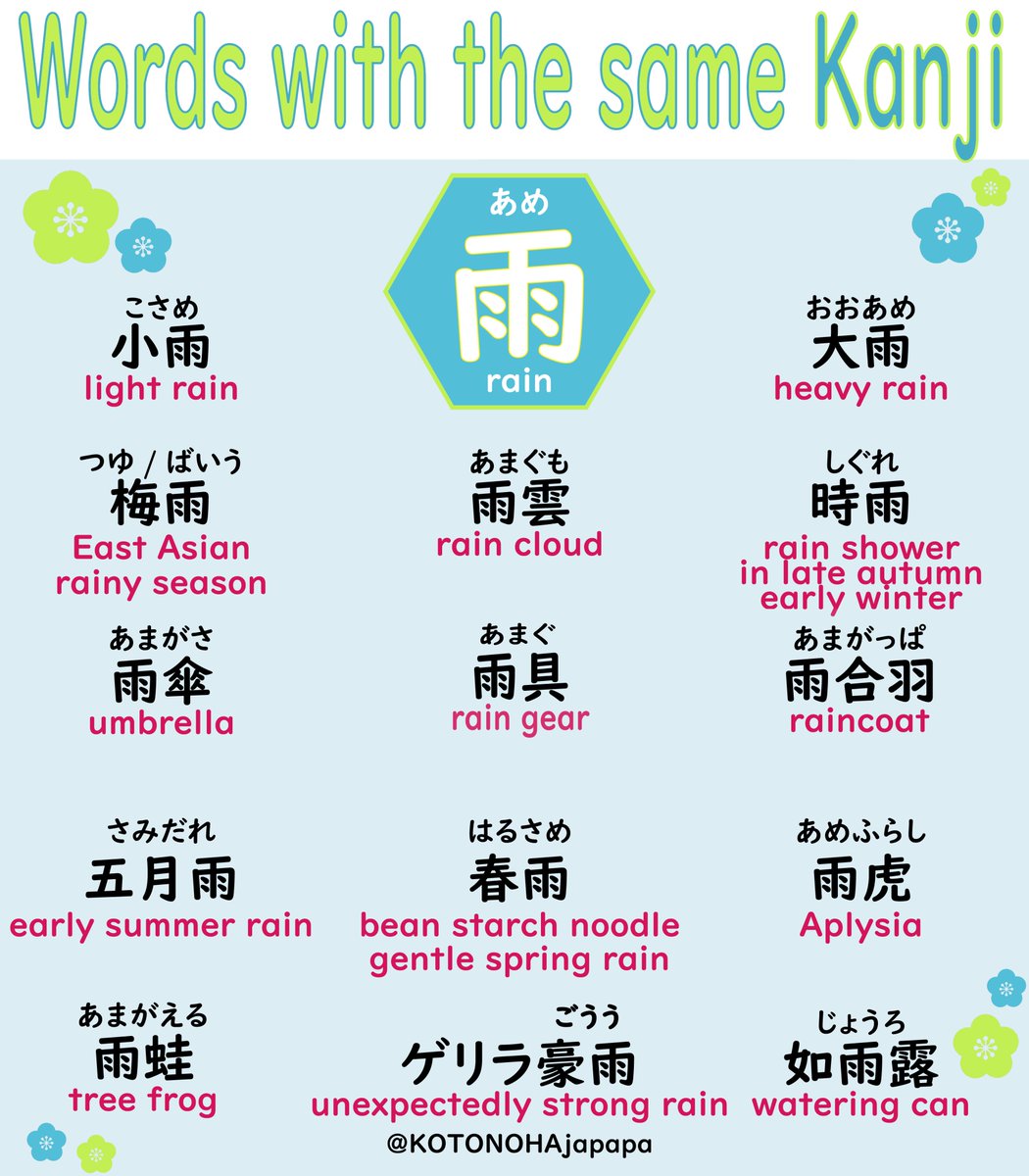
We have 小雨 & 大雨 but not 中雨
雨具(あまぐ) is a generic term for things that protect against rain, such as 傘 & 雨合羽
The reason why 傘 is called 雨傘 is because there is 日傘(ひがさ) which is used regularly for protection against ultraviolet rays☂
#Japanese
In Istanbul, cats aren’t just pets — they’re basically honorary citizens.
You’ll find them napping on bookstore shelves, lounging in café chairs, sitting in store windows, and even getting their own little shelters and food bowls left out by locals. The whole city seems to look out for them, treating them with so much love and respect.
It’s like the cats run the place… and honestly, I'm not mad about it.
Would you love living somewhere where stray cats are this well taken care of?