Shock Waves in the Heart of the Milky Way: How the Galaxy “Squeezes Out” New Stars
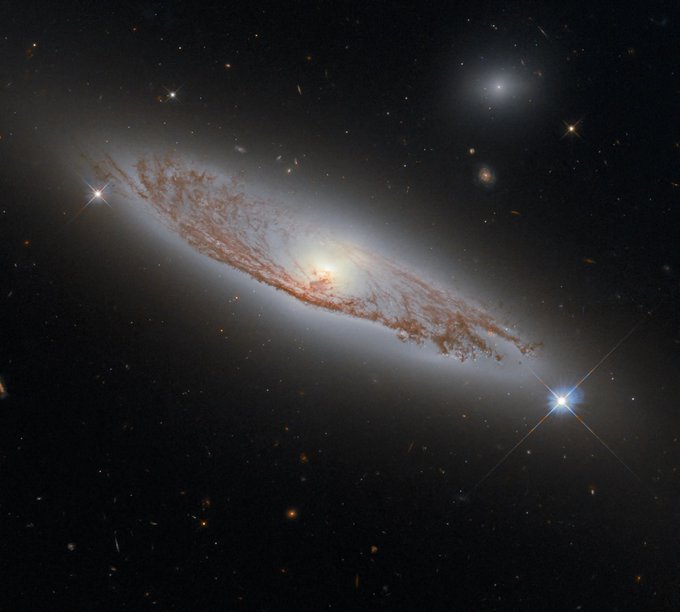
Something unusual is happening right in the centre of our Galaxy — something rarely seen in other spiral galaxies like ours. Where star formation is normally suppressed, here it flares up instead.
Hillary Davis, a PhD student at the University of Sydney, found the cause: shock waves racing through gas clouds inside the galactic bar. These waves compress matter with such force that they create ideal conditions for new stars to form. The discovery was published in *Nature Astronomy*.
Davis compared computer models of galaxy evolution with real observations of masers — natural cosmic “beacons” that light up exactly where massive stars are being born. The data matched: it is the shock fronts inside the Milky Way’s bar that act as the trigger for star formation.
The study also casts doubt on the existence of the Norma spiral arm. Part of what was thought to be an arm is more likely just a zone of active star birth running along the edge of the galactic bar. According to the new estimates, the bar itself stretches about 14,000 light-years from the centre and rotates relatively slowly.
It turns out the heart of the Milky Way plays by its own rules: where other galaxies fall quiet, ours keeps giving birth to stars — and it does so with the help of shock waves.
Something Big May Still Be Hiding Beyond Neptune — And It Might Not Be Planet Nine
Out past Neptune, where the Sun is just a bright star and the temperature never rises above a deep freeze, the outer Solar System has been leaving strange footprints in the snow. Distant icy worlds like Sedna swing on wildly stretched, tilted orbits that the known planets can’t fully explain. For years the leading suspect was Planet Nine — a hypothesized super-Earth or mini-Neptune several times Earth’s mass. Now a new theory proposes a different culprit: a smaller, Earth-class world nicknamed Planet X2.
The Hidden World in Earth’s Weight Class
Led by planetary scientist Patryk Sofia Lykawka (University of Southern Queensland / Kindai University), the research, published in *Monthly Notices of the Royal Astronomical Society*, uses massive computer simulations that rewind the Solar System’s 4.5-billion-year history. When the team added a planet of roughly 1.5 to 2 Earth masses on a distant, elliptical orbit, the models suddenly produced the weird populations of extreme trans-Neptunian objects that astronomers actually see: bodies whose closest approaches stay far beyond Pluto and others whose orbits are tilted at extreme angles.
In the best-fitting scenarios, Planet X2 orbits with a semi-major axis of about 350–500 astronomical units (AU). It never gets closer than roughly 200 AU — more than six times Neptune’s distance — and averages 12 to 17 times farther out than Neptune. At those ranges the Sun is a faint pinprick, and the planet itself would be extremely dim and hard to spot.
“It’s a bit like the footprints in the snow,” co-author Jonti Horner told ScienceAlert. “It’s telling you that somebody’s been there that you didn’t expect.”
Not Planet Nine — Or Maybe Both
Planet X2 is deliberately different from the classic Planet Nine hypothesis (typically 4–10 Earth masses, often placed around 200–1,000+ AU). The two ideas target somewhat different orbital oddities. Researchers note it is entirely possible that neither exists, that one does, or that both are out there — a configuration that would look less strange once you study the messy, migrated planetary systems found around other stars.
The simulations don’t match every detail perfectly (a perfect match would have been more suspicious, Horner says), but they reproduce several key features that models with only the known giant planets struggle to create. The idea is that Planet X2 may have formed closer in and been scattered outward early on, then spent billions of years gently shepherding the distant icy debris.
The Hunt Is On
No one has seen Planet X2. Its great distance and faintness make direct detection tough. The Vera C. Rubin Observatory in Chile, now ramping up its decade-long sky survey, is the best near-term hope. It will discover huge numbers of new distant objects; if Planet X2 is real, the distinctive orbital patterns it predicts should become clearer. There is even a slim chance Rubin could catch the planet itself.
The proposal is still a hypothesis — one promising explanation among others that will be tested as more data arrives. But it keeps alive one of astronomy’s oldest and most tantalizing questions: after centuries of searching, is the Solar System still hiding a world beyond Neptune?
Based on the Royal Astronomical Society.
A Preview of the Sun’s Final Performance
One day, roughly five billion years from now, our Sun will exhaust its core fuel, swell into a red giant, and then cast off its outer layers in a spectacular farewell. That cosmic curtain call may look a lot like the Ring Nebula (M57), now revealed in breathtaking infrared detail by the James Webb Space Telescope.
Roughly 2,500 light-years away in the constellation Lyra, this planetary nebula is the glowing shroud of a dying star. As the star sheds its atmosphere, the expelled gas is ionized and lit by the hot remnant at its heart—a star already on its way to becoming a white dwarf, the dense, Earth-sized ember that awaits stars like our own.
Webb’s Near-Infrared Camera peels back the veil to show the inner ring’s intricate, filamentary structure in exquisite clarity. Scattered throughout the nebula are some 20,000 dense globules rich in molecular hydrogen—tiny, self-contained clouds that have survived the star’s final convulsions. Just beyond the main ring lie about ten faint, concentric arcs, subtle ripples left by the central star’s gravitational dance with a low-mass companion that orbits roughly as far out as Pluto does from the Sun.
What looks like a perfect ring is actually a distorted doughnut (or torus), and we are staring almost straight down one of its poles. Charles Messier and Antoine Darquier de Pellepoix first spotted this celestial smoke ring in 1779 while chasing a comet—never imagining the layered drama that infrared eyes would later uncover.
It is both a preview of our own Sun’s eventual exit and a reminder that even stellar death can be extraordinarily beautiful.
Image: ESA/Webb, NASA, CSA, M. Barlow, N. Cox, R. Wesson
Training shouldn’t depend on mood or motivation.
Military calisthenics with equipment gives you a clear structure you can rely on every session.
You know what to do and you execute it.
- consistent structure
- controlled tension
- no wasted movement
🚨: In the farthest reaches of the universe lies a reservoir of water so immense that it defies the imagination.
Astronomers detected around a quasar, over 12 billion light-years away, the largest reserve of water ever observed. Its volume is equivalent to 140 trillion times all the water contained in Earth's oceans.
The gigantic water vapor cloud is extremely hot, formed when the universe was still very young. The discovery shows that water was already abundant in the early stages of the cosmos.
The essential ingredient of life was present long before planets like ours existed.
As MCP adoption grows, teams are moving quickly to secure how LLMs connect to tools and data. We put together 7 best practices to help you:
- Lock down supply chains
- Enforce least privilege
- Add human oversight
Go Watch my hilarious new show on Patreon! Spicy Fun w/ Trixi Montana!
@TrixiB100
2 Episodes every week, New models Every week, $5/month! Uncensored hilariousness. https://t.co/pp08EIQwan
Florida and the Bahamas from Space — Earth’s Natural Beauty at Its Finest! 🌎✨
Seen from orbit, Florida and the Bahamas reveal a breathtaking contrast of crystal-clear turquoise shallows and the deep blue Atlantic Ocean. A spectacular reminder of just how extraordinary our planet looks from above! 🛰️💙