Greetings Colleagues,
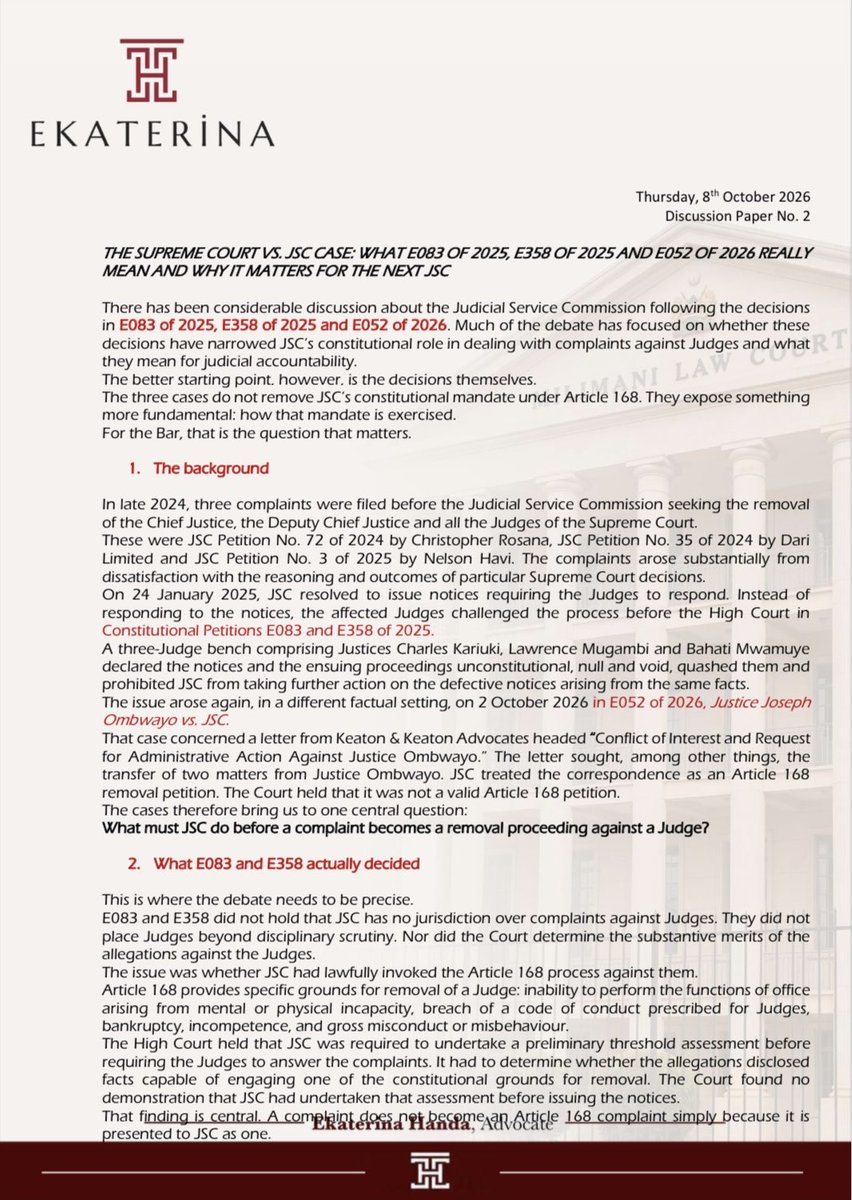
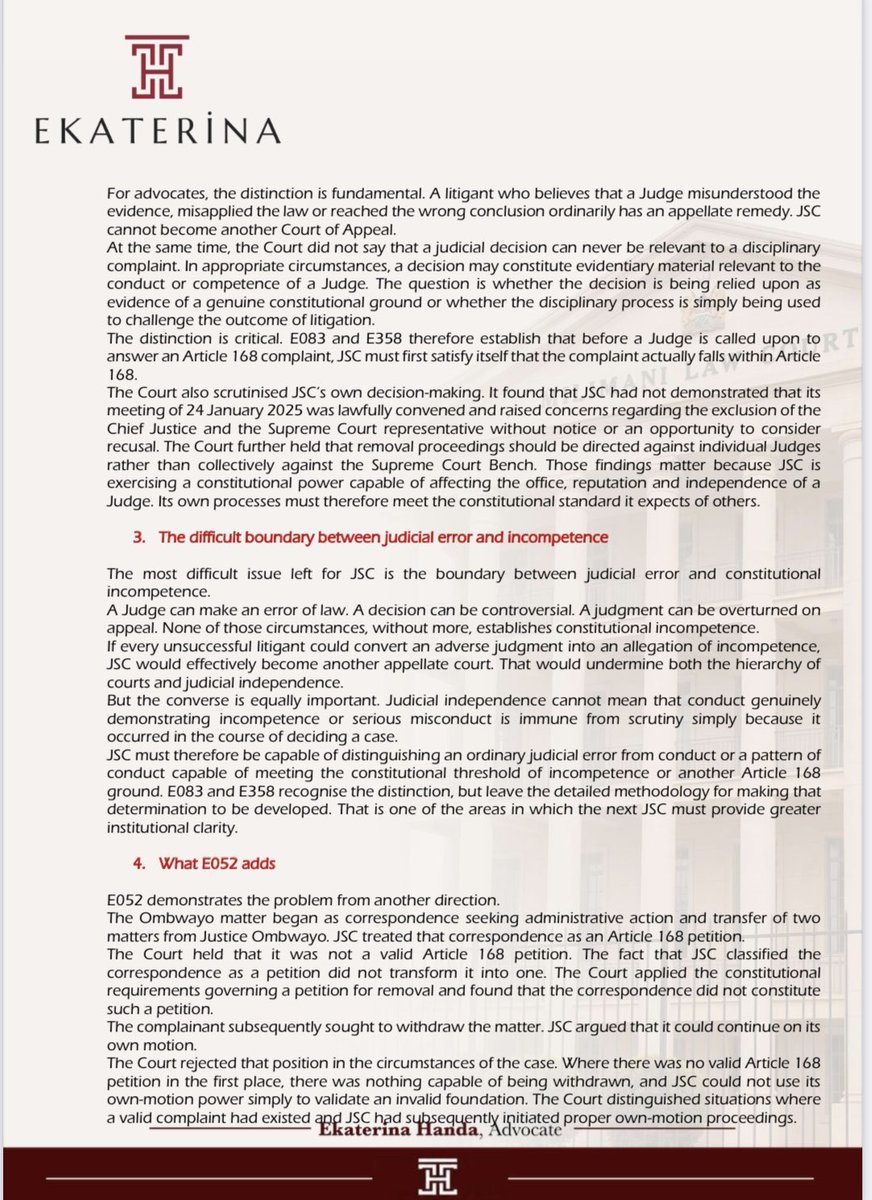
There has been considerable discussion on social media regarding *E083 of 2025, E358 of 2025 and E052 of 2026*, particularly concerning what the decisions mean for the Judicial Service Commission, judicial accountability and judicial independence.
I have followed the discussion with interest and taken time to reflect on the judgments, particularly from the perspective of the Bar and the constitutional role of the JSC.
I have therefore compiled this short Discussion Paper No. 2, examining what these cases actually decided, the distinction between an appeal and an Article 168 complaint, and what the decisions may mean for the next JSC.
My central concern is this: the JSC ought not be a postbox. It must be capable of filtering complaints properly i.e. protecting judges from disciplinary proceedings that are really disguised appeals, while ensuring that genuine allegations of misconduct, incompetence or corruption are properly examined.
In short, judicial independence must not become judicial immunity, and judicial accountability must not become a substitute for an appeal.
I share the paper here, though the link below, for your consideration and discussion. I would particularly welcome your views on the institutional questions raised by these decisions.
Ekaterina Handa
Partner,
Gitonga, Kinyanjui & Co. Advocates
https://t.co/yS7QIyWJsl
Greetings colleagues,
Sharing a short discussion paper I’ve put together on judicial conduct, complaints and accountability in Kenya, and more specifically, whether Article 168 is working as it should.
It’s not meant to be an academic paper or the final word on the subject. It’s simply meant to get a conversation going among us as members of the profession.
I’d be interested in your views, whether you agree, disagree, have additional information, or think I’ve got something wrong. Please feel free to challenge the arguments and the facts.
The bigger question is: have we got the balance right between protecting judicial independence and ensuring meaningful accountability?
Would be good to hear what colleagues think.
Ekaterina Handa
Partner
Gitonga, Kinyanjui & Co. Advocates
RETROSPECTIVE LIABILITY & UNREASONABLE DELAY: High Court Quashes Life Sentences for 25 Ex-Navy Officers
Simon Njoroge Mbugua & 24 Others vs Republic, Mombasa HCCRMISCAPPL/E062/2024 | Micheni J. | 22 Sept 2026
SUMMARY
25 Kenya Navy servicemen left service in 2007-08 after applying for discharge, one resigned his commission. Some cleared, surrendered stores. Command knew. 6-7 years later in 2014, after presenting themselves at bases and some rejoining via REJAB, they were arrested at Mtongwe, charged with desertion under s.74(1)(a) as read with s.74(3)(a)(i) KDF Act 2012 and sentenced to life.
First appeal substituted absence without leave (2 yrs max). Court of Appeal in Pepela & 24 Others KECA 204 declared it a nullity - consolidated judgment never evaluated each appeal individually. Remitted to Micheni J for rehearing.
KEY ISSUES:
1. Which law governs - KDF Act 2012 or repealed Armed Forces Act - and effect of ss.309/310/311 and s.23 IGPA?
2. Was prosecution lawful when DMP also served as Chief of Legal Services contrary to s.213(6)?
3. Was there unreasonable delay under Art 50(2)(e) and unlawful pre-trial detention?
4. Was active service proved to justify life?
5. Should Court Martial finding stand, and if not, substitute conviction or retrial?
DETERMINATION:
1. Consolidation is convenience, not merger. Each of 25 appeals retains identity. Common law questions once, facts individually.
2. DMP office unlawful. Brig. K.O. Dindi held DMP + CLS together contrary to mandatory s.213(6). Following Kamau v DMP. Nemo dat quod non habet - delegate cannot have more than delegator. S.214 delegation cannot cure. S.382 CPC cannot validate prosecution without statutory authority.
3. Delay + detention unconstitutional. No limitation for desertion ≠ prosecute anytime. 6-7 yr delay unexplained. Applications were on file. Art 50(2)(e) violated. Detention unlawful - no periodic reports produced. Art 24 cannot limit Art 25(c) which is non-derogable. Art 24(5) is not blanket KDF exemption.
4. Retrospective charge. Offence crystallised 2007-08 under Armed Forces Act, 90 days under s.31(2)(d) completed before 2012 Act. S.23(3)(e) IGPA preserves liability under old law, does not permit swapping penal statutes. S.310 is administrative continuity. Charging under 2012 Act is substantive defect violating Art 50(2)(n) & (p).
5. Life sentence baseless. Operation Linda Mpaka directive = planning/preparedness, not active service. Linda Nchi began Oct 2011. Active service not ingredient of desertion but condition for enhanced punishment. Respondent conceded.
6. Court Martial finding unsafe. Finding need not be judgment under s.169 CPC, brevity allowed, but must show evidence & defence considered. Here bare "desertion proved" - no engagement with discharge, delay, DMP authority, discrimination. Recusal objection unresolved.
7. No substitution, no retrial. Declined to substitute s.75 absence without leave - would assume validity of unlawful proceedings. No retrial - ∼20 yrs later, delay itself unconstitutional, defects by State not innocent slip, would allow State to repair case.
DISPOSITION: All 25 appeals allowed, convictions quashed, life sentences set aside, acquitted, bonds discharged.
PRACTICAL NOTES FOR ADVOCATES
a) Always ask for DMP appointment instrument + CLS appointment. If same person, raise preliminary objection under s.213(6) before plea. File Kamau. Argue nemo dat + s.382 inapplicable
b) Plead retrospectivity as constitutional, not procedural error. Frame under Art 50(2)(n)(p) to avoid s.382 cure argument. Get charge sheet dates vs KDF Act commencement date (14 Sept 2012)
c) On delay, demand OB, occurrence book, detention authority & periodic review reports, discharge files. No explanation = inordinate. Invoke Art 50(2)(e) + Art 25(c)
Ekaterina Handa
Partner, Gitonga, Kinyanjui & Co. Advocates
Greetings colleagues,
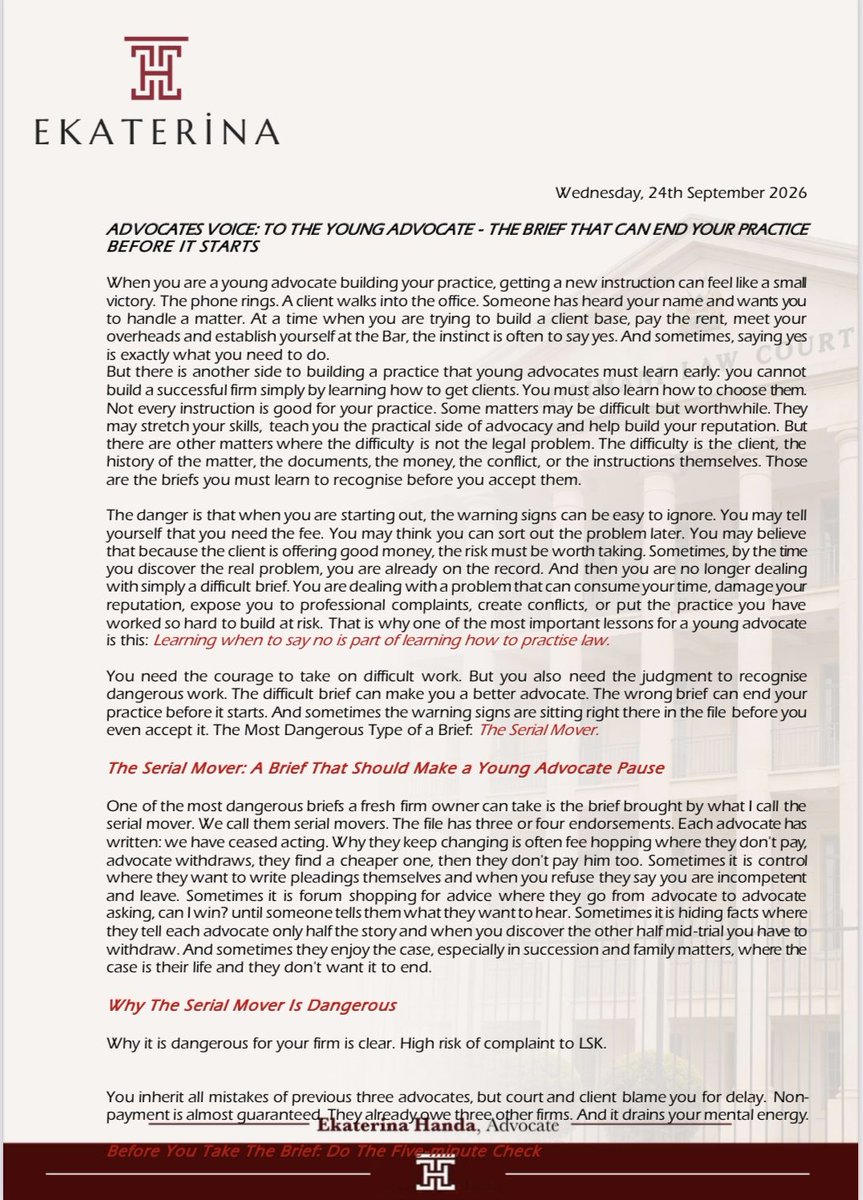
Once again for the benefit of young advocates, and indeed, for anyone building a legal practice, this week on Advocate’s Voice, I share the write up on “THE BRIEF THAT CAN END YOUR PRACTICE BEFORE IT STARTS”
We are often taught to seize every opportunity that comes through the door. But in practice, learning which briefs to take and which ones to walk away from can be just as important as winning clients.
Today, I look at the serial mover, professional red flags, conflicts of interest, questionable instructions, handling of client money, and the importance of proper retainers, documentation and boundaries.
Most importantly, it is a reminder that saying no to the wrong brief is not turning away business - it can be protecting the practice you are building.
I invite you to read, share and, as always, I welcome your thoughts and experiences.
Protect your name. Protect your practice. Protect your future.
Ekaterina Handa
Partner, Gitonga, Kinyanjui & Co. Advocates
🚨 HAVE WE JUST KILLED HABEAS CORPUS IN KENYA? 🚨
Court: "If Abductors Cover Their Faces, Habeas Corpus Will NOT Help You"
Case: Dika & 2 others v IG Police & 3 others KEHC 13502 - Nyaundi J (17 Sept 2026)
SUMMARY:
On 23rd May 2024, two men - Hassan Maalim Ali and Ahmed Ibrahim Wako - were blocked near Mlango Kubwa, Nairobi, by 4 plain-clothed men in a grey double-cab KCV 015F. Handcuffed. Driven off. No arrest, no booking. Family reported at Pangani OB/23/05/24. Police said "we don't know them". DCI took statements and went silent. Two years later, they are still missing.
Family went to High Court for Habeas Corpus - "Produce the bodies, tell us where they are."
On 17th Sept 2026, Court dismissed everything.
COURT'S REASONS:
1. You did not prove police are holding them.
Disappearance is not proof of custody. Handcuffs, plain-clothes, double-cab is only suspicion, not evidence under Sections 107-109 Evidence Act.
2. Habeas corpus is not a tracing tool.
It can only be used if you already know who has the person. It cannot be used to FIND who abducted them.
3. DPP struck out.
You cannot force DPP to order investigations.
Result: No production, no disclosure, no compensation. Each party bears own costs.
WHY THIS JUDGMENT IS DANGEROUS:
This judgment gives a blueprint for extrajudicial killings and enforced disappearances:
1. It Rewards Masking and Plain-Clothes Operations:
The court says if abductors cover faces, use civilian number plates (KCV), and don't book at OB, then Habeas Corpus fails. What police unit will ever book an abduction at OB again? The more professional you hide, the more you are protected by this judgment.
2. It Makes Proof Impossible for Poor Families:
How does a mother in Eastleigh prove KCV 015F belongs to DCI? NTSA records are controlled by State. CCTV is controlled by State. Safaricom data needs a court order. Yet court demands the family provide that link BEFORE State is forced to explain. This is asking the victim to investigate the State.
3. It Reverses 30 Years of Human Rights Jurisprudence:
From Koigi Wamwere to Matheri, our courts held that once a person disappears after last being seen with State agents, burden shifts to State to explain. This court says "No prima facie case until you prove custody." This is back to Nyayo era.
4. Direct Link to Extrajudicial Killings:
If habeas corpus is dead, what is the next step? Families cannot get production order. Police have no duty to disclose. The subject remains missing for months. By the time an inquest is done, the body is at City Mortuary as "unknown" or in River Yala. This judgment closes the URGENT door (habeas corpus) and tells families to go to the SLOW door (investigations & inquests), where evidence dies.
PRACTICAL TAKEAWAYS FOR ADVOCATES:
If you have a disappearance case tomorrow, you will lose on this precedent unless you:
a) Do NOT file habeas corpus alone. Add prayers for mandamus to compel IG to investigate under Art 244, and for preservation of CCTV/NTSA/Safaricom data.
b) Attach NTSA search, private investigator affidavit linking KCV to State, OB certified copies showing refusal to investigate.
c) Plead with precision: Name Article 29(a)(c)(d) - freedom from arbitrary detention, 25(a) - freedom from torture, 26 - right to life, not just "Bill of Rights violated".
d) Do not join DPP unless you can prove file reached him.
We must appeal this or distinguish it urgently. Otherwise we have told every plain-clothed squad: Just cover your face, and the High Court will not ask you where the body is.
Thoughts? Has anyone filed a similar matter after this?
#HabeasCorpus #EnforcedDisappearance #RuleOfLaw_
Ekaterina Handa
Partner
Gitonga, Kinyanjui & Co. Advocates
Exhaustion Doctrine Won't Save Banks: A Customer Can Sue the Bank Directly for Unlawful CRB Listing
Bank of Africa Kenya Ltd v Miano KEHC 13565 - Judgment by Sergon J, 17th Sept 2026, Nakuru
This one matters to everyone with a loan, a salary check-off, or an M-Shwari limit. It’s not just about one borrower. It’s about how banks treat your name.
SUMMARY
Francis Miano took a Kshs. 780,000 loan from Bank of Africa, repayable over 72 months through his employer. The Bank said his employer was late in remitting, so his account was in arrears. It reported him to Metropol CRB.
Miano’s version: He was paying via salary. Without warning, the Bank closed his original account, opened a new one- Account No. 0008049720055, and used THAT new account to blacklist him. No call. No letter. No notice.
He only discovered it when Unaitas Sacco rejected his loan application. He sued in Nakuru CM Court No. 598 of 2018. He won. Kshs. 200,000 damages. The Bank appealed.
On 17th September 2026, the High Court dismissed the Bank’s appeal entirely.
WHY THIS JUDGMENT IS A BIG DEAL
For years banks have hidden behind two excuses:
1. “We are required by law to report you under Section 31 Banking Act."
2. “Go complain to Metropol, not us."
Sergon J has dismantled both.
LESSONS FOR BANKS & RIGHTS FOR CUSTOMERS
1. The right to report you is not absolute. It is conditional.
Yes, banks can and must share credit information under the Banking Act and Regulation 18 & 50. But Regulation 25(1) is clear: You must be given 30 days NOTICE before negative information is sent. Regulation 25(8): You must be told AFTER it is sent. The Court called these rules "not ornamental." Bank of Africa could not produce any notice- no date, no content, no proof of service. That alone killed its case.
2. Arrears ≠ Accuracy.
The Bank kept saying "but he was in arrears." The Court said: That’s not the question. The question is, was the information you sent ACCURATE? You listed him on an account he says he never knew existed. You never linked that second account to his original facility. If you claim accuracy, prove it.
3. You cannot outsource blame to Metropol.
Metropol is a separate company, true. But the Court said Metropol only processed what the Bank supplied. The sin was committed when the Bank pressed "send." The Bank answers for what it supplies.
4. You don’t have to beg the CRB first before suing your bank.
The Bank argued Miano should have used the CRB dispute process under Reg 20 & 35. The Court: That process is for disputing what the Bureau holds. It does NOT shield a bank that breached its own duty. Miano had already complained to the Bank. The Bank said "we will investigate" and did nothing. He was entitled to go to court.
5. Your credit reputation has value, even if you can’t prove you lost land.
The trial court rejected his claim that he lost a land deal because he didn’t prove it. But it still gave him Kshs. 200,000 for injury to his credit standing, embarrassment, and distress. The High Court upheld it as within range. Message: You don’t need a title deed to prove your name was damaged.
THE BOTTOM LINE FOR THE PUBLIC
If you have ever checked your phone and found you are blacklisted, this case is your shield.
A bank must:
a) Tell you before it lists you
b) Tell you after it lists you
c) Prove the debt is yours and the figure is accurate
d) Keep proof of that notice
If it doesn’t, the listing is unlawful ab initio- void from the start, and you can get damages.
THE BOTTOM LINE FOR ADVOCATES & BANKERS
Stop pleading "statutory duty" without pleading compliance with Regulation 25. The Court wants to see: Date of notice, mode of service, contents. And stop hiding behind Reg 20 exhaustion. Where the complaint is about the bank’s own furnishing of data, a direct suit lies.
Also, Section 31(5) Banking Act protection is qualified immunity - good faith + accuracy + proper purpose. No notice + unexplained second account = no good faith.
Appeal dismissed
Can Adverse Possession Survive Expiry of Head Lease i.e. Can You Lose Adverse Possession of Land by Waiting Too Long?
Boniface vs. Macharia KEELC 5404 (KLR)
Coram: Kemei J - ELC Nairobi
Date:9th September 2026
Case No: ELC Originating Summons E001 of 2024
Facts:
A family bought land LR 8285/494 in 1971 for 30k, paid in full, but never transferred title. They lived there from 1971. The original 50-year lease from County Council to the seller was from 1972 to 2022.
In 2024, the son sued for title by adverse possession (12+ years living on land). Seller never came to court.
Court agreed: Yes, they lived there since 1971, so adverse possession was completed in 1983 and seller's title ended.
BUT court dismissed the case because by 2022 the head lease had expired and land went back to Nairobi City County. The law (Sec 41 Limitation Act) says you cannot claim adverse possession against County or Government land. He waited too long - he should have applied before 2022.
Court told him: Apply to County for a fresh lease as the person living there.
Held:
Adverse possession against lessee crystallises under Sec 17, but cannot be enforced against reversion after expiry if not registered under Sec 38 before expiry due to Sec 41 bar.
1. Even undefended, ingredients of adverse possession must be proved.
2. Fully paid purchaser possesses adversely - vendor becomes trustee after full payment. Public Trustee v Wanduru.
3. Time from 1971, crystallised in 1983. Sec 17 Limitation Act - defendant's title extinguished.
4. Head lease expired 31/12/2022 and land reverted to City County. Sec 41 Limitation Act - no adverse possession against County.
5. Plaintiff never applied under Sec 38 before expiry. Delay fatal. Suit struck out, no costs. May apply to County for fresh lease as occupant.
Practical Considerations For Advocates:
1. File S.38 immediately 12 years lapses - don't sit on right.
2. Always check head lease expiry. You beat lessee, not reversion.
3. If reverted to County/Govt, shift to regularization/allotment, not adverse possession.
4. Keep sale agreement + receipts + utility bills - proves trust.
5. Even if undefended, lead full evidence of open, continuous, hostile possession.
Ekaterina Handa
Partner
Gitonga, Kinyanjui & Co. Advocates
Grateful for every moment, every challenge and every memory. ❤️
Thank you to the fans, my teammates, the staff and everyone at the club for the support throughout this journey. It’s been an honour to wear this shirt.
Wishing the club all the best for the future. 🙏🏾
Pep Guardiola is much more than just an unbelievable manager.
He spoke up for the people of Palestine, Sudan and Congo while others looked away.
Pep used his platform to defend our shared humanity. That will never be forgotten. Thank you, Pep.