NEW: The Education Maintenance Allowance, a weekly cash transfer to disadvantaged students aged 16-19, did not improve their long-run outcomes.
The EMA only provided around 40p of benefits to students for every £1 spent.
THREAD on our new @NuffieldFound-funded report:
[1/10]
@RogersHistory It's not perfect, but we had a go at trying to answer this question, and found P8 actually does a pretty good job of getting at school effectiveness https://t.co/RoCS5hPWNx
A bit late, but this went out today. Hopefully this will result in more accountability in terms of what universities are doing to promote social mobility. Queen Mary is really impressive on this, especially its computing, maths and economics degrees.
Less selective post-1992 institutions perform best on social mobility, with high intakes of low-income students.
Russell Group unis generally do poorly. Though their low-income students do well in the labour market, they admit very few of them.
[6/9]
We released this earlier this week. It's something I've wanted to do for ages but don't have the programming skills. Fortunately my colleague Ben Waltmann does. Worth a look for anyone interested in student loan design!
https://t.co/5waa70nTiY
NEW: Higher education enables young people to move to places with better career prospects – but this leads to brain drain from the North and coastal areas.
Read our report commissioned by @educationgovuk> https://t.co/fR2q8u5PdO
NEW: What financial benefits do students from different socio-economic and ethnic groups gain from attending university?
In a new report, commissioned by @educationgovuk, we’ve investigated > https://t.co/VtpqUf2DUL
'Allocating A Level grades to students who did not sit exams was never going to be easy. But the government’s solution is a clear fail.'
The #ALevelsResults U-turn will have repercussions for universities and students, say Jack Britton and Ben Waltmann.
https://t.co/hBOiQRTkHN
Some sleep-deprived thoughts on the Augar Review. Broadly speaking, it is very sensible - and of course I'm happy to see it drawing heavily on our work!
https://t.co/DgMWdxcd6q
https://t.co/1q3MFOE3Nh
My paper with @AnnaVignoles, Neil Shephard and @lorrainedearden on the earnings at age 30 of richer and poorer students who do the same degrees... published today!
BBC News - Who are the winners and losers from degrees? Big questions if a third of men are getting no extra earning power from their degrees. https://t.co/ayySZpxalo
On average, attending #highereducation increases the earnings of men by 6% and women by 26% at age 29, compared to not going to university. But there is significant variation by subject.
Our new research, funded by @educationgovuk: https://t.co/jutnUk47Kd @ESRC
@oilysailor Michael butler in the Guardian: "Of the 831 touches Jorginho has made in the Premier League, 762 have been passes." I'm struggling to believe it. Is it right? Does anyone else get anywhere near this?
This is a really amazing opportunity.
The job holder will work with world leading researchers on graduate earnings using the new and unique Longitudinal Educational Outcomes data. There can be no more exciting role for an empirical micro-economist.
Apply, retweet, tell people.
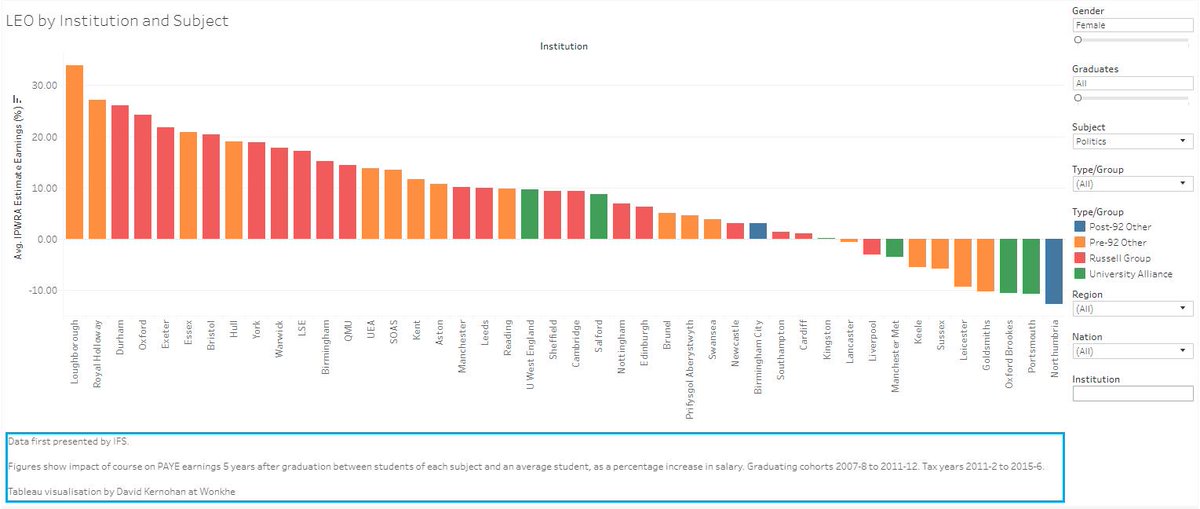
I wrote something with @chrisbelfield on our report on graduate earnings. But the best bit by a mile is @Wonkhe's excellent data visualisation tool https://t.co/MZawOIzsmn
How important are university courses to defining graduate earnings? @jack_britton and @chrisbelfield of @TheIFS introduce their research https://t.co/5E4aGNXPlz





![TheIFS's tweet photo. NEW: The Education Maintenance Allowance, a weekly cash transfer to disadvantaged students aged 16-19, did not improve their long-run outcomes.
The EMA only provided around 40p of benefits to students for every £1 spent.
THREAD on our new @NuffieldFound-funded report:
[1/10] https://t.co/IqEdXv3237](https://pbs.twimg.com/media/Gksm7CUXsAIowN9.jpg)
![TheIFS's tweet photo. Less selective post-1992 institutions perform best on social mobility, with high intakes of low-income students.
Russell Group unis generally do poorly. Though their low-income students do well in the labour market, they admit very few of them.
[6/9] https://t.co/ncI7CJrjsb](https://pbs.twimg.com/media/FE8T0dxWYAcQmzX.jpg)