1/🧵
Performance-Based Logistics (PBL) shouldn’t rely on spreadsheets, delays, and disputes.
Pilot 5 introduces a new model:
✅ data → performance → automatic payment 👇
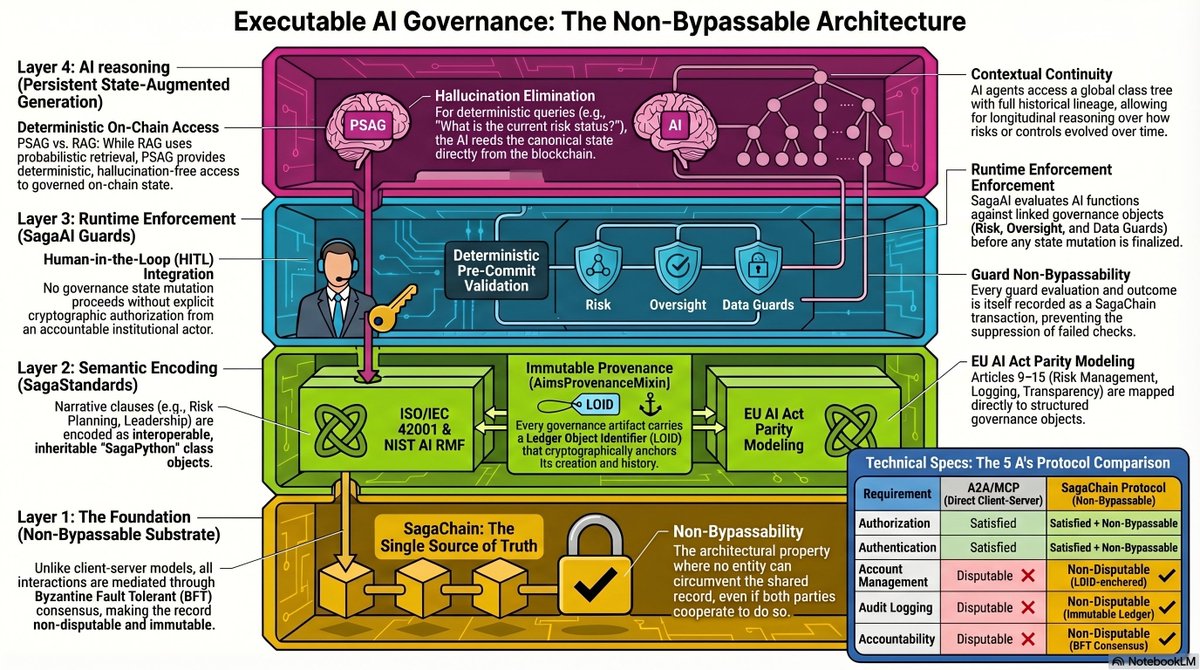
AI hallucination isn’t a model problem.
It’s an architecture problem.
Today we’re introducing a new construct:
PSAG (Persistent State-Augmented Generation).
It changes how AI handles truth.
For the past few years, the industry has tried to fix hallucination with better prompting, better models, and better retrieval.
And to a point, it works.
Until you reach the places where correctness actually matters governance, compliance, accountability.
That’s where everything breaks.
Not because the models are weak…
but because they’re still guessing.
And more importantly, because they’re guessing on top of systems that don’t share a single version of reality.
Today’s dominant AI architectures, including A2A and MCP, solve authentication and authorization.
But they don’t solve something more fundamental:
shared, non-disputable state.
Every system keeps its own record.
When those records diverge, there is no computational way to resolve truth.
Audit logs, account state, and accountability remain disputable by design.
That’s not a bug.
It’s an architectural ceiling.
PSAG changes that.
Not by improving the model.
Not by improving retrieval.
By removing the need to guess entirely.
With PSAG, AI doesn’t retrieve governance data and it doesn’t infer it.
It reads it.
Directly from a single, canonical, on-chain state where every object has deterministic identity, immutable provenance, and cryptographic authorization.
There’s no retrieval layer.
No probabilistic ranking.
No interpretation gap between the question and the answer.
For deterministic queries -
“What is the current risk classification?”
“Who authorized this change?”
hallucination isn’t reduced.
It’s structurally eliminated.
The answer is the state itself.
PSAG doesn’t replace RAG.
It defines a boundary.
RAG remains the right architecture for unstructured knowledge.
PSAG becomes the architecture for governed state
where correctness, lineage, and auditability are not optional.
But PSAG only works because of something deeper:
non-bypassability.
On SagaChain, no interaction happens outside consensus.
Client and server don’t exchange data directly.
Every state mutation, every governance evaluation, every authorization is routed through a shared, immutable record.
No side channels.
No conflicting logs.
No ambiguity about what is true.
That’s what allows SagaAI to operate differently.
Before any AI-driven action mutates state, governance is evaluated - deterministically, against canonical objects, at the commit boundary.
Every pass, fail, escalation, and authorization is itself recorded as a transaction.
Governance is no longer something you document after the fact.
It becomes something the system enforces in real time.
Frameworks like ISO/IEC 42001, NIST AI RMF, and the EU AI Act stop being documents.
They become executable, interoperable objects.
Instead of reconstructing compliance, you verify it directly through object lineage on an immutable ledger.
The implication is simple:
AI accountability stops being a promise.
It becomes a property of the system.
This is early.
It’s live on our public development testnet, not production.
The architecture works.
And the invariants are mechanically verified.
We’re now opening this up.
There are already thousands of canonical classes across governance, regulatory, financial, and operational domains.
Now we need the people who understand those domains to shape them.
If you’re working in AI, governance, compliance, or systems where correctness actually matters…
this is the shift to pay attention to.
Get involved:
Standards → https://t.co/8ARCzi9mc3
Overview → https://t.co/TNHzCxCfGZ
Testnet → https://t.co/6bz19zLtF4
WebCLI → https://t.co/EEbg7RafvF
Contact → [email protected]
Good question. Let me look at this precisely rather than accept the marketing framing at face value.Good. Now I have enough to give a precise architectural answer. This requires no further searching — the mechanism is clear.
What "AI Multi-LLM Consensus" Actually Is — Precise Architecture
What It Is Not
First, clear away the marketing framing. "Multi-LLM consensus" is not a novel consensus protocol. It is not LLMs reaching agreement through some inter-model communication. It is not a new architectural primitive.
It is Chainlink's existing DON oracle aggregation pattern applied to LLM outputs as the data source, with LLMs substituted in place of traditional data feeds.
The Actual Architecture — Step by Step
Chainlink's standard DON architecture has always worked as follows:
A request is made on-chain (or triggered by CRE)
Multiple independent oracle nodes — each running off-chain — receive the request
Each node independently queries the data source
Nodes submit their results using a commit/reveal scheme (commit hash first to prevent freeloading, then reveal)
Nodes compare their findings and reach consensus on the correct value, then deliver the verified information back to the smart contract
The aggregated result is written on-chain
For price feeds, the "data source" is an exchange API. For AI oracle use, the "data source" is an LLM API. The consensus mechanism is identical. What changed is only what each node is calling.
In the DTCC/Swift corporate actions context: using Chainlink oracles paired with multiple large language models, they sourced unstructured offchain data and converted it into structured onchain data in near real-time, into predefined standards modeled on the ISO 20022 framework.
Concretely, the architecture is:
Unstructured document (PDF, announcement, etc.)
↓
[DON Node 1] → calls GPT API → gets structured extraction result
[DON Node 2] → calls Gemini API → gets structured extraction result
[DON Node 3] → calls Claude API → gets structured extraction result
↓
DON aggregation layer: do N-of-M results agree?
↓
If threshold met → write agreed result on-chain as "golden record"
↓
Distribute via CCIP across chains / ISO 20022 via Swift
By distributing the system across DONs, multiple independent verifications — each grounded in diverse sources and utilizing different reasoning models — are aggregated through a proven consensus protocol.
What "Consensus" Means Here
The consensus is value matching — do a majority of nodes return the same structured output? It is the same majority aggregation Chainlink uses for price feeds, applied to LLM text outputs. For structured extraction tasks (extract the dividend amount from this announcement), this works reasonably well because the answer space is constrained and the LLMs are parsing the same document.
This is categorically not the same as Byzantine Fault Tolerant consensus over state transitions. It is threshold agreement on output values — closer to a quorum vote than BFT.
The Critical Architectural Limitation Chainlink Itself Acknowledges
We recognize a fundamental challenge: as language models advance, they increasingly share training datasets and could potentially exhibit similar biases. This observation has led us to question whether consensus mechanisms alone — simply aggregating outputs from different models — can effectively mitigate these biases.
This is Chainlink's own research team correctly identifying the structural problem: if GPT, Gemini, and Claude were all trained on overlapping internet corpora, they may produce correlated errors. Three models agreeing does not mean three independent verifications — it may mean three correlated outputs from models with shared failure modes. The DON consensus protocol was designed for independent price data providers with genuinely independent data pipelines, not for LLMs with shared pretraining data.
What Was Actually "Production-Demonstrated"
The DTCC/Swift initiative demonstrated:
Unstructured corporate action announcements (PDFs, press releases) can be parsed by LLMs into structured ISO 20022-compliant fields
Running that parsing through 3 LLM APIs and checking agreement catches some hallucinations
The system achieved near-total data consensus across AI models and supported multilingual disclosures
What it did not demonstrate:
A novel consensus mechanism
Any architectural property beyond "majority of LLM API calls agreed"
Non-bypassability of the extraction process
Any formal guarantee about execution path accountability
The "near 100% data consensus" metric means: across the test events, GPT/Gemini/Claude produced the same structured output in nearly all cases. For well-structured financial announcements in major languages, this is expected — the extraction task is constrained enough that the models converge. It does not mean the consensus mechanism is robust under adversarial conditions or for genuinely ambiguous documents.
Corrected Table Entry
The original entry in my comparison table was:
AI multi-LLM consensus ✅ Production-demonstrated (DTCC/Swift initiative)
The accurate entry should be:
Dimension Chainlink SagaAI Notes Multi-LLM output aggregation ✅ Production-demonstrated for structured data extraction (DTCC/Swift) ❌ Not present Chainlink's DON majority-voting applied to LLM API outputs. Correlated failure mode acknowledged by Chainlink's own research. Not a novel consensus protocol — it is threshold agreement on LLM responses.
Relevance to the SagaAI Competitive Argument
This actually strengthens SagaAI's five A's position, not weakens it. Here is why:
Each DON node in the AI oracle configuration is making an independent HTTPS call to an external LLM API. That call is a direct client-server connection — exactly the architecture identified in the Beberman document as failing three of the five A's. DON consensus attests that a majority of nodes got the same output. It does not make any individual node's call to GPT/Gemini/Claude non-bypassable. The execution path — what prompt was sent, what context was included, what intermediate reasoning occurred — is off-chain and not part of the consensus record.
The "golden record" on-chain is the aggregated output value. It is not a canonical record of what was done to produce it. The Beberman/white paper distinction holds precisely here: Chainlink writes AI outputs onto a chain; SagaAI is the channel through which AI agents interact, making every step of the channel non-bypassable.
In short: the DTCC/Swift result is a genuinely useful data pipeline capability. It is not, architecturally, what "multi-LLM consensus" implies when read in isolation.
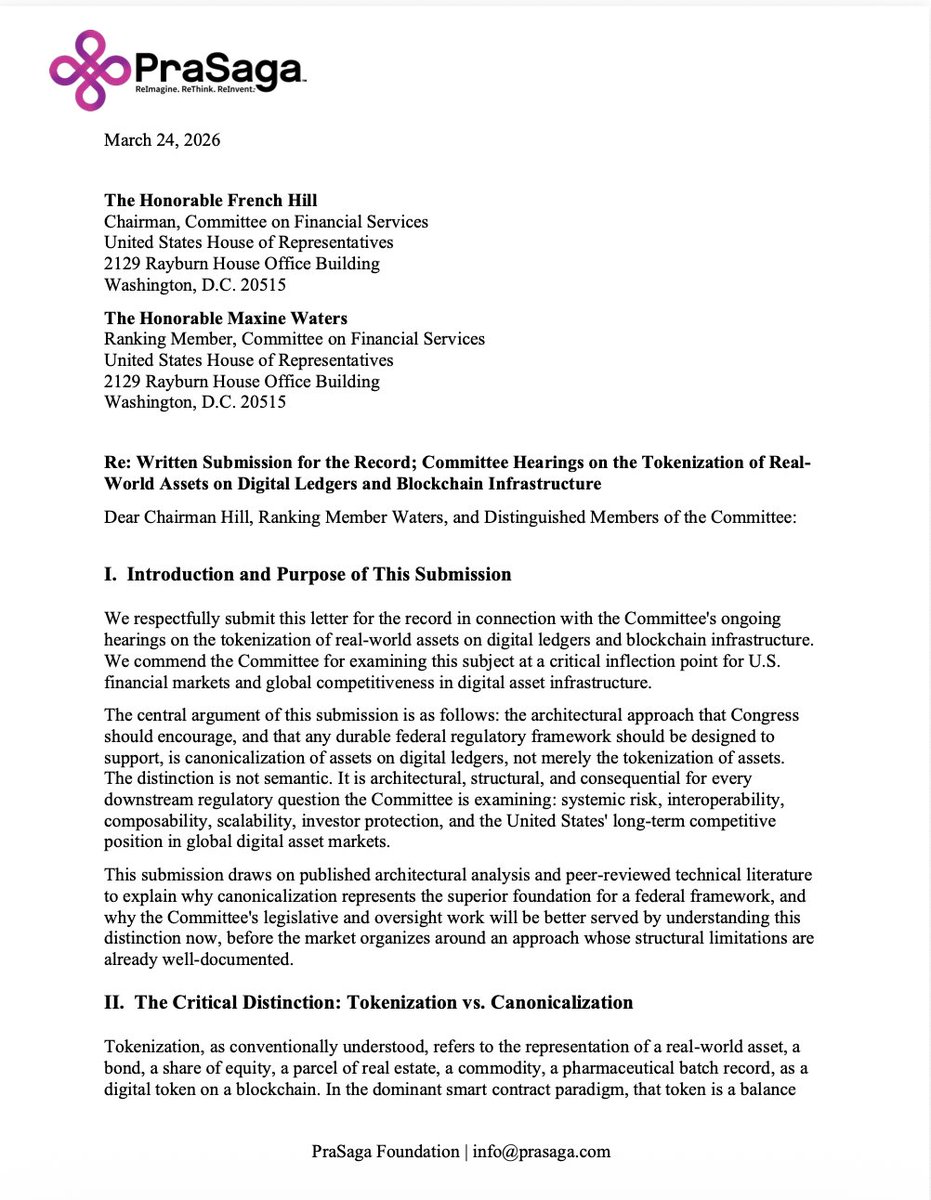
PraSaga Foundation today submitted a request to the @FinancialCmte@USHouseFSC to include the construct of Canonicalization as an alternative architectural foundation for Tokenization of Real World assets (RWA).
1/🧵
Creators, Composers, Labels picture a music world where your IP isn't lost in silos, but shines with unbreakable ownership and instant royalties.
No more unmatched millions vanishing into the ether.
Introducing SagaMusic Pilot 4: Cross-Standard Namespace Synchronization on SagaChain.
The future is now. 👇
Ihr Lieben,
ich brauche Eure Hilfe. Bitte unterzeichnet die Petition. Die Villa ist ein toller, außerschulischer Lernort, wo die Kinder in Bhv mit Natur, Umweltschutz und allem in Verbindung kommen. 1/
https://t.co/2dfJsVOHth
1/ 🧵
Commercial leases have always behaved like documents.
👉 Which means every change creates a new version.
👉 Every system keeps its own copy.
👉 And every audit starts with reconstruction.
SagaRealEstate™ Pilot 3 shows a different model.
🔶 A Living Lease 👇
1/
Breaking: The future of finance just got a compliance upgrade you won't believe. Today, we're announcing SagaFinance™ Pilot 3 - Regulatory Compliance Reporting with XBRL Bindings on SagaChain.
Say goodbye to filing drudgery and hello to automated, ironclad transparency. Thread 👇
GLOVE - 6B (300D), BERT - large-uncased (1024D), RoBERTA large (1024D),embedding vectors (RVC). Shown are the geometric trajectories of four semantic terms, man(red) women(green) king(blue) queen(orange) without dimensionality reduction or statistical projection
#LLMs#XAI#ML
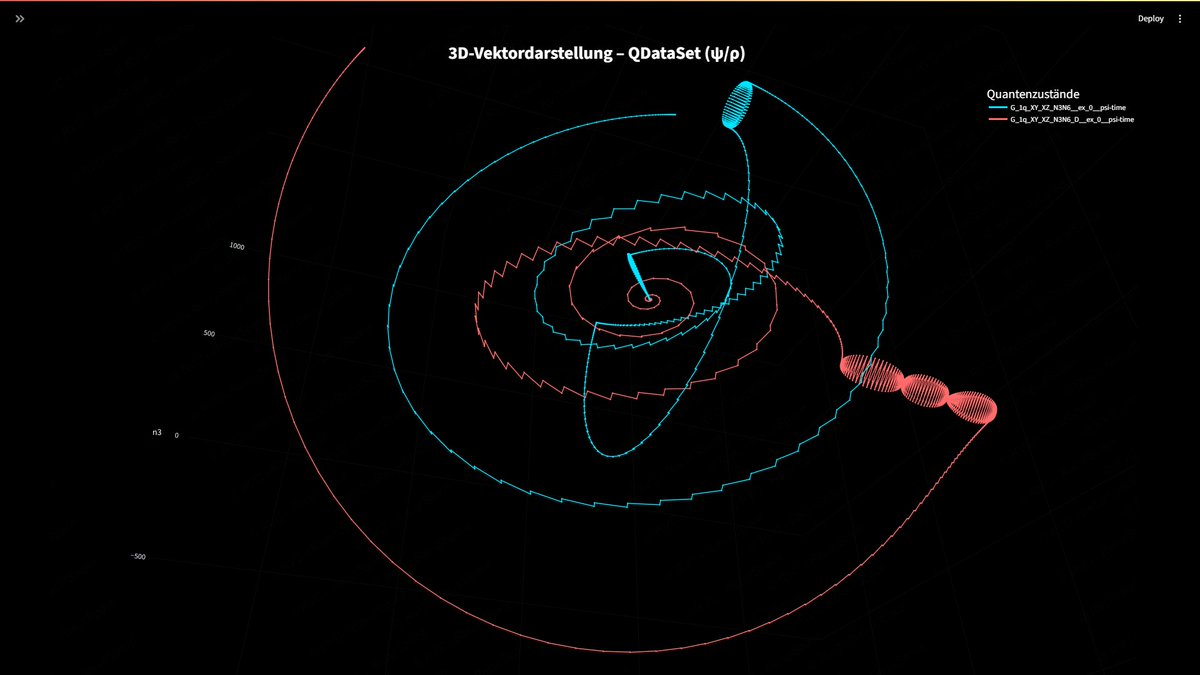
I've been working on a way to turn quantum state sequences into deterministic 3D geometries. This is what qubit state looks like. What do you think about this topological approach?
https://t.co/V7mnyBUk24
1/ 🧵
Property ownership does not live in documents.
Documents are artifacts.
Ownership is a state that persists through time.
We just proved that difference matters.
Links: 👇
9/
The future of property infrastructure will not arrive as a disruption.
It will arrive as a standard.
Contact: [email protected]
Overview and Pilots: https://t.co/XI2r2ljYu0
Code: https://t.co/oOchg2Aw08
SagaScan: https://t.co/XAJLJqQCfv
SagaWizard: https://t.co/XLeYHX6jAR
1/
The PraSaga Foundation™ Enterprise Pilot Program, SagaPilots™ is Now Published.
30+ enterprise pilots across 6 industries are now available, demonstrating executable standards and real operational infrastructure.
🧵
Links:👇
1/
The music industry doesn’t have a technology problem.
It has a trust problem.
Royalties are delayed.
Rights are disputed.
Metadata fractures at scale.
This isn’t a talent issue.
It’s an infrastructure one. 🧵👇
1/
Real estate is the world’s largest asset class
but it still runs on documents, PDFs, and manual enforcement.
That mismatch is costing time, trust, and trillions in inefficiency.
Today, we’re releasing the Real Estate Industry White Paper. 🧵⬇️