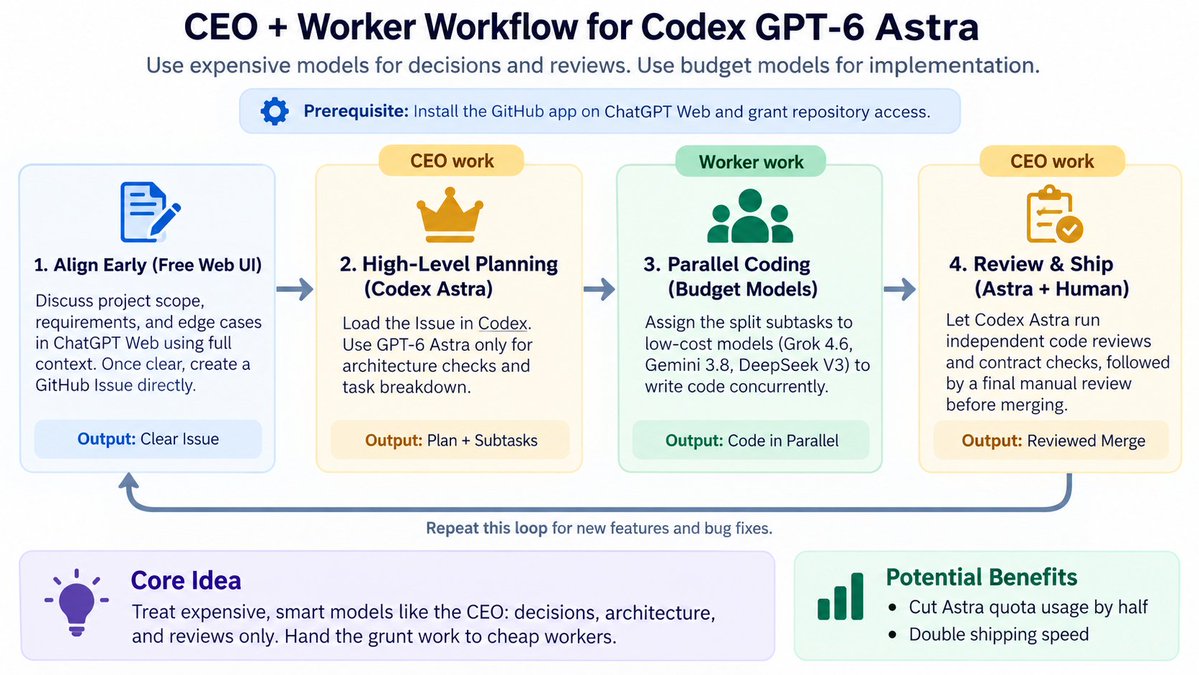
I noticed many people struggling with the 5-hour Codex GPT-6 Astra limit. Here is my simple "CEO + Worker" workflow to cut costs and boost speed:
Prerequisite: Install the GitHub app on ChatGPT Web and grant repository access.
Align early (Free Web UI): Discuss project scope, requirements, and edge cases in ChatGPT Web using full context. Once clear, create a GitHub Issue directly.
High-level planning (Codex Astra): Load the Issue in Codex. Use GPT-6 Astra only for architecture checks and task breakdown.
Parallel coding (Budget models): Assign the split subtasks to low-cost models (Grok 4.6, Gemini 3.8, DeepSeek V3) to write code concurrently.
Review & Ship (Astra + Human): Let Codex Astra run independent code reviews and contract checks, followed by a final manual review before merging.
Core idea: Treat expensive, smart models like the CEO (decisions and reviews only), and hand the grunt work to cheap workers.
Repeat this loop for new features and bug fixes. You will cut your Astra quota usage in half while doubling your shipping speed.
I noticed many people struggling with the 5-hour Codex GPT-6 Astra limit. Here is my simple "CEO + Worker" workflow to cut costs and boost speed:
Prerequisite: Install the GitHub app on ChatGPT Web and grant repository access.
Align early (Free Web UI): Discuss project scope, requirements, and edge cases in ChatGPT Web using full context. Once clear, create a GitHub Issue directly.
High-level planning (Codex Astra): Load the Issue in Codex. Use GPT-6 Astra only for architecture checks and task breakdown.
Parallel coding (Budget models): Assign the split subtasks to low-cost models (Grok 4.6, Gemini 3.8, DeepSeek V3) to write code concurrently.
Review & Ship (Astra + Human): Let Codex Astra run independent code reviews and contract checks, followed by a final manual review before merging.
Core idea: Treat expensive, smart models like the CEO (decisions and reviews only), and hand the grunt work to cheap workers.
Repeat this loop for new features and bug fixes. You will cut your Astra quota usage in half while doubling your shipping speed.
Stop prompting a single LLM to build complex projects.
I just orchestrated a 14,000-line full-stack build in 30 minutes using Codex for high-level coordination alongside 4 parallel Cursor Grok Agents—shipping zero-defect code that passed client acceptance on the very first try (a task that typically takes a team 2 full days).
Most multi-agent setups fall apart because they lack frozen API contracts and independent code review.
Here is the exact Human-in-the-Loop architectural blueprint we used to close the loop from design to real-backend integration. Breakdown below 🧵👇
I noticed many people struggling with the 5-hour Codex GPT-6 Astra limit. Here is my simple "CEO + Worker" workflow to cut costs and boost speed:
Prerequisite: Install the GitHub app on ChatGPT Web and grant repository access.
Align early (Free Web UI): Discuss project scope, requirements, and edge cases in ChatGPT Web using full context. Once clear, create a GitHub Issue directly.
High-level planning (Codex Astra): Load the Issue in Codex. Use GPT-6 Astra only for architecture checks and task breakdown.
Parallel coding (Budget models): Assign the split subtasks to low-cost models (Grok 4.6, Gemini 3.8, DeepSeek V3) to write code concurrently.
Review & Ship (Astra + Human): Let Codex Astra run independent code reviews and contract checks, followed by a final manual review before merging.
Core idea: Treat expensive, smart models like the CEO (decisions and reviews only), and hand the grunt work to cheap workers.
Repeat this loop for new features and bug fixes. You will cut your Astra quota usage in half while doubling your shipping speed.
Claude Code security & constraints: Enterprise and local execution boundaries/sandboxing are too restrictive or raise compliance flags.
UI & diagramming precision: Cursor still lags behind Codex when it comes to rendering diagrams, architectural visual generation, and SVG fidelity.
Codex remains my contract/orchestration hub, while other agents handle isolated implementations.
Stop prompting a single LLM to build complex projects.
I just orchestrated a 14,000-line full-stack build in 30 minutes using Codex for high-level coordination alongside 4 parallel Cursor Grok Agents—shipping zero-defect code that passed client acceptance on the very first try (a task that typically takes a team 2 full days).
Most multi-agent setups fall apart because they lack frozen API contracts and independent code review.
Here is the exact Human-in-the-Loop architectural blueprint we used to close the loop from design to real-backend integration. Breakdown below 🧵👇