Joe Feltz has died at the age of 40.
Joe had been collecting rare, sacred, hidden & last editions of old & ancient books & was in the process of scanning & uploading them as a free source on the internet.
Joe has been found dead, the cause of death has not yet been released.
Some of the books included original Masonic books & bibles, The 1812 Bible (including the Book of Esdras, Wisdom of Solomon, Apocrypha, and Psalms), The Lost Books of the Bible, Conversations on the Bible, Encyclopaedia of Witchcraft & Demonology (chronicling the inquisitions & Salem witch trials), Ancient Magic & Magnetism & much more.
Many of these books showed many inconsistencies with the modern version of history & exposed many hidden secrets.
Joe was also created free blueprints & online design tools to help his audience build their own off-grid power systems without expensive corporate costs & with free energy.
R.I.P & Fly High Joe 🤍🕊️
@MEMO0423@QuePocaMadre_Mx El olor al que se refieren es el compuesto 2- nonenal y se produce a partir delos 35 años, viejas pendejas les faltó saberse defender.
@QuePocaMadre_Mx Vivimos en los tiempos de la santa inquisición, del coliseo romano digital, yo pensé que se refería a un baúl de sarcófago, resulta que se refería al Baúl de la ropa, pues sí, los de más de 35 ya empezamos a oler a humedad, el compuesto que genera ese olor se llama 2-nonenal, ...
La inyección que se está utilizando en el Reino Unido para combatir esta enfermedad se llama Nivolumab. Es un fármaco inmunoterapéutico que puede administrarse en tan solo 3 a 5 minutos.
será de gran eficacia para ayudar a combatir hasta 15 tipos de cáncer. Entre los que se encuentra el cáncer de piel, de intestino, de vejiga, riñones, estómago, pulmón, cabeza, esófago y cuello.
🇨🇳 Imagine drawing a math equation on a blackboard... and watching it instantly come to life.
At the 2026 World AI Conference in Shanghai, a company unveiled an AI-powered blackboard that transforms handwritten equations into live graphs and simple sketches into interactive 3D models in real time.
If this technology reaches classrooms, math lessons could look very different in the future.
Writer: Monica
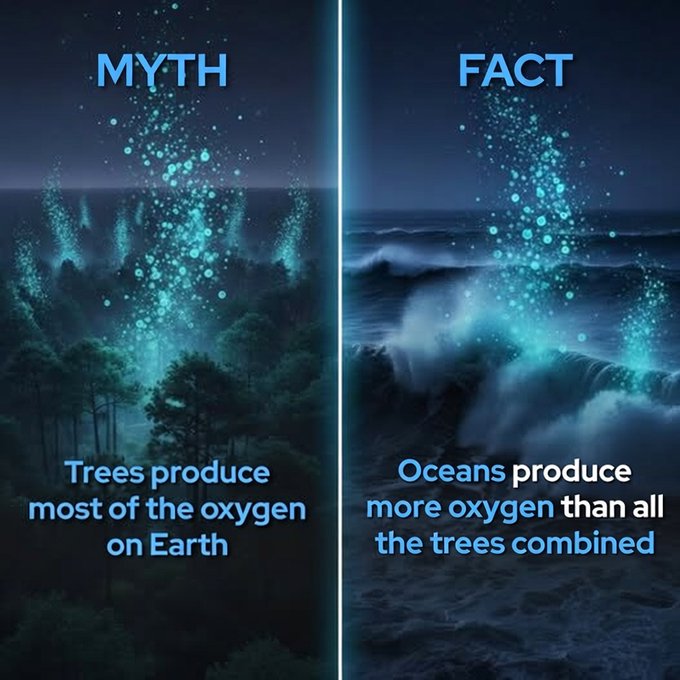
Every second breath you draw comes from the ocean.
While forests are frequently hailed as the “lungs of the Earth,” they are not the main source of our planet’s oxygen. That distinction belongs to the ocean—specifically to the countless trillions of microscopic marine organisms drifting in its sunlit upper layers.
Phytoplankton, along with cyanobacteria and other tiny algae, perform photosynthesis just like land plants: they harness sunlight to turn carbon dioxide and water into energy, releasing oxygen as a byproduct.
Though individually invisible to the naked eye, these organisms are extraordinarily productive. Together, they generate an estimated 50–80% of the oxygen present in Earth’s atmosphere.
This massive oxygen factory operates across the world’s oceans, largely out of sight. From space, satellite imagery reveals their seasonal blooms as swirling, paint-like patches of color—vivid evidence of the hidden engine that keeps our air breathable. These blooms respond sensitively to shifts in sea temperature, sunlight, nutrient availability, and ocean currents; scientists continue to study how climate change and other pressures may reshape these patterns in the coming decades.
This does not lessen the vital importance of forests. Trees lock away carbon, support immense biodiversity, regulate local climates, and provide countless other benefits. But when it comes to producing the oxygen we breathe, the ocean—not the rainforest—is the dominant contributor.
Pocas personas saben que la sangre del cangrejo herradura ha sido clave para proteger millones de vidas. Gracias a sus propiedades únicas, se utiliza para detectar la presencia de bacterias y endotoxinas en vacunas, medicamentos, implantes y equipos médicos, ayudando a garantizar que sean seguros antes de llegar a los pacientes.
Aunque esta especie ha sobrevivido durante cientos de millones de años, hoy enfrenta nuevos desafíos por la actividad humana, lo que ha impulsado esfuerzos para desarrollar métodos alternativos y fortalecer su conservación. Un verdadero héroe de la naturaleza que ha contribuido silenciosamente al avance de la medicina. 🌎🦀💙
🇩🇪 | URGENTE: La Asociación de Fútbol Alemana se ha negado a firmar una carta de apoyo a Gianni Infantino para que ocupe en el futuro otro mandato como Presidente de la FIFA.
🚨 BREAKING
🇺🇸 FED JUST ANNOUNCED AN EMERGENCY LIQUIDITY INJECTION TO PREVENT A FURTHER MARKET CRASH!
THEY WILL INJECT $17,600,000,000.00 INTO THE ECONOMY AMID GROWING AI BUBBLE FEARS AND A STOCK MARKET COLLAPSE.
SOMETHING BAD IS HAPPENING RIGHT NOW...
A Nobel Prize-winning chemist has developed a machine that can harvest up to 270 gallons of clean drinking water daily directly from dry, desert air.
The innovative system, developed by 2025 Nobel laureate in chemistry Professor Omar Yaghi and his company Atoco, utilizes molecularly engineered, porous materials that act like 'molecular sponges' to trap water vapor from the atmosphere. Unlike traditional desalination methods—which require massive amounts of energy and produce environmentally harmful salty brine—Yaghi’s machine utilizes ultra-low-grade heat to release the trapped molecules as pure liquid water.
Contained in a unit the size of a 20-foot shipping container, the system can function completely off-grid, ensuring a reliable water source even when natural disasters or severe droughts knock out centralized electricity and municipal water supplies.
For Yaghi, a chemistry professor at UC Berkeley, this scientific breakthrough is deeply personal. Having grown up in a Jordan refugee community with no running water or electricity, he spent his childhood rushing to fill containers during scarce, bi-weekly water deliveries.
Driven by these early struggles, Yaghi designed this technology to foster water independence for the 2.2 billion people worldwide who lack safely managed drinking water.
Because atmospheric water harvesting operates wherever there is moisture in the air, the technology offers a highly resilient and sustainable alternative for isolated island nations, remote desert communities, and areas devastated by hurricanes.
source: Duncan, N. (2026). 'Reimagining matter': Nobel laureate invents machine that harvests water from dry air. The Guardian.