I absolutely love this talk by Destin (@smartereveryday) and he's absolutely right! Overall, he made a well thought out case to simplify & ensure mission success for the Artemis program. That being said, I did want to write a few thoughts I have on some things. Thank you Destin for sharing this talk and allowing room for fun and important discussion, I look forward to everyone's comments below!
While @SpcaeX's plans for Starship HLS (Human Landing System) currently rely on somewhere around 15 Starship launches to refuel in order to get Starship HLS to the moon, the reality is, it doesn't NEED to rely on 15 launches. SuperHeavy has demonstrated its capability as a super heavy lift booster, by simply sacrificing some SuperHeavy Boosters (if the mission timeline would slip too far), they could greatly reduce the number of refueling trips by about half, and if they utilized disposable Starships to refuel HLS, they could probably do the entire HLS system launch in a few launches. So even if the full rapidly reusability / in orbit refueling is too ambitious for this timeline, SpaceX would have no problem walking backwards on these technologies for the HLS system in the interim. It's better for SpaceX to be pushing for the full vision and if need be, walk it back, which is much better than trying to go the other direction (realizing your system isn't capable and need to scale it up / increase performance).
Another fun note is Destin continually said it will take "15 rockets" to refuel HLS. This might be a bit pedantic and a matter of semantics, but technically, SpaceX will require 15 LAUNCHES, not 15 rockets. It very likely could be done by the same physical rocket or a few rockets that would do the work to refuel a depot. I just think it's fun how engrained the idea of 1 launch = 1 rocket when the reality can be 1 rocket = 18 launches (so far) with the Falcon 9.
On that same note, despite 15 launches for a lunar mission sounds absolutely absurd today, I think even 3 years ago if we said there would need to be 15 launches of a Falcon 9 for a lunar mission, it would've seemed ridiculous considering there were only 26 launches in 2020. But we're getting closer to 4 times that amount of launches for Falcon 9 just 3 years later. So 15 launches for a Falcon 9 already seems much much more reasonable and feasible than it did 3 years ago. Although Starship hasn't made it to orbit on any of its test flights, once it does get to orbit, its cadence will very likely increase and if it were to double each year, it won't be long before 15 launches isn't out of the question. It still could easily be 4+ years by this estimate, but in grand scheme of things, say in 20 years, 15 launches of a rocket shouldn't seem that ridiculous, I would actually assume by then anything less than 15 launches of a rocket would be ridiculous.
And I think the scariest part of all of this is the unproven / unknown nature of all of these technologies. But for me, the number of launches for refueling isn't scary. If they can refuel once, they can refuel twice, they can refuel 10 times, they can refuel 20 times. Yes complications, costs and risk do increase with a higher number of refueling trips, but if it is technically possible, someday, that number will be trivial.
But we're also missing one HUGE point. And I mean HUGE. Starship has nearly 1,000 cubic meters of payload volume and after doing 15 refueling trips, it can land 100 metric tonnes OF PAYLOAD on the moon (not including the weight of the vehicle itself and its propellant). The Apollo lunar landers had 4.5 cubic meters of payload volume. 1,000 vs 4.5... but this actually goes to Destin's point. If "We are going" as Artemis promos excitedly push, isn't an entire Starship just absolute overkill? I mean, even if it was "just" 15 times the volume, (75 cubic meters), it'd still be gargantuan and luxurious for a small crew, more on par with the massive Space Shuttle crew compartment. So yes, it might take 15 launches, but it's taking over 200 times the volume, and 100 times the mass to the surface of the moon. SpaceX is planning to basically land something with the internal volume of the International Space Station on the moon!!! AND importantly, it's designed to be reusable, so of those 15 launches, if all goes as planned, NONE of the hardware to do that mission would actually be thrown away... only their propellant! So that means every single Saturn V / Apollo Lander that ever launched still wouldn't match the capability of this one Starship HLS mission in terms of payload and volume. We aren't trying to repeat Apollo by barely being able to put two humans in a cramped tin can (said with love) for a few days, NASA is trying to develop the systems for sustained lunar exploration at a scale and cost unheard of during the Apollo program.
If I were at SpaceX's HLS program and I was nervous about being the "long pole" in the Artemis program's return to the moon, I would consider scaling down HLS to 1/10th the size. It'd still be 20 times the volume of the Apollo lunar lander and could likely be done in a single expendable Starship / SuperHeavy mission. And although it goes against the entire philosophy and ethos of SpaceX / @elonmusk's vision for Starship, when the customer is waiting, maybe we don't need the ENTIRE kit and caboodle to be fully realized before fulfilling at least the most basic return to the moon mission. And again, it's much easier to scale down and scale back reusability efforts in order to increase performance and I genuinely think if SpaceX HAD to put a scaled down HLS lander into orbit with enough propellant for a TLI and landing, they would have the physical capabilities by next year just by building a one off disposable Starship (I mean they're already disposing full scale Starship / SuperHeavy's for their test campaigns anyway, so it's fairly trivial in the grand scheme of things).
Another little note, Blue Origin's lunar lander is taking what I would say is a more conservative approach in terms of scale and complexity, however it still relies on some undemonstrated technologies, including also refueling on orbit of cryogenic propellants, and a boiloff prevention system for hydrolox. If boil-off is a concern for Starship and its methalox propellant is of concern, then let's not even get started on hydrolox boil-off. But again, the capabilities of the Blue lander are leaps ahead of the Apollo program and I think it's still ambitious and worthy of the Artemis program.
Lastly, Destin was quick to rightfully point out why Artemis is using NRHO (Near Rectilinear Halo Orbit) because Orion isn't capable of getting into Low Lunar Orbit, but he didn't dive into the even bigger problem of why Orion can't. The simple answer is SLS doesn't have the performance to send any more mass to the moon than Orion with its small, undersized service module. If NASA were to wait to develop a lunar system and Gateway until SLS Block 1B was at least flying with the Exploration Upper Stage, they could stretch the service module by 10 tonnes, so potentially nearly doubling the propellant capacity, it would be able to achieve a much lower lunar orbit. This doesn't change the size / scale / refueling requirements of the current SpaceX HLS lander at all, but it at least gets rid of the potential 6+ day rendezvous from the surface of the moon to the Orion capable which is required to get a crew home safely.
I likely made my own false assumptions about things in this write up, but these are just my thoughts when I heard this talk. The bigger point of Destin's talk about leaning on "the Playbook" is still fantastic, however, "we" aren't just trying to return to the moon with the same ambitions as Apollo, NASA is trying to do things bigger, safer and ultimately less expensive in the long run than that Apollo program. And that's a HUGE HUGE ask since the Apollo Program is still easily one of the most impressive things humans have EVER done, especially given the available technologies of their day. Fantastic video Destin, thanks for opening up a fun and honest conversation!!!
I enjoyed your delivery and overall enthusiasm. It’s great to see this kind of dialogue and I respect that you had the courage to give such a speech to such an audience.
I do have some feedback that’s more on the negative side, but I share in a friendly way and as part of the “feedback loop” in hopes we all can continue the good faith discussion.
I think you fundamentally missed the mark in not recognizing and emphasizing further that Artemis aims to do substantially more than Apollo did. That’s the mission. And to do so, it requires a different and more complex architecture than Apollo.
Apollo was a veiled technological superiority race with the Soviet Union during the Cold War. It was a national priority and received significant funding incomparable to what NASA gets today. It achieved its goal of putting humans on the Moon and returning them to Earth by the end of the 1960s. A lot was learned, and the accomplishment is truly mind-boggling when considering the technology used and the timeframe in which it was developed. It’s the pinnacle of human achievement.
But it was a “flags and footprints” program. And frankly, at least in retrospect, it was a program to nowhere beyond flags and footprints. In contrast, today's Artemis program isn't driven by a strong national mandate or a comparable budget. The urgency of a “race to the Moon” is absent, though competition with China looms on the horizon.
Despite lacking a similarly strong national mandate, Artemis seeks to establish a prolonged lunar presence, focusing on extended missions, global collaboration, and further scientific research, and it lays groundwork for future interplanetary travel. That’s the mission. This is much more than the short stays of Apollo with single-use rockets that put a few tons on the surface.
There are definitely some oddities to the program and its complexity, largely stemming from the political necessity of SLS/Orion and as a result, Gateway. That’s (largely) another discussion and those vehicles and programs can be, and are, debated heavily. But the reality is they are here to stay, at least for a bit.
Another item of discussion is the high launch volume required for in-space refueling, the criticism of which is fair at a surface level but ultimately overblown. I think you overlook the capabilities this brings. These missions will support a ginormous lunar lander that will be able to deliver dozens and dozens of tons of cargo to the lunar surface — a stark contrast to Apollo's small, single-use spacecraft.
Those capsules ended up on display in museums. Starship itself could house a small museum.
Overall:
Sure, some of this mission architecture is complicated at first glance and could be communicated better to the public. “We are going” is a fun and simple slogan, but it immediately begs the question of “didn’t we already go?” That said, I recognize that “we are going back and are going to do way more cool stuff and stay for longer” doesn’t quite work as well.
Could today’s engineers maybe spend a bit of time “being more like Apollo?” Yeah, they might learn a thing or two about being a bit scrappier and applying old ways of thinking to new problems. But that’s the wrong angle because we’re not just repeating Apollo.
Also, I think it’s wrong to think of the situation as a 0-6 scorecard of Artemis engineers versus Apollo engineers. Let’s think of it as getting the U.S. and all of humanity from 6 to 7 and beyond.
While the current reality of the Artemis program is a bit contrived in its combining of outdated shuttle technology with modern commercial hardware and solutions, it’s still a pragmatic step. And for the most part, that step is forward.
Is it ideal? No. But it’s better that we have a less than ideal reality versus having a perfect dream. I’d rather say “we are going,” even if the methodology isn’t perfect, rather than say “I wish we would go.”
So, if we can trust the telemetry from Starship’s flight, there was a significant negative g observed on the booster during staging. More force was transmitted to the booster than anticipated during hot staging, this would have generated a lot of propellent slosh that may have been enough to damage the booster and ultimately cause it to fail.
One last observation - during hot staging the booster velocity drops rapidly for a moment, this is faster than can be explained by gravity. If this is accurate the booster had negative g loading for a moment, possibly lifting propellent off bottom of tanks. It's very short, but still a bigger deceleration than I expected
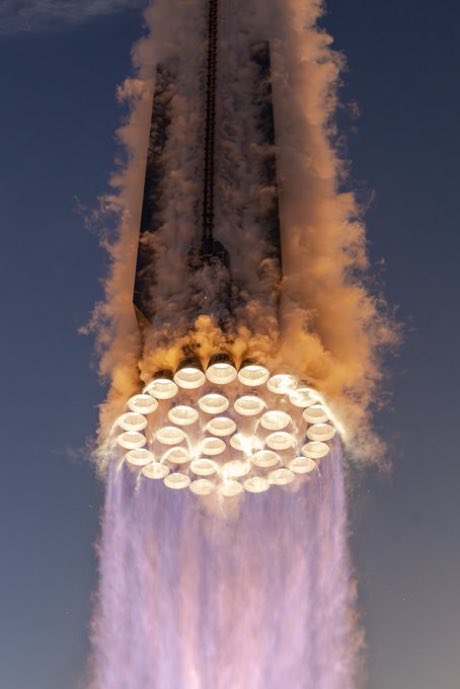
Witness our POV of the world’s largest and most powerful rocket ever, fly with 33 raptor engines (something MANY had doubts about!) HUGE congrats to the teams @SpaceX / @elonmusk. What a STUNNING launch!!! Wait till you see all of our 4K footage 😍
Congrats to @SpaceX on Starship’s first integrated flight test! Every great achievement throughout history has demanded some level of calculated risk, because with great risk comes great reward. Looking forward to all that SpaceX learns, to the next flight test—and beyond.