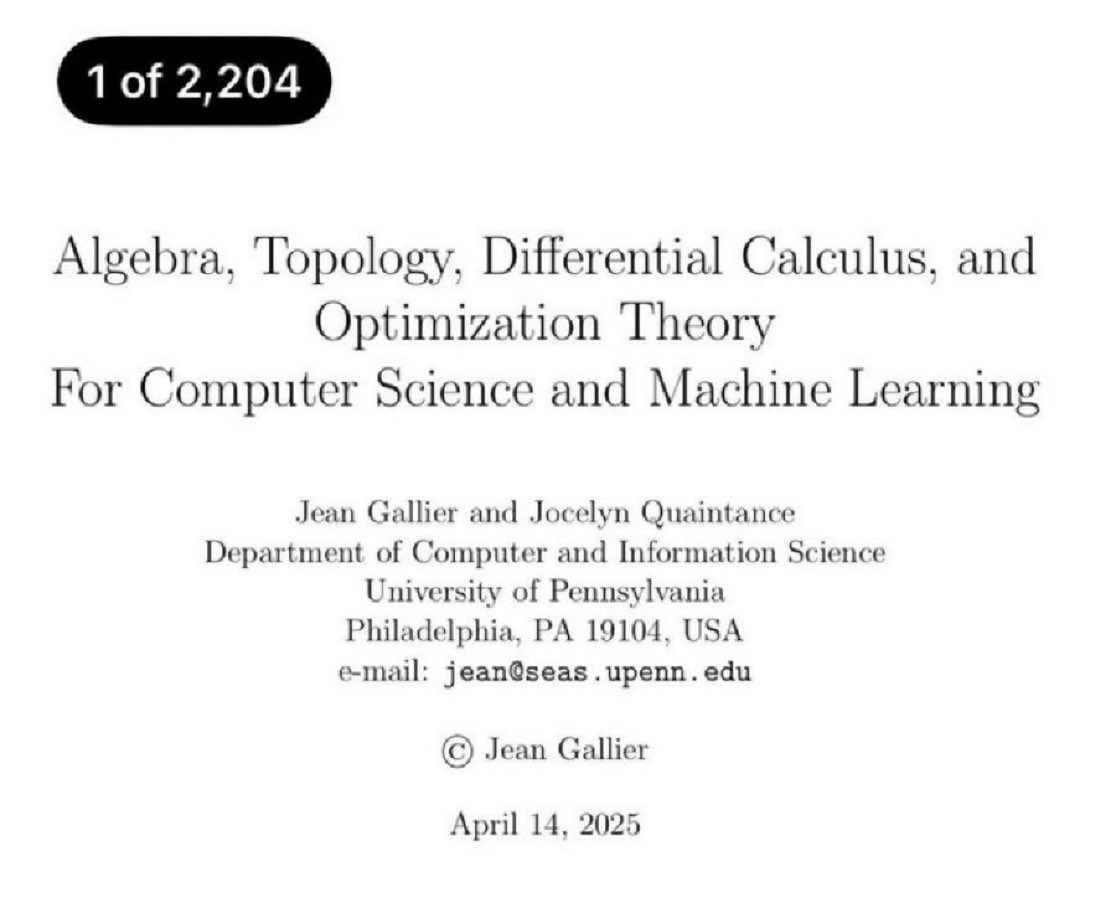
Updated 2204-page PDF Mathematics ebook:
"Algebra, Topology, Differential Calculus, and Optimization Theory For Computer Science and Machine Learning"
Find it here: https://t.co/HZc0LRoD7R
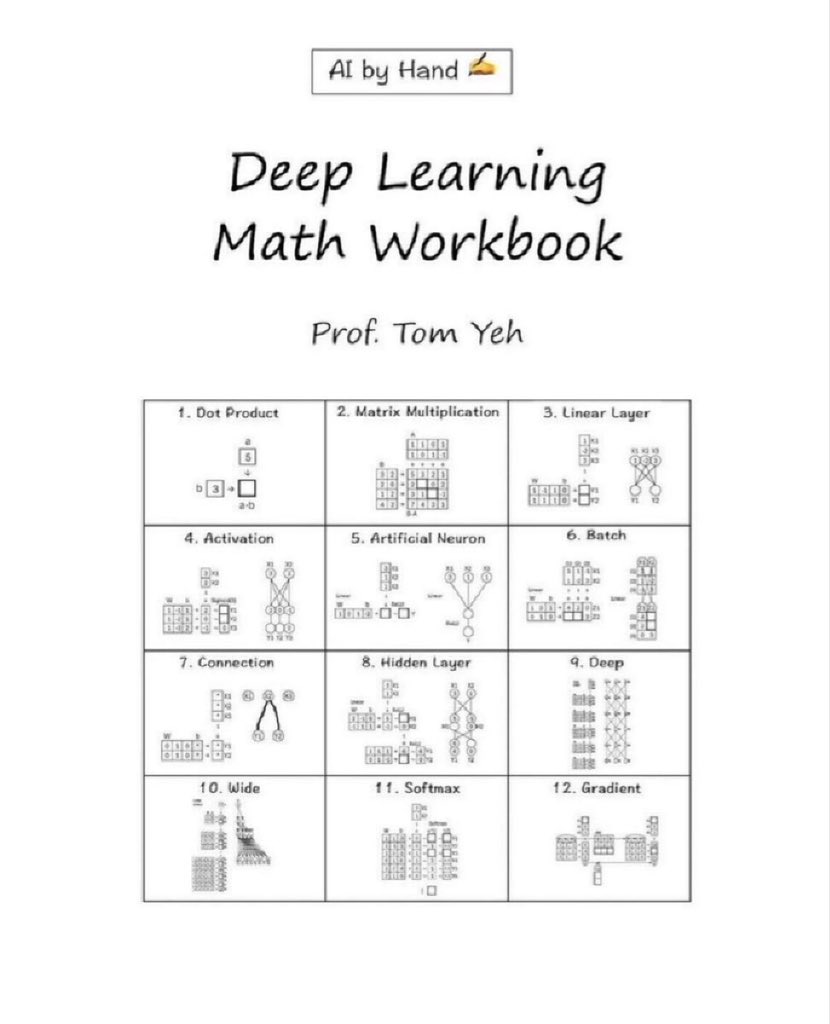
Hands-on Mathematics, Linear Algebra, and Machine Learning ... "Deep Learning Math Workbook" … with 300 puzzles — by @ProfTomYeh at https://t.co/5hyGm6rBUx
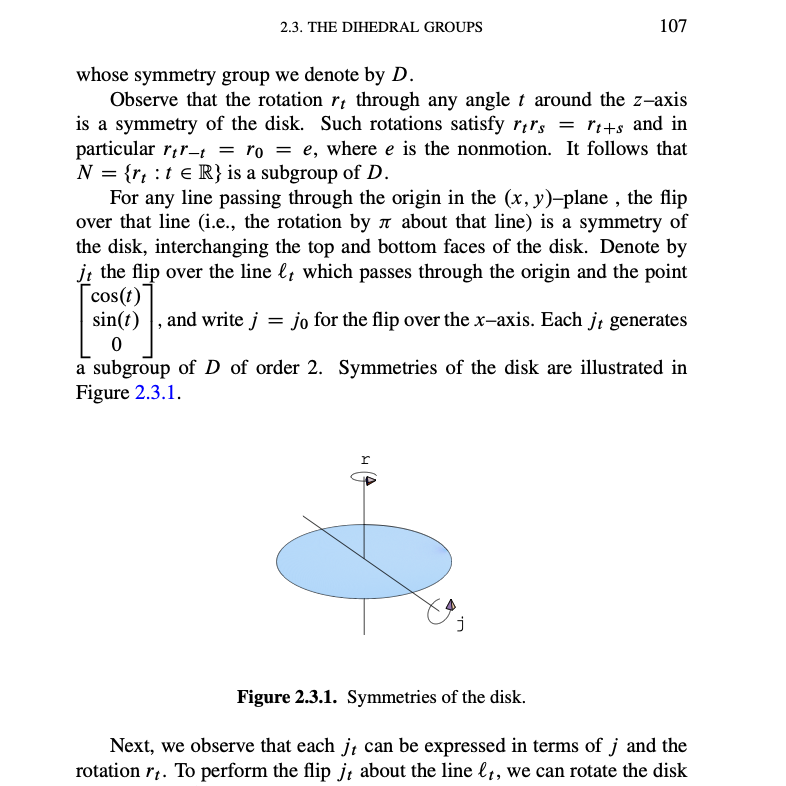
"Algebra: Abstract and Concrete" by Frederick M. Goodman is a freely available university-level textbook that provides a thorough introduction to abstract algebra.
It covers groups, homomorphisms, quotient groups, group actions, rings, fields, field extensions, modules, Galois theory, linear algebra, isometry groups, and many other topics. It also includes numerous exercises and appendices reviewing logic, set theory, induction, complex numbers, and linear algebra.
I find it a clear and practical reference, suitable both for readers approaching these topics for the first time and for consulting specific concepts when needed.
https://t.co/SOniIe8iYV
"Solving Mathematical Problems: A Personal Perspective," by Terence Tao
╰┈➤https://t.co/jsZApXcdbO
Amazon summary: "Authored by the leading name in mathematics, this engaging and clearly presented text leads the reader through the various tactics involved in solving mathematical problems at the Mathematical Olympiad level. Covering number theory, algebra, analysis, Euclidean geometry, and analytic geometry, Solving Mathematical Problems includes numerous exercises and model solutions throughout. Assuming only a basic level of mathematics, the text is ideal for students of 14 years and above in pure mathematics."
This very practical math book is for anyone who wants to develop their powers to think mathematically, especially anyone who has always wondered what lies at the core of mathematics.
"Thinking Mathematically" at https://t.co/wU5qiYiu1i
most people think mathematics is about being good with numbers. it isn’t.
mathematics is the discipline of seeing patterns.
• patterns in change.
• patterns in structure.
• patterns in logic.
• patterns in uncertainty.
build a mathematical mind by Albert rutherford argues that mathematical thinking is a skill, not a talent.
you develop it by asking:
• what stays the same?
• what changes?
• what repeats?
• what constrains the system?
• what is the simplest rule that explains this?
that is why mathematics reaches so far beyond the classroom.
the same pattern-recognition machinery powers engineering, programming, physics, finance, and science.
a mathematical mind doesn’t memorize formulas.
it learns to compress complexity into structure.
One man. Two fields named after him.
Dynkin diagrams in algebra. Dynkin's formalism in Markov processes.
And in between, E.B. Dynkin wrote a probability book for schoolchildren — Random Walks, straight from the Moscow math circles.








![KirkDBorne's tweet photo. Introduction to Time Series Analysis and Forecasting [2nd edition] (from the Wiley Series in Probability and Statistics): https://t.co/Ai7mv6dYjJ https://t.co/jGEeT8SpM0](https://pbs.twimg.com/media/HN7H-SvXYAAW1FK.jpg)