Exercise is about more than just fitness or aesthetics.
It’s what it means for our ability to stay independent for longer.
Here’s the cardiorespiratory fitness (VO2peak) needed for common daily activities.
Once our fitness drops below these thresholds, we can no longer “afford” the metabolic cost of tasks needed to remain independent.
One of the many reasons to stay active for as long as possible.
https://t.co/Rpw6xdVup0
🧠 Insights and image from:
M. Á. Rodríguez, B. Cheval, M. Gerber, I. Crespo, and H. Olmedillas. Why do Humans Exercise? A Neuro-evolutionary Framework for Discretionary Physical Effort. Evolutionary Anthropology: Issues, News, and Reviews 35 (2026): e7003.
https://t.co/yjR3d1bFCa
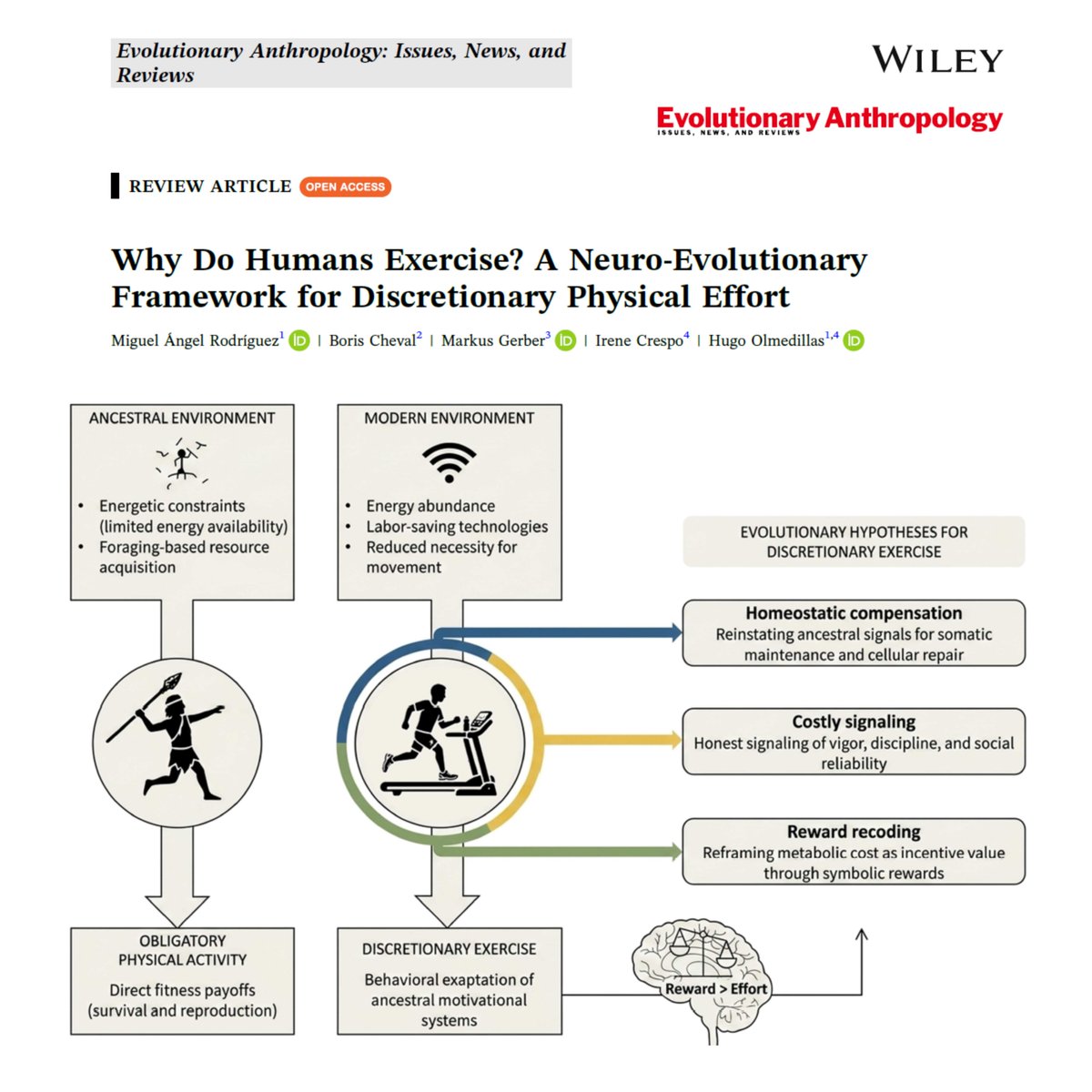
Why do we exercise?
It’s an interesting question given we evolved to be physically active, but not necessarily to exercise.
And this mismatch may help explain why so many struggle to exercise consistently.
👇🏼
Of course it’s important to know why exercise is good for us in the long-term.
But when deliberately expending physical effort is now optional, we need more convincing reasons to make exercise feel like a worthwhile decision today.
How strong is strong enough?
When most people think about being strong, they probably picture an athlete or someone lifting a ridiculous amount of weight.
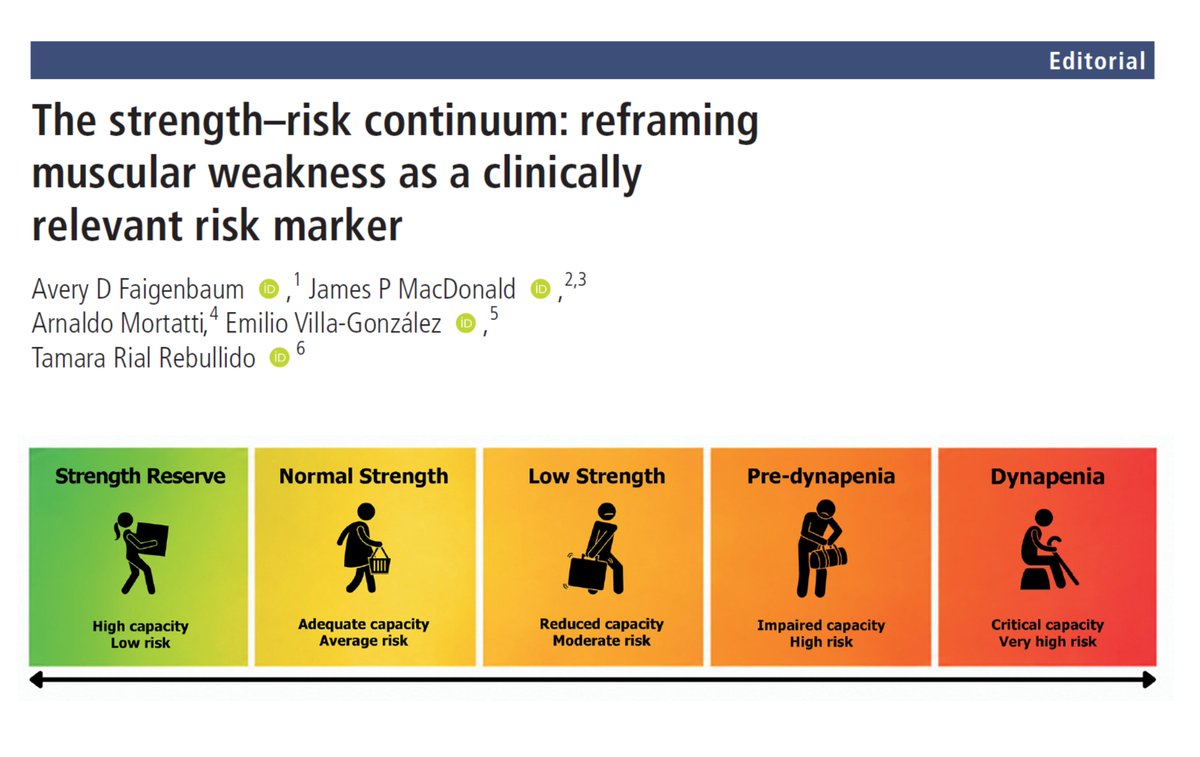
A potentially useful way to think about strength is through the strength-risk continuum, as described in this new editorial in the BJSM.
The idea is that as strength declines, our risk of chronic disease and vulnerability to adverse outcomes tend to increase, particularly the lower end of the strength spectrum.
Building strength now is a way to build a valuable reserve of physical capacity that may hold you in good stead later - particularly when declines in strength may be accelerated by future injury, illness, or prolonged inactivity.
That’s a helpful message, but I also think we should consider what better strength can mean for us right now as well.
Picture something as simple as climbing a flight of stairs. For one person it’s effortless, but for another, it requires almost everything they’ve got. Both complete the task, but one has far more physical capacity left in reserve.
That means improving strength could make your everyday activities easier and less physically demanding right now.
What’s encouraging too is strength can improve quite quickly with relatively low amounts of training, particularly in those with a lower starting point. One study (Fisher et al., 2014) found middle-aged adults increased the weights they could lift by 38-91% over 12-19 weeks - with a training commitment of just two 12-15-minute sessions per week.
The point is strength matters - not just for the future, but for making everyday life easier now too. And you don’t need to become exceptionally strong or spend hours in the gym to start seeing those benefits.
-----
📸 Image from:
Faigenbaum AD, MacDonald JP, Mortatti A, Villa-González E, Rial Rebullido T. The strength-risk continuum: reframing muscular weakness as a clinically relevant risk marker. Br J Sports Med. 2026 Sep 17:bjsports-2026-112013.
📊 Strength data from:
Fisher J, Steele J, McKinnon P, McKinnon S. Strength Gains as a Result of Brief, Infrequent Resistance Exercise in Older Adults. J Sports Med. 2014;2014:731890.
Can resistance training protect muscle and strength during GLP-1 therapy?
This new study provides some important (and in some cases surprising) insights.
GLP-1-based medications induce substantial weight loss, but a common concern is how much of that weight lost is lean tissue (including muscle).
For the first time, this study reported whether structured resistance training could offset potential losses of lean mass and strength during treatment with tirzepatide (a dual GIP/GLP-1 receptor agonist).
The study randomised 120 adults aged ~58 with overweight or obesity to undergo 40 weeks of GLP-1 therapy (tirzepatide) alone or in combination with structured resistance training three time per week.
Both groups lost a similar amount of body weight - approximately 22.6 kg on average, which was about 23% of their initial weight, over 40 weeks.
But what really stood out to me was the strength results.
Across three strength tests (bench press, lat pulldown, knee extension), the tirzepatide-only group lost 6-9% of their baseline one-repetition maximum strength, while the tirzepatide + resistance training group improved strength by 11-18%.
The losses seen with tirzepatide alone are pretty striking, but without a placebo group it’s difficult to say how much of that was attributed to the medication itself, the weight loss, or other factors.
What’s also interesting is that both groups actually improved their knee extension strength when expressed relative to body weight:
- Tirzepatide: +15.9%
- Tirzepatide + RT: +45.7%
In other words, despite losing absolute strength, participants receiving tirzepatide alone actually became stronger relative to their body weight. These gains were clearly much larger in the resistance training group, and it will be interesting to see how these changes translate to physical performance, which hasn’t yet been reported.
As for what happened to lean mass?
Those taking tirzepatide alone lost -4.67 kg total lean soft tissue mass, while those adding resistance training also lost -3.57 kg (a between group difference of 1.09 kg). So resistance training attenuated the loss of lean mass, but didn’t prevent it completely.
One thing to be clear on is lean soft tissue mass assessed in a DXA scan is not the same as muscle mass (estimates suggest muscle may only account for just over 50% of lean soft tissue mass).
I think these findings highlight why it’s important to look beyond muscle (or lean) mass alone when it comes to GLP-1 therapy. Despite losing a considerable amount of lean mass, those undertaking resistance training substantially improved their strength both in absolute and relative terms.
It’s a good reminder the goal often isn’t to just preserve muscle, but protect what our muscles are capable of doing.
-----
📊 Data from: Green DJ et al. Resistance exercise to attenuate lean mass loss during tirzepatide therapy for obesity: a randomized controlled trial. Nat Med (2026).
@nancymarie1000 Definitely doesn’t work for everyone. But it does provide another option for those who might be able to train at home or have close access to a gym/equipment.
Does it matter if you do your strength training all at once, or spread across the day?
New data suggests either way can deliver meaningful results.
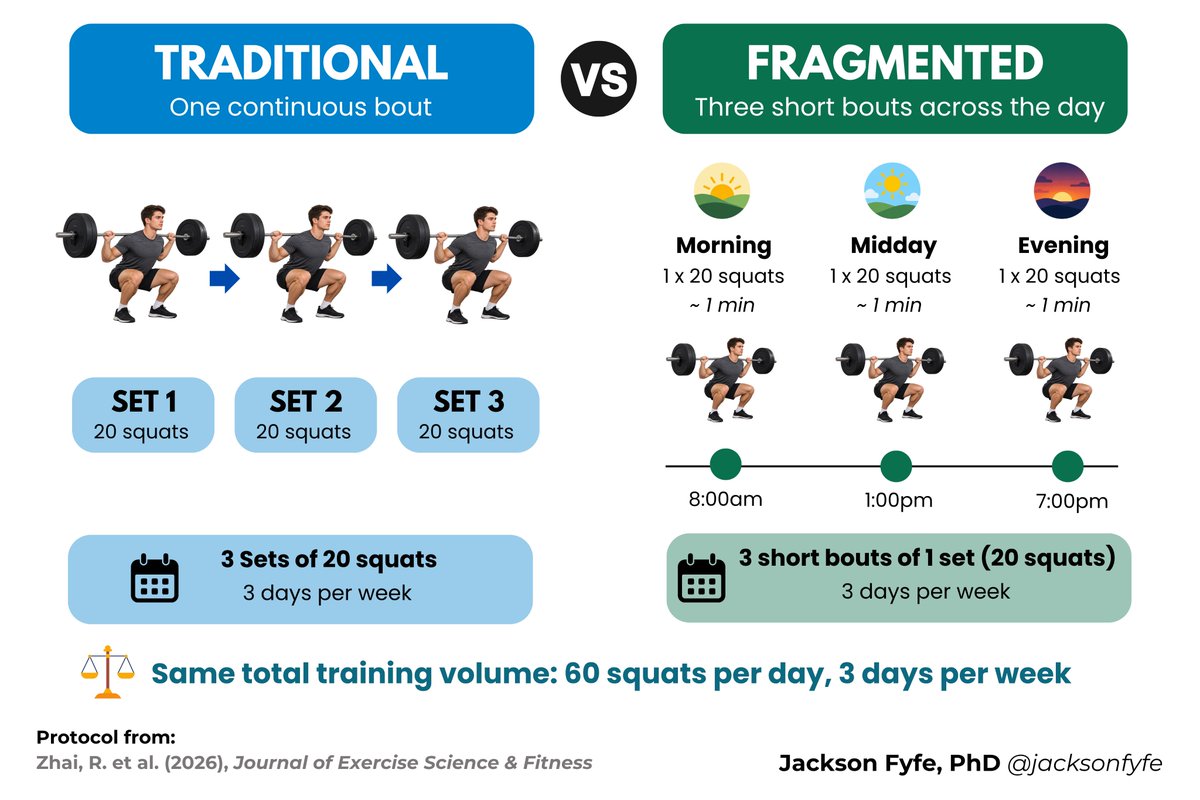
The study involved 45 young men with previous resistance training experience, who performed Smith Machine squats three days per week in a “traditional” or “fragmented” manner:
1⃣ Traditional: one continuous session (3 sets of 20 squats), three times per week
2⃣ Fragmented: three short bouts of 1 set of 20 squats (approx. one minute each), spread throughout the day, three days per week
There was also a control condition that continued their usual exercise habits.
Over eight weeks, both the “traditional” or “fragmented” groups showed greater improvements than the control group in the following outcomes (after adjusting for baseline values):
🏋️♂️ Maximum strength (1-RM squat): +41 kg for traditional, +33 kg for fragmented
⚡️ Isometric squat force: +48 kgf for traditional, +40 kgf for fragmented
🫁 Relative muscular endurance: +10 reps for traditional, +6 reps for fragmented
These changes were greater than the control group, and while the changes were numerically higher in the traditional group, the differences were not statistically significant (which, by the way, does not actually confirm they were equally effective).
As for enjoyment, the fragmented group reported higher enjoyment than the traditional group based on the Physical Activity Enjoyment Scale (PACES).
Together this supports the idea that meaningful strength improvements are possible even when training is spread across several shorter bouts rather than completed in one continuous session.
The big question is whether this “fragmented” approach is actually practical for people. My view is for some it might be, but for others it might not. For example, in this study the gym was located on the ground floor of the participants’ student accomodation, meaning it was probably quite easy for them to drop in and out multiple times per day.
But for me that’s kinda the point - because it shows there are often more ways to achieve a goal (in this case strength) than many people think.
Ultimately, if using a fragmented approach helps more people get started, and do something even when a continuous approach is less feasible - that’s a win.
-----
📊 Data from:
Zhai, R. et al. (2026). Fragmented versus traditional resistance training: A randomized controlled trial on muscular strength, endurance, and enjoyment in recreationally trained young adults. Journal of Exercise Science & Fitness, 24, 200521.
For a (slightly) deeper dive on this topic, check out my latest newsletter:
https://t.co/DggFvNJpny
Sign up (for free) for similar articles in your inbox every week!
As an exercise scientist, you’ll probably be surprised to hear I think we focus too much on the long-term benefits of exercise.
Not because improving your fitness, strength, muscle mass, or reducing your risk of chronic disease isn’t important - but because these benefits alone might not provide enough incentive for people to act on what they already know is good for them.
When you think about it, many of the benefits usually associated with exercise can take months, years, or decades to achieve, and some can be hard to appreciate personally (what does a 20% reduction in the risk of X chronic disease actually mean?).
And when the short-term costs of exercise (time, effort, fatigue) are so immediate and obvious, it’s easy to see why the distant and often abstract benefits struggle to compete.
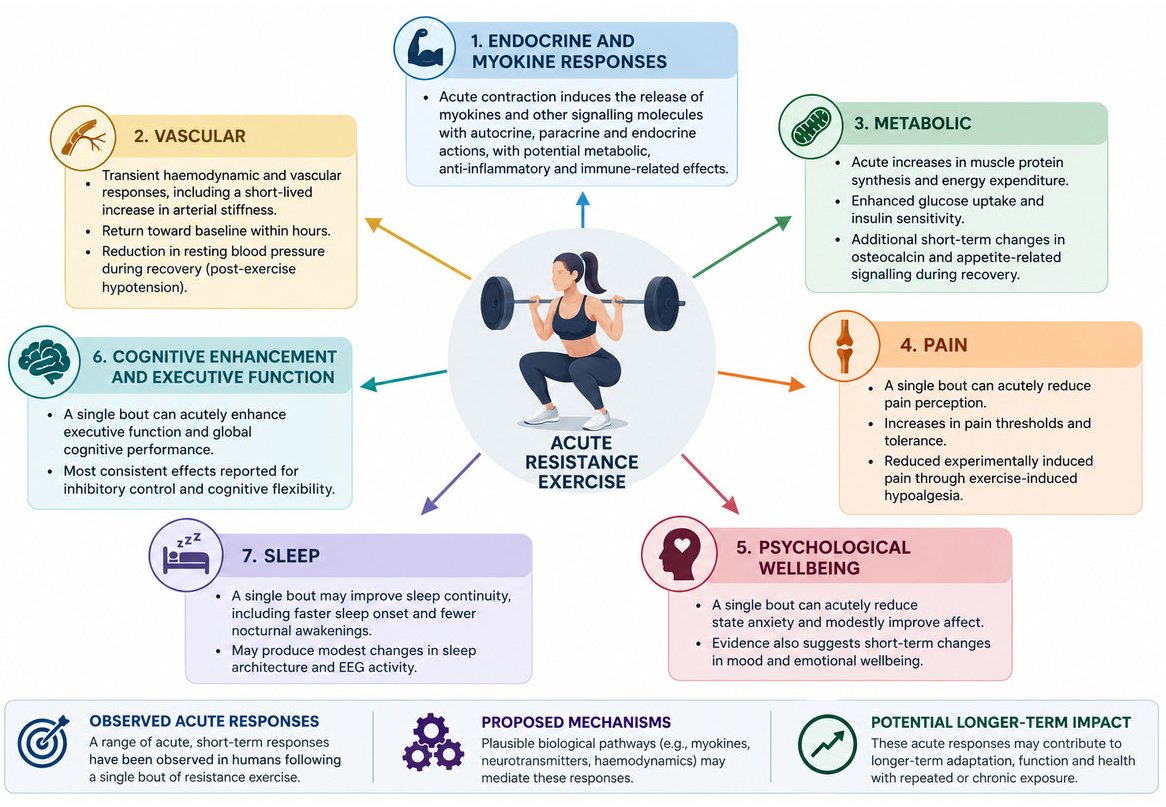
Which is why I think we should pay more attention to what exercise can do for us today - and this great new review by James Fisher PhD helps us do exactly that.
It summarised the many benefits of just a single resistance training session, including:
🙂 Mood and anxiety: Reduced feelings of anxiety, sometimes within minutes of finishing.
🧠 Brain function: Improvements in certain aspects of cognitive performance.
🩸 Blood glucose: Increased glucose uptake by muscles and changes in glucose regulation that can persist into the following day.
🩺 Blood pressure: Temporary reductions in resting blood pressure during recovery.
What’s striking is the sheer range of responses triggered by just a single workout - which is of course well before any large changes in strength or muscle mass may be evident.
Some of these may be more noticeable (like changes in mood) but others occur behind the scences (such as blood pressure or glucose impacts).
But the important thing is they might just provide you with another reason to take action today. And the more reasons you have to value exercise might just keep you coming back for the longer-term benefits anyway.
-----
📸 Insights and image from:
Fisher JP. Beyond the pump: a narrative review of the acute molecular, metabolic, and neuropsychological responses to a bout of resistance exercise. PeerJ. 2026 Oct 16;14:e21827. doi: 10.7717/peerj.21827.
What eating less and exercising more have in common:
The "best" diet probably isn't the one that makes you eat the least, but the one that makes eating less easier.
The "best" training program probably isn't the one that makes you do the most, but the one that makes coming back easier.
@midlifesystems@orssattolucas Yes - I think we can't ignore the fact that muscle matters for reasons beyond movement (e.g., the major site for glucose disposal, plus other endocrine-like effects), but it's certainly not the only factor resposible for movement and physical function.
We tend to have a “muscle-centric” view of the effects of ageing and inactivity on health and physical performance.
But as this great new article by @orssattolucas and colleagues argues, sarcopenia is a disease of the whole motor system, not just our muscles.
Ageing affects the entire system responsible for producing movement - from the brain and spinal cord to motor neurons, peripheral nerves, the neuromuscular junction, and finally - the muscle itself.
This is likely why the loss of muscle mass alone doesn’t always do a great job of accounting for the much larger declines we see muscle function, like strength and power, and physical function with ageing. It's also one reason why modern definitions of sarcopenia place more emphasis on muscle strength and physical function, rather than just muscle mass.
But I think this broader view also helps us understand why resistance training is such a critical intervention here.
Because resistance training already trains the whole motor system.
With every repetition, the brain generates a signal, the spinal cord and motor neurons transmit it, the neuromuscular junction passes it on to the muscle, and the muscle fibres ultimately contract and produce force.
That’s why resistance training is not just about building muscle, but challenging the whole system responsible for creating movement. It’s also why resistance training can produce large (and more rapid) gains in strength, power, and physical function, even without measurable changes in muscle size.
I totally agree with the shift away from a “muscle-centric” view of sarcopenia. But perhaps we should do the same with resistance training too.
@MorrisPelzel Thanks Mo! That's right - we don't often don't know when these roadbumps will come, but staying in shape means we can handle them better when they do. Hope the recovery is going well so far!
Absolutely stoked to complete my first half marathon over the weekend.
After always struggling to prioritise my running, it was great to finally achieve something I’d wanted to do since I last ran a 14 km event over 10 years ago.
But this process also helped me realise something important about training.
On one hand, setting a goal like competing in a physical event is a great way to bring some motivation and purpose to your exercise routine.
But these kind of goals can be tricky too - because once they are achieved, we can quickly lose motivation to continue.
So in a lot of ways, training is for more than race day.
I don’t currently have another event in the calendar, but I’m going to keep training like I do anyway. My goal isn’t to train for another race, but to stay in a position where I could run one if I wanted to.
Because life doesn’t announce it’s biggest physical challenges in advance. You don’t always know when you’ll want to go hiking on a holiday, keep up with your kids or grandkids, or need to recover from surgery or an unexpected illness.
So perhaps the biggest benefit of maintaining good physical fitness is to be better prepared for the unexpected things life can throw your way.
Training for events can be a great way to encourage action. But the real goal is to make exercise a part of just what you do, not just because you are training for an event.
Because we should all train for the “events” in life we can’t see coming, too.
It's about adopting a "life-ready" mindset, instead of a race-ready one.