$𝟭𝗕 𝘁𝗼 $𝟭𝟬𝟬𝗕. 𝗜𝗻 𝟮 𝘆𝗲𝗮𝗿𝘀. That’s the annual pace of payments now flowing through @openfx_.
We started OpenFX with one mission: to bend reality to our will and force into existence infrastructure that moves money like data. Globally, 24x7, in near real time.
For our first 2 years, we did one thing very well: we converted currency A to currency B, and delivered the money to our clients’ own accounts in under an hour, any time, any day, weekends included. Most cross-border payments still take 2 to 3 days to settle and only move during weekday banking hours. In the corridors where we operate, cross-border money now moves continuously, at a small fraction of what it used to cost before OpenFX entered the region.
This quarter OpenFX took one giant step forward.
We noticed something about how customers used us. Many would start their day with OpenFX, end it with OpenFX, and then move their funds back to a local bank overnight, only to send them back the next morning. The money wanted to stay. It simply had nowhere to live.
So in October we launched 𝗚𝗹𝗼𝗯𝗮𝗹 𝗔𝗰𝗰𝗼𝘂𝗻𝘁𝘀 and 𝗦𝗲𝗻𝗱. Customers can now collect and hold funds with us, not only convert them, and pay anyone, anywhere we operate.
We built both the way we build everything: compliance-first, programmatic, and automated end to end. Building our entire architecture this way, agentic and automated, let us operate far below the cost of age-old incumbents and pass the savings on to our customers, as we have with FX since day one.
Lower prices haven’t cost us revenue. Over the past year, 𝗢𝗽𝗲𝗻𝗙𝗫 𝗿𝗲𝘃𝗲𝗻𝘂𝗲 𝗴𝗿𝗲𝘄 𝗳𝗮𝘀𝘁𝗲𝗿 𝘁𝗵𝗮𝗻 𝘃𝗼𝗹𝘂𝗺𝗲.
None of this would be possible without two years spent securing licenses in the US, EU, UK, Canada, and UAE. Licenses take years and can’t be accelerated with money.
I think it is useful to see this as a sequence. A company that only moves money earns per transaction. A company that also holds money, operates the network it settles on, and eventually extends credit against what it sees is a different kind of institution. Infrastructure like this tends to consolidate, and we expect cross-border settlement to be served by one or two companies at scale. We would like to be one of them. October was when the second layer became real. We’ll share more about the third soon.
Most of the hard problems are still ahead: pricing liquidity in markets where there is very little, building a ledger that never closes, and working with a dozen regulators in parallel. We are nearly 200 people across Miami, New York, London, Amsterdam, Dubai and Bangalore, and we are hiring across all of it.
Money still moves roughly the way it did in 1975, which seems unlikely to remain true for much longer. Infrastructure like this gets rebuilt about once a generation, and every hour of work at OpenFX makes some dollar, somewhere, arrive sooner.
If you want that to be true of your work, come build it with us. We are hiring.
Pumped to announce the launch of @openfx_ Ventures.
Having followed the venture world closely for years, being part of this next chapter feels incredibly rewarding.
I speak with founders from across the globe every week and see firsthand the ambition (and the very real challenges) that come with building across borders. I’m excited that we can now support these teams in a new way, combining capital with the infrastructure, market access, and operating experience we’ve built at OpenFX.
Looking forward to meeting even more exceptional founders and seeing what they build. Link in comments:
@wyatt_khos My intro to financial markets was learning what a dividend was before I could even buy my first stock. That led me down the rabbit hole of compound interest and from there I was hooked. gambling/prediction markets are the antithesis of long-term, "smart" investing (I'm unc)
What does the future of cross-border money movement look like?
Our founder and CEO @prabhakar2reddy joined @atomico's @NiklasZENNSTORM to discuss instant settlement, the $200T embedded FX opportunity, and why AI agents could become the biggest users of cross-border payments. Worth a listen👇
@openfx_ is expanding 🌎. My team is hiring an Account Executive to help drive the next phase of North American growth.
OpenFX is building infrastructure that enables money to move as freely as data, without being constrained by time zones, banking hours, or legacy systems. We’re growing quickly, scaling to $80b in annualized TPV as of June '26. In March, we announced a $94m Series A backed by Accel, Atomico, Faction VC, Pantera Capital and others.
This is a high-impact role for someone who wants to help define the go-to-market motion, not simply inherit a playbook.
You’ll own the full sales cycle with banks, fintechs, and other institutions across North America - from identifying and developing opportunities to navigating complex stakeholder groups and closing strategic deals. You’ll also work closely with our Product, Engineering, Legal, Compliance, and Marketing teams to bring customer feedback into the heart of what we build.
We’d especially like to meet people who have:
• 5+ years of full-cycle, quota-carrying sales experience in fintech or payments
• A strong record of meeting or exceeding revenue targets
• Experience managing complex, multi-stakeholder sales cycles
• The energy and judgment to thrive in a fast-moving, early-stage environment
The role is based in Miami and offers the opportunity to help shape both a company and the next generation of global financial infrastructure.
Interested or know someone exceptional? Apply here: https://t.co/FTh0fUWKXj
Banking shouldn’t be a single point of failure for fintechs.
Very proud of what the OpenFX team is building and excited to welcome Tyler McIntyre as we open the waitlist for multi-currency accounts. This is a meaningful step toward giving cross-border companies more resilient financial infrastructure.
The first 100 companies receive $30,000 in fee credits toward migration costs.
Join the waitlist: https://t.co/0bJpEdHKFN
Two big announcements.
The first is that we have acquired the neobank Global Ledger, and as a part of that deal are bringing on its founder Tyler McIntyre as Head of Banking. Tyler has over a decade of experience in the industry and in that time founded both Global Ledger and the small business bank Novo. He is going to bring his knowledge and talent to help us design new products to rethink how payment providers hold currency.
The second is that as Tyler’s first act, we are opening a waitlist for our multi-currency accounts product.
This will allow you to hold what you were paid in and pay out from that same place, converting whenever it suits your treasuries needs.
You no longer have to park pre-funded balances across multiple providers, waiting to be drawn down against payouts. Your money also stops converting twice, reducing fees and delays.
This product is another step towards our mission of Embedded FX, providing fintechs with reliable, API-driven, end-to-end transactions. These accounts sit alongside our world-class liquidity product, so your funds are there where the trade is already happening.
We're starting with named USD accounts on ACH, Fedwire and SWIFT, paying into and out of more than 100 countries, and plan on adding currencies from there.
The first 100 companies to join receive $30,000 in fee credits.
Sign up for our waitlist today: https://t.co/eBOfnhhLyS
2026 headline: "stablecoins are solving cross-border payments". 2026 reality: they're still ~1% of global flows.
What's actually moving is corridor by corridor. UPI abroad in India, USDC in US-Mexico remittances, B2B settlement in the Gulf-to-Southeast Asia lane. No single rail wins. The winners are the ones who build for each corridor's specific mess.
The UAE dirham has been pinned to the US dollar at exactly 3.6725 since 1997. The rate is not allowed to move. So can someone explain why this $100 payment lost a dollar to "currency conversion"?
A US customer paid $100 for a Dubai SaaS subscription. The merchant received $95.00 (AED 348.9). That $5.00 didn't disappear, it was split across 7 intermediaries you've never heard of.
Most people think a card payment is one transaction. It's not. It's a relay race between 9 parties, running on two parallel networks, each taking a different cut on a different timeline.
I traced a single $100 payment from the US to the UAE, end to end. Here's what I found.
𝗧𝗵𝗲 𝟮 𝗻𝗲𝘁𝘄𝗼𝗿𝗸𝘀 𝗿𝘂𝗻𝗻𝗶𝗻𝗴 𝘀𝗶𝗱𝗲 𝗯𝘆 𝘀𝗶𝗱𝗲:
→ The info layer: ~2 seconds. Authorisation messages bouncing between the US issuer, Visa, the UAE acquirer and the processor. This is the part that flashes "Order paid ✓" on the merchant's screen.
→ The money layer: 1 to 3 days. The actual settlement, with the USD→AED conversion buried in the middle.
Your checkout feels instant. The money is still in flight, and that quiet conversion step in the middle is where the margin hides.
𝗪𝗵𝗲𝗿𝗲 𝘁𝗵𝗲 $𝟱.𝟬𝟬 𝗮𝗰𝘁𝘂𝗮𝗹𝗹𝘆 𝘄𝗲𝗻𝘁:
1️⃣ You: $100 leaves your account
2️⃣ US issuing bank (Chase / Bank of America): authorises, takes interchange −$1.30
3️⃣ Card network (Visa / Mastercard): −$1.10 scheme + cross-border fee
4️⃣ FX / currency conversion: −$1.00, a ~1% markup (Stripe +1%, up to ~1.8% at Adyen) on a rate fixed at 3.6725
5️⃣ Processor / gateway (Network International / Checkout): −$1.00 gateway + fixed fee
6️⃣ VAT (Govt of UAE · FTA): −$0.15, 5% on the processing fee (vs 18% GST in India)
7️⃣ Acquiring bank (Mashreq / Emirates NBD / FAB): −$0.45 acquirer margin
8️⃣ CBUAE: no fee, no capital controls, the money settles in 1–3 days with no lock
9️⃣ UAE SaaS merchant: receives AED 348.9 (~$95.00)
𝗧𝗵𝗲 𝗳𝗲𝗲 𝘁𝗵𝗮𝘁 𝘀𝗵𝗼𝘂𝗹𝗱𝗻'𝘁 𝗲𝘅𝗶𝘀𝘁:
In India, the biggest cut was a ~2.3% FX spread, and you could almost justify it: the rupee floats, so someone is carrying real currency risk.
The dirham doesn't float. It's hard-pegged. The interbank rate literally cannot move outside 3.6720–3.6730. There is no FX risk to price.
And yet the "currency conversion" line is still there: ~1% at Stripe, up to ~1.8% at Adyen, 2.5–4% at PayPal. On a pegged currency, that isn't risk. It's margin with a story attached.
𝗪𝗵𝗮𝘁'𝘀 𝗶𝗻𝘃𝗶𝘀𝗶𝗯𝗹𝗲 𝗯𝘆 𝗱𝗲𝘀𝗶𝗴𝗻:
The customer sees 1 actor (their bank). The merchant sees 2 (their gateway and their bank). The other 6 are invisible.
The next generation of payment infrastructure isn't trying to add a 10th intermediary. It's trying to delete 5 of them.
PS: I'm the founder of @Subyhq. If you're moving money in or out of the Gulf, that's exactly what we're building.
Just published my reflections from Consensus 2026.
One theme stood out above all others: we’re witnessing a convergence of stablecoins, payments infrastructure, AI, and global liquidity that feels less like an incremental evolution and more like a platform shift.
I shared a few observations on where cross-border FX is headed and why the next decade of financial infrastructure may look very different from the last.
Read here: https://t.co/gAZKEb5krF[…]26:_a_cambrian_moment_in_cross_border_fx&utm_term=jack_vaughn
“The blockchain solved cross-border payments, and anyone still struggling just hasn’t adopted them yet.”
This is basically nonsense. A common sentiment, and not entirely unjustifiable, but basically nonsense.
Sit in any payments company pitch in 2026 and you'll hear "instant blockchain settlement" within the first five minutes. People nod along because it’s partially true. We all pretend that moving stablecoins between wallets was the thing that needed solving.
But we all know there is more to it than that.
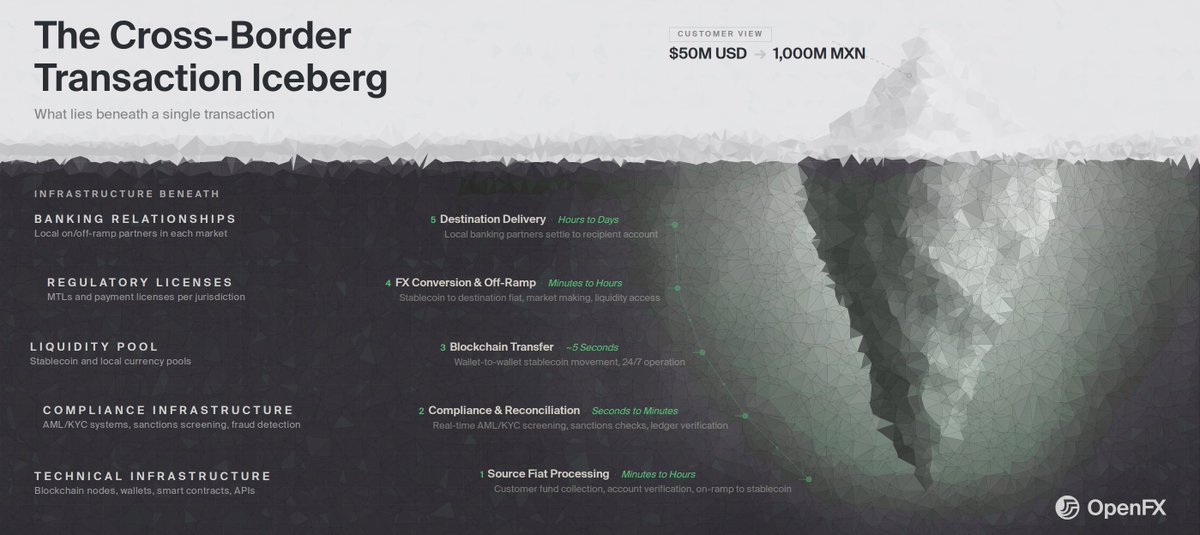
If you've ever actually tried to get $50 million through an exotic corridor on a Saturday night, you know the blockchain transfer is the least of your worries. Maybe 1% of the problem.
Here's what everyone knows but rarely talks about in the marketing copy:
Before that five-second transfer can happen, you need to clear that $50M through domestic banking rails. Run compliance screening. Handle the edge cases that trigger manual review. Get the money on-chain in the first place.
After that five-second transfer, you need liquidity in the target currency. Not thin liquidity that slips when you execute at size, but actual depth. That makes banking partners willing to take your calls after getting home from their kid’s soccer game.
Then you need to navigate local payment rails that work differently in every jurisdiction. Then you need to land the funds in a bank account that's willing to receive them.
The blockchain transfer sits in the middle of all of this – fast, commoditized and largely irrelevant.
Exotic corridors don't fail on-chain. They fail at the off-ramp. They fail because not many people have those kinds of banking relationships. They fail because liquidity doesn't exist at the depth you need between BRL and AED. They fail because for a long time everyone was worried about moving G3 dollars a micro-second faster, and almost no one focused on building rails the rest of the world could use.
Here at OpenFX we say that we want to "move money like data.”
But what does that mean?
That means caring about every part of the transaction – the iceberg, above and below the surface.
It also means caring more about emerging markets and exotic corridors, where these problems are even more acutely felt.
Blockchain as a selling proposition is over. Wallet-to-wallet transfers are fully commoditized.That part of the game has been won, what matters now is whether the money wallets move actually lands in the account your supplier can access, in the currency they need, on the timeline you promised.
That's an operations problem. An infrastructure problem. A relationships problem.
The kind of hard problem we were built to solve.
holy fuck, a hair dryer at a Paris airport broke Polymarket weather markets & made someone $34,000 richer
- polymarket was settling Paris temperature bets on a single Météo France sensor sitting near the Charles de Gaulle runway perimeter - basically unguarded
- the guy bought the long-shot outcome (like "22°C" when everyone expected 18°C) for pennies, since nobody thought it'd hit
- then he walked up to the probe and briefly heated the air around it with a portable heat source, spiking the reading just long enough to register as the daily max
- temperature snapped back to normal in minutes, the market resolved in his favor, and he cashed out - twice, on April 6 and April 15, before Météo France caught on and filed charges
hyperstitions.
Every FX provider advertises "tight spreads" and "deep liquidity" on a sunny day. But what happens when market volatility hits?
Everything breaks down:
Trades are rejected, spreads widen, and settlement times become completely unreliable. Worse of all, these failures are entirely opaque.
Planning around a system so prone to breaking down means spending enormous amounts of time and resources developing complex hedging strategies and operational processes instead of scaling your business.
This is the true cost of low-quality liquidity, the operational drag required to babysit fragile legacy infrastructure.
At @openfx_ , we've built our liquidity infrastructure with market volatility in mind. We focus on liquidity depth that can withstand macroeconomic shocks and transparency, so you always know where your money is.
OpenFX's investors realize how big a problem this is to tackle => @Accel / @PanteraCapital / @M13Company / @FactionVC / @northzoneVC / @atomico / @hash3xyz / @NFX
If you want to learn more about how we differentiate "real liquidity" from everything else, read our recent post.
https://t.co/U96sjPgOke
$4T stuck in legacy rails isn’t just inefficiency, it’s a tax on global growth.
@prabhakar2reddy highlights something that I think a lot of people overlook - the window is collapsing quickly:
1. FX spreads compressing by 80+% → entire business models break
2. Settlements quickly moving to <60 min, 24/7 → “waiting for money” becomes obsolete
3. Agentic payments arriving in ~24–36 months → software will expect instant liquidity by default
@openfx_ is preparing for this future and, if that last point lands, this won't just be a fintech disruption, it’ll be an infrastructure upgrade for the AI-native economy.
Worth the listen 👇
$4 trillion is stuck in legacy payment rails. Cross-border FX is still broken. OpenFX is fixing it.
@prabhakar2reddy CEO of @openfx_ joins our Stateful podcast, hosted by @masonnystrom.
In this episode, they discuss the future of money movement:
- Zero to $40B+ annualized TPV in 18 months, 99.99% automated, 3 people on trade ops
- Stablecoins replace SWIFT: cross-border settlement in under 60 minutes, 24/7
- FX spreads compressed by 90-95% in every market OpenFX enters
- Agentic payments timeline just collapsed from 7-10 years to 24-36 months
- Spot FX could grow from $2 trillion to $200 trillion a day as the pipes widen
00:59 Why Cross-Border FX Is Still Broken in 2025
03:35 GBP to MXN in Minutes: How Open FX Works
07:14 $4 Trillion Stuck in Transit Right Now
07:44 Zero to $40B TPV in 18 Months
09:07 The 3 Factors Behind Open FX's Explosion
12:08 Payments Is Going Through a Complete Upheaval
14:55 AI Agents Won't Wait 3 Days for Money to Move
16:42 Open FX Is Building the AWS of Money
17:10 Do Fintech Moats Still Exist?
18:40 Moving $100B in Crypto vs. 5 Days for Wires
19:40 Why Crypto Companies Die Without Compliance
20:14 Culture Is Just the Founder's Personality Scaled
22:08 The World Order Is Changing
23:22 Agent Payments: From 10 Years Away to 24 Months
24:35 Where a Payments Insider Would Bet Today
25:47 Why There's No Universal Founder Advice
I've spent my career watching fintech promise to fix cross-border payments - and then optimize around the same broken infrastructure instead of replacing it.
What we're building at OpenFX is different. The North American market alone moves trillions across borders every year, and the friction is still embarrassingly high.
The "global HQ" model isn't just a philosophy, it's the only architecture that can actually solve a distributed problem. Proud to be leading that charge from this side of the Atlantic. 🌎
In the 1990s, construction workers in Dubai stood in long lines to pay a 7% fee just to send their paychecks home.
In 2022, after a tech revolution that put supercomputers in our pockets, those exact same lines were still there.
Why?
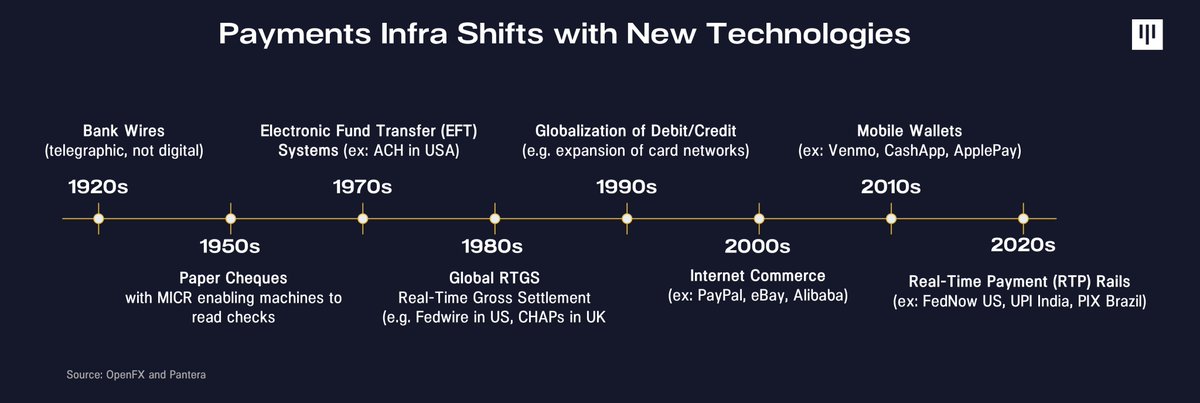
Every decade the global payments system gets upgraded by new technologies.
Companies like @openfx_ are leveraging blockchains and stablecoins to power the next shift in global payments infrastructure.
We came out of stealth nine months ago at $8B in volume. As of February we crossed $45B. Revenue is up 10x.
This week we raised a $94M Series A.
@Accel, @atomico, @FactionVC, @northzoneVC, @M13Company, @PanteraCapital, some of the biggest names on both sides of finance chose to back us.
You might be wondering why.