Cross-border payments still run on infrastructure built decades ago. Settlements take days, costs remain high, and businesses are forced to pre-fund accounts across countries, leaving $4 trillion in working capital sitting idle globally.
OpenFX (@openfx_) is addressing this by using stablecoins as a settlement layer to enable near-instant FX conversion across any currency pair, 24x7, eliminating the need for traditional intermediary banking networks.
Read this blog by Manasi Shah and Shekhar Kirani (@skirani) on why we continue our partnership with OpenFX, and our conviction in rebuilding the rails global business runs on.
@prabhakar2reddy • #AccelFamily
It’s fitting to announce our acquisition as the industry comes together in Amsterdam for @money2020 Europe.
@openfx_ acquires Embed, an Amsterdam-based payments infrastructure company. It’s our first acquisition, a major step in our European expansion, and a clear statement about how we think financial infrastructure should be built.
Many companies claim to operate across Europe. In practice, many are reselling someone else’s license, relying on a partner’s BIN, or sitting one step removed from the regulated rails their customers depend on.
That can work for a while. But when a corridor breaks, a partner changes terms, or a customer needs certainty, the difference between renting access and owning the regulated layer becomes very real.
With Embed, OpenFX is moving deeper into that regulated layer.
Embed holds two licenses that matter: a Dutch PI regulated by DNB and a UK EMI regulated by the FCA. The transaction is subject to regulatory approval, but once complete, OpenFX will have regulated entities in two of Europe’s most important financial jurisdictions.
For our customers, that means more control, more resilience, and a stronger foundation for moving money across markets.
We’re also building the team locally. We now have offices in London and Amsterdam, with 20 people across Product, Engineering, Compliance, and Go-To-Market.
With backing from European investors, including @northzoneVC and @atomico, and $60B in annualized TPV across the network, Europe has become our largest commitment outside the United States.
We’re here to build locally, own the infrastructure that matters, and make global money movement more reliable from the ground up.
https://t.co/CPzbbPnuu0
Stablecoins solved a real problem. They shortcut the correspondent banking network, side-stepping days of unnecessary delays.
That's genuine progress. For the first time in half a century, the needle moved on cross-border settlement speed.
So why can it still take days to complete a transaction?
Because a transaction that looks smooth on the surface hides the dozens of processes required to actually move money from one place to another, and the wallet-to-wallet transfer is only a tiny part. Everything else requires skill to manage.
How well a provider navigates these challenges can mean the difference between a transaction that clears in 60 minutes and one that takes a day.
Cross-border payments are an iceberg.
In this article, we show you how deep it goes => https://t.co/Jo9GGwxVjd
Join us to kick off Consensus in Miami on May 5 with @M13, @WithAlfred, and @yellowcard_app.
7:30 PM panel on stablecoins and cross-border:
Prabhakar Reddy (OpenFX), Latif Peracha (M13), Diego Yanez (Alfred), John Colson (Yellowcard).
RSVP =>https://t.co/T5zTWasZJa
It’s all about reframing….
Stablecoin desirable and crypto dirty….
In the end everyone just wants a payment experience that feels like the speed of cash in person, anytime time of day, with no middle man taking fees.
Seems simple enough.
SF / @Stripe Sessions takeaways 🌉
Crypto x Fintech:
- fintech is taking over crypto - they’re raising money without telling investors they’re actually using crypto underneath, crypto founders take note
- corporates are extremely interested in stablecoins, not crypto
- enterprises guarantee if something doesn’t work they’ll make a customer whole, crypto teams don’t do this enough, which important in the agent era when there’s a lot of risk
- imo there’s room for a decentralised network that uses all agent payment standards and is open - @Tempo will be huge for enterprises and massive for blockchain adoption, TBD on timeline for a 3rd party developer ecosystem there
- still think some of the best apps in the world going forward will uniquely use crypto rails in a way competitors (like pure AI) don’t to differentiate and provide better UX / value to users
AI
- AI infrastructure is everywhere, if people think crypto pitches are saturated, try AI
- lots of talk about what AI agents will do but unclear exactly what they’ll be doing in outstanding use-cases
- somewhat consensus in SF that blockchain can improve trust of AI, yet very little founders have answers as to how to make it happen
- becoming more consensus that hardware is a great way to build strong moats in the age of AI
- accessing prop data is a huge moat for AI startups, there’s likely industries that are sitting on very interesting datasets in niche markets that will be high growth in the future, which AI startups can target - interesting investment opportunity
Startups & Fundraising:
- very few founders have good responses for why frontier models won’t eat their startup in the next 6-12 months
- the best startups glue incredibly complex workflows together, which require special kinds of permissions to do so and would be hard for competitors to replicate
- surprising amount of trad VCs have dedicated crypto teams
- talent in SF is best I’ve ever seen, barely had 1 bad pitch across crypto or AI
—
overall I’m very bullish SF and the intersection of crypto, FinTech and AI.
The vibes are high in SF. People are curious in how technologies will intersect and care about distribution / moats. Could see some generational winners here being built at the intersection if not already, then in the future.
Now headed to Consensus Miami! DMs open for builders keen to meet there 🌴
The longer I study cross-border payments in emerging markets, the more I believe that "settlement speed" is an effect, downstream of what really matters: liquidity.
Liquidity and its availability determine how fast the transaction settles, what price it settles at, and how reliably you can scale that transaction across the corridor.
In a G7 corridor like EUR/USD, liquidity is self-reinforcing. High volume attracts market makers and tightens spreads, tighter spreads attract more volume.
In exotic corridors, the cycle inverts. Lower volumes mean wider spreads and fewer people willing to make markets. Everything gets worse because the situation is already bad.
Traditional banking institutions do this math and retreat.
This clarified something for me.
Technology alone won't solve liquidity in emerging markets, nor will traditional institutions. You can build "faster rails," but if the economics of providing liquidity don't work, the liquidity won't materialize.
These corridors need infrastructure designed around different economics — where the cost of providing liquidity makes sense, not just in New York and London, but in Lagos and Manila and São Paulo.
More on what that looks like:
https://t.co/sLI2ZsChQR
Fintech 2.0 (crypto-native) start-ups are for sure using remittances as the wedge for customer acquisition as legacy margins are prime for disruption.
We are seeing our clients like @get_aspora quickly launch remittance products on our FX liquidity with a hyper segmented go to market strategy to ramp quickly in targeted markets like INR remittances.
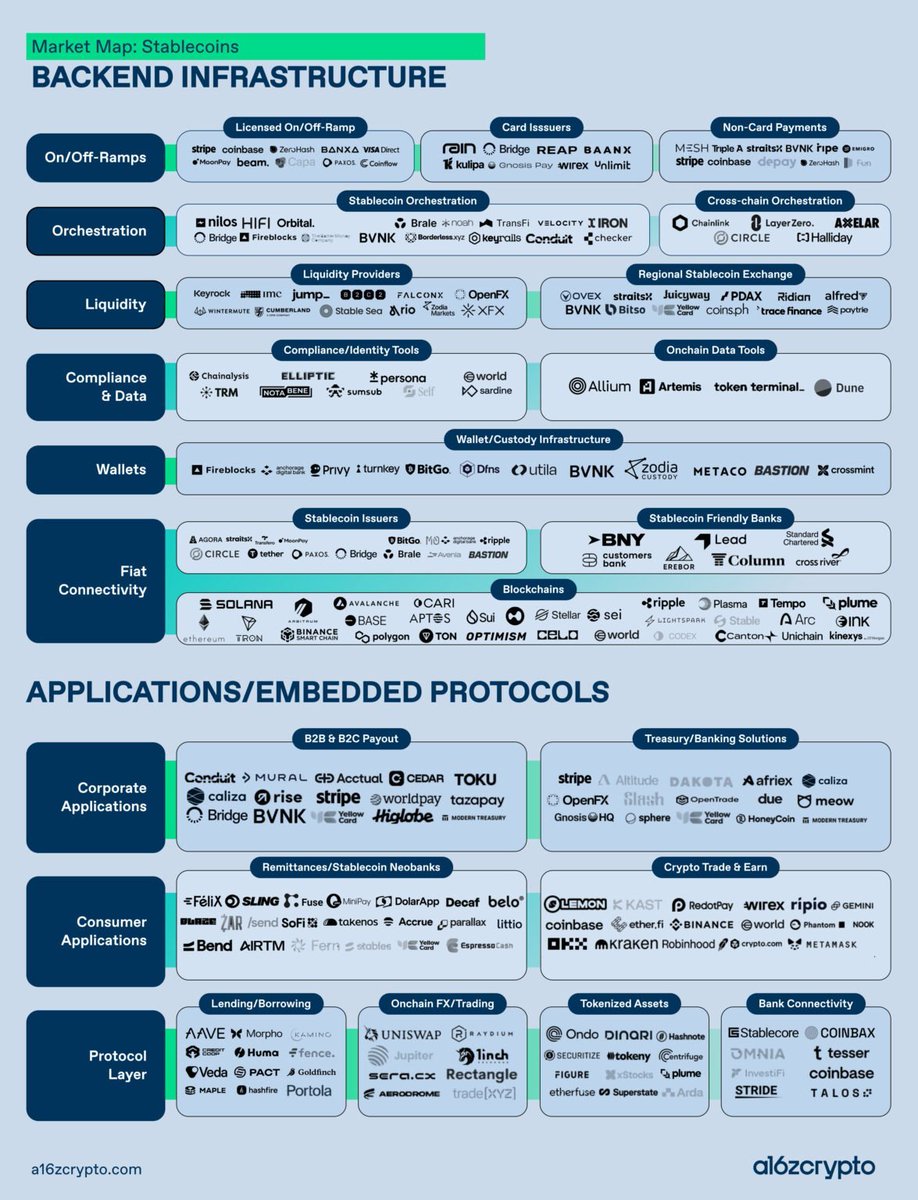
@a16zcrypto recognized @openfx_ as a critical component of the cross border money movement infra stack.
Our focus on emerging markets and exotic corridors with liquidity to power settlements in minutes not days will be crucial for the transformation of x-border payments.
Our Founder @prabhakar2reddy had the opportunity to sit down with Atomico to discuss his entrepreneurial journey.
In this clip, he describes how he decides which ideas to pursue, and the personal story that led him to start OpenFX.
Some of the key take-aways:
- Have a clear vision of the future, of what is possible.
- Double down in those domains where this future meets your unique abilities.
- Invest in others who can carry the torch in those areas outside of your expertise.
This is a part of a much longer interview that you can see if you visit @atomico's page.
The most misleading phrase in global finance: “instant settlement.”
In most corridors, money doesn’t simply jump from the vendor to the recipient, arriving in their hands instantly after the transfer is initiated. It passes through sometimes dozens of hands, where it is screened, run through a compliance gauntlet, and converted between one or more intermediary currencies.
At every step, fees and the risk of slippage mount. @openfx_ understands this problem deeply at each phase of the payment process and has started with FX conversion to improve.
I wrote a quick, practical explainer with numbers and a mental model you can reuse to understand this process.
#MoneyManagement #CrossChain #remittance
https://t.co/afzTzrEbaA
FX Liquidity is the oil of the cross-border payments engine.
Without liquidity, payments seize up, just like an engine, as prices spike with massive slippage and orders fail to fill.
Crypto native, naturally, understands this pain after probably being part of a shit-coin project that mooned and crashed, and you went from being a millionaire to losing it all.
How does the rest of the world relate without understanding the difference between high and low quality liquidity?
My thoughts on it here => https://t.co/U96sjPgOke
Every FX provider advertises "tight spreads" and "deep liquidity" on a sunny day. But what happens when market volatility hits?
Everything breaks down:
Trades are rejected, spreads widen, and settlement times become completely unreliable. Worse of all, these failures are entirely opaque.
Planning around a system so prone to breaking down means spending enormous amounts of time and resources developing complex hedging strategies and operational processes instead of scaling your business.
This is the true cost of low-quality liquidity, the operational drag required to babysit fragile legacy infrastructure.
At @openfx_ , we've built our liquidity infrastructure with market volatility in mind. We focus on liquidity depth that can withstand macroeconomic shocks and transparency, so you always know where your money is.
OpenFX's investors realize how big a problem this is to tackle => @Accel / @PanteraCapital / @M13Company / @FactionVC / @northzoneVC / @atomico / @hash3xyz / @NFX
If you want to learn more about how we differentiate "real liquidity" from everything else, read our recent post.
https://t.co/U96sjPgOke
@openfx_ is lucky to have investors like @latifperacha who truly understands the opportunity to fix cross border money movement in emerging markets and exotic corridors.
Pleased to formally announce our investment in @openfx_ , which has raised $94M in its Series A.
OpenFX is rebuilding the financial infrastructure for global money movement with stablecoin-powered rails that settle nearly instantly. The business is already processing nearly $50B in transaction volume and just scratching the surface. We're very proud to @prabhakar2reddy + the very talented team. Much more to come…