Got a letter from the IRS in the mail? Don't panic.
Most IRS notices are not audits. They're (often automatically generated) paperwork.
Here's what to actually do, from an IRS Enrolled Agent: 🧵
A Fed governor said a half-point December hike should be considered if core CPI stayed at 0.3%. That's the number we got.
Quarter-point or half — which way are you leaning?
Not advice.
Side hustle or 1099 income this year? Start a simple folder now: invoices, mileage, home-office notes, estimated payments. April is easier when January isn't a scavenger hunt.
October CPI rose 0.4%, more than expected, and traders are leaning toward a December Fed hike, per Yahoo Finance.
If they hike, are you watching rates, your portfolio, or nothing yet?
Not advice.
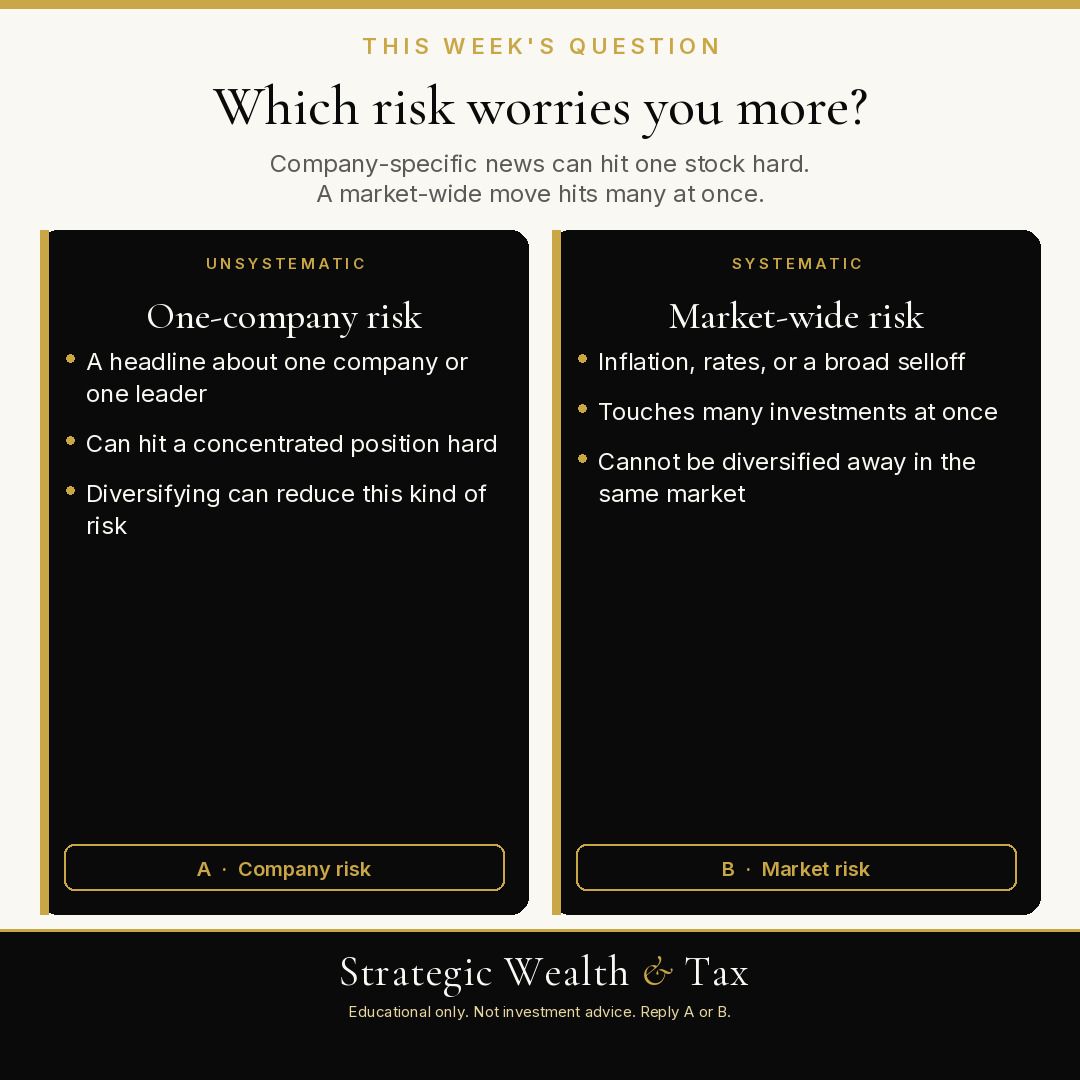
Nvidia fell more than 4% Mon. and about 5.5% Tue. after a board review tied to its CEO, per CNBC. The S&P 500 was down about 0.4%.
Company risk or market risk — which is louder for you?
Not advice.
2027 HSA limits (IRS Rev. Proc. 2026-24): $4,500 self-only / $9,000 family. If you're 55+, you may also add the catch-up. Open enrollment is the time to set next year's contribution.
Annuities aren't 'good' or 'bad.' They're tools. Ask what problem you're solving: lifetime income, growth with limits, or legacy. If the pitch skips fees, surrender periods, and alternatives, keep asking.
Before you increase investing, check three basics: emergency cash for a job loss, high-interest debt under control, and any full employer 401(k) match. Get the order right and the rest compounds from a stronger base.
Health FSA still have a balance? Many plans are use-it-or-lose-it unless yours offers a grace period or carryover. Check your plan rules and planned expenses before year-end so you don't forfeit what's left.
Myth: holiday shopping for yourself is a business write-off. Personal gifts and household buys generally aren't deductible. Only the documented business portion of a mixed expense may qualify.
2027 annual gift tax exclusion: $20,000 per recipient (IR-2026-133). Many gifts never create a tax bill, but the giver — not the recipient — generally handles any filing.
Checked against IRS Rev. Proc. 2026-35: the 2027 0% long-term capital gains rate applies up to $51,050 of taxable income (single) or $102,100 (joint). Taxable means after deductions, and the gains themselves count toward that total.
🇺🇸 THE IRS JUST RAISED THE 0% CAPITAL GAINS BRACKET FOR 2027
If your taxable income stays under these limits, you pay 0% federal tax on long-term gains, per CNBC:
Single: $51,050
Married: $102,100
"Long-term" means you held the investment for more than 1 year.
"Taxable income" is your income after deductions. The standard deduction for 2027:
Single: $16,600
Married: $33,200
So a married couple taking the standard deduction can make about $135,300 in total, gains included, and still pay 0% on those gains.
What money decision are you putting off until year-end? Reply with the topic (no personal details) and I'll explain a few of the most common ones in general terms this week.