Honestidad ante todo: El vocalista de Papa Roach participó en un entretenido desafío musical en el que tuvo que escoger entre distintas bandas.
Por el camino quedaron nombres fundamentales del rock, metal alternativo y el nu metal como Metallica, Limp Bizkit, Three Days Grace, LANDMVRKS, Slipknot, Korn y Linkin Park. Pero hubo una elección que se mantuvo firme hasta el final: Deftones.
Y sí, cuando tuvo que elegir entre la banda de Chino Moreno y Papa Roach, tampoco hubo favoritismo por su propia camiseta. Shaddix se quedó con Deftones.
La preferencia tiene historia. El cantante ha contado que durante su adolescencia viajaba desde Vacaville hasta Sacramento para ver a Deftones tocar en clubes. Aquellos conciertos y la escena musical de la época fueron parte importante de sus primeros años como músico.
¿Deftones por encima de Papa Roach? Jacoby ya dio su veredicto. ¿Estás de acuerdo?
📹 @rock_antenne
#paparoach #deftones #quiz #jacobyshaddix
🎤 ¡Bruce Dickinson recuerda a Chris Cornel! ✨
El vocalista de Iron Maiden sorprendió con sus declaraciones durante una entrevista con el canal The Star Tapes, donde incluyó al fallecido líder de Soundgarden entre sus cinco cantantes favoritos. Dickinson destacó su extraordinario rango vocal y, especialmente, su capacidad para combinar la potencia y la furia con una profunda vulnerabilidad emocional, asegurando que ni siquiera Ronnie James Dio podía igualar esa dimensión de su interpretación. 🖤
Además, Bruce recordó su admiración por Soundgarden y confesó que todavía escucha los discos de Cornell, lamentando no haber podido agradecerle personalmente por su música 😞.
💬 ¿Qué te parece? ¿Estás de acuerdo con sus declaraciones? 🧐
🚨#ÚLTIMAHORA | Anthropic afirma que redujo el uso de CPU por solicitud en aproximadamente un 70% y el consumo de memoria en más de un 80% tras migrar su API de Messages de Python a Rust, utilizando a Claude para escribir gran parte del código.
Además, el tiempo medio hasta la generación del primer token disminuyó aproximadamente un 20%, según una publicación del blog de ingeniería de Anthropic.
El servicio permaneció operativo durante toda la migración, sin interrupciones.
Qwen3.8-27B Has Been Compressed from 55.6GB to Just 5.9GB
Qwen3.8-27B has reportedly gone from a 55.6GB checkpoint to just 5.9GB, while retaining 98.2% of its original aggregate benchmark performance.
That’s an 89.4% reduction in checkpoint size.
The compression comes from Bonsai 2, the latest generation of PrismML’s model compression technology.
What’s particularly interesting is the improvement over its predecessor. The original Bonsai 27B reportedly retained approximately 95% of the base model’s benchmark performance. Bonsai 2 raises that figure to 98.2% across 20 benchmarks, while maintaining the same 5.9GB compressed checkpoint size.
In other words, PrismML reports a 3.2 percentage-point improvement in benchmark retention without increasing the compressed model’s storage footprint.
Here are the reported figures:
• Original Qwen3.8-27B: 55.6GB
• Bonsai 2 checkpoint: 5.9GB
• Storage reduction: 89.4%
• Aggregate benchmark retention: 98.2%
• Previous Bonsai generation: Approximately 95% retention
• Evaluation coverage: 20 benchmarks
The technology behind this result is particularly interesting because it takes model compression far beyond conventional low-bit quantisation.
1. Ternary quantisation is at the centre of Bonsai 2
Bonsai 2 uses a technique called ternary quantisation.
Most conventional model checkpoints represent weights using numerical formats such as FP16, BF16, INT8 or INT4.
Ternary quantisation takes a more aggressive approach. Instead of allowing weights to take a large range of numerical values, it represents them using just three possible values:
• -1
• 0
• +1
This dramatically reduces the amount of information required to represent each weight.
The challenge is that model weights are not arbitrary numbers. They encode relationships learned during training, and those relationships contribute to the model’s ability to reason, generate code, understand instructions and solve problems.
Reducing weights to three possible values can introduce substantial information loss if the compression process is not carefully designed.
Bonsai 2 combines ternary representations with scaling factors to preserve more of the information carried by the original weights.
The objective is to remove unnecessary numerical precision while retaining the relationships that make the model useful.
This is what makes the reported result interesting: the compressed checkpoint is dramatically smaller, but the developer claims that most of the original benchmark performance survives.
2. Bonsai 2 improves on the original compression system
The first Bonsai 27B release reportedly retained around 95% of Qwen3.8-27B’s aggregate benchmark performance.
Bonsai 2 raises that to 98.2%.
That’s a 3.2 percentage-point improvement, which is meaningful when the goal is to preserve as much capability as possible under such aggressive compression.
PrismML also highlights improvements in three areas:
• Coding agents
• Multimodal reasoning
• Long-horizon tool use
The coding-agent results deserve particular attention.
An agent working on a real software project has to do more than generate a function from a prompt. It may need to inspect an unfamiliar repository, understand existing code, modify several files, run commands, interpret errors and revise its implementation.
These workflows place repeated demands on reasoning, planning and tool interaction.
A compressed model that can retain strong performance across these tasks could be useful for developers who want to run coding agents locally without having to store or load a much larger checkpoint.
However, aggregate benchmark retention is not enough to establish that extended agent workflows behave almost identically to the original model. Long-running tasks need their own evaluations.
3. What does a 5.9GB model mean for local AI?
This is where the compression becomes particularly practical.
Tool, late '90s, playing ‘Forty Six & 2’ live 🔥 Maynard crouched and snarling, Danny Carey a human octopus, and that Justin Chancellor bassline still hits like nothing else.
30 years on, is Ænima still Tool's best album? For me yes, back on release day to now. You!?
Nirvana 'Aneurysm' with Kim Gordon Rock Hall of Fame 2014
Surviving members plus Sonic Youth legend tear into the classic. Written about Kurt’s romance with Bikini Kill’s Tobi Vail. Unforgettable night.
AI Agents are much more than just LLMs.
A language model can understand and generate text, but an AI agent needs an entire architecture to reason, make decisions, use tools, and execute tasks autonomously.
Here are the 7 core components behind AI Agents.👇
1️⃣ Reasoning & Planning
↳ Break complex tasks into smaller steps.
↳ Analyze situations and decide what to do next.
↳ Plan actions to achieve specific goals.
2️⃣ Memory & Context
↳ Remember previous interactions.
↳ Maintain context across multiple tasks.
↳ Store relevant information for future decisions.
3️⃣ Orchestration
↳ Coordinate multiple agents and workflows.
↳ Manage task execution and decision-making.
↳ Connect different components into one system.
4️⃣ RAG (Retrieval-Augmented Generation)
↳ Retrieve information from external knowledge sources.
↳ Access company documents and databases.
↳ Generate context-aware and relevant responses.
5️⃣ Tools & APIs
↳ Interact with external applications.
↳ Execute code and query databases.
↳ Connect agents with real-world systems.
6️⃣ Guardrails & Evaluations
↳ Prevent unsafe or unwanted actions.
↳ Monitor accuracy and reliability.
↳ Evaluate agent performance and outputs.
7️⃣ Deployment
↳ Run agents in production environments.
↳ Monitor performance and scalability.
↳ Optimize latency, infrastructure, and costs.
The key takeaway:
An LLM provides the intelligence, but the surrounding architecture gives an AI agent the ability to plan, remember, interact, execute, and complete tasks.
The future isn't just about building more powerful AI models.
It's about building reliable, scalable, and autonomous AI systems.
That's the real foundation of Agentic AI.
Repost to help others understand AI Agents.
Follow for more AI & Tech content.
@SaurabhDub28465
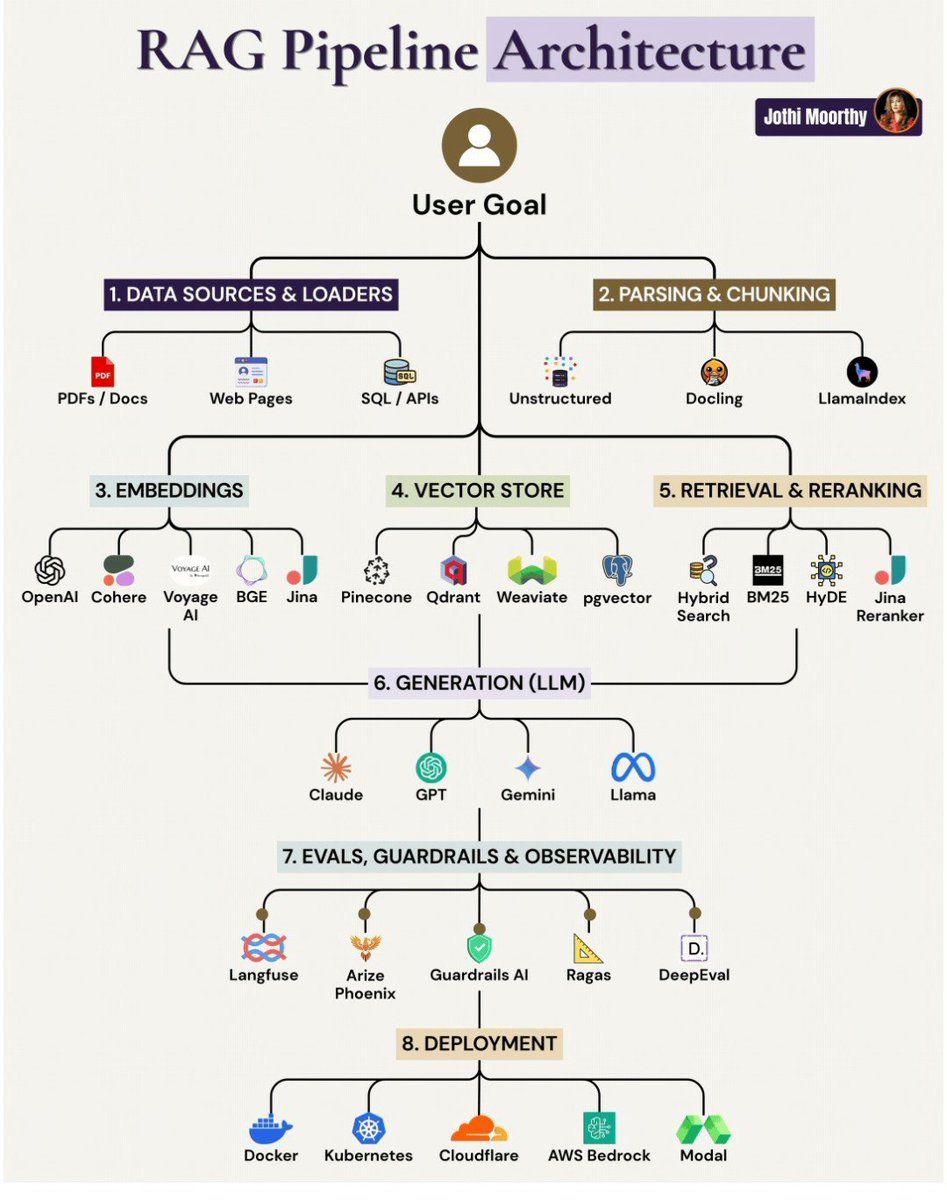
A RAG pipeline is more than an LLM + vector database.
8 essential stages:
1. Data Ingestion
2. Parsing & Chunking
3. Embeddings
4. Vector Stores
5. Retrieval & Reranking
6. LLM Generation
7. Evals & Guardrails
8. Deployment
Every layer matters for building reliable AI systems.
🇻🇪‼️ | LO ÚLTIMO — Delcy Rodríguez ordenó realizar las gestiones necesarias para lograr el desbloqueo total de las plataformas de inteligencia artificial en el país. Según declaró Rodríguez, la medida busca que la juventud venezolana pueda acceder a estas herramientas tecnológicas para impulsar un “desarrollo propio” y fomentar “nuestras propias inventivas”.
#20Nov | 🎮🇻🇪 Venezuela se apoderó de las calles de Vice City en el estreno de GTA 6 y el sello criollo es protagonista inesperado de la conversación global.
📱 Tras 13 años de espera, los jugadores descubrieron que el universo de Rockstar Games suena más venezolano que nunca: personajes secundarios ("sifrinas") recorren la ciudad soltando expresiones, jergas y groserías típicamente venezolanas que ya son virales en redes.
🎶 "Caballo Viejo" de Simón Díaz suena en una de las primeras cinemáticas del juego, "Llorarás" de Óscar D'León forma parte de la emisora Radio La Ola y la caraqueña Arca pudiera estar en el álbum oficial. 💃 Hasta Bad Bunny menciona las "horas locas" de las bodas venezolanas en su estación de radio.
✍ @karemwithanem
🔗 Conozca más detalles en https://t.co/fp6G90EwG9