New in Claude Code: your sessions can now message each other.
Instead of having to re-explain yourself in another session, you can now tell Claude to do it. It sends a summary (not your history or files), and the other session picks it up mid-task.
One of most popular Ai agent /skills package just added a “/wait-what” skill. For when AI is smarter than you and you need it to be dumbed down
Probably nothing
This certainly isn’t a signal of a major tipping point between human cognitive abilities vs machines where we need Ai to dumb it down for our tiny little ape brains
The reason I was able to switch my workflows immediately to deepseek + competitors from codex is because I refused to install some vendor lock in app that you can't switch easily
Only use the CLI
Everything else is meant to chain you, remove your options, enslave you forever
The average person does not try to solve their problems or struggles. They get stuck in a routine and live the same day over and over. It does not cross their minds to snap out of it, engage in strategic thinking, and change direction so they can eventually reach a more advantageous position in life.
If you want to get ahead of 90% of people, all you have to do is pause, think, and actually attempt to overcome the struggle you're faced with.
The US government, citing national security authorities, has issued an export control directive to suspend all access to Fable 5 and Mythos 5 by any foreign national, whether inside or outside the United States, including foreign national Anthropic employees.
The net effect of this order is that we must abruptly disable Fable 5 and Mythos 5 for all our customers to ensure compliance.
Access to all other Claude models is not affected.
We apologize for this disruption to our customers. We believe this is a misunderstanding and are working to restore access as soon as possible.
Read our full statement: https://t.co/bwn0sximKZ
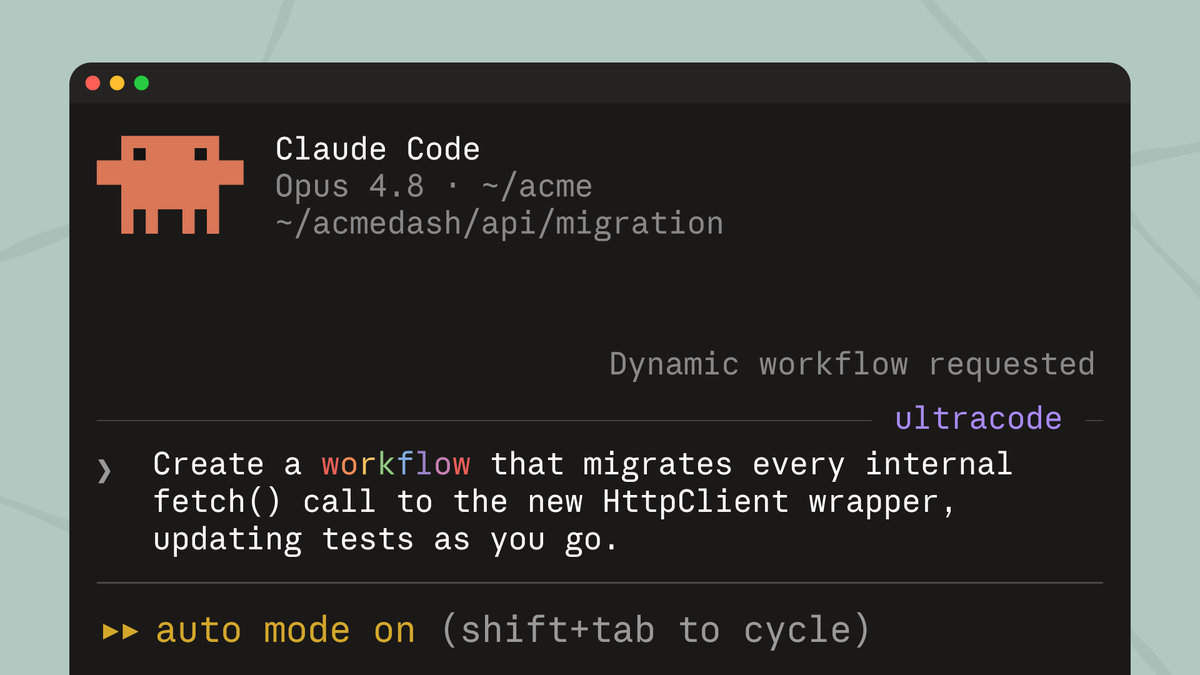
New in Claude Code (research preview): dynamic workflows.
Claude writes an orchestration script on the fly, then spins up a large fleet of coordinated subagents in parallel to take on your most complex tasks.
Use the word "workflow" in a prompt to get started.
Stripe just created a role that didn't exist 12 months ago (and they're paying multiple six figures for it)
It's called the Forward Deployed AI Accelerator.
They are hiring AI-native individuals to work directly with their marketing teams to fundamentally change how they work.
Each person will be assigned to a cohort of 20 marketers. Their job is to build custom AI tools and agents and coach each marketer until they are self-sufficient.
Basically, work with marketers until they automate their jobs.
Stripe's marketing org is betting that AI should not be an occasional tool but the default mode for all work.
But they also understand that most employees won't upskill themselves. They'll need someone who is embedded within their teams to build alongside them.
If you are AI-pilled, this is probably the role for you.
And this also gives a clear picture of where every organization within a company is heading.
Someone is going to build a worldclass “Brain” for enterprises & make a stupid amount of money.
Why? As @da_fant said, “coding w ai is solved bc all context is in the git repo. knowledge work is difficult bc context is spread out. an ai system that creates a git repo w all context for a knowledge worker will be able to 100% automate the work.”
When companies talk about being data ready for AI, this is what they’re implicitly saying.
Engineering has been prepared for this moment for a long time because of the deterministic nature of code, the centralization/versioning of data (read: GitHub), and AI tools that are largely build by engineers for engineers.
But for the rest of white collar work, there’s a TON of catching up to do to properly harness the power of the technology.
The big challenge here, and why no one has truly cracked the code for "an ai system that creates a git repo w all context for a knowledge worker" is because unlike code, most knowledge is 1) distributed, 2) unstructured, and 3) unverifiable.
It's distributed: transcripts live in Granola. Documents in Notion. Customer Data in Hubspot. ERP. Emails. Slack messages. Random spreadsheets. SOP docs. Etc. Etc.
Building an ingestion engine that connects to all of your disparate data sources and auto-updates based on the shelf-life of the data is the first, and frankly, easiest step of the process.
Next, it's unstructured: let's say I want to create a proposal for a potential client. To nail the proposal, I want it to pull important information from a variety of sources. The specific asks & background from our initial sales call. Previous proposals to anchor ourselves to a proven format. And completed sprint boards from Linear, so the pricing & timeline in the document is grounded in truth.
Whether it's a thoughtful filesystem (a la Obsidian) or an OpenClaw-esque memory structure, the brain needs to be great at self-organizing in a thoughtful schema. This is very hard, especially if you want to build a generalizable brain that can be shaped to an array of different enterprises.
And finally, most knowledge is unverifiable: writing a function, running a unit test, and seeing if the code works is easy. It works or it doesn't. Using AI to accelerate your content creation process is highly subjective. What is a good/bad idea? Is the content in your voice or not? Does it feel like slop or novel? Answering these questions are both difficult and non-verifiable.
That same system described above doesn't just have to be great at organizing & forming coherent relationships, but it also has to be great at self-improving based on feedback from the user. Memory systems (like those introduced by OpenClaw) are great to a point, but as you scale the corpus of data within your company's brain, things like compaction and cleaning become wildly important to avoid the needle in the haystack problem.
Someone is going to figure out how to solve this problem, and when they do, not only will they make a shit ton of money, but they'll be robinhood for knowledge workers, enabling non-engineers to enjoy the sort of leverage that only technical folks have felt for the last few years.
Introducing Project Glasswing: an urgent initiative to help secure the world’s most critical software.
It’s powered by our newest frontier model, Claude Mythos Preview, which can find software vulnerabilities better than all but the most skilled humans.
https://t.co/NQ7IfEtYk7
Some of the smartest and most capable people I know either dropped out of college, went to a public university or worked at smaller fast paced companies.
Some of the lowest agency and inefficient people i've ever worked with were ex Fortune 100 company employees.
You know the type:
- They need to plan a meeting about planning a meeting.
- They escalate or delegate problems rather than solving them cause that's just what "corporate" companies do.
- They care more about bureaucratic systems than execution
I'd take the person who's worked at a smaller team that's had to put out fires on the fly, learn new skills for roles or tasks they've never done, and don't let ego get in the way of the mission.
99% of people on X are using OpenClaw wrong...
and i deeply mean it
people are setting up second brains, plugging a ton of MCPs, 13 sub-agents... completely automating their whole lives
but may i remind you of something?
an AI system without human input produces literal slop
they've been selling you the dream of 100% automating content creation, SEO, trading... and now they're selling you the OpenClaw dream
OpenClaw is one of the most impressive tech i've ever laid my hands on
but trust me, if you plan on staying out of the loop, you'll definitely automate your life, your business and anything you want... but the results you'll be getting will be terrible
just like running SEO on autopilot isn't viable for more than 3 months, just like automating content creation on X will only result in reposting other people's takes with zero originality...
you need to stay in control, you need to use your brain to provide a valuable input and taste
OpenClaw is an amplifier... not a replacement for your thinking
the people getting real results aren't removing themselves from the process, they're using it to move 10x faster on ideas they actually came up with
Something that I think goes under-emphasized is how much AI coding demands a 'lead dev' mentality.
If you spent your pre-AI career trying to level up your teammates
(through API design, feedback loops, architecture)
Then working with AI will feel natural.
If you only focused on your own output, it will feel super bad.
@kloss_xyz Seems like with OpenClaw we're rapidly approaching the ability to skip a lot of the SaaS and build what we need directly. Figma and Framer still major "human-needed" pieces for me. Have you found a way to bridge your agents into those tools effectively?