Alzheimer’s is one of medicine's hardest unsolved problems, and one of the most devastating.
At the OpenAI Foundation, we believe AI is well suited to its complexity. We're directing over $100M to scientists mapping the disease, designing drugs, & more.
I wrote about it here:
https://t.co/wOkiE78KUo
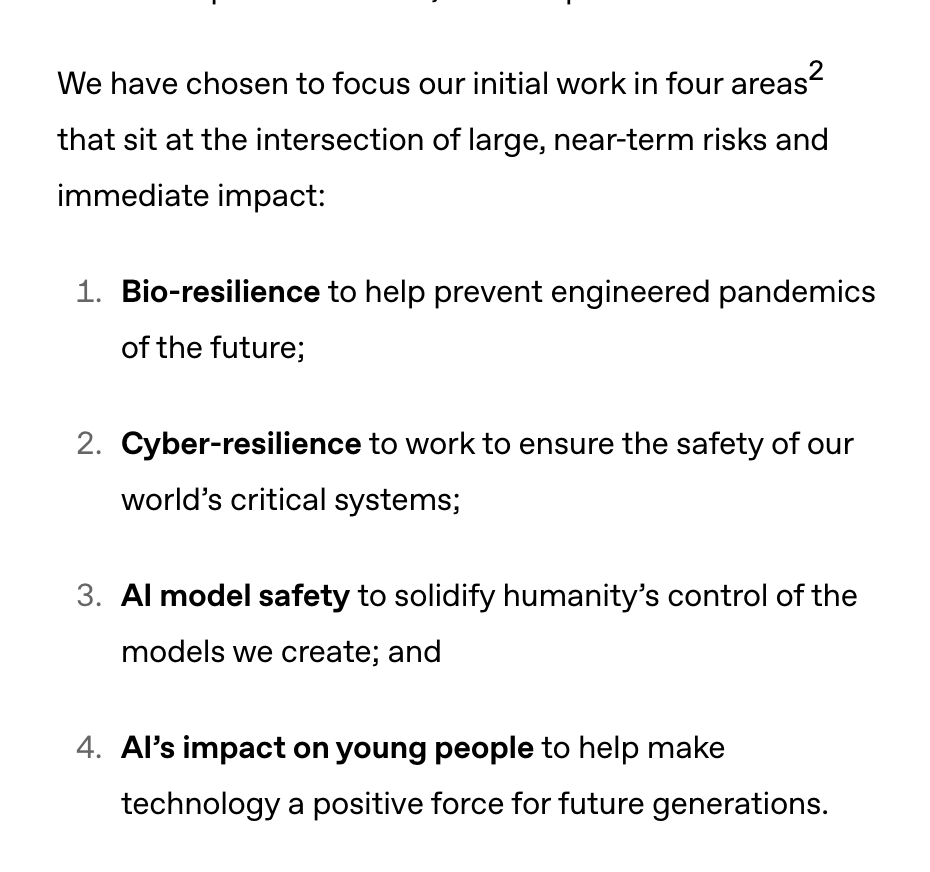
Here's where we are starting, on AI resilience:
* Bio-resilience
* Cyber-resilience
* AI model safety
* AI's impact on young people
We are grateful for what we've learned so far from practitioners in each of these fields. Building resilience will take a broad community of people and organisations, and we look forward to supporting many.
Read more:
AI is advancing quickly. Society’s ability to manage its risks must advance just as fast.
Today we’re sharing our vision for AI Resilience, with more than $130M in initial grants underway across bio-resilience, cyber-resilience, AI model safety, and AI’s impact on young people: https://t.co/mXwqzIYAPm
The OpenAI Foundation just laid out its vision for AI resilience and it's exactly the kind of ecosystem thinking this moment demands.
Wojciech Zaremba frames this effort by noting that every general purpose technology, from fire to electricity to the internet, followed the same arc of rapid innovation, real risk, and institutions racing to catch up. What made each one safe wasn't the technology itself but the resilience built around it, layer by layer.
The difference with AI is speed. Fire resilience took millennia. Electricity took decades. AI resilience has to evolve in a matter of years built alongside the technology, not after it.
A few areas of the important areas they're focusing on include:
🔐 Cyber-resilience: Well-resourced companies can defend their own systems. The Foundation's focus on the under-resourced institutions that keep society running—the ones that can't deploy AI-ready defenses fast enough—is where the real gap is.
🛡️ AI model safety: The recognition that alignment can't rest on labs alone. We need independent institutions to evaluate safety and public infrastructure to verify safe deployment in practice. A broader, more robust ecosystem.
🌱 AI's impact on young people: As someone focused on youth wellbeing, this one matters most to me. Young people are the earliest adopters, and we still lack the evidence base to understand how AI shapes human connection, learning, and development. Leading with independent research before standards is the right sequence.
Resilience is a permanent discipline and it takes many people and institutions building, investing, and collaborating together. Glad to see this work taking shape, and looking forward to following where it goes.
Cheers, chills, and a standing ovation when RASolute 302 showed unprecedented survival on daraxonrasib for patients with progressive pancreatic cancer
Seldom do you sense you’re witnessing a historic moment in cancer care but this feels like ras targeting has arrived
#ASCO26
Saloni and I started Hard Drugs because we like inventors and scientific discoveries. It’s a treat to record our first interview with an inventor of a difficult drug.
This episode goes deep on a story that mostly has not been told before. The R21 malaria vaccine will help millions of kids at risk of malaria. How was it invented?
And, what is needed next, to improve durability, and to reduce the number of doses? How can other people, perhaps someone reading this tweet, invent a third malaria vaccine...?
Thank you, @Kat_a_Collins. Enjoy:
Guys, how do you invent a vaccine? Or wilder, how do you invent a vaccine during your PhD?!
In a new episode of Hard Drugs, we talked to someone who did just that: @Kat_a_Collins!
A single malaria parasite that reaches your liver is enough to cause an infection. Worse, malaria has a complicated lifecycle with multiple stages, during which it changes shape and switches its surface proteins. And it’s co-evolved with humans for thousands of years, learning to evade and misdirect our immune system.
That’s why it’s been so much harder to develop vaccines against than viruses or bacteria. But not impossible!
In this episode, @JacobTref and I are joined by Katharine Collins, who co-invented the second malaria vaccine, R21, during her PhD at the Jenner Institute in Oxford!
After reading the expired patent of the first malaria vaccine (RTS,S), she stripped out the excess Hepatitis B surface antigen that RTS,S, leaving a particle with a much higher proportion of malaria antigen, used many newer processes, and paired it with a cheaper, more scalable adjuvant.
The result is a vaccine that’s around a third of the price, easier to manufacture at scale, and may be more durable as well.
It also means a vaccine that can reach far more children and save far more lives. Efficiency and scale matter enormously in the real world.
It’s probably our coolest episode ever. You will learn lots of secret, behind the scenes information about how innovation really works.
We chat about all this and much more!
Timestamps:
00:00 Introduction
05:08 Our favourite parasites
10:12 How to invent a vaccine during your PhD
34:18 Why is it called the R21 vaccine?
37:32 Moving from the bench to hundreds of millions of doses
41:43 The vicious life cycle of malaria parasites
46:15 Malaria research IN MICE
53:03 The murderer in malaria research
55:51 Would you volunteer to get infected by malaria?
1:08:21 Why did the first malaria vaccine take so long?
1:18:26 Could we have had the vaccine sooner?
1:40:48 Vaccine versus vaccine: which one’s better?
1:46:53 If we did this again today, could we make better vaccines?
2:04:55 Conclusion and our reasons for pessimism and optimism
AI will transform the economy and jobs, creating opportunities while also bringing new challenges.
At OpenAI Foundation, we are launching a program to better understand shifts, support the transition, and build long-term economic security.
Starting with $250M dedicated
https://t.co/7GUw9KaA64
On Friday, I resigned from OpenAI. Today is my first day at the OpenAI Foundation, where I'm helping build out our AI Resilience program.
There is a great deal to do before superintelligence, and little time to do it. If you were debating when to pivot to help, it's time.
The ballad of TIGIT
https://t.co/CWJbOLatwG
in 2014, an extremely promising class of oncology drug was identified. over the following decade, pharma spent $3B testing it on nearly 49,000 cancer patients. today, the drug category has been largely abandoned
this is its story
Today, @coeff_giving is launching the Strep A Vaccine Fund, a multi-donor initiative to accelerate vaccine development against one of the world's most neglected infectious diseases relative to its scale.
Strep A kills ~639,000 people a year. There is no vaccine. I think that can change 🧵
its easy to start believing that the bulk of scientific innovation is coming from private institutions, but a surprising amount of insane research is being created at academic labs that remain obscure because everybody involved is too busy to write a position paper on the subject that is legible to laymen and too offline to get those laymen to even try to read it
Introducing the inaugural cohort of the Arc AIxBio Fellows. These five student teams will each tackle an ambitious ML project over the next 6-12 months with a dedicated mentor.
X-Labs lives!
The initial topic areas are:
1. Scientific Instrumentation for Sensing and Imaging
2. Quantum Systems: Interconnects and Integrated Photonics
I am really excited to see and someday use the new technologies that come out of the initiative!
https://t.co/SNqrVwkztW
Speedrunning the civilizational tech tree with AI for Science
Great study by Conor Griffin, Don Wallace, and Theo Brown of Google DeepMind making the case for “AI data stocktakes” - identifying the areas where the availability of data would accelerate progress in AI for science. This case study explores opportunities to do for fusion what the Protein Data Bank did for protein structure prediction and protein design. https://t.co/ZUCOIWZvUj
A few thoughts
· If we want to speed run the civilizational tech tree, we should be doing this in more areas of science and engineering. For example, Woody Sherman, Conor Coley et. al. identified 22 opportunities to use AI to accelerate small molecule drug discovery, if only we had the right data. https://t.co/iCzoOiPqE9
· White paper competitions are a low-cost way to identify these ideas. @RenPhilanthropy organized a white paper competition for the UK Government which surfaced great ideas in fusion, engineering biology, biomedical research, advanced materials, and quantum technology. The value of white paper competitions is that they unbundle idea generation from execution. A researcher may recognize the value of a dataset, but may not be in a position to create or liberate it.
· In addition to data, AI for Science requires complementary investments in benchmarks, RL environments, compute, self-driving labs, formalization, tools for high-throughput experimentation, tools for inverse design, and porting numerical simulations written in Fortran to more modern languages such as Jax and Julia. We also need more people and teams who are bilingual, with both domain and computational expertise.
· One question about the datasets. When and under what circumstances should they be public goods, club goods, or private goods?
Please get in touch if you’d like to work with Renaissance Philanthropy on this! @sebkrier
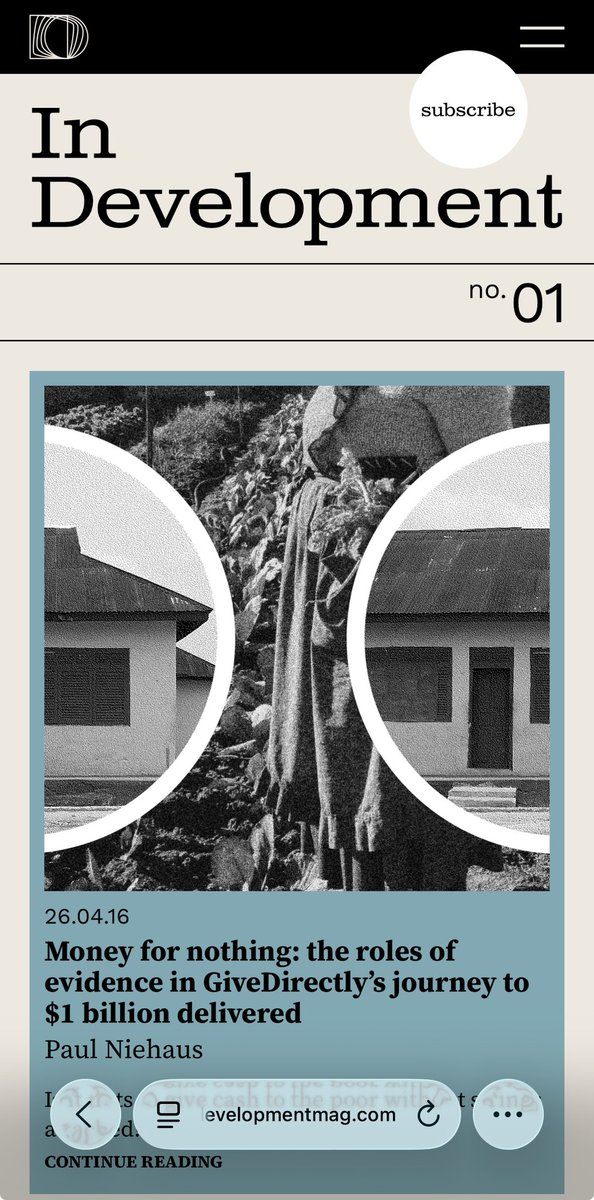
Congratulations to @notanastronomer for launching this new magazine. Subscribed!
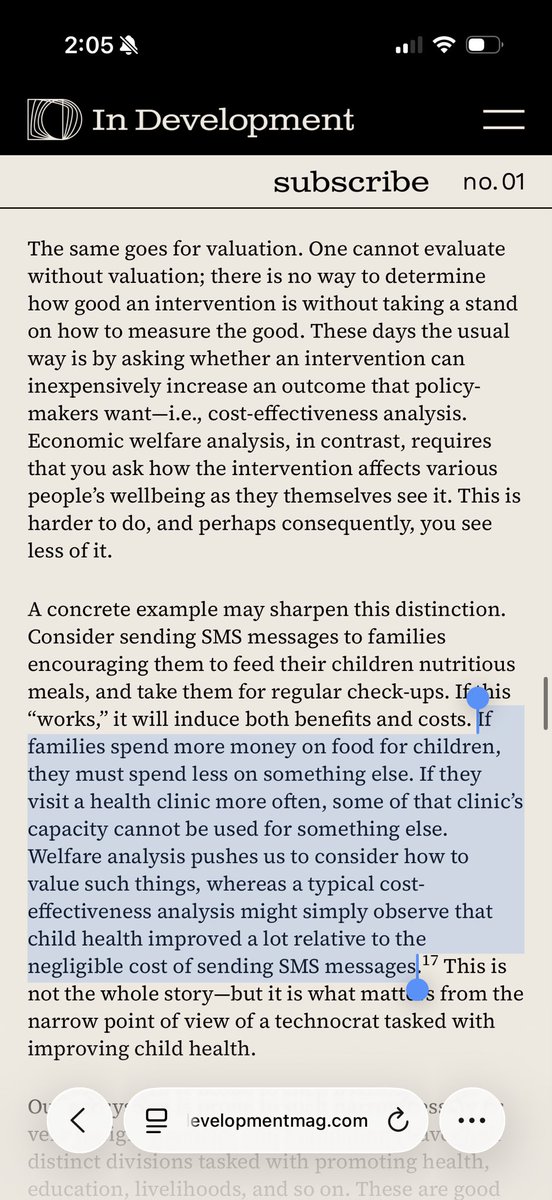
I enjoyed this first piece from @PaulFNiehaus for its range across practical and philosophical issues. E.g. I liked this example highlighting the limits of narrow cost-effectiveness analysis:
@eric_is_weird@salonium It is quite possible that was me (overwhelmed with pride), but I don’t actually recall (blinded by excitement). And Saloni’s fan club extends to places none of us can quantify…