The data used to train an AI model is vital to understanding its capabilities and risks. But how can we tell whether a model W actually resulted from a dataset D?
In a new paper, we show how to verify models' training-data, incl the data of open-source LMs!https://t.co/DKQf4eoC5y
The OpenAI national security policy team is hiring for my old job!
As the AI stakes get stratospheric, the technical nuances of policy become extremely important. This can be an incredibly positively impactful role for the right person. If you might be excellent at this, I’d love to answer your Qs.
AI is advancing quickly. Society’s ability to manage its risks must advance just as fast.
Today we’re sharing our vision for AI Resilience, with more than $130M in initial grants underway across bio-resilience, cyber-resilience, AI model safety, and AI’s impact on young people: https://t.co/mXwqzIYAPm
On Friday, I resigned from OpenAI. Today is my first day at the OpenAI Foundation, where I'm helping build out our AI Resilience program.
There is a great deal to do before superintelligence, and little time to do it. If you were debating when to pivot to help, it's time.
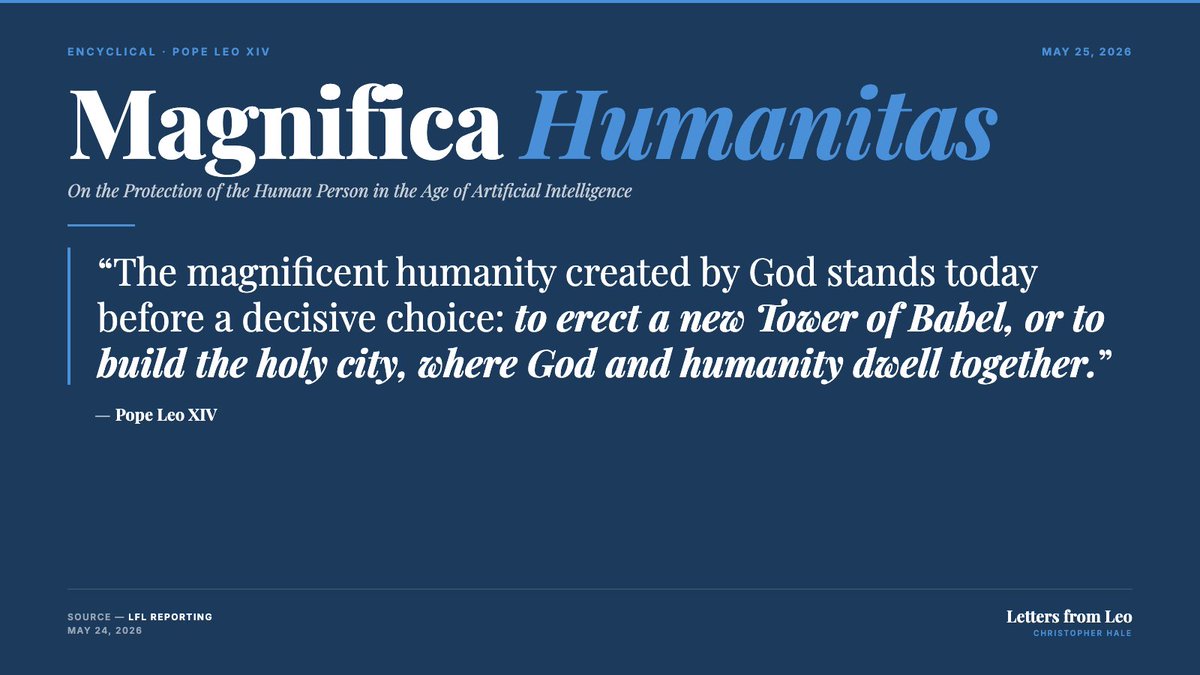
UPDATE: According to sources who have seen the final text, Pope Leo XIV’s AI encyclical, set for release tomorrow, will argue that humanity faces a defining choice regarding AI.
He uses the Tower of Babel — the ancient story of a people who tried to engineer their way to godhood and collapsed under the weight of their own power — as a warning about where unchecked technical mastery leads.
Instead, the U.S.-born pontiff will urge the world to build something humbler in its place: a civilization where God and humanity can dwell together.
Today, we share a breakthrough on the planar unit distance problem, a famous open question first posed by Paul Erdős in 1946.
For nearly 80 years, mathematicians believed the best possible solutions looked roughly like square grids.
An OpenAI model has now disproved that belief, discovering an entirely new family of constructions that performs better.
This marks the first time AI has autonomously solved a prominent open problem central to a field of mathematics.
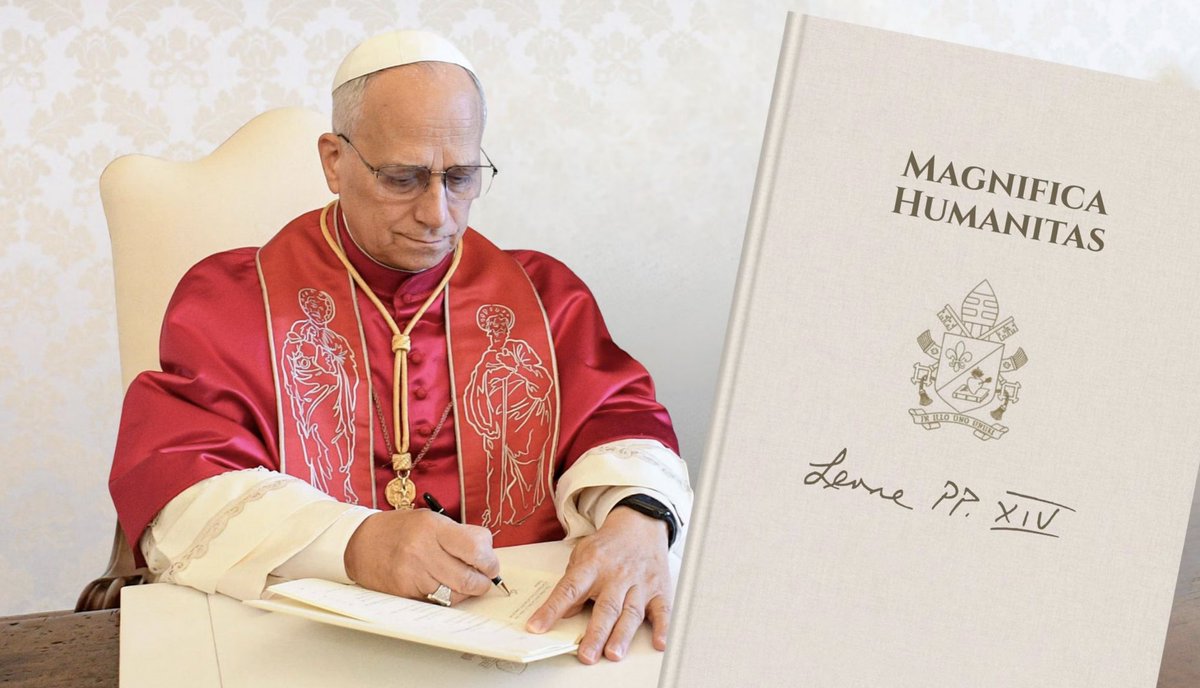
JUST IN: Vatican announces that Pope Leo XIV’s first encyclical — titled Magnifica Humanitas, on the safeguarding of the human person in the age of AI — will be presented at 11:30am on Monday, May 25, in the Vaticanʼs Synod Hall, in the presence of the Holy Father.
Speakers at the presentation will include:
Cardinal Víctor Manuel Fernández, Prefect of the Dicastery for the Doctrine of the Faith;
Cardinal Michael Czerny, Prefect of the Dicastery for the Service of Integral Human Development;
Professor Anna Rowlands, Political Theology, including Catholic Social Teaching, and theological ethics of human migration, Department of Theology and Religion, Durham University, United Kingdom;
Christopher Olah, co-founder of Anthropic (USA) and head of interpretability research for artificial intelligence;
Dr. Leocadie Lushombo, Political Theology and Catholic Social Thought, Jesuit School of Theology / Santa Clara University, California.
Concluding remarks will be delivered by thel Secretary of State, Cardinal Pietro Parolin.
The presentation will also include an address by Pope Leo XIV.
Magnifica Humanitas was signed and dated on May 15, the 135th anniversary of the promulgation of Pope Leo XIII’s Encyclical Letter Rerum Novarum.