Excited to share flow control, a method that allows users to steer VLAs in real time with keyboard arrow presses. This method doesn't require any fine-tuning of a VLA and can run out-of-the-box.
Clinical ML has a generalization problem. The standard playbook: train a model, watch it fail at the next hospital, and retrain it with new tricks. We invert this! Don't change the model—change the input so any model will generalize. Introducing Record2Vec at #ICLR2026! 🔄🚀 1/5
(1/7) We introduce MDM-Prime-v2 which scales 21.8× better than autoregressive models (ARMs) in compute-optimal comparisons.
📎 Paper: https://t.co/VhBVo75abe
🌟 Blog: https://t.co/miWdTmcGtL
⌨️ Github: https://t.co/ac1eDV8O8Q
Here’s how we did it👇:
A few months back I pushed @jacobyhsi88 to test how well GPT-5.2 did on this task. We found that open-source models can do even better when they are instructed to use the right tools. 😉
(I hope the Qwen team will continue leading the open-source LLM contributions 🫡)
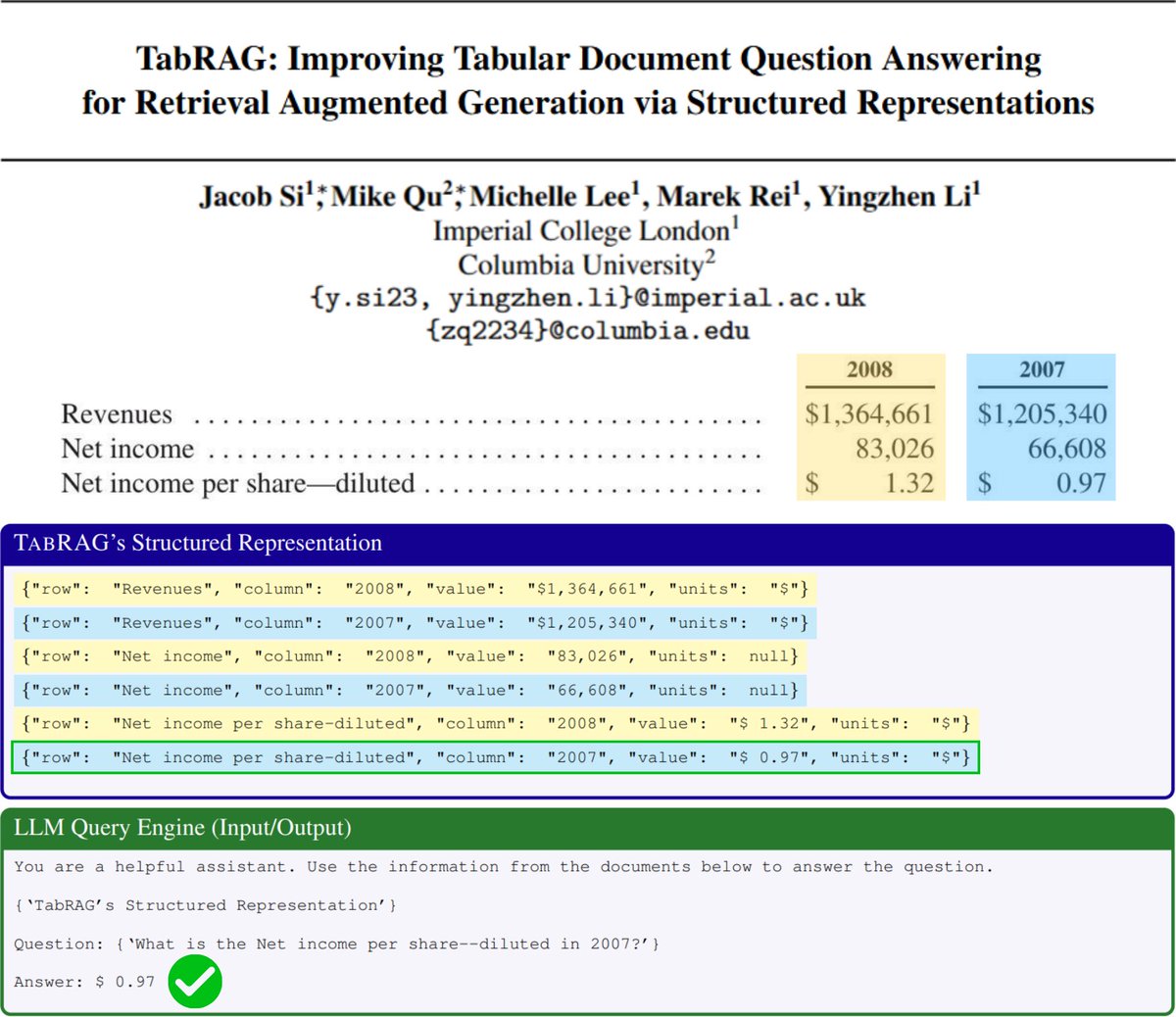
Ever queried RAG pipelines about tabular documents 𝄜 and find that answers are often incorrect ❌🤔?
🚀 Introducing TabRAG, an end-to-end parsing-based RAG framework designed to improve tabular document question answering via structured representations 👍!
📄 Paper: https://t.co/I90RvDPn9h
💻 GitHub: https://t.co/Pv93LkB945
🧵9/10 We analyze the effect of the number of self-generated ICL demonstrations on our generation performance. The performance improves sharply when moving from zero to a small number of demonstrations, with three ICL examples consistently yielding stable gains across most datasets.