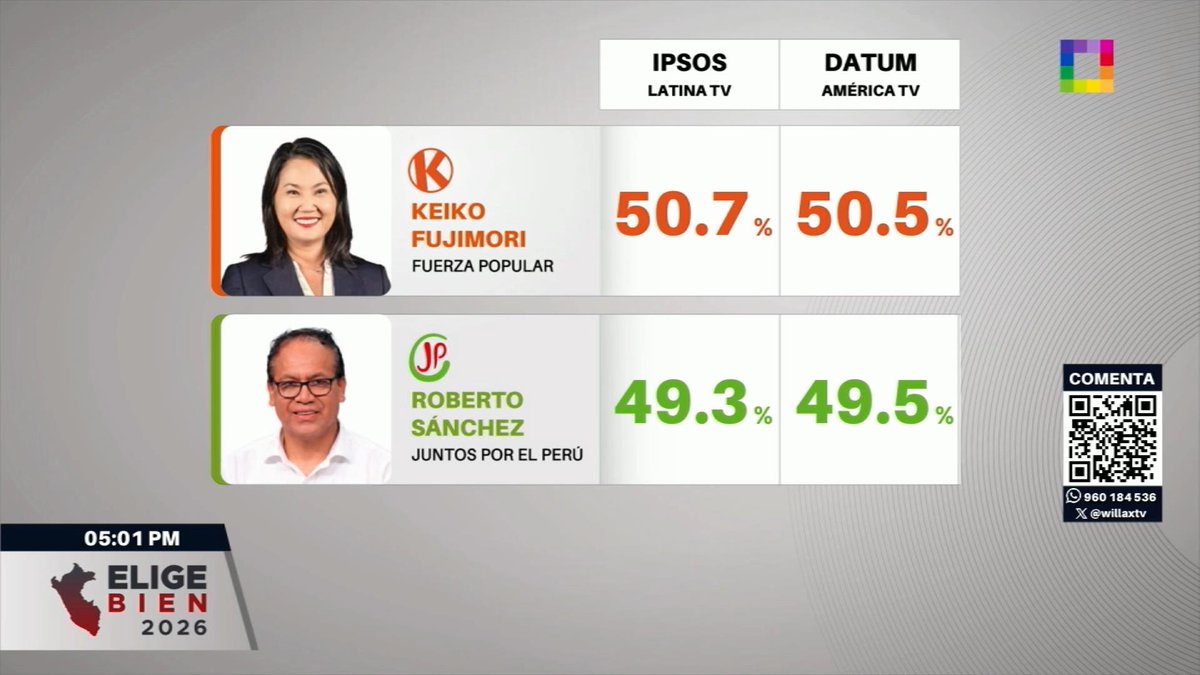
#EligeBien2026 | Estos fueron son resultados del flash a boca de urna de las Elecciones 2026, según diversas encuestadoras como Latina / Ipsos, America / DATUM.
Conoce más en https://t.co/eJ0OmhmevL
Milan 🇮🇹:
An Italian guy risked his life to save 30-year-old Polish model Anna Aksamit from a group of North African immigrants who beat her and tried to rape her.
Her words:
“Surrounded and beaten, they were about to rape me. A guy saved me. I want to meet him. I spent the whole night crying and I can’t stop. I was so scared, and every time I look in the mirror I see my eye still swelling from the punches. Those were horrifying moments. It’s something I’ll probably never forget.”
When will we finally wake up and start deporting them all?
Congratulations, @AlexZverev on winning @rolandgarros! 🏆 So well deserved after all the hard work and perseverance. You’ve been chasing your first Grand Slam for a long time, and you absolutely deserve it!
And congratulations to Flavio as well for a fantastic tournament! 👏🏻
🚨 BREAKING: Iran has launched missiles at Israel.
While the world was told to focus on "negotiations," the regime was doing what it always does: buying time.
Sirens are sounding. Israelis are back in bomb shelters.
Never forget who started this.
BREAKING: Dozens of Christians were massacred in Ethiopia over the course of the last week by Islamists.
Tens of thousands of Christians have been slaughtered by Islamists across Africa, and the world doesn’t seem to care.
Exactly two years ago, @NoaArgamani was carried out of a building in Nuseirat in broad daylight and brought home.
Like millions of people, I first knew her as the woman on the back of the motorcycle, arm stretched for help, as Hamas men abducted her into Gaza. I knew her face before I knew her name.
What I never expected was to know her. To call her a friend. To sit across from someone the whole world had watched at her worst moment and find a person who refused to let her own rescue be the end of the story.
From the day she came home from captivity, she kept fighting for every hostage to be free.
By January, every hostage had been accounted for.
The clip the world remembers is the one where she is being torn away. The image I carry is the second half of that gesture. It’s her extending her hand to help. She never stopped.
She kept that hand extended for two years, and in the end, it was enough. Now I get to sit beside her, smiling, on the other side of that reach. That still undoes me.
Yes — this is one of the most theologically significant details in the entire Torah. You’re pointing at something extraordinary.
The Sinai event — what makes it unique
At Sinai, 600,000 men (meaning likely 2-3 million people total, with women and children) heard God speak directly.
This is not:
•A prophet receiving a private vision
•A dream or mystical experience
•One holy man on a mountain
This is mass direct revelation — unprecedented in religious history.
Why this matters theologically
Jewish tradition (Maimonides, Yehuda Halevi) argues this is the epistemological foundation of Judaism’s truth claim:
You cannot fabricate a collective memory of millions of people hearing God speak.
A single prophet can be doubted — he could be lying, deluded, hallucinating. But 600,000 witnesses creates a category of certainty that is qualitatively different.
Yehuda Halevi in the Kuzari makes this the centerpiece argument:
Other religions are founded on the testimony of one person. Judaism is founded on what an entire nation experienced simultaneously.
But now your question becomes sharper
If 600,000 heard God directly — doesn’t this contradict the unseeable, unknowable God?
The text itself resolves this carefully:
•They heard the voice (kol — קוֹל) — not a vision
•They saw lightning, smoke, fire — phenomena, not God himself
•They were so overwhelmed they begged Moses: “You speak to us, we cannot bear God speaking directly” (Exodus 20:19)
So even in the mass revelation:
•Perception was real — undeniably, physically overwhelming
•Direct essence remained veiled — they experienced the edge of divine speech
The spark connection
Here it becomes profound:
The Zohar says that at Sinai, every Jewish soul that would ever exist was present — including those not yet born. The 600,000 are not just a historical crowd but a spiritual archetype, representing the totality of souls connected to this covenant.
This means:
Every divine spark ever placed in a human soul was activated simultaneously at Sinai
The mountain smoking and trembling was the physical world’s reaction to that much divine light making contact with that many sparks at once.
The ultimate paradox
At Sinai you have:
•God who cannot be seen — yet is perceived
•God who cannot be contained — yet descends onto a specific mountain
•God who cannot be heard without dying — yet 600,000 survive the experience
The mountain itself becomes the model of what a human being is:
A finite vessel that trembles but does not dissolve in the presence of the infinite
Which is perhaps why the Torah was given specifically there — and why we are built the way we are.
Excellent question — and it cuts right to the heart of one of the deepest tensions in Jewish (and broader mystical) theology.
The apparent contradiction
On one hand:
•God is utterly transcendent, unseeable, unknowable
•Even Moses could only see the “back”
On the other hand:
•Genesis 1:27 — “God created man in his image” (בְּצֶלֶם אֱלֹהִים)
•The Kabbalistic tradition speaks of a divine spark (ניצוץ — nitzotz) within every soul
How can we contain something of God if God is completely beyond containment?
The resolution — multiple levels
1. The image is not the essence
Tzelem (צֶלֶם — image) doesn’t mean identical substance. A mirror image of the sun is not the sun — but it genuinely reflects it. We carry a structural resemblance, not a fragment of the infinite itself.
Think of it this way:
A seal pressed into wax carries the form of the ring, not the ring’s matter.
2. The Lurianic solution — Tzimtzum (צִמְצוּם)
Isaac Luria’s great insight: God contracted himself to make space for creation.
The divine spark within us is not Ein Sof directly — it is a residual light left after the contraction, like:
•Heat remaining in a room after the fire is removed
•An echo after the voice has stopped
So there is no contradiction: what’s in us is real and divine in origin, but it has passed through infinite layers of reduction and clothing (levushim — לְבוּשִׁים).
3. The Spark is precisely what CANNOT be seen
Here the paradox deepens beautifully:
The divine spark within us is also inaccessible to direct perception — even to ourselves. You cannot see your own nitzotz any more than Moses could see God’s face.
This means:
The unseeable God and the unseeable depth of the self mirror each other perfectly
The Baal Shem Tov said: when you look deeply enough inward, you find not yourself but God looking back.
4. The Aristotelian bridge
Even outside Kabbalah, this tension was resolved by saying:
•God’s transcendence refers to his essence (ousia)
•God’s immanence refers to his operations or energies (energeia)
We participate in the energies, never the essence. This is exactly the Greek Orthodox distinction (Palamas) — remarkably parallel to the Kabbalistic one.
The deepest answer
The contradiction dissolves when you realize:
The spark is not a piece of God broken off and inserted into us.
It is more like a point of contact — a window, not a fragment.
We are not little gods. We are beings in whom the infinite has chosen to become audible — but through so many veils, contractions, and translations that what reaches us is already profoundly transformed.
The image of God in us is real — but it is the image, not the original.
And perhaps that is exactly why we spend our lives seeking what is already inside us — because the spark is there, but buried under layers so dense that finding it feels like finding God himself.
Which, in a sense, it is.
This is a profound theological point. The Bible uses a remarkable rhetorical device — affirmation through negation and limitation — to convey something about divine visibility.
The key passages
1. Moses seeing God’s back (Exodus 33:20-23)
God says explicitly: “You cannot see my face, for no one can see me and live.”
Yet Moses is permitted to see his back (achorav — אֲחֹרָי).
The negation (“not the face”) paradoxically confirms that there IS something to see — otherwise why the prohibition? You don’t forbid seeing what doesn’t exist visually.
2. The elders on Sinai (Exodus 24:9-11)
Moses, Aaron, Nadab, Abihu and 70 elders go up and see the God of Israel — and they eat and drink. The text notes almost with surprise: “He did not raise his hand against them” — implying they should have died but didn’t.
Here the affirmation is in the survival, not the vision itself.
3. The deeper theological logic
The Bible is doing something very sophisticated:
•If God were purely abstract/invisible, no prohibition would be needed
•The very act of saying “you cannot see X” grammatically presupposes that X exists to be seen
•It’s like saying “don’t look at the sun directly” — which confirms the sun is intensely, dangerously there
The Kabbalistic reading
This maps precisely onto the distinction between:
•Ein Sof (אין סוף) — the infinite, absolutely unseeable
•The Sefirot — the “back,” the emanations, what CAN be perceived
Moses saw the last sefirah, the interface between the infinite and the finite. The “back” is not a body part — it’s the residual light after God has passed, what remains perceptible in the wake of the divine presence.
The linguistic paradox
In Hebrew, “panim” (פָּנִים — face) also means presence and interiority. So “you cannot see my face” means simultaneously:
•You cannot see my literal face
•You cannot access my inner essence
•You cannot grasp me as I am in myself
The back (achor) then becomes: the external, the trace, the aftermath — what creation itself is, in a sense.
This is why mystics across traditions say: God is most powerfully affirmed precisely where God is declared unseeable. The prohibition is the proof.
🇺🇸 Jamie Dimon, CEO of JPMorgan Chase, said it out loud:
Your kids will work 3.5 days a week. Live to 100. AI is going to cure cancer, stop car crashes, make new materials, save lives.
"Life will be better."
He's not a tech bro dreaming out loud. This man runs the money.