Most of the airdrops you're farming will never happen
Every narrative had two types of users: the first had software and earned the most, the second did everything manually and barely broke even
And the narrative died when these two types merged, usually when the software ended up in the hands of the second type
- In 2022 it was NFTs: the first type farmed dozens of whitelists with their bot farms, or swept FCFS sales
- In 2024 it was airdrops: the first type farmed projects with farms, running onchain actions across thousands of wallets
Now anyone can vibe code any kind of software, so we're entering an era where capital matters
The next airdrop meta will play out in perps and prediction markets, where the size of your deposit beats the size of your farm
Whoever risks more money takes the biggest share of the rewards
Since I started this account with airdrop guides, I felt like I should say this
The fundamental issue in the Web3 space is the sheer volume of projects launching identical products, all fighting over a tiny pool of participants and capital.
I don't blame retail investors for staying away. Our current 'PvP' mentality is toxic. It is discouraging to watch your investment plummet in less than a minute just because someone rushed to lock in a quick profit.
For Web3 to move forward and survive these brutal market conditions, we drastically need to improve our industry ethics.
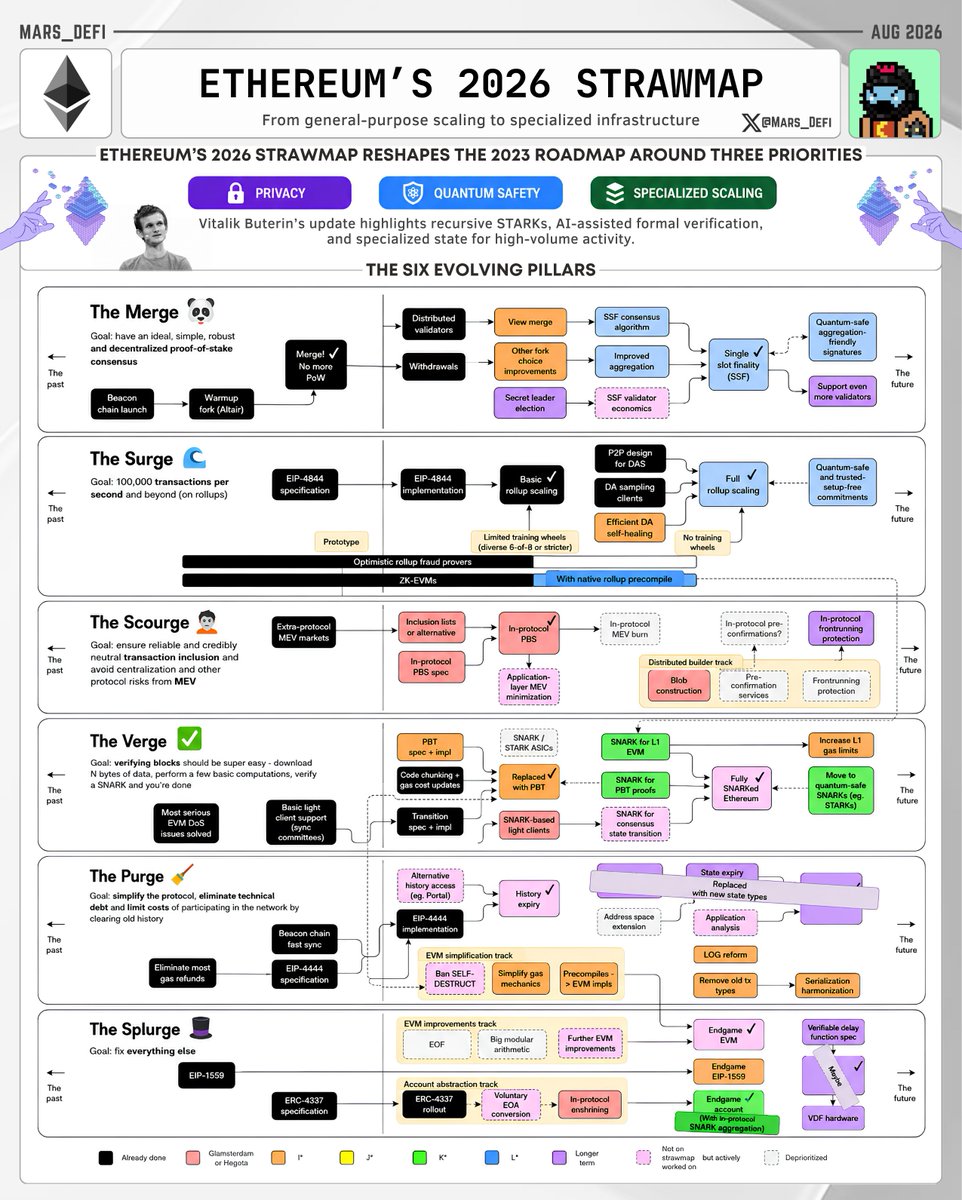
Ethereum’s 2026 Strawmap reshapes the 2023 roadmap around privacy, quantum safety, and specialized scaling.
@VitalikButerin’s update highlights recursive STARKs, AI-assisted formal verification, and new state types for high-volume activity.
Let’s break down what’s next for $ETH at the infrastructure level.
—
● The 2026 Strawmap is more than an updated roadmap
Vitalik’s comparison shows @ethereum kept its broad goals, but the technical path has changed significantly.
• ZK/STARK technology has matured
• AI-assisted formal verification is more practical
• Privacy, quantum safety, and specialized state are higher priorities
Don’t read the Strawmap as:
2023 roadmap -> bigger version of the same roadmap
It’s closer to:
2023 vision -> new technical assumptions → redesigned Ethereum architecture.
—
● The biggest shift: scale what matters
The new approach moves from scaling every workload equally to specialized mechanisms for dominant activity.
● Old architectural model: General-purpose Ethereum
• Everything stays flexible
• Workloads compete for the same resources
• Scaling everything becomes expensive
● New architectural model: Specialized high-throughput lanes
• Token transfers use specialized state
• Privacy gets dedicated mechanisms
• Complex apps remain on general-purpose Ethereum
—
● Ethereum’s new state model
Vitalik’s roadmap moves beyond state expiry toward specialized state types for different workloads.
Long-term sketches suggest ~2 TB for general-purpose state versus ~100 TB for specialized state.
For DeFi, ERC-20s, NFTs, transfers, swaps, and privacy nullifiers could benefit from specialized state.
—
● Privacy and quantum safety move up the stack
The Strawmap brings privacy and censorship resistance closer together while moving post-quantum security higher up the priority list.
• FOCIL
Enforces transaction inclusion, strengthening censorship resistance.
• leanSPHINCS
Uses hash-based, ZK-friendly signatures for post-quantum security.
• zkzk frames
Enable efficient proof and signature aggregation, bringing STARKs deeper into the protocol.
—
● Ethereum’s six evolving pillars
1. The Merge: Faster finality, stronger aggregation, and quantum-safe signatures.
2. The Surge: Scaling through DAS, ZK-EVMs, efficient DA, and native rollups.
3. The Scourge: Censorship resistance, inclusion lists, PBS, and MEV.
4. The Verge: SNARK/STARK verification, light clients, and state proofs.
5. The Purge: Simplifying history, state, EVM complexity, and obsolete components.
6. The Splurge: EVM evolution, account abstraction, gas, and future execution
architecture.
—
Ethereum is moving toward specialized execution, state, and proving systems while retaining its general-purpose core.
For DeFi, the biggest opportunity is cheaper scaling for tokens, swaps, and privacy-heavy workloads.
The real shift is architectural which is to optimize the workloads that matter most without sacrificing decentralization.
"Alts on the verge of a breakout!"
"Alts going to explode!"
"Alts looking to rip soon!"
No matter which part of the cycle we are at, you'll always see these posts. Even today.
Despite being an optimistic holder and lover of alts myself, there's a time and place for everything.
And using technical analysis and trendline ain't perfect either.
Alts most of all need strong and new liquidity. Something we are currently not seeing yet as of TODAY.
That doesn't mean it will never. It means you need to take all these posts on X with a huge grain of salt and realize most are just posting to post.
Hell even I'm sometimes just posting something to post to keep myself semi-active. Although I do try to always keep it more real and objective.
Posting to post is fine. But posting slop is another thing.
Alts remain a huge topic of discussion for the majority of us in here.
Most of our wealth depend on it like it has done for many of us in the past. Both good or bad.
But alts rely on just more than a chart that has hit support or anything.
The bandwagon needs to start first. Fresh and newfound volume that's entering the markets.
So don't expect it next week or anything.
In the meantime it's quite boring to do so I know. But monitoring is all we can do.
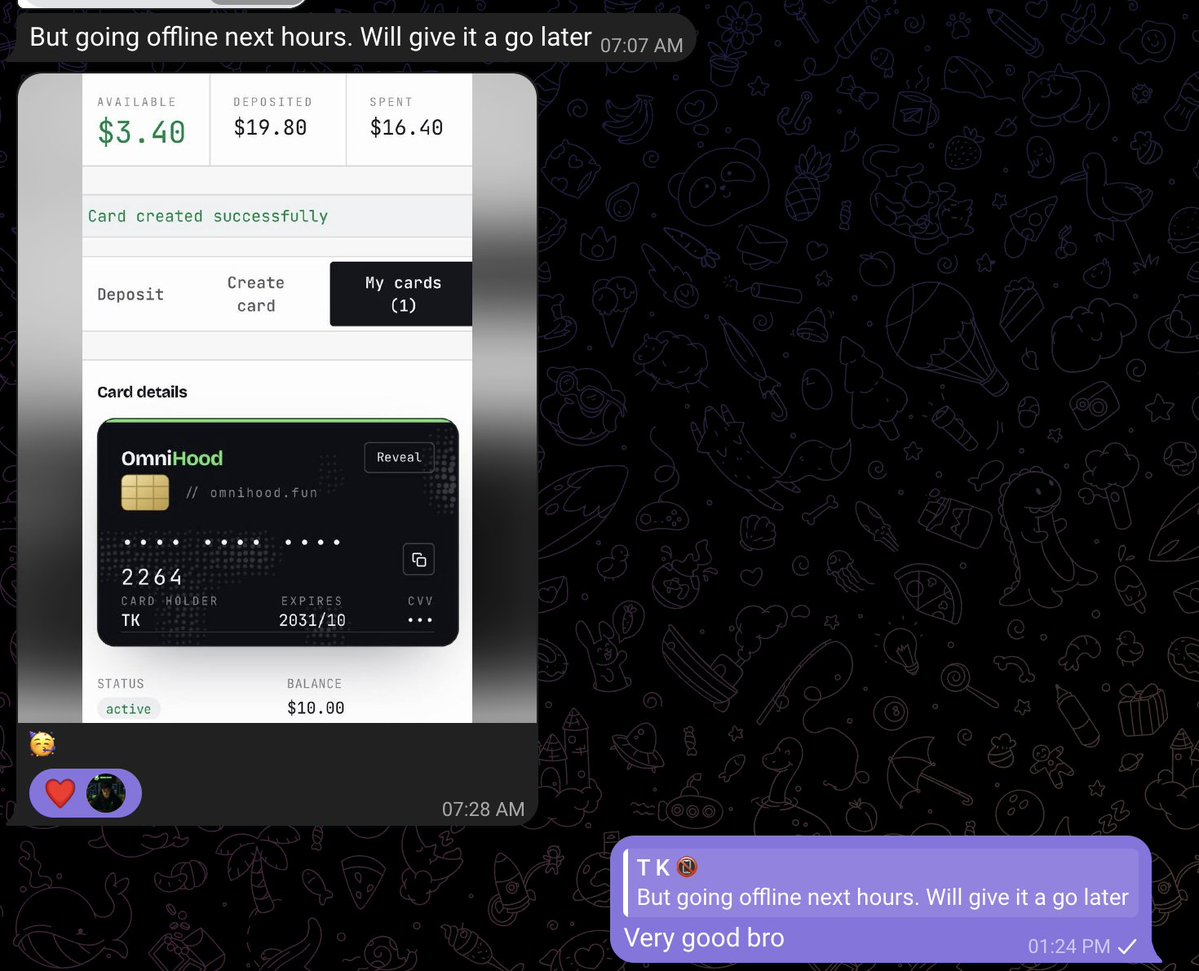
Another card has been created in our system.
We know that Africa and Europe face multiple card blocks due to sanctions and regulations.
That is why the no-KYC card solution offers tremendous value.
Plus, we've already burned $16 in $OMHD on card creation.
@Crypt0_Andrii@votesa I just read through my reply and I realized I wasn’t clear enough.
I’m not defending the scammers, I’m talking about people still buying into the scams with hopes of making it.