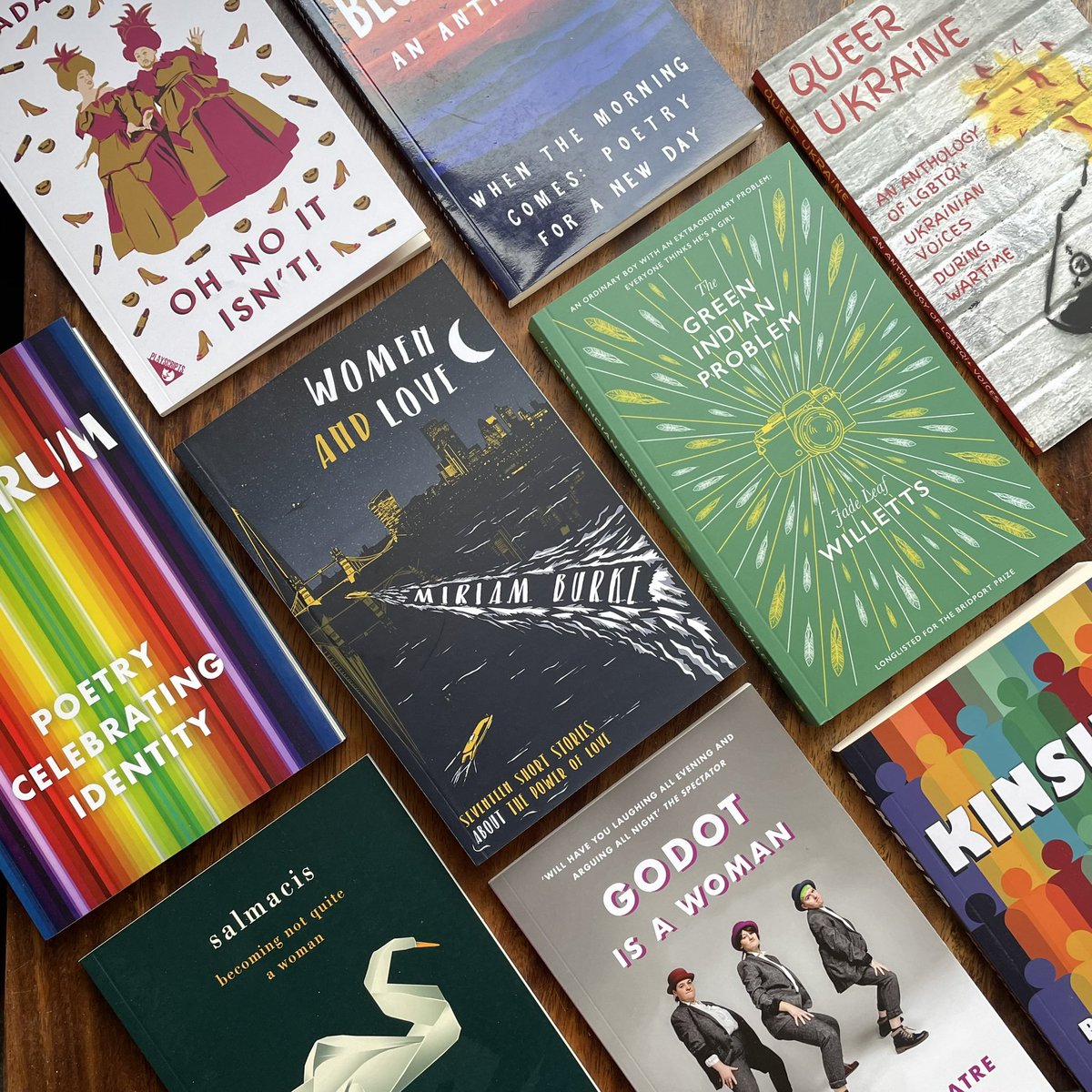
Something rather exciting is coming in three short weeks: a beautiful collection of excerpts, poems, short stories, scenes from all the authors we’ve published in our first five years.
📚 All proceeds to our @bookbanksuk scheme.
https://t.co/fQvN0DuKoW
#beautifulbooks#booktwt
#ICYMI, delighted to welcome @jade_leaf_w to this month’s #shufflingtheshelves feature – here’s a peek behind the scenes of The Green Indian Problem – a powerful short novel about a boy with an extraordinary problem: everyone thinks he’s a girl.
https://t.co/eY1OSQMaas
The 2025 National #poetry Competition, run by The Poetry Society, is open until 31st October. 40 lines max. £8 entry fee. Top prize £5,000. Winners will have their winning poems published in The Poetry Society's quarterly journal, The Poetry Review. https://t.co/ix0oN2rZon
It’s #pridemonth, and what better time than to celebrate some of the queer writers and stories in our list! 🏳️🌈🏳️⚧️
First out of the door, one of the first novels we published – delighted to reintroduce you to #TheGreenIndianProblem by @jade_leaf_w…
https://t.co/v8k5OkVuk6
The Bristol Short Story Prize 2025, now housed at @UoBrisEnglish@UoBWriting, is now open for entries! Full rules and the entry form appear on our website, https://t.co/AKSkamgdJT, so take a look and send us your best stories!
But who are the esteemed judges?
The legendary @parisreview now accepting poetry and prose submissions via Submittable for the month of October. See more details here: https://t.co/za66ubvNFU
ALL YOU NEED
When I think about The Beatles, l like to consider an interesting if not provocative statement: 'No masterpiece was ever produced by several people together.'
When I think about The Beatles, l like to consider an interesting if not provocative statement: 'No masterpiece was ever produced by several people together.' This is said by a character in The Counterfeiters, by French novelist André Gide.
Clearly, Gide wasn't pondering movies, or architecture, or newspapers, or popular music from Liverpool. And even if we contemplate the great 'soloists' of our time, like Picasso, do we not have to include in the picture his colleagues and contemporaries? These were poets, philosophers and composers, as well as painters like Matisse and Braque, with whom the great soloist conducted a running dialogue. As with the four Beatles, the respect and rivalry of this close-knit gang made each of them better artists. They too were 'roped together for the climb', as Picasso put it about Braque.
When I - a mixed-race boy, brought up in a rough, lower-middle-class London suburb after the war - dream of this group of friends and collaborators, The Beatles, they remind me of everything I love about Britain. That love is for the exhilarating, dissenting art that comes from its young people. When I think about The Beatles, which I do every day - I sit down and play one song all through in the morning, before starting work, to ignite my mood - I dream of magic, stardust and variety, of lightness, charmand joie de vivre. And I often wonder how this sunshine seemed to break out one fine day in the 1960s.
If you want to understand how people and systems break down, you can learn a lot by studying how creative partnerships like those of The Beatles do work, how they develop, and how brilliant collaborators can together make something extraordinary where there was nothing before, through a kind of play. You could call this Eros, a form of pleasurable, creative making, the best kind of enjoyable work. But it is unusual for the outsider, the passionate observer, to have a chance to witness this kind of labour. Normally, we only see the artist's polished outcome; the struggle, the early Sketches and drafts, remain private.
But here, in the film and accompanying book Get Back, we have a fly-on-the-wall opportunity. This is the only time in their career that The Beatles were filmed at such length while in the studio creating. It is a privilege and an opportunity to see them chatting and improvising, in close-up, in their everydayness. These are young people, don't forget, in their mid to late twenties, three of whom have known each other since school, and who have collectively made music together most days since. Like us they gossip, joke, argue, split up, get back together. Most importantly - they work together.
These four non-posh Liverpool boys worked a lot. They rarely stopped, or had a day off. 'The White Album' had been released in November1968. Here they are again, in this new story, from 2 January 1969, at Twickenham Film Studios in West London, where they would be filmed by Michael Lindsay-Hogg, the director who had made the 'Hey Jude' video.
There they intend to rehearse for a proposed live gig, and work on what became the Let It Be album. They also develop some of the brilliant songs - 'Something', 'She Came In Through The Bathroom Window', 'Carry That Weight', I Want You (She's So Heavy)' and 'Octopus's Garden' - which would later appear on the George Martin-produced Abbey Road. Although they are preparing to play live again - maybe while travelling to North Africa on an ocean liner, playing on Primrose Hill, or perhaps on Gibraltar - they can't agree as to where or how this event would take place. They do know, at least, that Ringo doesn't want to go abroad; he doesn't like the food.
Fortunately for us, this process was recorded on two Nagra tape recorders. There are over 120 hours of it. As well as the music, these tapes contain the conversations between songs by all the band and the crew (although we hear slightly less from Ringo than from the others because his drums weren't always miked).
It's sometimes assumed that this was a sad or grim time for the band, that they were falling apart, unhappy, and no longer really wanted to work together. There were indeed disputes and differences, as there would be with any group of artists. But in fact this was a productive time for them, when they created some of their best work. And it is here that we have the privilege of witnessing their early drafts, the mistakes, the drift and digressions, the boredom, the excitement, joyous jamming and sudden breakthroughs that led to the work we now know and admire.
If you grew up, as I did, after the war in the 1950s, then your notion of culture was bewildering: being taken, for instance, around an endless, unexplained art gallery and being made to listen to Tchaikovsky. The message was clear: culture, whatever it was, was above our heads. We were not people it was made for. Not that we were not already sceptical of adults, who, from where we were looking, seemed mostly to lead dull, unenviable lives. It school was anything to go by, adults seemed to fear and envy young people, when they were not deriding or disparaging them. What was supposed to be appealing to us in the future - the idea of becoming a working adult with a family - just didn't look that desirable.
Yet all the time, young people - particularly if they had heard Elvis or Little Richard - were yearning for art they could understand in terms of the frustration and snowballing sexuality of their lives. An art that would speak for and about them, giving them a reason to be excited about the future. After all, belief in the future is a precious commodity. It is not something you can acquire alone. You need a group, a movement, a shared culture.
And then, suddenly, it was there. It existed. It was happening, in our country.
Britain, having begun to recover from the war, and wondering what sort of place it wanted to be, was being reborn as a country of culture. There were these young faces - The Beatles and others - with strange and fascinating hair on television and in newspapers and magazines; and the music they made was on the radio. Somewhere - mostly in London, but not only in London - there was social mobility, the possibility of escape, and of a fuller future. And it wasn't one of Britain's public schools or great universities which produced these revolutionary boys. It was a war-ruined and ravaged port city in the North.
The Beatles, these artists who were by far the best of all the talent around, were like us, both ordinary and extraordinary, from nowhere and going somewhere - everywhere! Even in the suburbs we were aware the kids were taking over. On the bus to school in the morning you might witness a terrifying parade: there would be Teds, mods, rockers, skins and, a bit later, hippies. It was a meritocratic moment.
From now on, it looked like anyone could try to be an artist: in music, fashion, photography, theatre, movies or writing. It had all opened up. As British kids, until The Beatles, we never knew what we were supposed to be proud of. But once The Beatles arrived, and Britain was at the forefront of a cultural revolution led by young people, London, in particular, was becoming a world city of art, a catwalk, a crucible, a party where you wore what you wanted, and where anything could happen.
Unlike us, The Beatles had busy lives and most days we wondered what they were doing, and, more importantly, what they were thinking. Not that it was difficult to find out. For a while, fame suited them. Maureen Cleave stated in the Evening Standard, in March 1966, They are famous in the way the Queen is famous. When John Lennon's Rolls-Royce, with its black wheels and its black windows, goes past, people say: "It's the Queen," or "It's The Beatles." With her they share the security of a stable life.'
Why would they object to being looked at? We were learning to become consumers, and we consumed The Beatles, who were very consumable. We couldn't get enough. They were, after all, beautiful, desirable, clever and funny, and were forever being photographed somewhere or other, looking sexy and cool. And the music that poured from them so prolifically in a kind of Mozartian flow always seemed effortless. For a start, they weren't coerced into producing it, as we felt coerced and intimidated at school. It was obvious they loved what they did.
What they were up to, and their humour confirms it, was playing. And it is in play, so the psychologists tell us, and Jung in particular who appeared on the cover of Sgt. Pepper that we are at our most human. Play is where nothing is unthinkable, unimaginable or mocked. Play is dynamic, creative, experimental, it is always open to the new. The child makes and remakes the world, taking control of it, exerting a magical mastery over it. A child who couldn't play would be in trouble. Something would be stuck.
The point was: there were four of them, along with manager Brian Epstein and producer George Martin. Despite the dominance of the idea of the romantic, solitary genius, such collaborative magic has happened before. There have been more partnerships in art than stolid old André Gide could imagine. Think of the creative friendship and enmity between Coleridge and Wordsworth, when to be young was very heaven'; of Pound urging Eliot to crop large sections of The Waste Land; of Vita Sackville-West stirring Virginia Woolf's body and imagination so that she could write Orlando; and of Hitchcock and his producer Selznick making Hitchcock's perverse and strange art box-office gold.
Those four Beatle boys were more than good for one another. And 'snags', as Patricia Highsmith calls them in her wonderful book about writing, Plotting and Writing Suspense Fiction, or what we might call 'problems in art', have - she insists - to be solved practically, in the room, not in someone's mind. This is where you need severe criticism and/or encouragement.
It takes a lot of trust and nerve to sing or play a new song in front of someone else. You would need to believe your companions would hear you without mockery, that you were in a welcoming environment. You would also have to believe that exchange and influence is replenishing, nurturing even, and that the other person is not only good for you, but that they will improve and enthuse you. They could change you significantly, in a kind of mutual metamorphosis, or productive encounter. If you're going to argue, you'd want to argue with the right people. Some disagreements can be fruitful or even inspirational. Art is a flux and dialogue, not only with the past, but with the present, with what others are doing. As Charles Darwin wrote, 'It is the long history of humankind (and animal kind, too) that those who learned to collaborate and improvise most effectively have prevailed.'
It is this dialogue of friends we will witness here. Once the group stopped touring and they could concentrate in the studio, their music reached a new level, developing from album to album. As songwriters, The Beatles mostly wrote separately at this time. But they could only have worked with one another in mind, later transforming one another's ideas. They would be one another's convivial, useful critics, mates who would help you produce work you couldn't make alone. To become yourself you need other people.
My parents and I had loved Cliff Richard and even The Shadows; we adored Tommy Steele, who apparently had the good fortune to live nearby in Catford, South London. But there wasn't much originality or freshness to love in most of the British music I grew up with. My father, a Muslim growing up in Bombay, had become enthralled by American writers like Ernest Hemingway, Raymond Chandler and James M. Cain; by American movies and style, particularly raincoats like Bogart's. And when Dad moved to the London suburbs and started a family, there was something new for us from America. We found we were listening to Chuck Berry and Fats Domino on the radio.
By 1964 what a scene and excitement it had become, even for us, people who led conventional, well-behaved lives with ordinary, if not small, dreams. I was astonished to see my own mother screaming at The Beatles in Bromley Odeon - indeed, many of the mothers of my friends, a line of them in the cheap seats, with their hands clapped to their cheeks and their mouths open like in Munch's Scream. Women were not supposed to behave like this. I’d never seen such passion in mothers before. Those Beatle boys, who wrote songs about men desiring women, were certainly doing something to women who thought of themselves as ‘housewives’.
The Beatles did a lot for us. And here they were, bringing in the rest of the world. They were provincial British, English even, but they were never insular: there was always something international, or cosmopolitan, about them. Their Liverpudlian manager Brian Epstein had always felt like an outsider. A failure at school, he'd wanted to be a dress designer. It was his strongest wish. But his father didn't consider it a 'manly' occupation. The Beatles had been seen hanging about in his shop - ‘they were not very tidy and not very clean' - and, after seeing them in the Cavern, Epstein signed them up.
The suits he persuaded the formerly scruffy and leather-clad Beatles to wear made them look French or what we used to call Continental. They resembled Alain Delon or Jean-Paul Belmondo in moody thrillers about good-looking, stubbornly original people, who weren't prepared to fit into the straight world. The Beatles were not only musicians, they had what became known as an Image. They were always at the very pinnacle of style, and their visual sense was strong. Their album covers, as well as their great movie A Hard Day's Night, looked like art works. The Beatles weren't just ahead of the wave, they were the wave.
As if to confirm their originality, more snobbish adults didn't get The Beatles at all. Noel Coward wrote in his diary in 1965, '... On the Sunday night, I went to see the Beatles. I had never seen them in the flesh before. The noise was deafening throughout ... I was truly horrified and shocked by the audience. It was like a mass masturbation orgy.'
The aliveness of teenagers can be terrifying. But if older people looked down on 'beat' music this was all right with us. If teenagers agree about wanting one thing, they don't want to be closed in, or understood. But you can see from the numerous television interviews The Beatles did, particularly in America, how patronised and belittled they were, and not taken seriously as artists. Pop was supposed to be as throwaway as advertising, and as permanent as candyfloss. A year later no one would remember those songs. Or want to hear them again.
Why did they seem so fresh? Outside of pop, the highbrow, war-stained culture of the early '60s was heavy with history. It was deliberately difficult and obscure, as far from the market as it could get. It was intellectual: you'd have to know a lot to make it out. In music there was Morton Feldman, in literature Samuel Beckett and Alain Robbe-Grillet, and in art there was Mark Rothko. This art was sublime. But it was not easy, popular or uplifting. In some ways it was deliberately frustrating, anti-hedonistic. It wasn't afraid of being boring; it wasn't committed to the market.
For me the question was: how could you put your love for The Beatles together with your fascination with Waiting for Godot? In what way might they be similar? How to understand it? One day I discovered a copy of Susan Sontag's essay collection Against Interpretation in a second-hand bookshop in Bromley. (This was a time when there were several bookshops in the town.)
What had struck me was a photograph on the cover of the volume. Wow, I thought, who is this? It was indeed the author, a ravishing dark-haired young woman, looking like an intelligent model.
And what she was telling us was mind-blowing. Sontag isn't condescending. She mentions The Supremes; she's telling us that Style wasn't just the box, it was what was inside the box too. Style itself was art; the popular was serious, and the serious could be a bit frivolous, like Duchamp, or playful like Picasso, and popular like Hitchcock. The Look was all. It was Style, not morality, that mattered when it came to art. Works of art simply exist. They just are; they don't have to be deep. She talks about intelligence, grace and sensuousness'. Then she mentions The Beatles, along with Jean-Luc Godard and the great Italian director Michelangelo Antonioni, an acquaintance of Paul McCartney's. The Fabs had it. Everything had already changed.
To me, this was a revelation. Our education had tried to teach us that real art, even when it was boring, should morally improve you, make you a better person, cultured, aware, more fastidious, with a posher accent even. Education would show you the way. The authorities never stopped telling us what to attend to, what really mattered and what was worthless. What was called culture was always highly regulated and policed. The boundaries were supervised. You crossed them at your peril. If the borders fell, there would be chaos, wouldn't there? The 1950s had, after all, been an era of postwar scarcity, and art was scarce too. Not everyone could have it. Not everyone could understand it. Not you. Not your class or type.
But we'd stopped listening to the authorities. We knew by now that the cinema - formerly considered cheap entertainment - was considered to be art. We'd heard Elvis and now we'd discovered The Rolling Stones, The Beatles, The Kinks and The Who. They'd led us to bodies and to pleasure, and shown us what gratification art could effortlessly deliver. And the authorities - indeed most people - were suspicious of pleasure, and of any art like Pop that appeared to dispense unmediated good times and desire. Pleasure was a kind of sex, after all, and sex, let's say, could be a slippery slope.
Almost all art for young people was produced by adults, mediated by adults, and approved by them. Adults, apparently, knew what young people need, and what would be good for them. The kids had no say in it. But now they did. The Beatles were at the forefront of this revolution. If there was to be taste and fine distinctions, pop - the stuff we loved and danced to - was considered far below that. It barely counted as important on the scale of art. Again, that had changed: art was pictures and music. We were free.
Then, one day, as we all know, it became clear that this charmed collaboration had become a burden if not a limitation. It began to fall apart.
During the break between 'The White Album' and the Let It Be sessions, George Harrison had been in Woodstock, NY, with Bob Dylan, whom he adored and admired. Harrison had worked with Dylan, as well as with The Band, jamming, writing, and teaching Dylan new chords. In 1968 he and Dylan had written I'd Have You Anytime' together, later released on All Things Must Pass. Music was changing, becoming simpler, less psychedelic and experimental. It had entered a new period, more sincere and rootsy.
On his return to Britain, Harrison disliked the cavernous, inhospitable Twickenham studios. Something had started to change in him. He and Dylan had been equals, working together. With Lennon and McCartney, he had been a younger brother. Through his adolescence and young manhood, he had hidden himself behind that double-flower, where he was protected but also overlooked. He did have, after all, two older brothers. Being the younger one was a natural position for him. In some relationships, you might want to disguise or hide your talent because it threatens others. But this became the childhood he had to leave behind. The son was, indeed, coming.
We can hear the strain. During the Let It Be sessions it is George Harrison who says, 'Ever since Mr Epstein passed away... it's never been the same.' Paul agrees. He can see it too. 'We've been very negative since Mr Epstein passed away. I mean, you know, that's why all of us in turn has been sick of the group, you know, 'cos there's nothing positive in it. You know, it is a bit of a drag. But the only way for it not to be a bit of a drag is for the four of us to think, Should we make it positive?’
It does become positive. Once they move to their own studio, in the basement of Apple at 3 Savile Row, everyone cheers up. There is a burst of creativity before they appear on the roof a week later. Another electrifying element had been added: Billy Preston. Preston, who had first met The Beatles in Hamburg in 1962, was recording a TV special for the BBC, and was invited to join in by George Harrison. 'I feel much better since Billy came, because I feel as though he's doing fills which...' Paul: 'That we should have been doing, yeah.' George adds, "Cos sometimes it's like... any time there's a space missing.'
During this time they work on several songs simultaneously: 'Don't Let Me Down', I've Got A Feeling', 'Get Back' and others. In the transcripts we see them evolve. We can pinpoint the exact moment when Ringo suddenly finds the shuffling beat in 'Get Back', so essential to the classic song we know and love.
At one point during the sessions George Martin says to John Lennon, 'You're writing all the time, aren't you, John?' to which John replies, 'Sure I am.' Later, George Martin comments, 'You're looking at each other, you're seeing each other, you're... just happening [clicks fingers).'
After a discussion about the best place to buy comfortable black slip-ons, there's a lovely section when they all get down to work on 'Something' together. Harrison says he's already been working on it for six months, without getting any further. Now they all toss in suggestions for words and lines. Harrison remembers that a while ago, Lennon had given him good advice: that you should finish a song once you've started, presumably before you forget what inspired it. Naturally Lennon doesn't take his own advice. But now he says that, to keep the song moving, you should say any line that pops into your head. 'Attracts me like a cauliflower' is his idea for 'Something'.
After all the humour, incessant work, disputes, and the first mention of Allen Klein, they gave us a fabulous finale. The live session on the roof took place at the end of January 1969, and in February of that year they would cheerfully get down to work on the masterpiece that is Abbey Road.
From the point of view of the public, the rooftop gig was the last time we would see them perform as a live band. It was a collective decision to play on the roof, after many debates throughout January, but uncannily the ending of the concert was predicted in a discussion between Paul McCartney and Michael Lindsay-Hogg in early January. Paul says, 'It's almost in a way we [should] do the show in a place we're not allowed to do it. You know, like we should trespass, go in, set up and then get moved - and that should be the show. Getting forcibly ejected, still trying to play your numbers, and the police lifting you.'
Could there have been a better way to go, high above the city, almost floating, and with the police on their way? It was as positive as Paul wanted: this beautiful, poignant and fitting climax, the four of them, with the great Billy Preston on keyboards, on a gloomy day on a cramped and dangerous-looking roof in Savile Row, where the band can barely be seen by anyone. It took place in London too, interrupted by cops who look younger than the band.
Don't cry about it. The end of The Beatles was as necessary as it was inevitable, as important and liberating as the end of any relationship. The Sixties were done; the Seventies would be darker and The Beatles were only rarely a dark band. Something else, far harder and crueller, would be required. After Abbey Road there would be Bowie's Hunky Dory.
Bowing out is an art too. We are aware of the end even as we read these conversations. They discuss it openly, and with little rancour. Before he walked out and then came back, George said, I think we should have a divorce,' with Paul replying, 'Well, I said that at the last meeting. But it's getting near it, you know.'
Not long before the poignant finish on the roof there'd been a glimpse back, moving paeans to their dead mothers: McCartney's 'Let It Be', and Lennon's 'Julia'. Then the two songwriters left their childhoods behind, disappearing into the future, where they would concentrate on the important work of being parents. They'd been kids for a long time. But they can't, after all, even agree where or whether to play live at all. Their friendship remains, but their enthusiasm for one another has waned, as it would have to.
#TheGreenIndianProblem by @jade_leaf_w is such a beautiful story, and Green is one of the most engaging protagonists I've encountered - definitely a top @renardpress recommendation!
https://t.co/XtKSGQmXeS
It’s #lgbtplushm, which feels like a good time to celebrate the breadth of LGBTQAI+ talent in our list, and to round up some brilliant queer books! 🏳️🌈🏳️⚧️
Head to our site to find out more and grab a few excellent reads! 👇
https://t.co/Y7VuTGGy6t
#lgbtqia#lgbwiththet#pride
So I wrote a few words about the realities of royalties for our authors; a few of those kind authors shared this, & it seems to have spoken to people. If you’re a writer and aren’t selling in the numbers you see in the papers, take heart. It’s normal, & you made an amazing thing.
📚 Absolutely delighted to introduce you to the first #bookpost of the year!
Introducing our #DylanThomas series – well-presented editions in elegant designs & with helpful notes for those who want to get to know the writer behind the words.
Out now.
https://t.co/TU793aURlW
Tis the season! 🌲
Delighted to say that we’ve currently got 25% of ALL our contemporary titles – and subscriptions!
Some glorious titles here that would make GREAT gifts… and our Christmas Card Classics are still in stock! 🌲👇
https://t.co/wElRGHkSXM
#booktwt#christmas
.@renardpress's brilliant picks for the LGBTQ+ Pride Month Reading List are:
- 'The Green Indian Problem' by @jade_leaf_w
- 'Queer Ukraine' by The Dvijka Collective
See the complete reading list:
🏳️🌈 https://t.co/QjOKozSBkw 🏳️🌈
It’s fab to see so many rainbows around for #PrideMonth… but here’s your annual reminder to look past the corporate rainbow-washing & support queer artists and writers.
We’re proudly queer-led, and here are some LGBTQ+ books we’re proud to publish. 😁
https://t.co/Y7VuTGGy6t
…and Renard Press! 🦊
Lovely to see the extraordinary #GreenIndianProblem by @jade_leaf_w here, alongside the powerful #QueerUkraine by DVIJKA. Very proud of our list and the voices championed here. 💪 🏳️🌈


![Hanifkureishi's tweet photo. ALL YOU NEED
When I think about The Beatles, l like to consider an interesting if not provocative statement: 'No masterpiece was ever produced by several people together.'
When I think about The Beatles, l like to consider an interesting if not provocative statement: 'No masterpiece was ever produced by several people together.' This is said by a character in The Counterfeiters, by French novelist André Gide.
Clearly, Gide wasn't pondering movies, or architecture, or newspapers, or popular music from Liverpool. And even if we contemplate the great 'soloists' of our time, like Picasso, do we not have to include in the picture his colleagues and contemporaries? These were poets, philosophers and composers, as well as painters like Matisse and Braque, with whom the great soloist conducted a running dialogue. As with the four Beatles, the respect and rivalry of this close-knit gang made each of them better artists. They too were 'roped together for the climb', as Picasso put it about Braque.
When I - a mixed-race boy, brought up in a rough, lower-middle-class London suburb after the war - dream of this group of friends and collaborators, The Beatles, they remind me of everything I love about Britain. That love is for the exhilarating, dissenting art that comes from its young people. When I think about The Beatles, which I do every day - I sit down and play one song all through in the morning, before starting work, to ignite my mood - I dream of magic, stardust and variety, of lightness, charmand joie de vivre. And I often wonder how this sunshine seemed to break out one fine day in the 1960s.
If you want to understand how people and systems break down, you can learn a lot by studying how creative partnerships like those of The Beatles do work, how they develop, and how brilliant collaborators can together make something extraordinary where there was nothing before, through a kind of play. You could call this Eros, a form of pleasurable, creative making, the best kind of enjoyable work. But it is unusual for the outsider, the passionate observer, to have a chance to witness this kind of labour. Normally, we only see the artist's polished outcome; the struggle, the early Sketches and drafts, remain private.
But here, in the film and accompanying book Get Back, we have a fly-on-the-wall opportunity. This is the only time in their career that The Beatles were filmed at such length while in the studio creating. It is a privilege and an opportunity to see them chatting and improvising, in close-up, in their everydayness. These are young people, don't forget, in their mid to late twenties, three of whom have known each other since school, and who have collectively made music together most days since. Like us they gossip, joke, argue, split up, get back together. Most importantly - they work together.
These four non-posh Liverpool boys worked a lot. They rarely stopped, or had a day off. 'The White Album' had been released in November1968. Here they are again, in this new story, from 2 January 1969, at Twickenham Film Studios in West London, where they would be filmed by Michael Lindsay-Hogg, the director who had made the 'Hey Jude' video.
There they intend to rehearse for a proposed live gig, and work on what became the Let It Be album. They also develop some of the brilliant songs - 'Something', 'She Came In Through The Bathroom Window', 'Carry That Weight', I Want You (She's So Heavy)' and 'Octopus's Garden' - which would later appear on the George Martin-produced Abbey Road. Although they are preparing to play live again - maybe while travelling to North Africa on an ocean liner, playing on Primrose Hill, or perhaps on Gibraltar - they can't agree as to where or how this event would take place. They do know, at least, that Ringo doesn't want to go abroad; he doesn't like the food.
Fortunately for us, this process was recorded on two Nagra tape recorders. There are over 120 hours of it. As well as the music, these tapes contain the conversations between songs by all the band and the crew (although we hear slightly less from Ringo than from the others because his drums weren't always miked).
It's sometimes assumed that this was a sad or grim time for the band, that they were falling apart, unhappy, and no longer really wanted to work together. There were indeed disputes and differences, as there would be with any group of artists. But in fact this was a productive time for them, when they created some of their best work. And it is here that we have the privilege of witnessing their early drafts, the mistakes, the drift and digressions, the boredom, the excitement, joyous jamming and sudden breakthroughs that led to the work we now know and admire.
If you grew up, as I did, after the war in the 1950s, then your notion of culture was bewildering: being taken, for instance, around an endless, unexplained art gallery and being made to listen to Tchaikovsky. The message was clear: culture, whatever it was, was above our heads. We were not people it was made for. Not that we were not already sceptical of adults, who, from where we were looking, seemed mostly to lead dull, unenviable lives. It school was anything to go by, adults seemed to fear and envy young people, when they were not deriding or disparaging them. What was supposed to be appealing to us in the future - the idea of becoming a working adult with a family - just didn't look that desirable.
Yet all the time, young people - particularly if they had heard Elvis or Little Richard - were yearning for art they could understand in terms of the frustration and snowballing sexuality of their lives. An art that would speak for and about them, giving them a reason to be excited about the future. After all, belief in the future is a precious commodity. It is not something you can acquire alone. You need a group, a movement, a shared culture.
And then, suddenly, it was there. It existed. It was happening, in our country.
Britain, having begun to recover from the war, and wondering what sort of place it wanted to be, was being reborn as a country of culture. There were these young faces - The Beatles and others - with strange and fascinating hair on television and in newspapers and magazines; and the music they made was on the radio. Somewhere - mostly in London, but not only in London - there was social mobility, the possibility of escape, and of a fuller future. And it wasn't one of Britain's public schools or great universities which produced these revolutionary boys. It was a war-ruined and ravaged port city in the North.
The Beatles, these artists who were by far the best of all the talent around, were like us, both ordinary and extraordinary, from nowhere and going somewhere - everywhere! Even in the suburbs we were aware the kids were taking over. On the bus to school in the morning you might witness a terrifying parade: there would be Teds, mods, rockers, skins and, a bit later, hippies. It was a meritocratic moment.
From now on, it looked like anyone could try to be an artist: in music, fashion, photography, theatre, movies or writing. It had all opened up. As British kids, until The Beatles, we never knew what we were supposed to be proud of. But once The Beatles arrived, and Britain was at the forefront of a cultural revolution led by young people, London, in particular, was becoming a world city of art, a catwalk, a crucible, a party where you wore what you wanted, and where anything could happen.
Unlike us, The Beatles had busy lives and most days we wondered what they were doing, and, more importantly, what they were thinking. Not that it was difficult to find out. For a while, fame suited them. Maureen Cleave stated in the Evening Standard, in March 1966, They are famous in the way the Queen is famous. When John Lennon's Rolls-Royce, with its black wheels and its black windows, goes past, people say: "It's the Queen," or "It's The Beatles." With her they share the security of a stable life.'
Why would they object to being looked at? We were learning to become consumers, and we consumed The Beatles, who were very consumable. We couldn't get enough. They were, after all, beautiful, desirable, clever and funny, and were forever being photographed somewhere or other, looking sexy and cool. And the music that poured from them so prolifically in a kind of Mozartian flow always seemed effortless. For a start, they weren't coerced into producing it, as we felt coerced and intimidated at school. It was obvious they loved what they did.
What they were up to, and their humour confirms it, was playing. And it is in play, so the psychologists tell us, and Jung in particular who appeared on the cover of Sgt. Pepper that we are at our most human. Play is where nothing is unthinkable, unimaginable or mocked. Play is dynamic, creative, experimental, it is always open to the new. The child makes and remakes the world, taking control of it, exerting a magical mastery over it. A child who couldn't play would be in trouble. Something would be stuck.
The point was: there were four of them, along with manager Brian Epstein and producer George Martin. Despite the dominance of the idea of the romantic, solitary genius, such collaborative magic has happened before. There have been more partnerships in art than stolid old André Gide could imagine. Think of the creative friendship and enmity between Coleridge and Wordsworth, when to be young was very heaven'; of Pound urging Eliot to crop large sections of The Waste Land; of Vita Sackville-West stirring Virginia Woolf's body and imagination so that she could write Orlando; and of Hitchcock and his producer Selznick making Hitchcock's perverse and strange art box-office gold.
Those four Beatle boys were more than good for one another. And 'snags', as Patricia Highsmith calls them in her wonderful book about writing, Plotting and Writing Suspense Fiction, or what we might call 'problems in art', have - she insists - to be solved practically, in the room, not in someone's mind. This is where you need severe criticism and/or encouragement.
It takes a lot of trust and nerve to sing or play a new song in front of someone else. You would need to believe your companions would hear you without mockery, that you were in a welcoming environment. You would also have to believe that exchange and influence is replenishing, nurturing even, and that the other person is not only good for you, but that they will improve and enthuse you. They could change you significantly, in a kind of mutual metamorphosis, or productive encounter. If you're going to argue, you'd want to argue with the right people. Some disagreements can be fruitful or even inspirational. Art is a flux and dialogue, not only with the past, but with the present, with what others are doing. As Charles Darwin wrote, 'It is the long history of humankind (and animal kind, too) that those who learned to collaborate and improvise most effectively have prevailed.'
It is this dialogue of friends we will witness here. Once the group stopped touring and they could concentrate in the studio, their music reached a new level, developing from album to album. As songwriters, The Beatles mostly wrote separately at this time. But they could only have worked with one another in mind, later transforming one another's ideas. They would be one another's convivial, useful critics, mates who would help you produce work you couldn't make alone. To become yourself you need other people.
My parents and I had loved Cliff Richard and even The Shadows; we adored Tommy Steele, who apparently had the good fortune to live nearby in Catford, South London. But there wasn't much originality or freshness to love in most of the British music I grew up with. My father, a Muslim growing up in Bombay, had become enthralled by American writers like Ernest Hemingway, Raymond Chandler and James M. Cain; by American movies and style, particularly raincoats like Bogart's. And when Dad moved to the London suburbs and started a family, there was something new for us from America. We found we were listening to Chuck Berry and Fats Domino on the radio.
By 1964 what a scene and excitement it had become, even for us, people who led conventional, well-behaved lives with ordinary, if not small, dreams. I was astonished to see my own mother screaming at The Beatles in Bromley Odeon - indeed, many of the mothers of my friends, a line of them in the cheap seats, with their hands clapped to their cheeks and their mouths open like in Munch's Scream. Women were not supposed to behave like this. I’d never seen such passion in mothers before. Those Beatle boys, who wrote songs about men desiring women, were certainly doing something to women who thought of themselves as ‘housewives’.
The Beatles did a lot for us. And here they were, bringing in the rest of the world. They were provincial British, English even, but they were never insular: there was always something international, or cosmopolitan, about them. Their Liverpudlian manager Brian Epstein had always felt like an outsider. A failure at school, he'd wanted to be a dress designer. It was his strongest wish. But his father didn't consider it a 'manly' occupation. The Beatles had been seen hanging about in his shop - ‘they were not very tidy and not very clean' - and, after seeing them in the Cavern, Epstein signed them up.
The suits he persuaded the formerly scruffy and leather-clad Beatles to wear made them look French or what we used to call Continental. They resembled Alain Delon or Jean-Paul Belmondo in moody thrillers about good-looking, stubbornly original people, who weren't prepared to fit into the straight world. The Beatles were not only musicians, they had what became known as an Image. They were always at the very pinnacle of style, and their visual sense was strong. Their album covers, as well as their great movie A Hard Day's Night, looked like art works. The Beatles weren't just ahead of the wave, they were the wave.
As if to confirm their originality, more snobbish adults didn't get The Beatles at all. Noel Coward wrote in his diary in 1965, '... On the Sunday night, I went to see the Beatles. I had never seen them in the flesh before. The noise was deafening throughout ... I was truly horrified and shocked by the audience. It was like a mass masturbation orgy.'
The aliveness of teenagers can be terrifying. But if older people looked down on 'beat' music this was all right with us. If teenagers agree about wanting one thing, they don't want to be closed in, or understood. But you can see from the numerous television interviews The Beatles did, particularly in America, how patronised and belittled they were, and not taken seriously as artists. Pop was supposed to be as throwaway as advertising, and as permanent as candyfloss. A year later no one would remember those songs. Or want to hear them again.
Why did they seem so fresh? Outside of pop, the highbrow, war-stained culture of the early '60s was heavy with history. It was deliberately difficult and obscure, as far from the market as it could get. It was intellectual: you'd have to know a lot to make it out. In music there was Morton Feldman, in literature Samuel Beckett and Alain Robbe-Grillet, and in art there was Mark Rothko. This art was sublime. But it was not easy, popular or uplifting. In some ways it was deliberately frustrating, anti-hedonistic. It wasn't afraid of being boring; it wasn't committed to the market.
For me the question was: how could you put your love for The Beatles together with your fascination with Waiting for Godot? In what way might they be similar? How to understand it? One day I discovered a copy of Susan Sontag's essay collection Against Interpretation in a second-hand bookshop in Bromley. (This was a time when there were several bookshops in the town.)
What had struck me was a photograph on the cover of the volume. Wow, I thought, who is this? It was indeed the author, a ravishing dark-haired young woman, looking like an intelligent model.
And what she was telling us was mind-blowing. Sontag isn't condescending. She mentions The Supremes; she's telling us that Style wasn't just the box, it was what was inside the box too. Style itself was art; the popular was serious, and the serious could be a bit frivolous, like Duchamp, or playful like Picasso, and popular like Hitchcock. The Look was all. It was Style, not morality, that mattered when it came to art. Works of art simply exist. They just are; they don't have to be deep. She talks about intelligence, grace and sensuousness'. Then she mentions The Beatles, along with Jean-Luc Godard and the great Italian director Michelangelo Antonioni, an acquaintance of Paul McCartney's. The Fabs had it. Everything had already changed.
To me, this was a revelation. Our education had tried to teach us that real art, even when it was boring, should morally improve you, make you a better person, cultured, aware, more fastidious, with a posher accent even. Education would show you the way. The authorities never stopped telling us what to attend to, what really mattered and what was worthless. What was called culture was always highly regulated and policed. The boundaries were supervised. You crossed them at your peril. If the borders fell, there would be chaos, wouldn't there? The 1950s had, after all, been an era of postwar scarcity, and art was scarce too. Not everyone could have it. Not everyone could understand it. Not you. Not your class or type.
But we'd stopped listening to the authorities. We knew by now that the cinema - formerly considered cheap entertainment - was considered to be art. We'd heard Elvis and now we'd discovered The Rolling Stones, The Beatles, The Kinks and The Who. They'd led us to bodies and to pleasure, and shown us what gratification art could effortlessly deliver. And the authorities - indeed most people - were suspicious of pleasure, and of any art like Pop that appeared to dispense unmediated good times and desire. Pleasure was a kind of sex, after all, and sex, let's say, could be a slippery slope.
Almost all art for young people was produced by adults, mediated by adults, and approved by them. Adults, apparently, knew what young people need, and what would be good for them. The kids had no say in it. But now they did. The Beatles were at the forefront of this revolution. If there was to be taste and fine distinctions, pop - the stuff we loved and danced to - was considered far below that. It barely counted as important on the scale of art. Again, that had changed: art was pictures and music. We were free.
Then, one day, as we all know, it became clear that this charmed collaboration had become a burden if not a limitation. It began to fall apart.
During the break between 'The White Album' and the Let It Be sessions, George Harrison had been in Woodstock, NY, with Bob Dylan, whom he adored and admired. Harrison had worked with Dylan, as well as with The Band, jamming, writing, and teaching Dylan new chords. In 1968 he and Dylan had written I'd Have You Anytime' together, later released on All Things Must Pass. Music was changing, becoming simpler, less psychedelic and experimental. It had entered a new period, more sincere and rootsy.
On his return to Britain, Harrison disliked the cavernous, inhospitable Twickenham studios. Something had started to change in him. He and Dylan had been equals, working together. With Lennon and McCartney, he had been a younger brother. Through his adolescence and young manhood, he had hidden himself behind that double-flower, where he was protected but also overlooked. He did have, after all, two older brothers. Being the younger one was a natural position for him. In some relationships, you might want to disguise or hide your talent because it threatens others. But this became the childhood he had to leave behind. The son was, indeed, coming.
We can hear the strain. During the Let It Be sessions it is George Harrison who says, 'Ever since Mr Epstein passed away... it's never been the same.' Paul agrees. He can see it too. 'We've been very negative since Mr Epstein passed away. I mean, you know, that's why all of us in turn has been sick of the group, you know, 'cos there's nothing positive in it. You know, it is a bit of a drag. But the only way for it not to be a bit of a drag is for the four of us to think, Should we make it positive?’
It does become positive. Once they move to their own studio, in the basement of Apple at 3 Savile Row, everyone cheers up. There is a burst of creativity before they appear on the roof a week later. Another electrifying element had been added: Billy Preston. Preston, who had first met The Beatles in Hamburg in 1962, was recording a TV special for the BBC, and was invited to join in by George Harrison. 'I feel much better since Billy came, because I feel as though he's doing fills which...' Paul: 'That we should have been doing, yeah.' George adds, "Cos sometimes it's like... any time there's a space missing.'
During this time they work on several songs simultaneously: 'Don't Let Me Down', I've Got A Feeling', 'Get Back' and others. In the transcripts we see them evolve. We can pinpoint the exact moment when Ringo suddenly finds the shuffling beat in 'Get Back', so essential to the classic song we know and love.
At one point during the sessions George Martin says to John Lennon, 'You're writing all the time, aren't you, John?' to which John replies, 'Sure I am.' Later, George Martin comments, 'You're looking at each other, you're seeing each other, you're... just happening [clicks fingers).'
After a discussion about the best place to buy comfortable black slip-ons, there's a lovely section when they all get down to work on 'Something' together. Harrison says he's already been working on it for six months, without getting any further. Now they all toss in suggestions for words and lines. Harrison remembers that a while ago, Lennon had given him good advice: that you should finish a song once you've started, presumably before you forget what inspired it. Naturally Lennon doesn't take his own advice. But now he says that, to keep the song moving, you should say any line that pops into your head. 'Attracts me like a cauliflower' is his idea for 'Something'.
After all the humour, incessant work, disputes, and the first mention of Allen Klein, they gave us a fabulous finale. The live session on the roof took place at the end of January 1969, and in February of that year they would cheerfully get down to work on the masterpiece that is Abbey Road.
From the point of view of the public, the rooftop gig was the last time we would see them perform as a live band. It was a collective decision to play on the roof, after many debates throughout January, but uncannily the ending of the concert was predicted in a discussion between Paul McCartney and Michael Lindsay-Hogg in early January. Paul says, 'It's almost in a way we [should] do the show in a place we're not allowed to do it. You know, like we should trespass, go in, set up and then get moved - and that should be the show. Getting forcibly ejected, still trying to play your numbers, and the police lifting you.'
Could there have been a better way to go, high above the city, almost floating, and with the police on their way? It was as positive as Paul wanted: this beautiful, poignant and fitting climax, the four of them, with the great Billy Preston on keyboards, on a gloomy day on a cramped and dangerous-looking roof in Savile Row, where the band can barely be seen by anyone. It took place in London too, interrupted by cops who look younger than the band.
Don't cry about it. The end of The Beatles was as necessary as it was inevitable, as important and liberating as the end of any relationship. The Sixties were done; the Seventies would be darker and The Beatles were only rarely a dark band. Something else, far harder and crueller, would be required. After Abbey Road there would be Bowie's Hunky Dory.
Bowing out is an art too. We are aware of the end even as we read these conversations. They discuss it openly, and with little rancour. Before he walked out and then came back, George said, I think we should have a divorce,' with Paul replying, 'Well, I said that at the last meeting. But it's getting near it, you know.'
Not long before the poignant finish on the roof there'd been a glimpse back, moving paeans to their dead mothers: McCartney's 'Let It Be', and Lennon's 'Julia'. Then the two songwriters left their childhoods behind, disappearing into the future, where they would concentrate on the important work of being parents. They'd been kids for a long time. But they can't, after all, even agree where or whether to play live at all. Their friendship remains, but their enthusiasm for one another has waned, as it would have to.](https://pbs.twimg.com/media/GXlkmhmXgAAwJy4.jpg)
![Hanifkureishi's tweet photo. ALL YOU NEED
When I think about The Beatles, l like to consider an interesting if not provocative statement: 'No masterpiece was ever produced by several people together.'
When I think about The Beatles, l like to consider an interesting if not provocative statement: 'No masterpiece was ever produced by several people together.' This is said by a character in The Counterfeiters, by French novelist André Gide.
Clearly, Gide wasn't pondering movies, or architecture, or newspapers, or popular music from Liverpool. And even if we contemplate the great 'soloists' of our time, like Picasso, do we not have to include in the picture his colleagues and contemporaries? These were poets, philosophers and composers, as well as painters like Matisse and Braque, with whom the great soloist conducted a running dialogue. As with the four Beatles, the respect and rivalry of this close-knit gang made each of them better artists. They too were 'roped together for the climb', as Picasso put it about Braque.
When I - a mixed-race boy, brought up in a rough, lower-middle-class London suburb after the war - dream of this group of friends and collaborators, The Beatles, they remind me of everything I love about Britain. That love is for the exhilarating, dissenting art that comes from its young people. When I think about The Beatles, which I do every day - I sit down and play one song all through in the morning, before starting work, to ignite my mood - I dream of magic, stardust and variety, of lightness, charmand joie de vivre. And I often wonder how this sunshine seemed to break out one fine day in the 1960s.
If you want to understand how people and systems break down, you can learn a lot by studying how creative partnerships like those of The Beatles do work, how they develop, and how brilliant collaborators can together make something extraordinary where there was nothing before, through a kind of play. You could call this Eros, a form of pleasurable, creative making, the best kind of enjoyable work. But it is unusual for the outsider, the passionate observer, to have a chance to witness this kind of labour. Normally, we only see the artist's polished outcome; the struggle, the early Sketches and drafts, remain private.
But here, in the film and accompanying book Get Back, we have a fly-on-the-wall opportunity. This is the only time in their career that The Beatles were filmed at such length while in the studio creating. It is a privilege and an opportunity to see them chatting and improvising, in close-up, in their everydayness. These are young people, don't forget, in their mid to late twenties, three of whom have known each other since school, and who have collectively made music together most days since. Like us they gossip, joke, argue, split up, get back together. Most importantly - they work together.
These four non-posh Liverpool boys worked a lot. They rarely stopped, or had a day off. 'The White Album' had been released in November1968. Here they are again, in this new story, from 2 January 1969, at Twickenham Film Studios in West London, where they would be filmed by Michael Lindsay-Hogg, the director who had made the 'Hey Jude' video.
There they intend to rehearse for a proposed live gig, and work on what became the Let It Be album. They also develop some of the brilliant songs - 'Something', 'She Came In Through The Bathroom Window', 'Carry That Weight', I Want You (She's So Heavy)' and 'Octopus's Garden' - which would later appear on the George Martin-produced Abbey Road. Although they are preparing to play live again - maybe while travelling to North Africa on an ocean liner, playing on Primrose Hill, or perhaps on Gibraltar - they can't agree as to where or how this event would take place. They do know, at least, that Ringo doesn't want to go abroad; he doesn't like the food.
Fortunately for us, this process was recorded on two Nagra tape recorders. There are over 120 hours of it. As well as the music, these tapes contain the conversations between songs by all the band and the crew (although we hear slightly less from Ringo than from the others because his drums weren't always miked).
It's sometimes assumed that this was a sad or grim time for the band, that they were falling apart, unhappy, and no longer really wanted to work together. There were indeed disputes and differences, as there would be with any group of artists. But in fact this was a productive time for them, when they created some of their best work. And it is here that we have the privilege of witnessing their early drafts, the mistakes, the drift and digressions, the boredom, the excitement, joyous jamming and sudden breakthroughs that led to the work we now know and admire.
If you grew up, as I did, after the war in the 1950s, then your notion of culture was bewildering: being taken, for instance, around an endless, unexplained art gallery and being made to listen to Tchaikovsky. The message was clear: culture, whatever it was, was above our heads. We were not people it was made for. Not that we were not already sceptical of adults, who, from where we were looking, seemed mostly to lead dull, unenviable lives. It school was anything to go by, adults seemed to fear and envy young people, when they were not deriding or disparaging them. What was supposed to be appealing to us in the future - the idea of becoming a working adult with a family - just didn't look that desirable.
Yet all the time, young people - particularly if they had heard Elvis or Little Richard - were yearning for art they could understand in terms of the frustration and snowballing sexuality of their lives. An art that would speak for and about them, giving them a reason to be excited about the future. After all, belief in the future is a precious commodity. It is not something you can acquire alone. You need a group, a movement, a shared culture.
And then, suddenly, it was there. It existed. It was happening, in our country.
Britain, having begun to recover from the war, and wondering what sort of place it wanted to be, was being reborn as a country of culture. There were these young faces - The Beatles and others - with strange and fascinating hair on television and in newspapers and magazines; and the music they made was on the radio. Somewhere - mostly in London, but not only in London - there was social mobility, the possibility of escape, and of a fuller future. And it wasn't one of Britain's public schools or great universities which produced these revolutionary boys. It was a war-ruined and ravaged port city in the North.
The Beatles, these artists who were by far the best of all the talent around, were like us, both ordinary and extraordinary, from nowhere and going somewhere - everywhere! Even in the suburbs we were aware the kids were taking over. On the bus to school in the morning you might witness a terrifying parade: there would be Teds, mods, rockers, skins and, a bit later, hippies. It was a meritocratic moment.
From now on, it looked like anyone could try to be an artist: in music, fashion, photography, theatre, movies or writing. It had all opened up. As British kids, until The Beatles, we never knew what we were supposed to be proud of. But once The Beatles arrived, and Britain was at the forefront of a cultural revolution led by young people, London, in particular, was becoming a world city of art, a catwalk, a crucible, a party where you wore what you wanted, and where anything could happen.
Unlike us, The Beatles had busy lives and most days we wondered what they were doing, and, more importantly, what they were thinking. Not that it was difficult to find out. For a while, fame suited them. Maureen Cleave stated in the Evening Standard, in March 1966, They are famous in the way the Queen is famous. When John Lennon's Rolls-Royce, with its black wheels and its black windows, goes past, people say: "It's the Queen," or "It's The Beatles." With her they share the security of a stable life.'
Why would they object to being looked at? We were learning to become consumers, and we consumed The Beatles, who were very consumable. We couldn't get enough. They were, after all, beautiful, desirable, clever and funny, and were forever being photographed somewhere or other, looking sexy and cool. And the music that poured from them so prolifically in a kind of Mozartian flow always seemed effortless. For a start, they weren't coerced into producing it, as we felt coerced and intimidated at school. It was obvious they loved what they did.
What they were up to, and their humour confirms it, was playing. And it is in play, so the psychologists tell us, and Jung in particular who appeared on the cover of Sgt. Pepper that we are at our most human. Play is where nothing is unthinkable, unimaginable or mocked. Play is dynamic, creative, experimental, it is always open to the new. The child makes and remakes the world, taking control of it, exerting a magical mastery over it. A child who couldn't play would be in trouble. Something would be stuck.
The point was: there were four of them, along with manager Brian Epstein and producer George Martin. Despite the dominance of the idea of the romantic, solitary genius, such collaborative magic has happened before. There have been more partnerships in art than stolid old André Gide could imagine. Think of the creative friendship and enmity between Coleridge and Wordsworth, when to be young was very heaven'; of Pound urging Eliot to crop large sections of The Waste Land; of Vita Sackville-West stirring Virginia Woolf's body and imagination so that she could write Orlando; and of Hitchcock and his producer Selznick making Hitchcock's perverse and strange art box-office gold.
Those four Beatle boys were more than good for one another. And 'snags', as Patricia Highsmith calls them in her wonderful book about writing, Plotting and Writing Suspense Fiction, or what we might call 'problems in art', have - she insists - to be solved practically, in the room, not in someone's mind. This is where you need severe criticism and/or encouragement.
It takes a lot of trust and nerve to sing or play a new song in front of someone else. You would need to believe your companions would hear you without mockery, that you were in a welcoming environment. You would also have to believe that exchange and influence is replenishing, nurturing even, and that the other person is not only good for you, but that they will improve and enthuse you. They could change you significantly, in a kind of mutual metamorphosis, or productive encounter. If you're going to argue, you'd want to argue with the right people. Some disagreements can be fruitful or even inspirational. Art is a flux and dialogue, not only with the past, but with the present, with what others are doing. As Charles Darwin wrote, 'It is the long history of humankind (and animal kind, too) that those who learned to collaborate and improvise most effectively have prevailed.'
It is this dialogue of friends we will witness here. Once the group stopped touring and they could concentrate in the studio, their music reached a new level, developing from album to album. As songwriters, The Beatles mostly wrote separately at this time. But they could only have worked with one another in mind, later transforming one another's ideas. They would be one another's convivial, useful critics, mates who would help you produce work you couldn't make alone. To become yourself you need other people.
My parents and I had loved Cliff Richard and even The Shadows; we adored Tommy Steele, who apparently had the good fortune to live nearby in Catford, South London. But there wasn't much originality or freshness to love in most of the British music I grew up with. My father, a Muslim growing up in Bombay, had become enthralled by American writers like Ernest Hemingway, Raymond Chandler and James M. Cain; by American movies and style, particularly raincoats like Bogart's. And when Dad moved to the London suburbs and started a family, there was something new for us from America. We found we were listening to Chuck Berry and Fats Domino on the radio.
By 1964 what a scene and excitement it had become, even for us, people who led conventional, well-behaved lives with ordinary, if not small, dreams. I was astonished to see my own mother screaming at The Beatles in Bromley Odeon - indeed, many of the mothers of my friends, a line of them in the cheap seats, with their hands clapped to their cheeks and their mouths open like in Munch's Scream. Women were not supposed to behave like this. I’d never seen such passion in mothers before. Those Beatle boys, who wrote songs about men desiring women, were certainly doing something to women who thought of themselves as ‘housewives’.
The Beatles did a lot for us. And here they were, bringing in the rest of the world. They were provincial British, English even, but they were never insular: there was always something international, or cosmopolitan, about them. Their Liverpudlian manager Brian Epstein had always felt like an outsider. A failure at school, he'd wanted to be a dress designer. It was his strongest wish. But his father didn't consider it a 'manly' occupation. The Beatles had been seen hanging about in his shop - ‘they were not very tidy and not very clean' - and, after seeing them in the Cavern, Epstein signed them up.
The suits he persuaded the formerly scruffy and leather-clad Beatles to wear made them look French or what we used to call Continental. They resembled Alain Delon or Jean-Paul Belmondo in moody thrillers about good-looking, stubbornly original people, who weren't prepared to fit into the straight world. The Beatles were not only musicians, they had what became known as an Image. They were always at the very pinnacle of style, and their visual sense was strong. Their album covers, as well as their great movie A Hard Day's Night, looked like art works. The Beatles weren't just ahead of the wave, they were the wave.
As if to confirm their originality, more snobbish adults didn't get The Beatles at all. Noel Coward wrote in his diary in 1965, '... On the Sunday night, I went to see the Beatles. I had never seen them in the flesh before. The noise was deafening throughout ... I was truly horrified and shocked by the audience. It was like a mass masturbation orgy.'
The aliveness of teenagers can be terrifying. But if older people looked down on 'beat' music this was all right with us. If teenagers agree about wanting one thing, they don't want to be closed in, or understood. But you can see from the numerous television interviews The Beatles did, particularly in America, how patronised and belittled they were, and not taken seriously as artists. Pop was supposed to be as throwaway as advertising, and as permanent as candyfloss. A year later no one would remember those songs. Or want to hear them again.
Why did they seem so fresh? Outside of pop, the highbrow, war-stained culture of the early '60s was heavy with history. It was deliberately difficult and obscure, as far from the market as it could get. It was intellectual: you'd have to know a lot to make it out. In music there was Morton Feldman, in literature Samuel Beckett and Alain Robbe-Grillet, and in art there was Mark Rothko. This art was sublime. But it was not easy, popular or uplifting. In some ways it was deliberately frustrating, anti-hedonistic. It wasn't afraid of being boring; it wasn't committed to the market.
For me the question was: how could you put your love for The Beatles together with your fascination with Waiting for Godot? In what way might they be similar? How to understand it? One day I discovered a copy of Susan Sontag's essay collection Against Interpretation in a second-hand bookshop in Bromley. (This was a time when there were several bookshops in the town.)
What had struck me was a photograph on the cover of the volume. Wow, I thought, who is this? It was indeed the author, a ravishing dark-haired young woman, looking like an intelligent model.
And what she was telling us was mind-blowing. Sontag isn't condescending. She mentions The Supremes; she's telling us that Style wasn't just the box, it was what was inside the box too. Style itself was art; the popular was serious, and the serious could be a bit frivolous, like Duchamp, or playful like Picasso, and popular like Hitchcock. The Look was all. It was Style, not morality, that mattered when it came to art. Works of art simply exist. They just are; they don't have to be deep. She talks about intelligence, grace and sensuousness'. Then she mentions The Beatles, along with Jean-Luc Godard and the great Italian director Michelangelo Antonioni, an acquaintance of Paul McCartney's. The Fabs had it. Everything had already changed.
To me, this was a revelation. Our education had tried to teach us that real art, even when it was boring, should morally improve you, make you a better person, cultured, aware, more fastidious, with a posher accent even. Education would show you the way. The authorities never stopped telling us what to attend to, what really mattered and what was worthless. What was called culture was always highly regulated and policed. The boundaries were supervised. You crossed them at your peril. If the borders fell, there would be chaos, wouldn't there? The 1950s had, after all, been an era of postwar scarcity, and art was scarce too. Not everyone could have it. Not everyone could understand it. Not you. Not your class or type.
But we'd stopped listening to the authorities. We knew by now that the cinema - formerly considered cheap entertainment - was considered to be art. We'd heard Elvis and now we'd discovered The Rolling Stones, The Beatles, The Kinks and The Who. They'd led us to bodies and to pleasure, and shown us what gratification art could effortlessly deliver. And the authorities - indeed most people - were suspicious of pleasure, and of any art like Pop that appeared to dispense unmediated good times and desire. Pleasure was a kind of sex, after all, and sex, let's say, could be a slippery slope.
Almost all art for young people was produced by adults, mediated by adults, and approved by them. Adults, apparently, knew what young people need, and what would be good for them. The kids had no say in it. But now they did. The Beatles were at the forefront of this revolution. If there was to be taste and fine distinctions, pop - the stuff we loved and danced to - was considered far below that. It barely counted as important on the scale of art. Again, that had changed: art was pictures and music. We were free.
Then, one day, as we all know, it became clear that this charmed collaboration had become a burden if not a limitation. It began to fall apart.
During the break between 'The White Album' and the Let It Be sessions, George Harrison had been in Woodstock, NY, with Bob Dylan, whom he adored and admired. Harrison had worked with Dylan, as well as with The Band, jamming, writing, and teaching Dylan new chords. In 1968 he and Dylan had written I'd Have You Anytime' together, later released on All Things Must Pass. Music was changing, becoming simpler, less psychedelic and experimental. It had entered a new period, more sincere and rootsy.
On his return to Britain, Harrison disliked the cavernous, inhospitable Twickenham studios. Something had started to change in him. He and Dylan had been equals, working together. With Lennon and McCartney, he had been a younger brother. Through his adolescence and young manhood, he had hidden himself behind that double-flower, where he was protected but also overlooked. He did have, after all, two older brothers. Being the younger one was a natural position for him. In some relationships, you might want to disguise or hide your talent because it threatens others. But this became the childhood he had to leave behind. The son was, indeed, coming.
We can hear the strain. During the Let It Be sessions it is George Harrison who says, 'Ever since Mr Epstein passed away... it's never been the same.' Paul agrees. He can see it too. 'We've been very negative since Mr Epstein passed away. I mean, you know, that's why all of us in turn has been sick of the group, you know, 'cos there's nothing positive in it. You know, it is a bit of a drag. But the only way for it not to be a bit of a drag is for the four of us to think, Should we make it positive?’
It does become positive. Once they move to their own studio, in the basement of Apple at 3 Savile Row, everyone cheers up. There is a burst of creativity before they appear on the roof a week later. Another electrifying element had been added: Billy Preston. Preston, who had first met The Beatles in Hamburg in 1962, was recording a TV special for the BBC, and was invited to join in by George Harrison. 'I feel much better since Billy came, because I feel as though he's doing fills which...' Paul: 'That we should have been doing, yeah.' George adds, "Cos sometimes it's like... any time there's a space missing.'
During this time they work on several songs simultaneously: 'Don't Let Me Down', I've Got A Feeling', 'Get Back' and others. In the transcripts we see them evolve. We can pinpoint the exact moment when Ringo suddenly finds the shuffling beat in 'Get Back', so essential to the classic song we know and love.
At one point during the sessions George Martin says to John Lennon, 'You're writing all the time, aren't you, John?' to which John replies, 'Sure I am.' Later, George Martin comments, 'You're looking at each other, you're seeing each other, you're... just happening [clicks fingers).'
After a discussion about the best place to buy comfortable black slip-ons, there's a lovely section when they all get down to work on 'Something' together. Harrison says he's already been working on it for six months, without getting any further. Now they all toss in suggestions for words and lines. Harrison remembers that a while ago, Lennon had given him good advice: that you should finish a song once you've started, presumably before you forget what inspired it. Naturally Lennon doesn't take his own advice. But now he says that, to keep the song moving, you should say any line that pops into your head. 'Attracts me like a cauliflower' is his idea for 'Something'.
After all the humour, incessant work, disputes, and the first mention of Allen Klein, they gave us a fabulous finale. The live session on the roof took place at the end of January 1969, and in February of that year they would cheerfully get down to work on the masterpiece that is Abbey Road.
From the point of view of the public, the rooftop gig was the last time we would see them perform as a live band. It was a collective decision to play on the roof, after many debates throughout January, but uncannily the ending of the concert was predicted in a discussion between Paul McCartney and Michael Lindsay-Hogg in early January. Paul says, 'It's almost in a way we [should] do the show in a place we're not allowed to do it. You know, like we should trespass, go in, set up and then get moved - and that should be the show. Getting forcibly ejected, still trying to play your numbers, and the police lifting you.'
Could there have been a better way to go, high above the city, almost floating, and with the police on their way? It was as positive as Paul wanted: this beautiful, poignant and fitting climax, the four of them, with the great Billy Preston on keyboards, on a gloomy day on a cramped and dangerous-looking roof in Savile Row, where the band can barely be seen by anyone. It took place in London too, interrupted by cops who look younger than the band.
Don't cry about it. The end of The Beatles was as necessary as it was inevitable, as important and liberating as the end of any relationship. The Sixties were done; the Seventies would be darker and The Beatles were only rarely a dark band. Something else, far harder and crueller, would be required. After Abbey Road there would be Bowie's Hunky Dory.
Bowing out is an art too. We are aware of the end even as we read these conversations. They discuss it openly, and with little rancour. Before he walked out and then came back, George said, I think we should have a divorce,' with Paul replying, 'Well, I said that at the last meeting. But it's getting near it, you know.'
Not long before the poignant finish on the roof there'd been a glimpse back, moving paeans to their dead mothers: McCartney's 'Let It Be', and Lennon's 'Julia'. Then the two songwriters left their childhoods behind, disappearing into the future, where they would concentrate on the important work of being parents. They'd been kids for a long time. But they can't, after all, even agree where or whether to play live at all. Their friendship remains, but their enthusiasm for one another has waned, as it would have to.](https://pbs.twimg.com/media/GXlkAHdXIAAe8qg.jpg)
![Hanifkureishi's tweet photo. ALL YOU NEED
When I think about The Beatles, l like to consider an interesting if not provocative statement: 'No masterpiece was ever produced by several people together.'
When I think about The Beatles, l like to consider an interesting if not provocative statement: 'No masterpiece was ever produced by several people together.' This is said by a character in The Counterfeiters, by French novelist André Gide.
Clearly, Gide wasn't pondering movies, or architecture, or newspapers, or popular music from Liverpool. And even if we contemplate the great 'soloists' of our time, like Picasso, do we not have to include in the picture his colleagues and contemporaries? These were poets, philosophers and composers, as well as painters like Matisse and Braque, with whom the great soloist conducted a running dialogue. As with the four Beatles, the respect and rivalry of this close-knit gang made each of them better artists. They too were 'roped together for the climb', as Picasso put it about Braque.
When I - a mixed-race boy, brought up in a rough, lower-middle-class London suburb after the war - dream of this group of friends and collaborators, The Beatles, they remind me of everything I love about Britain. That love is for the exhilarating, dissenting art that comes from its young people. When I think about The Beatles, which I do every day - I sit down and play one song all through in the morning, before starting work, to ignite my mood - I dream of magic, stardust and variety, of lightness, charmand joie de vivre. And I often wonder how this sunshine seemed to break out one fine day in the 1960s.
If you want to understand how people and systems break down, you can learn a lot by studying how creative partnerships like those of The Beatles do work, how they develop, and how brilliant collaborators can together make something extraordinary where there was nothing before, through a kind of play. You could call this Eros, a form of pleasurable, creative making, the best kind of enjoyable work. But it is unusual for the outsider, the passionate observer, to have a chance to witness this kind of labour. Normally, we only see the artist's polished outcome; the struggle, the early Sketches and drafts, remain private.
But here, in the film and accompanying book Get Back, we have a fly-on-the-wall opportunity. This is the only time in their career that The Beatles were filmed at such length while in the studio creating. It is a privilege and an opportunity to see them chatting and improvising, in close-up, in their everydayness. These are young people, don't forget, in their mid to late twenties, three of whom have known each other since school, and who have collectively made music together most days since. Like us they gossip, joke, argue, split up, get back together. Most importantly - they work together.
These four non-posh Liverpool boys worked a lot. They rarely stopped, or had a day off. 'The White Album' had been released in November1968. Here they are again, in this new story, from 2 January 1969, at Twickenham Film Studios in West London, where they would be filmed by Michael Lindsay-Hogg, the director who had made the 'Hey Jude' video.
There they intend to rehearse for a proposed live gig, and work on what became the Let It Be album. They also develop some of the brilliant songs - 'Something', 'She Came In Through The Bathroom Window', 'Carry That Weight', I Want You (She's So Heavy)' and 'Octopus's Garden' - which would later appear on the George Martin-produced Abbey Road. Although they are preparing to play live again - maybe while travelling to North Africa on an ocean liner, playing on Primrose Hill, or perhaps on Gibraltar - they can't agree as to where or how this event would take place. They do know, at least, that Ringo doesn't want to go abroad; he doesn't like the food.
Fortunately for us, this process was recorded on two Nagra tape recorders. There are over 120 hours of it. As well as the music, these tapes contain the conversations between songs by all the band and the crew (although we hear slightly less from Ringo than from the others because his drums weren't always miked).
It's sometimes assumed that this was a sad or grim time for the band, that they were falling apart, unhappy, and no longer really wanted to work together. There were indeed disputes and differences, as there would be with any group of artists. But in fact this was a productive time for them, when they created some of their best work. And it is here that we have the privilege of witnessing their early drafts, the mistakes, the drift and digressions, the boredom, the excitement, joyous jamming and sudden breakthroughs that led to the work we now know and admire.
If you grew up, as I did, after the war in the 1950s, then your notion of culture was bewildering: being taken, for instance, around an endless, unexplained art gallery and being made to listen to Tchaikovsky. The message was clear: culture, whatever it was, was above our heads. We were not people it was made for. Not that we were not already sceptical of adults, who, from where we were looking, seemed mostly to lead dull, unenviable lives. It school was anything to go by, adults seemed to fear and envy young people, when they were not deriding or disparaging them. What was supposed to be appealing to us in the future - the idea of becoming a working adult with a family - just didn't look that desirable.
Yet all the time, young people - particularly if they had heard Elvis or Little Richard - were yearning for art they could understand in terms of the frustration and snowballing sexuality of their lives. An art that would speak for and about them, giving them a reason to be excited about the future. After all, belief in the future is a precious commodity. It is not something you can acquire alone. You need a group, a movement, a shared culture.
And then, suddenly, it was there. It existed. It was happening, in our country.
Britain, having begun to recover from the war, and wondering what sort of place it wanted to be, was being reborn as a country of culture. There were these young faces - The Beatles and others - with strange and fascinating hair on television and in newspapers and magazines; and the music they made was on the radio. Somewhere - mostly in London, but not only in London - there was social mobility, the possibility of escape, and of a fuller future. And it wasn't one of Britain's public schools or great universities which produced these revolutionary boys. It was a war-ruined and ravaged port city in the North.
The Beatles, these artists who were by far the best of all the talent around, were like us, both ordinary and extraordinary, from nowhere and going somewhere - everywhere! Even in the suburbs we were aware the kids were taking over. On the bus to school in the morning you might witness a terrifying parade: there would be Teds, mods, rockers, skins and, a bit later, hippies. It was a meritocratic moment.
From now on, it looked like anyone could try to be an artist: in music, fashion, photography, theatre, movies or writing. It had all opened up. As British kids, until The Beatles, we never knew what we were supposed to be proud of. But once The Beatles arrived, and Britain was at the forefront of a cultural revolution led by young people, London, in particular, was becoming a world city of art, a catwalk, a crucible, a party where you wore what you wanted, and where anything could happen.
Unlike us, The Beatles had busy lives and most days we wondered what they were doing, and, more importantly, what they were thinking. Not that it was difficult to find out. For a while, fame suited them. Maureen Cleave stated in the Evening Standard, in March 1966, They are famous in the way the Queen is famous. When John Lennon's Rolls-Royce, with its black wheels and its black windows, goes past, people say: "It's the Queen," or "It's The Beatles." With her they share the security of a stable life.'
Why would they object to being looked at? We were learning to become consumers, and we consumed The Beatles, who were very consumable. We couldn't get enough. They were, after all, beautiful, desirable, clever and funny, and were forever being photographed somewhere or other, looking sexy and cool. And the music that poured from them so prolifically in a kind of Mozartian flow always seemed effortless. For a start, they weren't coerced into producing it, as we felt coerced and intimidated at school. It was obvious they loved what they did.
What they were up to, and their humour confirms it, was playing. And it is in play, so the psychologists tell us, and Jung in particular who appeared on the cover of Sgt. Pepper that we are at our most human. Play is where nothing is unthinkable, unimaginable or mocked. Play is dynamic, creative, experimental, it is always open to the new. The child makes and remakes the world, taking control of it, exerting a magical mastery over it. A child who couldn't play would be in trouble. Something would be stuck.
The point was: there were four of them, along with manager Brian Epstein and producer George Martin. Despite the dominance of the idea of the romantic, solitary genius, such collaborative magic has happened before. There have been more partnerships in art than stolid old André Gide could imagine. Think of the creative friendship and enmity between Coleridge and Wordsworth, when to be young was very heaven'; of Pound urging Eliot to crop large sections of The Waste Land; of Vita Sackville-West stirring Virginia Woolf's body and imagination so that she could write Orlando; and of Hitchcock and his producer Selznick making Hitchcock's perverse and strange art box-office gold.
Those four Beatle boys were more than good for one another. And 'snags', as Patricia Highsmith calls them in her wonderful book about writing, Plotting and Writing Suspense Fiction, or what we might call 'problems in art', have - she insists - to be solved practically, in the room, not in someone's mind. This is where you need severe criticism and/or encouragement.
It takes a lot of trust and nerve to sing or play a new song in front of someone else. You would need to believe your companions would hear you without mockery, that you were in a welcoming environment. You would also have to believe that exchange and influence is replenishing, nurturing even, and that the other person is not only good for you, but that they will improve and enthuse you. They could change you significantly, in a kind of mutual metamorphosis, or productive encounter. If you're going to argue, you'd want to argue with the right people. Some disagreements can be fruitful or even inspirational. Art is a flux and dialogue, not only with the past, but with the present, with what others are doing. As Charles Darwin wrote, 'It is the long history of humankind (and animal kind, too) that those who learned to collaborate and improvise most effectively have prevailed.'
It is this dialogue of friends we will witness here. Once the group stopped touring and they could concentrate in the studio, their music reached a new level, developing from album to album. As songwriters, The Beatles mostly wrote separately at this time. But they could only have worked with one another in mind, later transforming one another's ideas. They would be one another's convivial, useful critics, mates who would help you produce work you couldn't make alone. To become yourself you need other people.
My parents and I had loved Cliff Richard and even The Shadows; we adored Tommy Steele, who apparently had the good fortune to live nearby in Catford, South London. But there wasn't much originality or freshness to love in most of the British music I grew up with. My father, a Muslim growing up in Bombay, had become enthralled by American writers like Ernest Hemingway, Raymond Chandler and James M. Cain; by American movies and style, particularly raincoats like Bogart's. And when Dad moved to the London suburbs and started a family, there was something new for us from America. We found we were listening to Chuck Berry and Fats Domino on the radio.
By 1964 what a scene and excitement it had become, even for us, people who led conventional, well-behaved lives with ordinary, if not small, dreams. I was astonished to see my own mother screaming at The Beatles in Bromley Odeon - indeed, many of the mothers of my friends, a line of them in the cheap seats, with their hands clapped to their cheeks and their mouths open like in Munch's Scream. Women were not supposed to behave like this. I’d never seen such passion in mothers before. Those Beatle boys, who wrote songs about men desiring women, were certainly doing something to women who thought of themselves as ‘housewives’.
The Beatles did a lot for us. And here they were, bringing in the rest of the world. They were provincial British, English even, but they were never insular: there was always something international, or cosmopolitan, about them. Their Liverpudlian manager Brian Epstein had always felt like an outsider. A failure at school, he'd wanted to be a dress designer. It was his strongest wish. But his father didn't consider it a 'manly' occupation. The Beatles had been seen hanging about in his shop - ‘they were not very tidy and not very clean' - and, after seeing them in the Cavern, Epstein signed them up.
The suits he persuaded the formerly scruffy and leather-clad Beatles to wear made them look French or what we used to call Continental. They resembled Alain Delon or Jean-Paul Belmondo in moody thrillers about good-looking, stubbornly original people, who weren't prepared to fit into the straight world. The Beatles were not only musicians, they had what became known as an Image. They were always at the very pinnacle of style, and their visual sense was strong. Their album covers, as well as their great movie A Hard Day's Night, looked like art works. The Beatles weren't just ahead of the wave, they were the wave.
As if to confirm their originality, more snobbish adults didn't get The Beatles at all. Noel Coward wrote in his diary in 1965, '... On the Sunday night, I went to see the Beatles. I had never seen them in the flesh before. The noise was deafening throughout ... I was truly horrified and shocked by the audience. It was like a mass masturbation orgy.'
The aliveness of teenagers can be terrifying. But if older people looked down on 'beat' music this was all right with us. If teenagers agree about wanting one thing, they don't want to be closed in, or understood. But you can see from the numerous television interviews The Beatles did, particularly in America, how patronised and belittled they were, and not taken seriously as artists. Pop was supposed to be as throwaway as advertising, and as permanent as candyfloss. A year later no one would remember those songs. Or want to hear them again.
Why did they seem so fresh? Outside of pop, the highbrow, war-stained culture of the early '60s was heavy with history. It was deliberately difficult and obscure, as far from the market as it could get. It was intellectual: you'd have to know a lot to make it out. In music there was Morton Feldman, in literature Samuel Beckett and Alain Robbe-Grillet, and in art there was Mark Rothko. This art was sublime. But it was not easy, popular or uplifting. In some ways it was deliberately frustrating, anti-hedonistic. It wasn't afraid of being boring; it wasn't committed to the market.
For me the question was: how could you put your love for The Beatles together with your fascination with Waiting for Godot? In what way might they be similar? How to understand it? One day I discovered a copy of Susan Sontag's essay collection Against Interpretation in a second-hand bookshop in Bromley. (This was a time when there were several bookshops in the town.)
What had struck me was a photograph on the cover of the volume. Wow, I thought, who is this? It was indeed the author, a ravishing dark-haired young woman, looking like an intelligent model.
And what she was telling us was mind-blowing. Sontag isn't condescending. She mentions The Supremes; she's telling us that Style wasn't just the box, it was what was inside the box too. Style itself was art; the popular was serious, and the serious could be a bit frivolous, like Duchamp, or playful like Picasso, and popular like Hitchcock. The Look was all. It was Style, not morality, that mattered when it came to art. Works of art simply exist. They just are; they don't have to be deep. She talks about intelligence, grace and sensuousness'. Then she mentions The Beatles, along with Jean-Luc Godard and the great Italian director Michelangelo Antonioni, an acquaintance of Paul McCartney's. The Fabs had it. Everything had already changed.
To me, this was a revelation. Our education had tried to teach us that real art, even when it was boring, should morally improve you, make you a better person, cultured, aware, more fastidious, with a posher accent even. Education would show you the way. The authorities never stopped telling us what to attend to, what really mattered and what was worthless. What was called culture was always highly regulated and policed. The boundaries were supervised. You crossed them at your peril. If the borders fell, there would be chaos, wouldn't there? The 1950s had, after all, been an era of postwar scarcity, and art was scarce too. Not everyone could have it. Not everyone could understand it. Not you. Not your class or type.
But we'd stopped listening to the authorities. We knew by now that the cinema - formerly considered cheap entertainment - was considered to be art. We'd heard Elvis and now we'd discovered The Rolling Stones, The Beatles, The Kinks and The Who. They'd led us to bodies and to pleasure, and shown us what gratification art could effortlessly deliver. And the authorities - indeed most people - were suspicious of pleasure, and of any art like Pop that appeared to dispense unmediated good times and desire. Pleasure was a kind of sex, after all, and sex, let's say, could be a slippery slope.
Almost all art for young people was produced by adults, mediated by adults, and approved by them. Adults, apparently, knew what young people need, and what would be good for them. The kids had no say in it. But now they did. The Beatles were at the forefront of this revolution. If there was to be taste and fine distinctions, pop - the stuff we loved and danced to - was considered far below that. It barely counted as important on the scale of art. Again, that had changed: art was pictures and music. We were free.
Then, one day, as we all know, it became clear that this charmed collaboration had become a burden if not a limitation. It began to fall apart.
During the break between 'The White Album' and the Let It Be sessions, George Harrison had been in Woodstock, NY, with Bob Dylan, whom he adored and admired. Harrison had worked with Dylan, as well as with The Band, jamming, writing, and teaching Dylan new chords. In 1968 he and Dylan had written I'd Have You Anytime' together, later released on All Things Must Pass. Music was changing, becoming simpler, less psychedelic and experimental. It had entered a new period, more sincere and rootsy.
On his return to Britain, Harrison disliked the cavernous, inhospitable Twickenham studios. Something had started to change in him. He and Dylan had been equals, working together. With Lennon and McCartney, he had been a younger brother. Through his adolescence and young manhood, he had hidden himself behind that double-flower, where he was protected but also overlooked. He did have, after all, two older brothers. Being the younger one was a natural position for him. In some relationships, you might want to disguise or hide your talent because it threatens others. But this became the childhood he had to leave behind. The son was, indeed, coming.
We can hear the strain. During the Let It Be sessions it is George Harrison who says, 'Ever since Mr Epstein passed away... it's never been the same.' Paul agrees. He can see it too. 'We've been very negative since Mr Epstein passed away. I mean, you know, that's why all of us in turn has been sick of the group, you know, 'cos there's nothing positive in it. You know, it is a bit of a drag. But the only way for it not to be a bit of a drag is for the four of us to think, Should we make it positive?’
It does become positive. Once they move to their own studio, in the basement of Apple at 3 Savile Row, everyone cheers up. There is a burst of creativity before they appear on the roof a week later. Another electrifying element had been added: Billy Preston. Preston, who had first met The Beatles in Hamburg in 1962, was recording a TV special for the BBC, and was invited to join in by George Harrison. 'I feel much better since Billy came, because I feel as though he's doing fills which...' Paul: 'That we should have been doing, yeah.' George adds, "Cos sometimes it's like... any time there's a space missing.'
During this time they work on several songs simultaneously: 'Don't Let Me Down', I've Got A Feeling', 'Get Back' and others. In the transcripts we see them evolve. We can pinpoint the exact moment when Ringo suddenly finds the shuffling beat in 'Get Back', so essential to the classic song we know and love.
At one point during the sessions George Martin says to John Lennon, 'You're writing all the time, aren't you, John?' to which John replies, 'Sure I am.' Later, George Martin comments, 'You're looking at each other, you're seeing each other, you're... just happening [clicks fingers).'
After a discussion about the best place to buy comfortable black slip-ons, there's a lovely section when they all get down to work on 'Something' together. Harrison says he's already been working on it for six months, without getting any further. Now they all toss in suggestions for words and lines. Harrison remembers that a while ago, Lennon had given him good advice: that you should finish a song once you've started, presumably before you forget what inspired it. Naturally Lennon doesn't take his own advice. But now he says that, to keep the song moving, you should say any line that pops into your head. 'Attracts me like a cauliflower' is his idea for 'Something'.
After all the humour, incessant work, disputes, and the first mention of Allen Klein, they gave us a fabulous finale. The live session on the roof took place at the end of January 1969, and in February of that year they would cheerfully get down to work on the masterpiece that is Abbey Road.
From the point of view of the public, the rooftop gig was the last time we would see them perform as a live band. It was a collective decision to play on the roof, after many debates throughout January, but uncannily the ending of the concert was predicted in a discussion between Paul McCartney and Michael Lindsay-Hogg in early January. Paul says, 'It's almost in a way we [should] do the show in a place we're not allowed to do it. You know, like we should trespass, go in, set up and then get moved - and that should be the show. Getting forcibly ejected, still trying to play your numbers, and the police lifting you.'
Could there have been a better way to go, high above the city, almost floating, and with the police on their way? It was as positive as Paul wanted: this beautiful, poignant and fitting climax, the four of them, with the great Billy Preston on keyboards, on a gloomy day on a cramped and dangerous-looking roof in Savile Row, where the band can barely be seen by anyone. It took place in London too, interrupted by cops who look younger than the band.
Don't cry about it. The end of The Beatles was as necessary as it was inevitable, as important and liberating as the end of any relationship. The Sixties were done; the Seventies would be darker and The Beatles were only rarely a dark band. Something else, far harder and crueller, would be required. After Abbey Road there would be Bowie's Hunky Dory.
Bowing out is an art too. We are aware of the end even as we read these conversations. They discuss it openly, and with little rancour. Before he walked out and then came back, George said, I think we should have a divorce,' with Paul replying, 'Well, I said that at the last meeting. But it's getting near it, you know.'
Not long before the poignant finish on the roof there'd been a glimpse back, moving paeans to their dead mothers: McCartney's 'Let It Be', and Lennon's 'Julia'. Then the two songwriters left their childhoods behind, disappearing into the future, where they would concentrate on the important work of being parents. They'd been kids for a long time. But they can't, after all, even agree where or whether to play live at all. Their friendship remains, but their enthusiasm for one another has waned, as it would have to.](https://pbs.twimg.com/media/GXlj4vuXwAIj0f_.jpg)


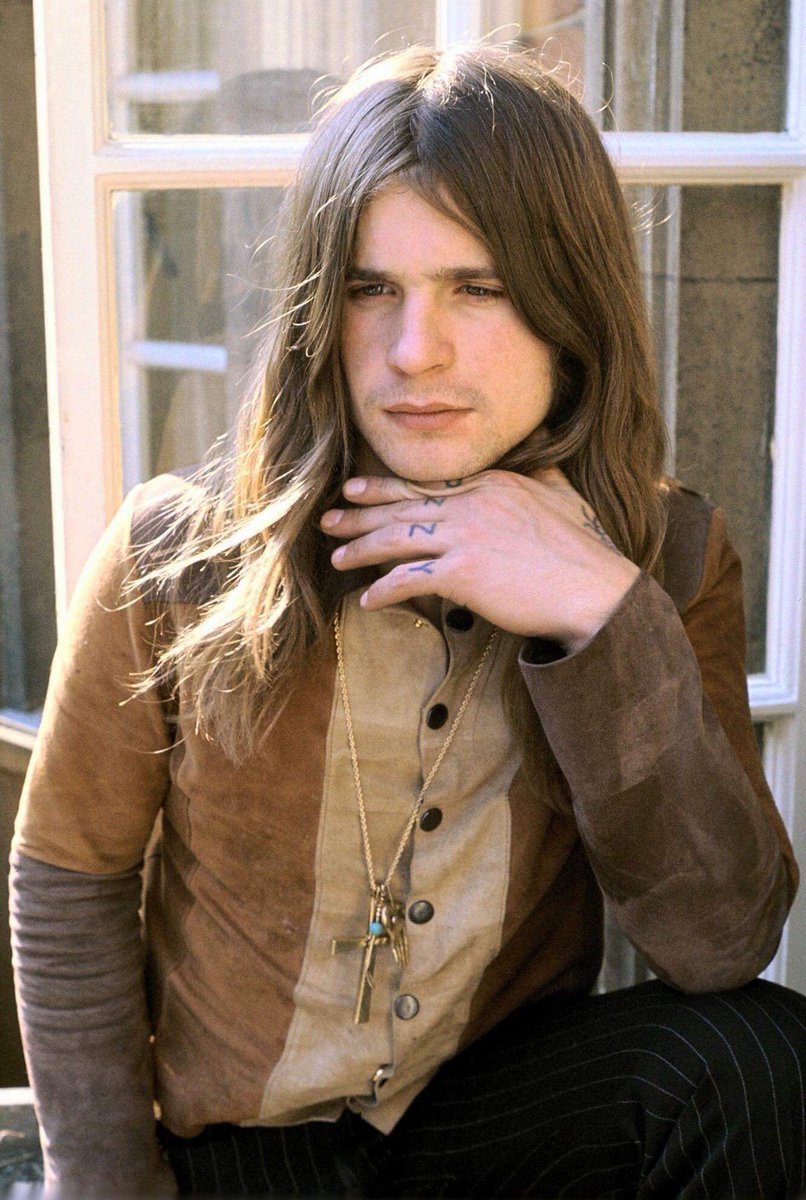


![Hanifkureishi's tweet photo. ALL YOU NEED
When I think about The Beatles, l like to consider an interesting if not provocative statement: 'No masterpiece was ever produced by several people together.'
When I think about The Beatles, l like to consider an interesting if not provocative statement: 'No masterpiece was ever produced by several people together.' This is said by a character in The Counterfeiters, by French novelist André Gide.
Clearly, Gide wasn't pondering movies, or architecture, or newspapers, or popular music from Liverpool. And even if we contemplate the great 'soloists' of our time, like Picasso, do we not have to include in the picture his colleagues and contemporaries? These were poets, philosophers and composers, as well as painters like Matisse and Braque, with whom the great soloist conducted a running dialogue. As with the four Beatles, the respect and rivalry of this close-knit gang made each of them better artists. They too were 'roped together for the climb', as Picasso put it about Braque.
When I - a mixed-race boy, brought up in a rough, lower-middle-class London suburb after the war - dream of this group of friends and collaborators, The Beatles, they remind me of everything I love about Britain. That love is for the exhilarating, dissenting art that comes from its young people. When I think about The Beatles, which I do every day - I sit down and play one song all through in the morning, before starting work, to ignite my mood - I dream of magic, stardust and variety, of lightness, charmand joie de vivre. And I often wonder how this sunshine seemed to break out one fine day in the 1960s.
If you want to understand how people and systems break down, you can learn a lot by studying how creative partnerships like those of The Beatles do work, how they develop, and how brilliant collaborators can together make something extraordinary where there was nothing before, through a kind of play. You could call this Eros, a form of pleasurable, creative making, the best kind of enjoyable work. But it is unusual for the outsider, the passionate observer, to have a chance to witness this kind of labour. Normally, we only see the artist's polished outcome; the struggle, the early Sketches and drafts, remain private.
But here, in the film and accompanying book Get Back, we have a fly-on-the-wall opportunity. This is the only time in their career that The Beatles were filmed at such length while in the studio creating. It is a privilege and an opportunity to see them chatting and improvising, in close-up, in their everydayness. These are young people, don't forget, in their mid to late twenties, three of whom have known each other since school, and who have collectively made music together most days since. Like us they gossip, joke, argue, split up, get back together. Most importantly - they work together.
These four non-posh Liverpool boys worked a lot. They rarely stopped, or had a day off. 'The White Album' had been released in November1968. Here they are again, in this new story, from 2 January 1969, at Twickenham Film Studios in West London, where they would be filmed by Michael Lindsay-Hogg, the director who had made the 'Hey Jude' video.
There they intend to rehearse for a proposed live gig, and work on what became the Let It Be album. They also develop some of the brilliant songs - 'Something', 'She Came In Through The Bathroom Window', 'Carry That Weight', I Want You (She's So Heavy)' and 'Octopus's Garden' - which would later appear on the George Martin-produced Abbey Road. Although they are preparing to play live again - maybe while travelling to North Africa on an ocean liner, playing on Primrose Hill, or perhaps on Gibraltar - they can't agree as to where or how this event would take place. They do know, at least, that Ringo doesn't want to go abroad; he doesn't like the food.
Fortunately for us, this process was recorded on two Nagra tape recorders. There are over 120 hours of it. As well as the music, these tapes contain the conversations between songs by all the band and the crew (although we hear slightly less from Ringo than from the others because his drums weren't always miked).
It's sometimes assumed that this was a sad or grim time for the band, that they were falling apart, unhappy, and no longer really wanted to work together. There were indeed disputes and differences, as there would be with any group of artists. But in fact this was a productive time for them, when they created some of their best work. And it is here that we have the privilege of witnessing their early drafts, the mistakes, the drift and digressions, the boredom, the excitement, joyous jamming and sudden breakthroughs that led to the work we now know and admire.
If you grew up, as I did, after the war in the 1950s, then your notion of culture was bewildering: being taken, for instance, around an endless, unexplained art gallery and being made to listen to Tchaikovsky. The message was clear: culture, whatever it was, was above our heads. We were not people it was made for. Not that we were not already sceptical of adults, who, from where we were looking, seemed mostly to lead dull, unenviable lives. It school was anything to go by, adults seemed to fear and envy young people, when they were not deriding or disparaging them. What was supposed to be appealing to us in the future - the idea of becoming a working adult with a family - just didn't look that desirable.
Yet all the time, young people - particularly if they had heard Elvis or Little Richard - were yearning for art they could understand in terms of the frustration and snowballing sexuality of their lives. An art that would speak for and about them, giving them a reason to be excited about the future. After all, belief in the future is a precious commodity. It is not something you can acquire alone. You need a group, a movement, a shared culture.
And then, suddenly, it was there. It existed. It was happening, in our country.
Britain, having begun to recover from the war, and wondering what sort of place it wanted to be, was being reborn as a country of culture. There were these young faces - The Beatles and others - with strange and fascinating hair on television and in newspapers and magazines; and the music they made was on the radio. Somewhere - mostly in London, but not only in London - there was social mobility, the possibility of escape, and of a fuller future. And it wasn't one of Britain's public schools or great universities which produced these revolutionary boys. It was a war-ruined and ravaged port city in the North.
The Beatles, these artists who were by far the best of all the talent around, were like us, both ordinary and extraordinary, from nowhere and going somewhere - everywhere! Even in the suburbs we were aware the kids were taking over. On the bus to school in the morning you might witness a terrifying parade: there would be Teds, mods, rockers, skins and, a bit later, hippies. It was a meritocratic moment.
From now on, it looked like anyone could try to be an artist: in music, fashion, photography, theatre, movies or writing. It had all opened up. As British kids, until The Beatles, we never knew what we were supposed to be proud of. But once The Beatles arrived, and Britain was at the forefront of a cultural revolution led by young people, London, in particular, was becoming a world city of art, a catwalk, a crucible, a party where you wore what you wanted, and where anything could happen.
Unlike us, The Beatles had busy lives and most days we wondered what they were doing, and, more importantly, what they were thinking. Not that it was difficult to find out. For a while, fame suited them. Maureen Cleave stated in the Evening Standard, in March 1966, They are famous in the way the Queen is famous. When John Lennon's Rolls-Royce, with its black wheels and its black windows, goes past, people say: "It's the Queen," or "It's The Beatles." With her they share the security of a stable life.'
Why would they object to being looked at? We were learning to become consumers, and we consumed The Beatles, who were very consumable. We couldn't get enough. They were, after all, beautiful, desirable, clever and funny, and were forever being photographed somewhere or other, looking sexy and cool. And the music that poured from them so prolifically in a kind of Mozartian flow always seemed effortless. For a start, they weren't coerced into producing it, as we felt coerced and intimidated at school. It was obvious they loved what they did.
What they were up to, and their humour confirms it, was playing. And it is in play, so the psychologists tell us, and Jung in particular who appeared on the cover of Sgt. Pepper that we are at our most human. Play is where nothing is unthinkable, unimaginable or mocked. Play is dynamic, creative, experimental, it is always open to the new. The child makes and remakes the world, taking control of it, exerting a magical mastery over it. A child who couldn't play would be in trouble. Something would be stuck.
The point was: there were four of them, along with manager Brian Epstein and producer George Martin. Despite the dominance of the idea of the romantic, solitary genius, such collaborative magic has happened before. There have been more partnerships in art than stolid old André Gide could imagine. Think of the creative friendship and enmity between Coleridge and Wordsworth, when to be young was very heaven'; of Pound urging Eliot to crop large sections of The Waste Land; of Vita Sackville-West stirring Virginia Woolf's body and imagination so that she could write Orlando; and of Hitchcock and his producer Selznick making Hitchcock's perverse and strange art box-office gold.
Those four Beatle boys were more than good for one another. And 'snags', as Patricia Highsmith calls them in her wonderful book about writing, Plotting and Writing Suspense Fiction, or what we might call 'problems in art', have - she insists - to be solved practically, in the room, not in someone's mind. This is where you need severe criticism and/or encouragement.
It takes a lot of trust and nerve to sing or play a new song in front of someone else. You would need to believe your companions would hear you without mockery, that you were in a welcoming environment. You would also have to believe that exchange and influence is replenishing, nurturing even, and that the other person is not only good for you, but that they will improve and enthuse you. They could change you significantly, in a kind of mutual metamorphosis, or productive encounter. If you're going to argue, you'd want to argue with the right people. Some disagreements can be fruitful or even inspirational. Art is a flux and dialogue, not only with the past, but with the present, with what others are doing. As Charles Darwin wrote, 'It is the long history of humankind (and animal kind, too) that those who learned to collaborate and improvise most effectively have prevailed.'
It is this dialogue of friends we will witness here. Once the group stopped touring and they could concentrate in the studio, their music reached a new level, developing from album to album. As songwriters, The Beatles mostly wrote separately at this time. But they could only have worked with one another in mind, later transforming one another's ideas. They would be one another's convivial, useful critics, mates who would help you produce work you couldn't make alone. To become yourself you need other people.
My parents and I had loved Cliff Richard and even The Shadows; we adored Tommy Steele, who apparently had the good fortune to live nearby in Catford, South London. But there wasn't much originality or freshness to love in most of the British music I grew up with. My father, a Muslim growing up in Bombay, had become enthralled by American writers like Ernest Hemingway, Raymond Chandler and James M. Cain; by American movies and style, particularly raincoats like Bogart's. And when Dad moved to the London suburbs and started a family, there was something new for us from America. We found we were listening to Chuck Berry and Fats Domino on the radio.
By 1964 what a scene and excitement it had become, even for us, people who led conventional, well-behaved lives with ordinary, if not small, dreams. I was astonished to see my own mother screaming at The Beatles in Bromley Odeon - indeed, many of the mothers of my friends, a line of them in the cheap seats, with their hands clapped to their cheeks and their mouths open like in Munch's Scream. Women were not supposed to behave like this. I’d never seen such passion in mothers before. Those Beatle boys, who wrote songs about men desiring women, were certainly doing something to women who thought of themselves as ‘housewives’.
The Beatles did a lot for us. And here they were, bringing in the rest of the world. They were provincial British, English even, but they were never insular: there was always something international, or cosmopolitan, about them. Their Liverpudlian manager Brian Epstein had always felt like an outsider. A failure at school, he'd wanted to be a dress designer. It was his strongest wish. But his father didn't consider it a 'manly' occupation. The Beatles had been seen hanging about in his shop - ‘they were not very tidy and not very clean' - and, after seeing them in the Cavern, Epstein signed them up.
The suits he persuaded the formerly scruffy and leather-clad Beatles to wear made them look French or what we used to call Continental. They resembled Alain Delon or Jean-Paul Belmondo in moody thrillers about good-looking, stubbornly original people, who weren't prepared to fit into the straight world. The Beatles were not only musicians, they had what became known as an Image. They were always at the very pinnacle of style, and their visual sense was strong. Their album covers, as well as their great movie A Hard Day's Night, looked like art works. The Beatles weren't just ahead of the wave, they were the wave.
As if to confirm their originality, more snobbish adults didn't get The Beatles at all. Noel Coward wrote in his diary in 1965, '... On the Sunday night, I went to see the Beatles. I had never seen them in the flesh before. The noise was deafening throughout ... I was truly horrified and shocked by the audience. It was like a mass masturbation orgy.'
The aliveness of teenagers can be terrifying. But if older people looked down on 'beat' music this was all right with us. If teenagers agree about wanting one thing, they don't want to be closed in, or understood. But you can see from the numerous television interviews The Beatles did, particularly in America, how patronised and belittled they were, and not taken seriously as artists. Pop was supposed to be as throwaway as advertising, and as permanent as candyfloss. A year later no one would remember those songs. Or want to hear them again.
Why did they seem so fresh? Outside of pop, the highbrow, war-stained culture of the early '60s was heavy with history. It was deliberately difficult and obscure, as far from the market as it could get. It was intellectual: you'd have to know a lot to make it out. In music there was Morton Feldman, in literature Samuel Beckett and Alain Robbe-Grillet, and in art there was Mark Rothko. This art was sublime. But it was not easy, popular or uplifting. In some ways it was deliberately frustrating, anti-hedonistic. It wasn't afraid of being boring; it wasn't committed to the market.
For me the question was: how could you put your love for The Beatles together with your fascination with Waiting for Godot? In what way might they be similar? How to understand it? One day I discovered a copy of Susan Sontag's essay collection Against Interpretation in a second-hand bookshop in Bromley. (This was a time when there were several bookshops in the town.)
What had struck me was a photograph on the cover of the volume. Wow, I thought, who is this? It was indeed the author, a ravishing dark-haired young woman, looking like an intelligent model.
And what she was telling us was mind-blowing. Sontag isn't condescending. She mentions The Supremes; she's telling us that Style wasn't just the box, it was what was inside the box too. Style itself was art; the popular was serious, and the serious could be a bit frivolous, like Duchamp, or playful like Picasso, and popular like Hitchcock. The Look was all. It was Style, not morality, that mattered when it came to art. Works of art simply exist. They just are; they don't have to be deep. She talks about intelligence, grace and sensuousness'. Then she mentions The Beatles, along with Jean-Luc Godard and the great Italian director Michelangelo Antonioni, an acquaintance of Paul McCartney's. The Fabs had it. Everything had already changed.
To me, this was a revelation. Our education had tried to teach us that real art, even when it was boring, should morally improve you, make you a better person, cultured, aware, more fastidious, with a posher accent even. Education would show you the way. The authorities never stopped telling us what to attend to, what really mattered and what was worthless. What was called culture was always highly regulated and policed. The boundaries were supervised. You crossed them at your peril. If the borders fell, there would be chaos, wouldn't there? The 1950s had, after all, been an era of postwar scarcity, and art was scarce too. Not everyone could have it. Not everyone could understand it. Not you. Not your class or type.
But we'd stopped listening to the authorities. We knew by now that the cinema - formerly considered cheap entertainment - was considered to be art. We'd heard Elvis and now we'd discovered The Rolling Stones, The Beatles, The Kinks and The Who. They'd led us to bodies and to pleasure, and shown us what gratification art could effortlessly deliver. And the authorities - indeed most people - were suspicious of pleasure, and of any art like Pop that appeared to dispense unmediated good times and desire. Pleasure was a kind of sex, after all, and sex, let's say, could be a slippery slope.
Almost all art for young people was produced by adults, mediated by adults, and approved by them. Adults, apparently, knew what young people need, and what would be good for them. The kids had no say in it. But now they did. The Beatles were at the forefront of this revolution. If there was to be taste and fine distinctions, pop - the stuff we loved and danced to - was considered far below that. It barely counted as important on the scale of art. Again, that had changed: art was pictures and music. We were free.
Then, one day, as we all know, it became clear that this charmed collaboration had become a burden if not a limitation. It began to fall apart.
During the break between 'The White Album' and the Let It Be sessions, George Harrison had been in Woodstock, NY, with Bob Dylan, whom he adored and admired. Harrison had worked with Dylan, as well as with The Band, jamming, writing, and teaching Dylan new chords. In 1968 he and Dylan had written I'd Have You Anytime' together, later released on All Things Must Pass. Music was changing, becoming simpler, less psychedelic and experimental. It had entered a new period, more sincere and rootsy.
On his return to Britain, Harrison disliked the cavernous, inhospitable Twickenham studios. Something had started to change in him. He and Dylan had been equals, working together. With Lennon and McCartney, he had been a younger brother. Through his adolescence and young manhood, he had hidden himself behind that double-flower, where he was protected but also overlooked. He did have, after all, two older brothers. Being the younger one was a natural position for him. In some relationships, you might want to disguise or hide your talent because it threatens others. But this became the childhood he had to leave behind. The son was, indeed, coming.
We can hear the strain. During the Let It Be sessions it is George Harrison who says, 'Ever since Mr Epstein passed away... it's never been the same.' Paul agrees. He can see it too. 'We've been very negative since Mr Epstein passed away. I mean, you know, that's why all of us in turn has been sick of the group, you know, 'cos there's nothing positive in it. You know, it is a bit of a drag. But the only way for it not to be a bit of a drag is for the four of us to think, Should we make it positive?’
It does become positive. Once they move to their own studio, in the basement of Apple at 3 Savile Row, everyone cheers up. There is a burst of creativity before they appear on the roof a week later. Another electrifying element had been added: Billy Preston. Preston, who had first met The Beatles in Hamburg in 1962, was recording a TV special for the BBC, and was invited to join in by George Harrison. 'I feel much better since Billy came, because I feel as though he's doing fills which...' Paul: 'That we should have been doing, yeah.' George adds, "Cos sometimes it's like... any time there's a space missing.'
During this time they work on several songs simultaneously: 'Don't Let Me Down', I've Got A Feeling', 'Get Back' and others. In the transcripts we see them evolve. We can pinpoint the exact moment when Ringo suddenly finds the shuffling beat in 'Get Back', so essential to the classic song we know and love.
At one point during the sessions George Martin says to John Lennon, 'You're writing all the time, aren't you, John?' to which John replies, 'Sure I am.' Later, George Martin comments, 'You're looking at each other, you're seeing each other, you're... just happening [clicks fingers).'
After a discussion about the best place to buy comfortable black slip-ons, there's a lovely section when they all get down to work on 'Something' together. Harrison says he's already been working on it for six months, without getting any further. Now they all toss in suggestions for words and lines. Harrison remembers that a while ago, Lennon had given him good advice: that you should finish a song once you've started, presumably before you forget what inspired it. Naturally Lennon doesn't take his own advice. But now he says that, to keep the song moving, you should say any line that pops into your head. 'Attracts me like a cauliflower' is his idea for 'Something'.
After all the humour, incessant work, disputes, and the first mention of Allen Klein, they gave us a fabulous finale. The live session on the roof took place at the end of January 1969, and in February of that year they would cheerfully get down to work on the masterpiece that is Abbey Road.
From the point of view of the public, the rooftop gig was the last time we would see them perform as a live band. It was a collective decision to play on the roof, after many debates throughout January, but uncannily the ending of the concert was predicted in a discussion between Paul McCartney and Michael Lindsay-Hogg in early January. Paul says, 'It's almost in a way we [should] do the show in a place we're not allowed to do it. You know, like we should trespass, go in, set up and then get moved - and that should be the show. Getting forcibly ejected, still trying to play your numbers, and the police lifting you.'
Could there have been a better way to go, high above the city, almost floating, and with the police on their way? It was as positive as Paul wanted: this beautiful, poignant and fitting climax, the four of them, with the great Billy Preston on keyboards, on a gloomy day on a cramped and dangerous-looking roof in Savile Row, where the band can barely be seen by anyone. It took place in London too, interrupted by cops who look younger than the band.
Don't cry about it. The end of The Beatles was as necessary as it was inevitable, as important and liberating as the end of any relationship. The Sixties were done; the Seventies would be darker and The Beatles were only rarely a dark band. Something else, far harder and crueller, would be required. After Abbey Road there would be Bowie's Hunky Dory.
Bowing out is an art too. We are aware of the end even as we read these conversations. They discuss it openly, and with little rancour. Before he walked out and then came back, George said, I think we should have a divorce,' with Paul replying, 'Well, I said that at the last meeting. But it's getting near it, you know.'
Not long before the poignant finish on the roof there'd been a glimpse back, moving paeans to their dead mothers: McCartney's 'Let It Be', and Lennon's 'Julia'. Then the two songwriters left their childhoods behind, disappearing into the future, where they would concentrate on the important work of being parents. They'd been kids for a long time. But they can't, after all, even agree where or whether to play live at all. Their friendship remains, but their enthusiasm for one another has waned, as it would have to.](https://pbs.twimg.com/media/GXlk40aWUAArFAT.jpg)