The Treasury costing error shows how pernicious new capital gains tax is. Treasury incorrectly claimed an ‘indexed’ loss of $120 k, when the nominal loss you can claim was only $30 k.
https://t.co/1LgN2r2mw2
If Treasury done the maths right on their new world’s highest capital gains tax, the investor has 0 net gain and still pays $40,000 tax. How stupid does that example look in a correctly calculated public document explaining their new tax???
https://t.co/zxxy2u1Krr
The inability to index losses under the redesigned CGT is literally the number one problem we’ve all been banging on about for months on here. Many of us have modeled it. And apparently Treasury still doesn’t understand it. Staggering incompetence.
pretty awesome how Accenture’s whole business model is charging tens of millions of dollars for a hundred consultants to say yeah dawg so what we’re gonna do is export your labor force to India and make everything way worse but you’ll save ~3.5% on payroll over the next 2 years
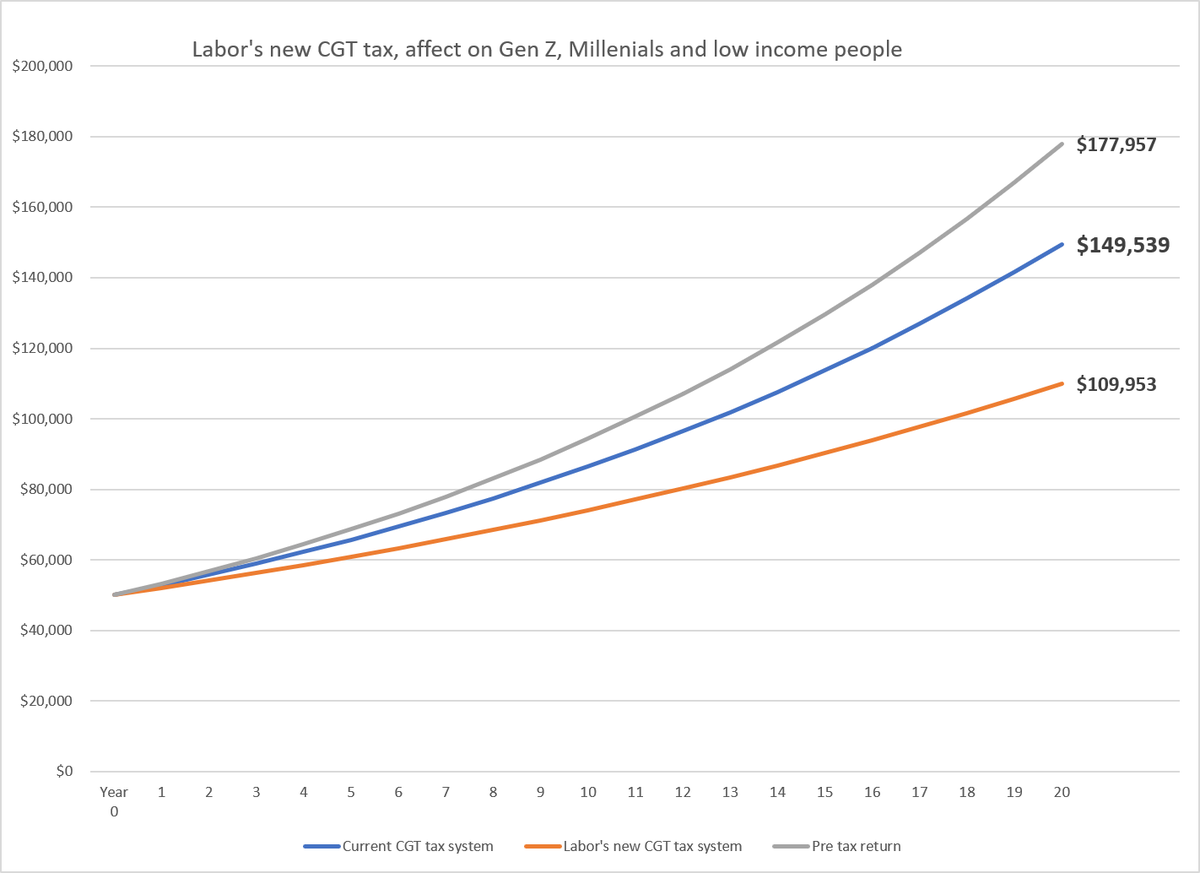
Below graph captures the effect on young people trying to grow wealth under the old and new tax system: in real terms $50,000 invested over 20 years grows to $150,000 under current system, but just $110,000 under new system, with government taking over 55% of the gain in tax!
The change he is making is to tax people more to pay for his govt’s higher spending on things like the NDIS that costing way more than expected and has been rorted. He is making no genuine change to housing affordability. New houses cost too much to build because of govt taxes which account for 43 % of the final cost. He is saying things his researchers tell him people want to hear while delivering nothing but higher taxes.
U.S. taxpayers who make less than around AUD $70,000 pay zero tax on capital gains.
Meanwhile in Australia we are going to slug students, stay at home parents, early retirees and people between jobs with a punitive 30% minimum tax.
What a joke.
When you think:
- imposing a 30% minimum CGT on a retiree
- increasing the effective CGT rate on a typical portfolio to >50%
- 60% tax on typical small business arrangements
While trumpeting a ~$5 per week tax offset as meaningfully “cutting taxes” is “fairer”…
Another reason some Australians are building their futures elsewhere: 🇦🇺
In 2008, Australia’s top 45% marginal tax rate kicked in above A$180,000.
In 2026, it starts at just A$190,000.
Adjusted for inflation, the 2008 threshold would be A$290,000 today.
That’s nearly A$100,000 of silent bracket creep.
Insane.
Wow, the support for Albo and Chalmers' world's highest CGT has fallen from 33% to 27% in May to July respectively, and opposition has increased from 32% to 37%.
Who woulda thought?
Keep going, and they'll eventually get the message. 💪
https://t.co/VjWftk10qJ
Australia : Who Gets Welfare?
https://t.co/93NkSE7Yzc
So initially I thought the numbers in the post below couldn't possibly be right so I pulled down the reports and dissected out the data and got AI to cross correlate.
Conclusion: "The numbers are credible and legitimately derived from the exact public government sources listed in the chart (DSS recipient data + ABS population data). They are not fabricated".
I mean WHAT THE HELL!!?
We are such a stupid country for voting in the screaming leftie incumbents...
@PaulineHansonOz@AngusTaylorMP
Why are we importing endless low-skilled migrants to steal jobs from Australian teenagers?
We do not need to ship in Indians to work in fast food restaurants.
>GM, another day in the "lucky country"
>PM has nuked all investment vehicles bar hooms & super
>hooms going down, super to become a "national asset"
>another 250,000 jeets arrive
>bacon & egg roll plus coffee is $25
>20B of NDIS fraudbucks redirected to public service leeches
The 9 most terrifying words in the English Language:
Anthony Albanese and Jim Chalmers saying: "The Labor party want to undertake ambitious tax reform." Please retweet.
Find a credible economist prepared to public debate me on new CGT, argue why its good: defend the world's highest CGT at + 60% tax on real returns, non neutrality shares v managed funds (shares paying 60% higher tax), taxing risk 50% to 100% higher for same return.