Prabowo’s @prabowo governing instinct is becoming clear:
When an institution does not work, do not fix it. Build a new one beside it.
School canteens and existing nutrition programs → MBG
Cooperatives → Koperasi Merah Putih
Public schools → Sekolah Rakyat
State universities and leadership institutes → Universitas Republik Indonesia
The mandates are not identical, but the pattern is similar: a new institution, a new bureaucracy, a new budget and a new acronym.
Why build instead of repair? Because fixing an existing system means confronting entrenched interests, procurement networks, incompetent officials, local politics and decades of accumulated failure. Building a parallel system is politically easier. You can appoint your own people, control the budget, announce ambitious targets and market it as transformation.
But duplication has a cost: overlapping mandates, fragmented accountability, competition for talent and permanent fiscal obligations.
Indonesia does not suffer from a shortage of institutions. It suffers from institutions that do not work.
Real reform is slow, boring and politically painful. New programs create headlines.
Institutional reform creates results.
The World Bank's latest report delivers a message that is far more important than "Indonesia should collect more taxes." The real message is that Indonesia does not have a debt problem, it has a revenue problem. For decades, Indonesia has operated with one of the smallest public sectors among emerging economies, not because it has chosen to spend lavishly, but because it simply collects too little tax relative to the size of its economy.
The numbers are striking. Indonesia's tax revenue amounted to only 10.1% of GDP in 2024, one of the lowest among regional peers. More importantly, the World Bank estimates that the government currently collects only 52% of its potential Corporate Income Tax (CIT) and 53% of its potential Value Added Tax (VAT). In other words, nearly half of Indonesia's corporate and consumption tax base is never translated into actual government revenue.
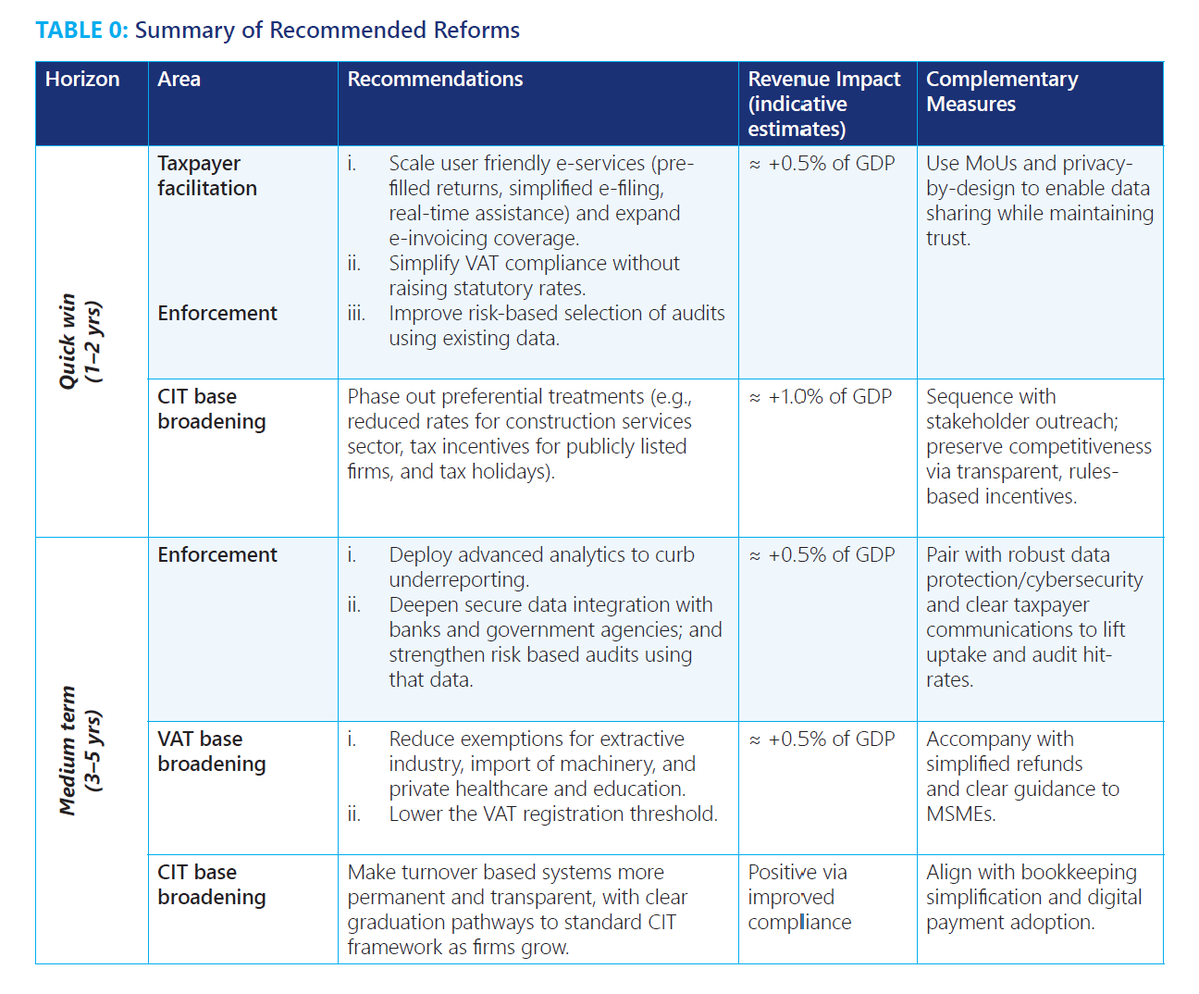
The report estimates that reforms could ultimately unlock around 2.5% of GDP in additional revenue over time through better enforcement, broader tax bases and digital administration. The theoretical upside from fully closing the CIT and VAT gap is even larger, roughly 6% of GDP, although the report recognizes that achieving full potential is unrealistic in practice.
What is particularly interesting is where the World Bank believes the money should come from. Contrary to what many fear, the report is not advocating higher statutory tax rates. Instead, it argues that Indonesia should collect more efficiently by broadening the tax base and reducing leakages. Among its recommendations are phasing out preferential corporate tax treatments, reducing VAT exemptions, lowering the VAT registration threshold, expanding e-invoicing, integrating tax data with banks and government agencies, deploying advanced analytics for risk-based audits, and simplifying taxpayer services such as pre-filled returns and digital filing. Together, these measures are expected to generate meaningful revenue without increasing headline tax rates.
The report also highlights Indonesia's structural challenge: around two-thirds of firms operate informally. That means a large share of economic activity remains outside the tax net altogether. Formalization therefore becomes more than a labor market issue; it is a fiscal issue. Every business that joins the formal economy broadens the tax base, improves competition and creates a more sustainable source of government revenue.
Perhaps the sharpest takeaway is what this means for Indonesia's long-term growth ambitions. The World Bank argues that Indonesia needs to sustain growth above 6% per year to achieve high-income status by 2045. Yet public investment remains constrained because tax collection has failed to keep pace with economic growth. The country has maintained prudent fiscal rules, including the 3% deficit ceiling and 60% debt ceiling, but those same rules make stronger domestic revenue mobilization even more critical. With limited room to borrow, higher investment in infrastructure, education and healthcare must ultimately be financed through a larger and more efficient tax system.
The investment implication is straightforward. Indonesia's fiscal challenge is less about excessive spending than about insufficient revenue collection. If the government can materially improve compliance through digitalization, better data integration and broader tax coverage, it would strengthen fiscal sustainability without relying on repeated tax rate hikes. That would create more room for productive public investment while preserving macroeconomic stability. The challenge, however, lies in execution. Closing even part of a tax gap worth several percentage points of GDP requires institutional capacity, consistent enforcement and sustained political commitment. As with many structural reforms, the opportunity is enormous, but realizing it will be considerably harder than identifying it.
Link to report: https://t.co/HfjxxTEthO
Google to UNLEASH 32 MILLION MOSQUITOES across Florida and California
‘BIO-ENGINEERED’ insects designed to ‘curb disease’
Plan still awaiting final approval — WTSP
One of the biggest policy mistakes under the Jokowi era was allowing the rapid digitization and platformization of Indonesian SMEs without first building stronger domestic wealth creation and local platform ownership.
On the surface, platforms like Tokopedia and Shopee appeared to empower small merchants by giving them digital access, logistics infrastructure, and nationwide demand reach. And to be fair, many SMEs initially benefited from that transition.
But over time, the ecosystem increasingly evolved into something far more extractive and financially asymmetric.
Millions of small Indonesian sellers became deeply dependent on platforms they do not own, operating under algorithms, pricing systems, advertising structures, and competitive rules controlled by large technology companies whose incentives are ultimately tied to maximizing platform dominance and shareholder returns, not protecting the long-term sustainability of Indonesian SMEs.
The uncomfortable reality is that neither Tokopedia nor Shopee is majority-owned by Indonesians, yet both platforms extract enormous economic value, transaction fees, advertising spending, merchant dependency, and consumer data from the Indonesian economy every single day. In many ways, Indonesia digitized its domestic commerce layer, but the ownership of that digital infrastructure increasingly sits outside the hands of Indonesians themselves.
The problem becomes even more severe in a country where broad-based wealth creation remains relatively weak.
In economies with strong middle-class purchasing power, deep capital markets, and higher productivity growth, digital disruption can often create new economic opportunities faster than it destroys old ones.
Indonesia is different. A very large portion of the population still depends on small-scale trading, informal commerce, and low-margin retail activity for survival. When hyper-competitive digital marketplaces aggressively compress margins through subsidies, predatory pricing, free shipping wars, and algorithmic prioritization, many traditional sellers eventually become trapped in a race to the bottom where revenue may rise but profitability and economic resilience deteriorate.
What makes this even more dangerous is that MSME exit opportunities in Indonesia remain extremely limited. Many small merchants cannot simply shut down their business and move into higher-paying formal employment because those jobs often do not exist at sufficient scale. For millions of Indonesians, small trading activity is not entrepreneurship in the Silicon Valley sense. It is survival capital. When margins collapse, there is often no realistic fallback option.
Worse, the long-term value capture increasingly migrates upward toward the platform layer itself rather than remaining with the merchants doing the actual work.
The irony is that Indonesia successfully digitized its SME economy before successfully industrializing or materially strengthening household purchasing power first.
That sequencing matters. Technology should strengthen national economic resilience, not simply accelerate dependency on external platform ecosystems while weakening the bargaining position of local merchants over time. Digitalization alone is not development if the underlying ownership structure, capital accumulation, and economic value creation increasingly flow outside the domestic economy.
RI1 said it. Straight up. Economy was mismanaged.
That's not a small thing to say from that podium.
The market asked for transparency. It got it, maybe more than it expected.
Three things came out of that speech worth sitting with:
One, the underinvoicing problem is being addressed. Routing exports through a single BUMN-controlled door is blunt instrument policy, but at least it signals the revenue leakage is being taken seriously.
Two, Indonesia setting its own commodity reference prices is bold. It can work if the pricing is credible and consistent. If not, it just becomes another reason for buyers to route around you. The market will watch the execution closely.
Three, and this is the one people will underestimate, he was transparent. After days of silence and noise, a leader standing up and saying "we got this wrong" is not nothing. That takes political will. Markets respect clarity even when the message is uncomfortable.
Pros and cons on the policy substance. But on communication, this is exactly what was needed.
God bless Indonesia. Now let's see the follow through.
Oh Tiongkok berkhianat lagi ke Iran seperti dulu Ia berkhianat ke Uni Soviet hingga hancur berantakan sekarang dan berkhianat ke Indonesia saat Kissinger datang.
Politik itu kotor sekali.
🫢🫢🫢🫢🫢
Trade Surplus maret surprisingly ok, padahal Oil import harusnya lebih duluan bengkak daripada adjustment ekspor. Implying probably : Capital Outflow & Repat DVD Season + Domestic Panic tuker USD. Gak salah, soalnya High Net Worth and Corporate been through a lot, ini vote of disKonfiden mereka. Tapi bisa juga berarti ini upfront act out of fear & higher real rate anticipation. Yang berarti kalo Middle East ease, Rate Hiked, weeks go by without meaningful public discourse. IDR regain ground
Tapi China protes terhadap Amerika terkait MDCP dengan Indonesia. Mereka protes bukan karena peduli dengan Indonesia. Tapi karena merasa hegemoninya di ASEAN khususnya di LCS terganggu dengan adanya Amerika yg meminta akses terbang bebas diatas wilayah Indonesia.
Mayoritas pedagang di Indonesia adalah rente middleman.
Gak ngasih produksi apa-apa cuma nambahin harga barang sampe ke konsumen.
Isu orang Indonesia itu harus mampu produksi lalu berdagang.
Ini produksinya gaada, dagangnya juga jadi rente atau makelar wkwk