Was chatting with @svembu ji this morning about limits of AI. I asked him what’s left for us once models commoditize reasoning.
He said and I quote (with consent) -
"Nature, Nurture, Culture, and Scripture."
Liked that perspective. Intelligence is no longer the moat :)
Forgive me for still having an Asian Games hangover, but as I start this week, one story from the Games keeps coming back to me.
Sujeet Kalkal was 9-2 down with less than a minute & a half left.
Most of us have an inner voice that does the maths at a moment like this.
I certainly admit to having such a voice.
It assesses the odds and tells us when the rational thing is to accept defeat.
Sujeet clearly has another voice. One that says: Not yet.
He kept going. 9-2 became 10-9. And an Asian Games gold.
The lesson goes well beyond the wrestling mat.
When I look back, I realise that some of my key successes in business came when I listened to my other voice that fought the rational one and simply refused to throw in the towel.
There are times to listen to reason. And there are times to tell it to wait.
It ain’t over till it’s over.
#MondayMotivation
Dear Doctors,
Please, please take care of yourselves too.
Yesterday we lost Dr. Kandhari - a brilliant neurosurgeon, just 49 years old. Too young, too soon, too huge a loss. A life spent saving other lives.
He left behind family, patients who trusted only him, and a reminder for all of us that even the strongest hands need rest.
As the legend says, "You are as good as your last patient" - but who takes care of you after that last patient goes home?
There will be no medal for you on 15th August or 26th January.
No one will count your sleepless nights, your missed meals, your skipped family functions, your anxiety before a critical surgery.
In the corporate world, the hospital earns the profit - but the world will still count YOUR fee.
They will abuse you, blame you, and question your intentions, forgetting you haven't slept for 30 hours.
You are on your own. So please, be on your own side too.
- Get your health check-up done
- Eat and sleep on time
- Be with your family, not just your patients
- Say NO when your body says no
- Allow yourself to be human
You cannot pour from an empty cup. You cannot save others if you don't save yourself first.
Look after yourself, Doctor. We love you and we need you.
OMS 🙏🏻❤️
El discurso de Alexander Zverev que tenés que escuchar. ❤️
🗣️ “Quiero agradecer a una persona más. Alguien que nunca ve realmente mis partidos, pero que es la persona más importante de mi vida tenística y de mi vida en general.
Cuando tu hijo de 4 años es diagnosticado con diabetes y los médicos te dicen que su vida y su práctica deportiva serán muy, muy limitadas, hace falta una madre muy fuerte para salir de ese consultorio y decir:
‘Mi hijo estará donde quiera estar. Si quiere ser tenista, será tenista. Si quiere hacer otra cosa, hará otra cosa. Pero esta enfermedad no nos va a definir’.
Mi madre es la persona más importante y fuerte que conozco. Hace falta una mujer increíblemente fuerte para hacer lo que ella hizo”.
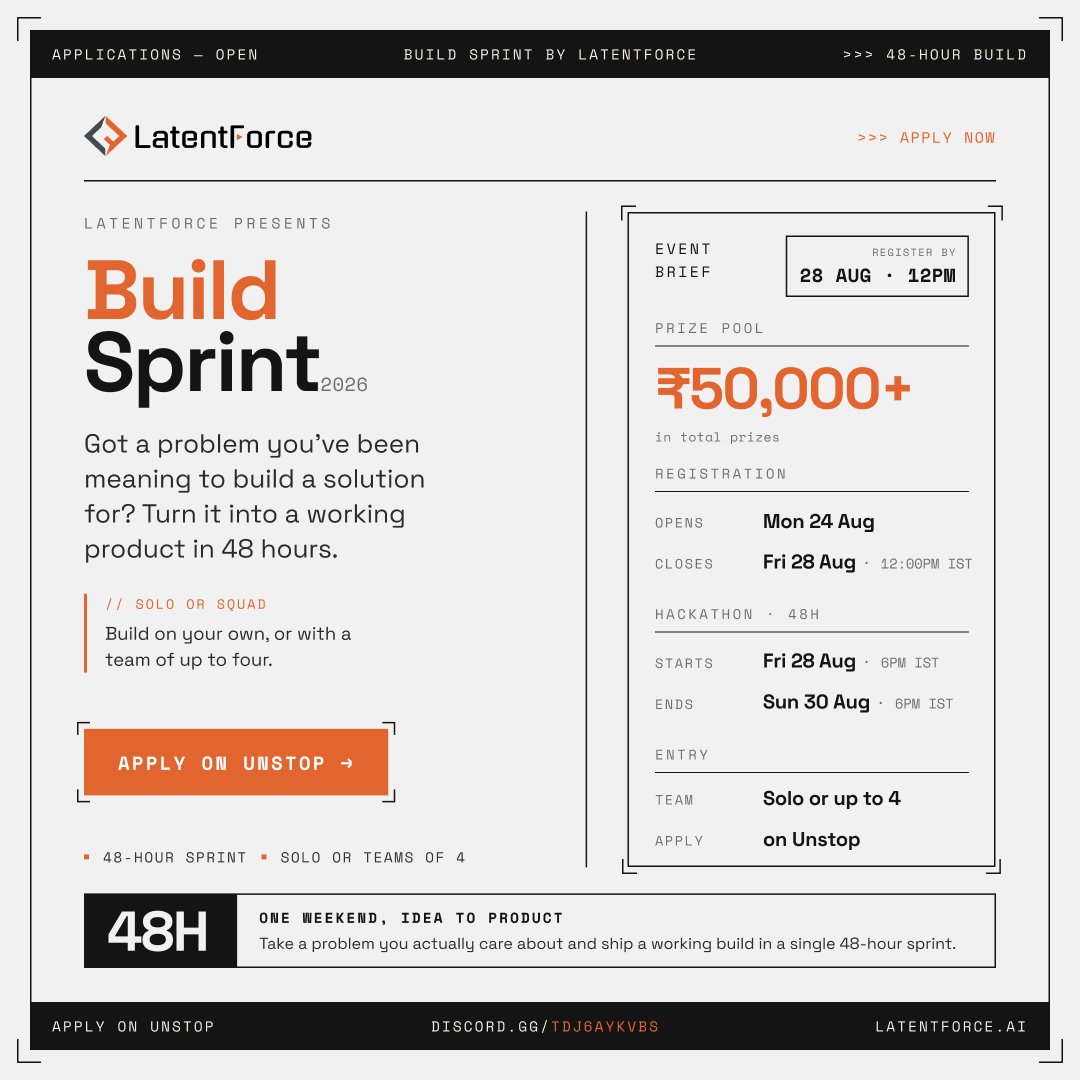
We are hosting a build-a-thon at @LatentForceHQ.
Turn your ideas into a working product in 48 hours with our BuildSprint.
₹50,000+ in prizes. Build solo or with a team of up to 4. 28 Aug, 6 PM IST → 30 Aug, 6 PM IST
Join here - https://t.co/5Y2N3l8QMw
Indian students are DIYing a semiconductor fab at IIT Bombay.
In just 10 months they've built:
1. A DLP-based lithography machine.
2. A tube furnace to oxidise silicon.
3. A DC plasma sputter.
Total cost: ₹30 lakh.
Here's a rare behind-the-scenes look at HackerFab IITB.
Let me explain what just happened today because it deserves so much recognition.
GalaxEye is a Bengaluru startup founded in 2021 by IIT Madras engineers. Today they launched Mission Drishti on a SpaceX Falcon 9. It is India's largest privately built satellite at 190 kg. And it carries a technology that no commercial satellite has ever carried before.
Normal satellites take photos of the Earth using optical cameras. Like your phone camera, but from 500 km up. The problem is obvious. Clouds. Night. Fog. Smoke. If any of these are in the way, the photo is useless. India has monsoon cover for 4 months a year. That is 4 months where optical satellites are partially or fully blind over large parts of the country.
The alternative is SAR. Synthetic Aperture Radar. Instead of taking photos with light, it sends radar waves down and reads what bounces back. Radar goes through clouds, through darkness, through smoke. A SAR satellite can image a flooded village at 2 AM during a cyclone when no optical satellite can see anything.
The problem with SAR is that the images look nothing like photos. They look like grainy black-and-white radar maps. A military analyst or a trained geospatial engineer can read them. A farmer, a disaster response team, or a city planner cannot.
Until today, if you wanted both optical and SAR data for the same location, you needed two different satellites, passing over at different times, at different angles. Then someone had to manually align and fuse the two datasets. Expensive, slow, and the data never perfectly matched because the satellites saw the same spot minutes or hours apart.
GalaxEye put both sensors on one satellite. Optical and SAR, fused into what they call OptoSAR. Three times more information than a single sensor. Processed onboard by an NVIDIA AI chip at 1.8 metre resolution.
Now in practice, during the next cyclone hitting Odisha, one satellite pass gives you a clear image of which villages are flooded, which roads are cut, and which buildings are standing. Day or night. Cloud or clear. In near real-time.
For defence, it means you can monitor a border area 24/7 regardless of weather. For agriculture, it means tracking crop health across an entire monsoon season without a single cloud gap. For infrastructure, it means monitoring construction progress on highways and bridges without waiting for a clear day.
GalaxEye tested their SAR tech on ISRO's POEM orbital platform. The satellite was tested at ISRO facilities. IN-SPACe provided regulatory clearance. NSIL, ISRO's commercial arm, will distribute the imagery globally. And it launched on SpaceX because ISRO's PSLV doesn't have the right orbit slot for this mission.
Yes, four IIT Madras graduates built a world-first satellite in 4 years in Bengaluru.
Take a bow!
How did a nation with a school in every village become "illiterate" in 100 years?
The answer isn't a lack of talent, it was a deliberate policy designed championed by people Thomas Macaulay to "form a class of persons Indian in blood, but English in taste"
The death of the Pathsala👇
Video is live:
Being a life long learner and a student of life, it was great to back to school and learn more about Generative AI and Agentic AI with Business Applications from @iimb_official
I express my gratitude to Dr Dinesh Kumar & Prof Naveen Kumar Bhansali for sharing their knowledge and wisdom.
Executive education thrives on collaborative group learning. The presence of executives from diverse backgrounds, varied experiences, and different industries greatly enriched the learning experience.
My top 5 learnings:
1. First, understanding business problems (use cases) and asking the right questions matters more than choosing AI technology. Don't put the cart before the horse, even though AI is exciting.
2. Reliable, high-quality data combined with deep domain expertise drives impact beyond mere value. Don't expect GIGO—Garbage In, and Gold Out.
3. Enterprise AI projects are agile and iterative, as user queries and model responses are probabilistic and non-deterministic. Don't underestimate users or overestimate the model.
4. ROI isn't the best metric for AI projects. Don't expect results in a couple of months—it's not an alpha-return scheme.
5. Always remember Tokens are the fundamental units of GenAI and Agentic AI systems. Don't overuse, use them prudently.
As innovation accelerates, possibilities multiply.
Stay adaptive and keep exploring.
Good article.
AI is a tool. Yes, innovations are happening at a never-experienced-before velocity with many new releases every week.
In this AI era, the underrated skills are:
asking the right questions,
critical thinking,
right judgement,
continuous learning and
"i-can" mindset.