It's that time of year again 🧬 🚀
2026 has been a landmark year for #TechBio, with rapid advances in AI-driven drug discovery, foundation models for biology, lab automation, and the growing convergence of software and the life sciences. As the field continues to evolve, we want to hear from the people building its future. We're excited to launch the 2026 @bitsinbio State of TechBio Survey!
Each year, this survey helps us get a pulse on the TechBio community, exploring emerging technologies, industry trends, challenges, and opportunities shaping the field.
Help us spread the word. Whether you're a scientist, engineer, founder, investor, student, or simply passionate about the intersection of technology and biology, we'd love your perspective. Share the survey with your colleagues and networks so we can capture perspectives from across the ecosystem.
https://t.co/D8tsm4DHGW
For my first post, I’m sharing a letter @NVIDIA signed on why open models matter.
AI will transform every industry, power every company, and be built by every country.
Open models strengthen safety and cybersecurity, accelerate innovation and diffusion, and enable sovereignty.
The world needs both frontier closed models and frontier open models.
https://t.co/AUKzoQ5Ikb
I recently deployed a project that I started during Christmas break: a full-stack cloud based #simulation platform. It was a fun exercise exploring a topic I’ve always found fascinating while diving into the deep end building a large and fairly complex system using #AI-driven development.
The project is called #Chaox. It allows you to create simulations using a custom #Python-like DSL (domain-specific language). The DSL is then compiled into an IR (intermediate representation) which is executed inside a custom #Rust engine. The simulation may be run directly in the browser using #WebAssembly, or on the Chaox #cloud. There is a built-in AI assistant which can help you draft simulations (and validates that they compile), as well as usage tracking to monitor cloud and AI spend. Additionally, there is support for custom Rust plugins which can be used within simulations, enabling capabilities like ML inference within simulation time steps using either #ONNX or #Candle.
Full Blog Post: https://t.co/B3IZkKDkxA
In a sea of endless #software products, and with an effectively infinite capacity to generate more software at will with #ai, how do you stand out?
https://t.co/vm5xDPlJ3V
The sharp decline in Nasdaq SaaS indexes following the recent announcements from @AnthropicAI is not surprising to anyone who has been building anything the past few months. Seeing this play out first hand in #biotech.
https://t.co/00TD0v0e2N
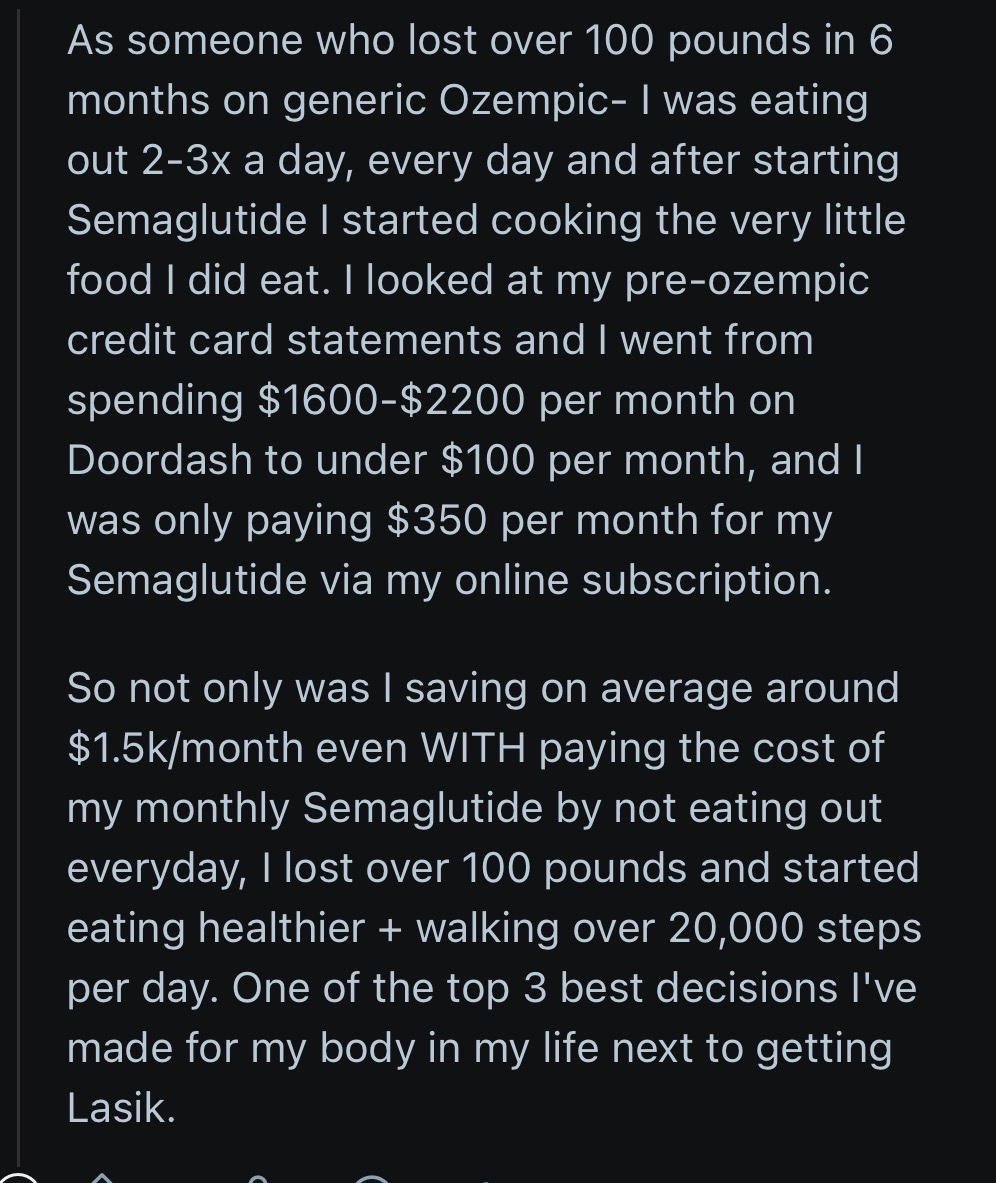
Seen on Reddit👇, GLP-1s are best consumer product since the iPhone. We should put half the drug discovery effort in biopharma against consumer applications like this.
This is the most important story in biotechnology right now. We're losing the startup biotechnology ecosystem to China -- US biotech VCs are opening offices in China and large US Biopharma companies are acquiring Chinese startups (30% +of new acquisitions!) which pushes $$ back into that ecosystem. Meanwhile 30% of biotech lab space is vacant in our biotech hubs and funding of US biotech startups is at its lowest in years. This would all be a reasonable trade if there was a huge international spend on drugs that made this a global market but the US is in control of the end market for drugs as we are the ones who pay our fair share for drug development. We should flex our muscles here and keep biotech innovation in the US.
I don't see how limiting these acquisitions of Chinese companies will create any chaos as is being suggested in this article -- this isn't about drugs on the market today -- it's about the next generation of innovative medicines. For every one of these Chinese startup biotech's there is are several US competitors with a similar asset that just pays more for scientists, lab space and regulatory so is a more expensive acquisition.
Slowing or stopping these acquisitions won't be chaos -- it will just be worse returns for people that invest in Chinese startup biotechs and better returns for people that invest in US startup biotechs. If China wants to maintain a biotech ecosystem they should pay more for drugs (like we do in the US!) and support that ecosystem.
It was a mistake when we did this the first time around in the tech industry 20 years ago -- with some US tech VCs backing Chinese tech startups and building that ecosystem -- we shouldn't repeat the same mistake with biotech. And we don't need to since the US has all the cards here as we are the large majority of the end market for drugs. Hopefully WH holds the line on this one.
Seems like thanks to ozempic we are maybe exiting the age of obesity, which we will then be able to see in retrospect (maybe) as a temporary period lasting from the rise of the superstimulus of modern food until the discovery of its pharmacological counter.
If it plays out that way then I bet we will see the pattern repeat itself, and I’m declaring by fiat that phone addiction will be the next big one. In the post-phonezempic world we will look back and see things like “digital detoxes” and apps that try to limit your screen time as the equivalent of 90s era weight watchers programs, desperate attempts of the animal to outrun something that it ultimately (apart from a few exceptional cases) was not able to outrun without artificial assistance.
And it will all seem horrifying and primitive, the way that now we look at outbreaks of the plague in the middle ages, when we were completely at its mercy.
We’ve just finished writing the missing 15,616 Wikipedia articles to get complete coverage of all 19,255 human genes. We used PaperQA2, which has higher accuracy than existing human-written Wikipedia articles, as judged by blinded biology PhD students and postdocs. 1/5
Big News! Arzeda has closed a $38M oversubscribed funding round! This investment was led by top investors like @SofinnovaVC, @FallLineCapital, and & W.L. Gore & Associates
https://t.co/TZOzwuDMv1
Huge congratulations to David Baker, Arzeda Co-Founder and Scientific Advisor, for being awarded the 2024 Nobel Prize in Chemistry! 🏆
Arzeda is the first protein design company to emerge from David's lab, contributing to breakthroughs in the field.
https://t.co/7UwDyb1BQs
BREAKING NEWS
The Royal Swedish Academy of Sciences has decided to award the 2024 #NobelPrize in Chemistry with one half to David Baker “for computational protein design” and the other half jointly to Demis Hassabis and John M. Jumper “for protein structure prediction.”
#SeattleTechWeek is next week, and @bitsinbio will be kicking it off with the BIOTECH PREGAME! Connect with Seattle's life sciences community before taking a short stroll over to the official STW Kick Off party.
https://t.co/aBh32UcQph
Very excited to host @bitsinbio during #SeattleTechWeek. Connect with Seattle's biotech community over drinks before the @MadronaVentures Kick-Off Party!! https://t.co/aBh32UcQph
📢 Seattle Tech Week — 7/29 to 8/2📢
Today, we are launching the 2nd annual #SeattleTechWeek! Join us in celebrating the diversity and vibrancy of our tech ecosystem with events all week and into the weekend! Summer in Seattle is spectacular, and while we can’t 100% guarantee the weather, we can guarantee the week will be filled with fun experiences, insights into the future of tech and our region — and networking. Check out the event page and RSVP to some of the great events already on the schedule!
Keep an eye on the schedule because more will get added before the end of July! https://t.co/1gTvvXk5NA
Want to host an event? You can still apply here: https://t.co/8EaJoM0lr8