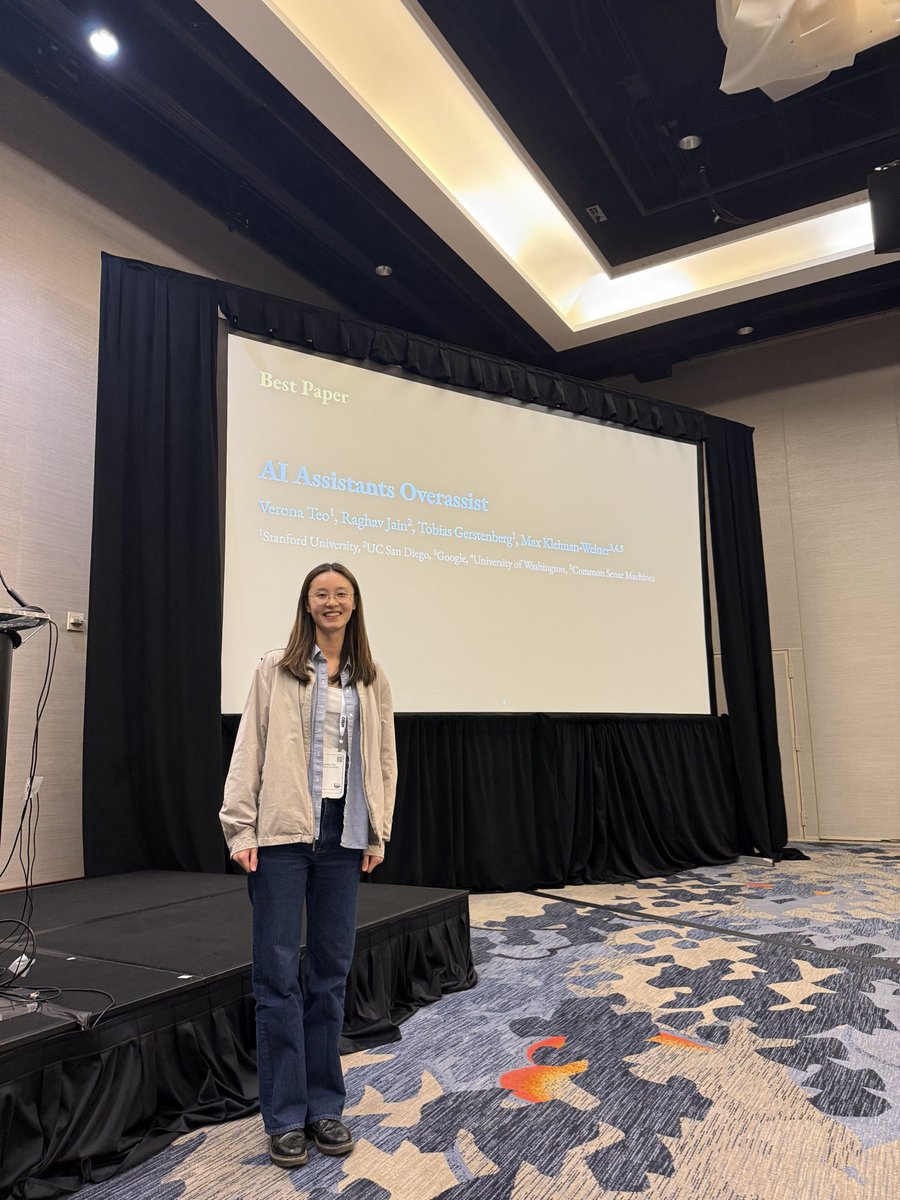
Had a great time presenting our work today at #COLM2026, and thank you to the organizers for an amazing workshop!
Super grateful to my wonderful collaborators @jainraghav10, @tobigerstenberg, and @maxhkw!!
We won best paper at the COLM Workshop on Agent Behavior for our paper: AI Assistants Overassist!
Congratulations @verona_teo, @jainraghav10! Check out the preprint https://t.co/Odb7dE7hil
New lab preprint! AI assistants are myopically helpful. Unlike caregivers that want to empower people and grow their long term autonomy, AI assistants interrupt independent thinking and jump right to the answer.
Deciding when to jump in and help someone—and when to hold back and let them work through it—is something humans navigate constantly. How do AI assistants handle this tradeoff?
We introduce Int-Bench, a framework for evaluating interventions during problem-solving tasks.
Call for workshop papers and Shared Task participation:
The 9th Workshop on Event Extraction and Understanding: Challenges and Applications (EEUCA 2026) (formerly CASE) @ ACL 2026
Also, this year the EEUCA workshop continues the tradition of the eight previous editions of our workshop on challenges and applications of event extraction.
Paper submission deadline: March 16, 2026
Pre-reviewed ARR commitment deadline: April 15, 2026
Notification of acceptance: April 28, 2026
Camera-ready paper due: May 12, 2026
Pre-recorded video due (hard deadline): June 4, 2026
Shared tasks and shared task papers:
Start of the Competition: Dec 10, 2025
Eval Phase Start: Dec 10, 2025
Test Phase Start: Jan 15, 2026
Test Phase End: March 15, 2026
Paper Submission Deadline: March 28, 2026
Notification of acceptance: April 28, 2026
Camera-ready paper due: May 12, 2026
We invite work on all aspects of automated coding and analysis of events from mono- or multi-lingual text sources. This includes (but is not limited to) the following topics
1) Extracting events and their arguments in and beyond a sentence or document, event coreference resolution.
2) New datasets, training data collection and annotation for event information.
3) Event-event relations, e.g., subevents, main events, spatiotemporal relations, causal relations.
4) Event dataset evaluation in light of reliability and validity metrics.
5) Defining, populating, and facilitating event schemas and ontologies.
6) Automated tools and pipelines for event collection related tasks.
7) Lexical, syntactic, semantic, discursive, and pragmatic aspects of event manifestation.
8) Methodologies for development, evaluation, and analysis of event datasets.
9) Applications of event databases, e.g. early warning, conflict prediction, and policymaking.
10) Estimating what is missing in event datasets using internal and external information.
11) Detection of new event types, e.g. creative protests, cyber activism, COVID-19 related, terrorism, food safety, food security, climate change, extreme weather events, disasters.
12) Release of new event datasets,
13) Bias and fairness of the sources and event datasets.
14) Ethics, misinformation, privacy, and fairness concerns pertaining to event datasets.
15) Copyright issues on event dataset creation, dissemination, and sharing.
16) Cross-lingual, multilingual, and multimodal aspects in event analysis.
17) Exploiting LLMs in Event Extraction.
18) Generative AI and event reports: detecting AI-generated news, exploiting generative AI for creating event corpora, etc.
Shared Task 1: Multimodal Identification of Vaccine Critical Content on Social Media
This shared task focuses on detecting vaccine-critical stance in multimodal social media memes. Using the VaxMeme dataset of over 10,000 annotated memes, participants will develop models that jointly leverage visual and textual signals to classify a meme’s stance as pro-vaccine, vaccine-critical, or neutral. The task encourages research on cross-modal understanding, sarcasm, implicit messaging, and misinformation dynamics in public health discourse. External data and transfer learning are permitted, and submissions will be evaluated using macro-F1. All system description papers will be published in the ACL Anthology.
Learn More: https://t.co/WBNWADAAJV
Shared Task 2: Understanding Toxic Behavioral Intent in Gaming Chat Logs for Healthy Online Interaction
This shared task tackles intent-level toxicity detection in online gaming communities using the GameTox dataset of 53,000 annotated chat utterances from World of Tanks. Participants will develop models that classify a player’s message into six fine-grained intent categories, including hate, threats, insults, extremism, and non-toxic communication. The challenge highlights contextual nuance, gaming slang, implicit aggression, and varied severity levels of toxicity. External datasets are allowed, and submissions are evaluated using macro-F1. All system description papers will be published in the ACL Anthology.
Learn More: https://t.co/QMvBjJxXER
Keep an eye on the workshop page that is being updated: https://t.co/eqUpfl7xhg and contact us for any inquiries (submission, collaboration, contribution, or just saying Hi :)
Chairs: @therealthapa@hurrial@TechnoTwitBot
Come check out our work at the “Responsible AI Research & Unlearning: From Consent to Compliance to Critique” panel at 3:30PM and at the poster session right after at 4:30PM at board #902. #NeurIPS2025!
This man dropped out of a no-name college in India to be a software engineer and by 33, worked his way up to being CEO of a $100M+ company in New York.
Here's the never-before-shared incredibly inspirational story of Ershad Kunnakkadan:
> be middle class kid in random state school in Kerala, India
> get really into computers
> senior hands you Ubuntu 8.04 CD, whole new world
> starts contributing to SMC (a malayalam computing group)
> gets into blogging cause SMC seniors are into it
> go to no-name small private college in Kerala
> spend more time in terminals than classrooms
> shell scripting contests, Linux admin, security, virus cleaning, bots, paper presentations
> doesnt see a point to college exams
> drops out after 2nd year, promises family "I will earn a degree somehow"
> lands internship at small software co
> grows into being an architect
> found security bugs in Github and Prezi
> reads "Hackers: Heroes of the Computer Revolution" and the "The Google Story", dreamt of being in the US one day
> does Google Summer of Code
> earns a degree remotely from Bharathiar University
> gets remote job at BigBinary
> moves back to Kochi to be near family
> involved in local free software circles and workshops, events, meetups
> building a quiet dense body of work over loud personal brand
> gets introduced to Gumroad as a consultant first
> joins Gumroad as a senior engineer
> gets married
> moves to Abu Dhabi to be closer to wife's family
> does the boring crucial stuff - scalability, security, payouts, infra
> grows to being a staff software engineer at Gumroad
> support millions of users and $1B+ in creator earnings
> just focusses on self-improvement
> never once thinks about promotion
> moves to New York City on an O-1 visa
> Gumroad looking for a new CEO
> board looks around and its clear who is best fit for the job
> become CEO of a $100M+ gmv business
I just love the story of Ershad. No brands, no pedigree, no MBA, no loudness. When I asked him the quality that got him here, he said "reliability". A truly kind, quiet and generous person. Who loves computers. Dropping out when you're rich is trendy in America, but to see someone Indian drop out and work their way up into the top role is pure inspiration.
Don't worry if you don't have all the accolades and ornaments you see in people who achieve your dreams. Be a good person, and be reliable.
I'm on the job market for academic and industry positions, and would appreciate a repost.
My research spans information systems, data science, and human-AI interaction, exploring how platforms can govern AI-mediated information exchange
https://t.co/uPMvql0n55
Details in 🧵👇
Excited to introduce our SoTA coding models, FrogBoss (32B) and FrogMini (14B), on SWE-Bench-Verified! (FrogBoss eats bugs… like a boss) 🐸🪲
These models were trained with bugs from a mix of existing and our new synthetic bug generation approach, called BugPilot.
(1/n)
Excited to share that Who Speaks Matters has been accepted to #EMNLP2025 🎉
We extended this analysis on how implicit dialect affects hate speech in comparison to explicit markers of linguistic identity and across multiple prompt settings
(1/N)
🔍 Most alignment pipelines compress verifiable and non-verifiable rewards into a single scalar value.
🤔 Can we learn vectorized alignment with smooth inference-time control?
✨ We try to answer that in our latest paper: Simultaneous Multi objective Alignment Across Verifiable and Non-verifiable Rewards
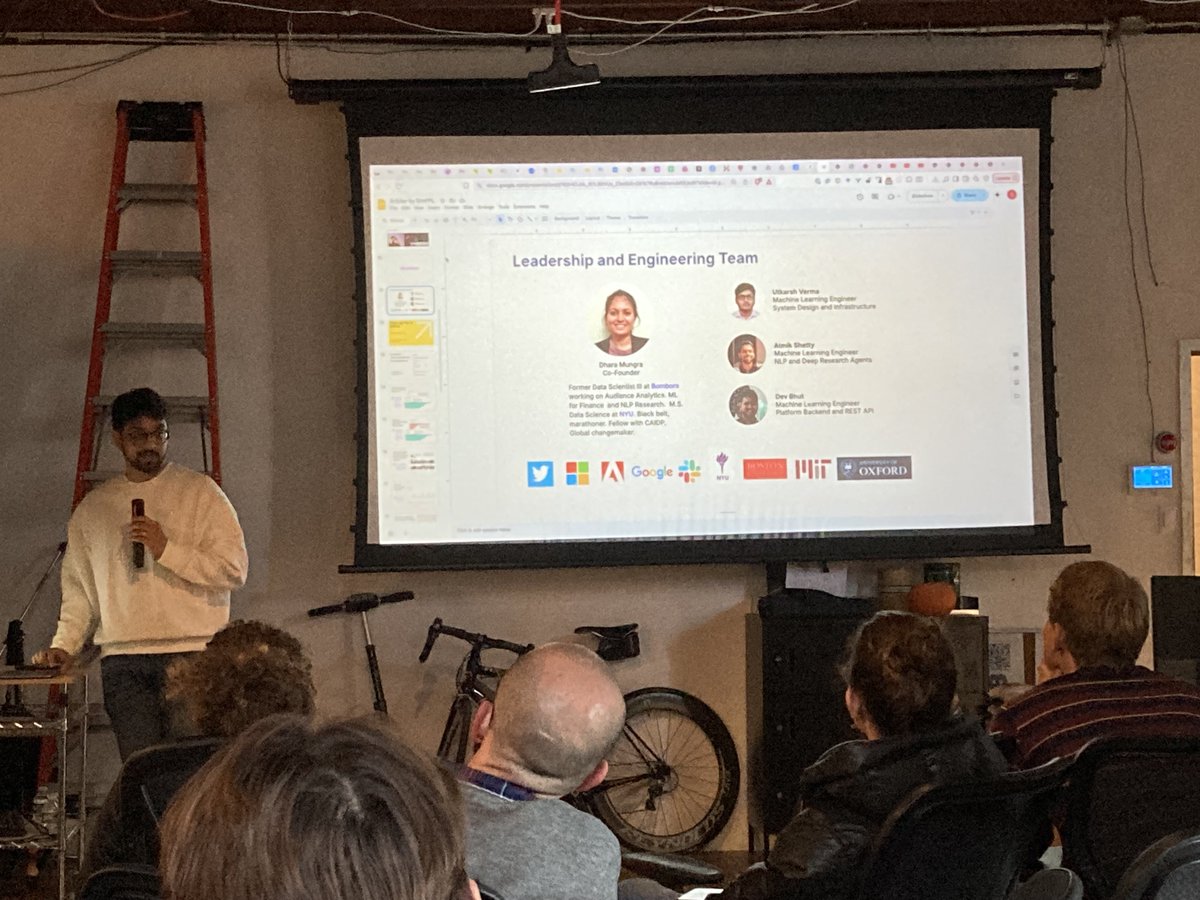
Was super cool dropping in on some talks, talking trust, ZK, interop, attention economy. I especially liked @swapneel_mehta's talk on digital trust - I think sources of truth and propaganda are an ever-interesting and relevant topic
Did you know tokenization for generative recommendation today looks a lot like LLM tokenization did *10 years* ago?
Meet ActionPiece, our #ICML2025 Spotlight paper, the first context-aware action tokenizer.
1/5 🧵
I'm hiring full-time research interns at @lossfunk
Lots of exciting problems to work on in an atmosphere you won't find anywhere else in 🇮🇳 India!
Please RT for reach 🙏