Spent some time with this MIT lecture on game theory.
The part that stuck: a VCG auction is designed so that lying about your valuation can never make you better off.
Bookmark this before it's lost!
Most market mechanisms aren't built that way. Most reward the best liar.
Worth knowing which kind of game you're actually playing.
Most trading strategies are two good rules and ten that do nothing.
This ten rules just make the backtest look pretty. Then you go live, and they quietly drain your account.
You can't tell the two real rules from the ten fakes by looking at a chart. Nobody can.
That's why 89% of retail lost money last year.
Horizon can - it tests every rule, deletes the ten that don't, and hands you only the part that makes money, before you risk a cent.
Free while the beta's open: https://t.co/qMCIUPVKGK
The same check a quant desk does by hand for $25,000 a year. You get it in minutes.
Save this and read the full method below - it's the test that tells you which of your rules are real before the market charges you to find out.
Run your best strategy through it. Most of what you built won't survive. Waitlist almost full.
An algorithm that turns $1 into $36 billion over 22 years sounds like a false headline right.
It's actually Table 3 of a University of Johannesburg working paper (Nkomo & Kabundi, ERSA 394), a Kalman-filtered, momentum-extended Anticor algorithm (K-ACM), backtested on NYSE data from 1962–1984.
No capacity constraints. 10bps in costs, full liquidity assumed.
The mechanism trade on deviation from Kalman trend, not raw returns is genuinely interesting. The headline number is a backtest artifact.
Bookmark this!
UN DESARROLLADOR CHINO MONTO UN SISTEMA DE AGENCIA IMPULSADO POR CLAUDE CODE PARA VENDER SITIOS WEB A PEQUEÑAS EMPRESAS.
SIRVE A UNOS 47 CLIENTES AL MES Y COBRA 400 DOLARES POR CADA UNO.
EL SISTEMA FUNCIONA ASI:
- RECORRE CIUDAD POR CIUDAD GOOGLE MAPS.
- ENCUENTRA NEGOCIOS QUE NO TIENEN PAGINA WEB.
- DESCARTA LOS QUE TIENEN SITIOS QUE PARECEN DE 2014.
- GENERA AUTOMATICAMENTE UN MOCKUP DE LANDING PAGE PARA CADA UNO.
- PRODUCE UN VIDEO PROMOCIONAL.
- ESCRIBE UN MENSAJE DE VENTA LISTO PARA USAR.
TODO ESTO LO HACEN 7 AGENTES:
- SCOUT: EXPLORA UNOS 220 NEGOCIOS AL DIA.
- DIAGNOSER: HACE UN DIAGNOSTICO PERSONALIZADO Y GENERA EL MENSAJE PARA CADA LEAD.
- BUILDER: PREPARA 3-5 LANDING PAGES COMPLETAS PARA LOS MEJORES CANDIDATOS.
- FILMER: CREA UN VIDEO VERTICAL DE 10 SEGUNDOS POR CADA PROPUESTA.
- PITCHER: ENVIA 30 MENSAJES AL DIA POR 4 CANALES DIFERENTES.
- CHECKER: REVISA AUTOMATICAMENTE LOS MENSAJES ANTES DE ENVIARLOS.
- MOBILE AGENT: VIVE DIRECTAMENTE EN EL IPHONE.
EL DUEÑO RESPONDE A LOS LEADS MIENTRAS VA EN EL METRO, EN TAXI O CAMINANDO. SI SURGE UN CLIENTE INTERESANTE, AGENDA UNA REUNION POR CALENDLY Y DEVUELVE EL CASO A LA COLA.
LO UNICO QUE HACE EL ES:
- PULSAR “APROBAR”.
- IR A LA REUNION.
- COBRAR EL DINERO.
Y LO MAS LOCO ES ESTO:
NO TIENE BACKEND PROPIO, NI GRAN EQUIPO, NI ARQUITECTURA DE SERVIDORES.
SOLO USA:
- UN SANDBOX LOCAL.
- CLAUDE CODE ROUTER.
- SERVIDORES MCP.
- ESTADO COMPARTIDO MEDIANTE EL SISTEMA DE ARCHIVOS.
- UNA CLAVE API.
- EL TELEFONO QUE LLEVA EN EL BOLSILLO.
MIENTRAS LAS AGENCIAS TRADICIONALES MONTAN UN EQUIPO ENTERO PARA HACER LO MISMO, EL COSTE REAL DE ESTE TIPO SON SOLO LOS TOKENS + LAS SUSCRIPCIONES A LOVABLE, HIGGSFIELD Y CALENDLY.
GASTO PROMEDIO EN APIS: UNOS 480 DOLARES AL MES.
INGRESOS: 18.800 DOLARES.
7 PROMPTS + 1 SISTEMA DE ARCHIVOS + 1 TELEFONO.
PARA MI, ESTE ES EL EJEMPLO MAS LIMPIO DE “AGENCIA DE AUTOMATIZACION UNIPERSONAL” QUE HE VISTO ESTE AÑO.
GUARDALO, PORQUE EN UNOS MESES TODO EL MUNDO VA A INTENTAR COPIARLO.
Aca abajo te dejo como configurarlo
Acaban de lanzar una herramienta brutalmente útil y 100% open source
Se llama docker android y permite ejecutar un emulador completo de Android dentro de un contenedor Docker.
Sí, leíste bien: puedes tener un teléfono Android virtual completo, aislado, reproducible y fácil de desplegar con solo un comando de Docker.
Por qué es interesante?
- Es minimalista y altamente personalizable
- Funciona en modo headless (sin interfaz gráfica)
- Soporta aceleración por hardware con KVM
- Puedes elegir la versión de Android que necesites (varios API levels disponibles)
- Incluye ADB listo para usar
- Se integra perfectamente con scrcpy para controlar la pantalla de forma remota
- Ideal para CI/CD, pruebas automatizadas, desarrollo y debugging
Todo está en un solo contenedor Docker, lo que significa que puedes levantar entornos Android limpios, consistentes y escalables en segundos, sin tener que instalar emuladores pesados localmente ni lidiar con configuraciones complicadas.
Repositorio oficial 100% open source - MIT License
Estás trabajando en pruebas de apps Android, automatizaciones o entornos de desarrollo? Esta herramienta puede ahorrarte muchísimo tiempo y dolores de cabeza.
Cuéntame para qué la usarías?
Repo en los comentarios 👇
Loop Engineering is getting hype now.
But not many talks about how to actually do it
So I open-sourced the template my team uses to build agent loops:
- a shared artifact / knowledge layer
- logging, verification
- and a codebase harness so work compounds across runs
Plus a 20-min deep dive on how to think about it and set it up for real: https://t.co/b3m22eX8oI
Copy the template. Adapt it to your own loops.
Max Margenot, quant lecturer at Quantopian:
"Jane Street pays $950,000 a year to quants who can explain how to apply stochastic processes and Markov chains in quantitative trading. "
this free lecture from 2017 holds the entire "institutional stat-arb edge" the 2026 quant threads sell you. cointegration, mean reversion, the spread, the entry and exit thresholds, all of it, explained slowly, for zero dollars.
394,000 people watched it. almost none of them made a dollar. the math was never the moat.
a whiteboard can't hand you the actual trade: data nobody else has, execution in microseconds, a server sitting next to the matching engine, and the one thing no formula on that board prices, how two venues actually settle when the window closes.
learn the formula. just never confuse knowing it with holding the edge. the formula's been free since 2017. the edge never was.
🚨BREAKING: A new open-source multi-agent LLM trading framework in Python
It's called TradingAgents.
Here's what it does (and how to get it for FREE): 🧵
as a quant architect, the hardest part of HFT modeling is deciding the timeframe.
You're always choosing between microstructure noise and macro trends.
This paper just cracked it with a Neural HMM that adapts its own granularity.
2.78 Sharpe. Game changer.
Bookmark and Read the article below.
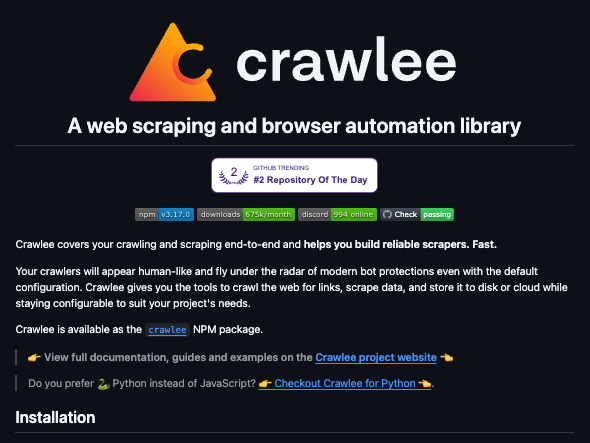
10 GITHUB REPOS THAT SCRAPE THE ENTIRE INTERNET FOR YOU
Bookmark every single one. Each one pulls clean data off any website on earth, the kind of access companies sell behind a sales call and a contract.
1. https://t.co/yjhB8qsY2r
Point it at any website and it crawls every page, renders the JavaScript, and hands back clean structured data an AI can read instantly. It crossed 130K stars and landed in GitHub's top 100 repos. The scraping backbone half the AI startups quietly run on, open for anyone.
2. https://t.co/H8tTZjwd7O
The #1 trending crawler on GitHub. Turns any site into clean, LLM-ready markdown, faster than the paid services and with no API key, no account, no per-page fee. A dev built it in days after getting fed up paying $16 for a gated scraper. 51K stars. Apache 2.0.
3. https://t.co/xgLQDLB4HL
An AI agent that drives a real browser like a human, clicking, scrolling, logging in, filling forms, and pulling data off sites it has never seen before. Two ETH Zurich researchers built it and it hit 95K stars in about a year. The thing that scrapes pages no simple crawler can reach. MIT.
4. https://t.co/bBDy50sR9R
The full professional scraping framework, with rotating proxies, automatic retries, browser fingerprint spoofing, and queue management, all the machinery that keeps you from getting blocked. The exact stack scraping companies charge thousands to operate, handed to you for free.
5. https://t.co/nKhjeJxe1F
The original industrial-strength scraper that has quietly powered data teams for over a decade. Crawl millions of pages, extract anything, export it clean. Battle-tested at a scale most paid tools never reach, and free the entire time.
6. https://t.co/0NeYEdAWDt
Microsoft's own tool that converts any file or web page, PDFs, Office docs, HTML, images, into clean markdown an AI can actually use. The messy-data-to-clean-data step companies build whole pipelines around, open-sourced by Microsoft itself.
7. https://t.co/vyKqqy18Pi
A stealth scraper built to stay invisible, adapting automatically when a site changes its layout and slipping past the bot detection that stops everything else. The cat-and-mouse layer that anti-scraping vendors sell as a premium feature, free and open.
8. https://t.co/o9TuMdEQ1l
Mirror and control any Android phone from your computer to pull data and automate apps that have no website at all. The bridge into mobile-only platforms that most scrapers can't touch. 130K+ stars. Apache 2.0.
9. https://t.co/24FQISv92x
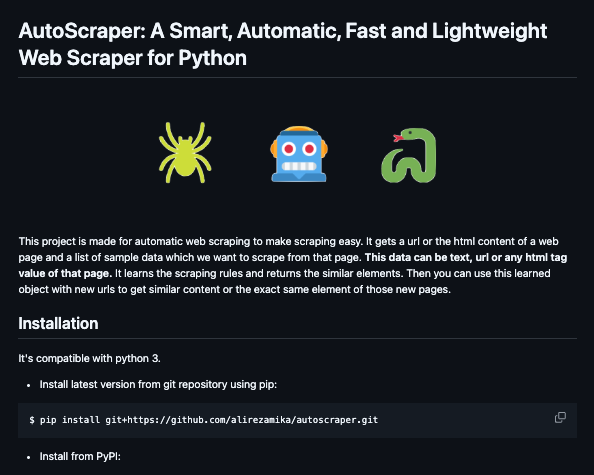
Show it one example of what you want and it figures out the pattern and scrapes the rest of the site automatically. No selectors, no code to maintain. The "just get me this data" button, in a few lines of Python.
10. https://t.co/BgL79bWL89
A version of curl that perfectly mimics a real browser's fingerprint, so the requests sneaking past every defense look exactly like a human with Chrome open. The lowest-level trick the expensive scraping APIs are quietly built on top of.
Companies sell this access for $2,000 a month. The source code is right here.
Web scraping will never be the same.
(100% open-source visual search at scale)
PixelRAG is a retrieval system that skips HTML parsing completely.
Instead of scraping a page into text and embedding chunks, it screenshots the page and retrieves the image. A vision-language model reads the answer straight off the pixels.
Why that matters: parsing is where web RAG quietly loses information.
- A single HTML-to-text parser can drop 40%+ of a page.
- Tables, charts, and layout get flattened or thrown out.
- Swapping parsers alone can move accuracy ~10 points on the same docs.
PixelRAG indexes the page a person actually sees. The team built a visual index of all of Wikipedia, 30M+ screenshots, and it still beats the strongest text RAG baseline by 18.1% on text-only QA.
The repo also ships a Claude Code plugin that gives Claude eyes.
It lets Claude screenshot any URL and read the rendered page instead of scraping the DOM. So you can hand it a live page, an arXiv paper, or your local site and ask what it actually looks like.
One setup script. No MCP server, no backend.
How the pipeline works:
- Renders each document (web, PDF, image) to image tiles.
- Embeds them with Qwen3-VL-Embedding, LoRA fine-tuned on screenshots.
- Builds a FAISS index and serves a search API.
A stronger reader model lifts accuracy with no re-indexing, since the index is just pixels.
Everything is open-source under Apache-2.0.
GitHub repo: https://t.co/qun9TjAdmw
Talking about RAG, I recently wrote an article on a new approach that makes retrieval much more efficient by cutting corpus size by 40x, reducing tokens per query by 3x, and improving vector search relevance by 2.3x.
The article is quoted below.
Un ingeniero de Netflix ha sacado algo tremendo.
¡Promete ahorrarte hasta el 95% de los tokens!
¿Cómo? Comprime tu contexto antes de enviarlo a la IA.
100% en local y compatible con Claude, Cursor, Codex...
24K estrellas en GitHub:
https://t.co/v4Ka8gmGV9