“Political language is designed to make lies sound truthful and murder respectable.”
- George Orwell (1946)
George Orwell’s personal experiences gave him firsthand insight into the political structures he would later examine in his writing. Born Eric Arthur Blair in 1903, he served in the British colonial police in Burma, experienced poverty among working-class communities in Paris and London, and traveled to Spain during the Spanish Civil War. These encounters shaped his commitment to democratic socialism while strengthening his opposition to imperialism, authoritarianism, and unquestioning political obedience.
In his 1946 essay Politics and the English Language, Orwell examined how political language can distort reality rather than clarify it. He argued that governments and political organizations often rely on vague expressions, complicated terminology, and euphemisms to disguise uncomfortable truths. By replacing straightforward descriptions with abstract language, serious events can be made to appear routine or impersonal. Orwell believed that imprecise writing was more than a stylistic weakness; it could encourage equally imprecise thinking.
His proposed remedy was straightforward: choose familiar words, eliminate unnecessary language, and describe reality with as much clarity as possible. He criticized overused metaphors and elaborate jargon designed to sound sophisticated without conveying genuine meaning, while acknowledging that his writing principles were flexible guidelines rather than absolute rules.
These concerns also appeared in his novel Nineteen Eighty-Four, where the fictional language of Newspeak demonstrates how controlling vocabulary can restrict independent thought. By systematically reducing the words available to people, the ruling Party seeks to make certain ideas increasingly difficult to formulate or communicate. Through both his essays and fiction, Orwell explored the relationship between language, political power, and the freedom to think independently.
I've updated my map of El Niño impacts this year to incorporate 13 dynamical models (NMME and C3S, Sept runs); the initial version was simply based on an assessment of the impacts literature for past very strong events. This also let me refine the impacted areas using the model fields:
This is the earliest known video of Jeff Bezos.
He’s 30.
Unknown.
Standing in a tiny room in Seattle in 1994.
No hype. No predictions. No guru act.
Just a young man pointing at his desk, a fax machine, and an orange extension cord because the room doesn’t have enough power - before the world decided to listen.
Rare footage.
🚨 ATENCIÓN COLOMBIA 🇨🇴
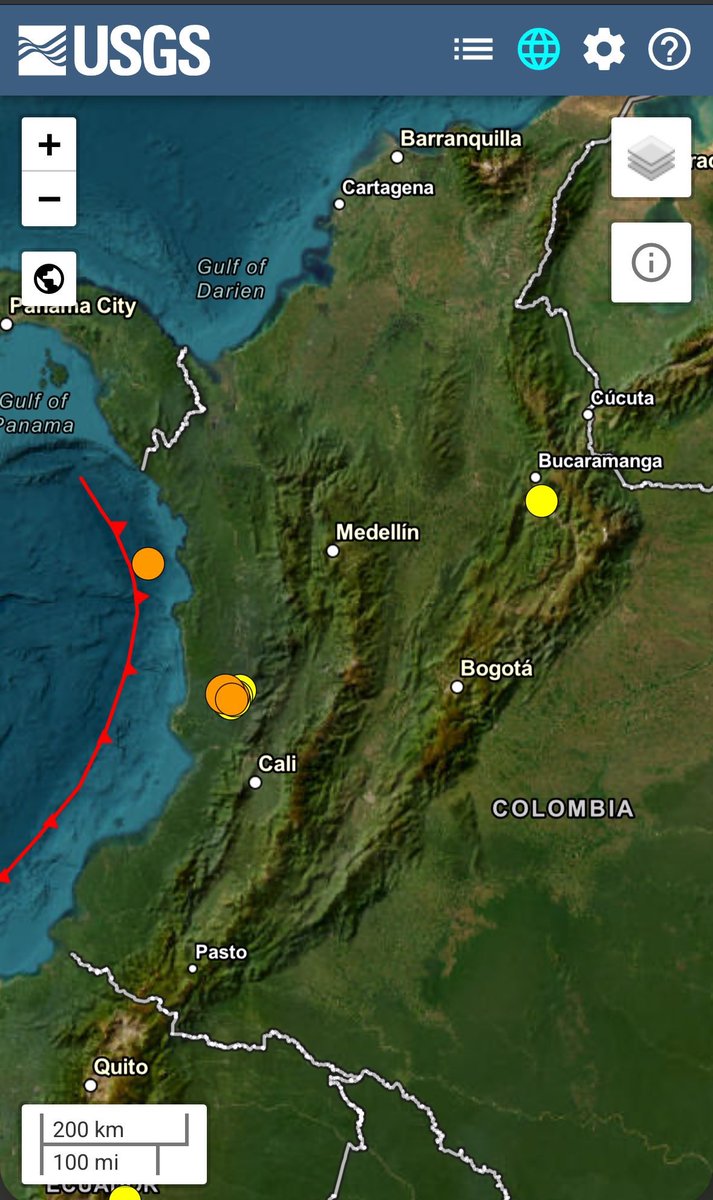
un enjambre sísmico inusual, en una zona adyacente a la del terremoto 7.4 está ocurriendo a unos 35 km más al sur hacia la localidad de Sipi 🚨
#Terremoto#Earthquake#Sismo RT
🚨 ATENCIÓN COLOMBIA 🇨🇴
un enjambre sísmico inusual, en una zona adyacente a la del terremoto 7.4 está ocurriendo a unos 35 km más al sur hacia la localidad de Sipi 🚨
#Terremoto#Earthquake#Sismo RT
See how the antipode line from the M6.5 that struck Indonesia 5 days ago perfectly slices through same plane as the Moon-Sun positioning, and the exact antipode of the M6.5 is only 400 km off from the Colombia EQ swarm.
An earthquake swarm continues to rumble western Colombia at the epicenter of the devastating magnitude 7.4 earthquake that struck August 10th 2026 at 108 km in depth. These are more in the 60-80 km range. It is possible for a follow-up strong earthquake to hit this location...
Hiring Tony Robbins today costs 1 million dollars for just one day.
This is a 21-minute tape recorded in his own home more than 30 years ago.
There, he explains exactly how to get anyone to say yes.
The same material for which they now charge a fortune... completely free.
It's a rare, unfiltered recording from the time when he still didn't charge millionaires just for being in the same room.
When someone says no, they give two excuses:
“I don’t have time” or “I don’t have money”
Neither is true.
The real reason is that they still don’t believe it’s worth it.
It’s not a money problem. It’s a state problem.
Tony teaches something he calls “attack and confess”
Instead of arguing the objection, you confess your own:
“I had the chance to go six months ago and I didn’t until two months ago.
I can’t even imagine the time I wasted”
The room goes silent. No one argues.
Then he gets the person on the “yes train”
Each little yes adds to the next.
Until saying no at the end feels harder than saying yes.
When it’s time to sign, the person has already said yes five times without realizing it.
Just 21 minutes.
There you learn the two only moves that people pay 1 million a day for:
how to read anyone’s state… and how to shift it.
Most people spend years guessing in sales.
He wrote it on a flipchart in his living room in less than half an hour.
A seat in that room cost $125 dollars.
Today it costs $1 million dollars a day to sit in front of him.
The tape is free right now.
And the answer is in this video.
If you are a lab researcher, I urge you to consider what the next few years will actually feel like. Do you want to kick off a superintelligent RL run without a rigorous understanding of its mind? Should you put your head down because “it’s happening anyway” - or take this moment to call for different conditions?
I am optimistic about the potential for coordination. Warning shots like the Hugging Face attack have made pacing agreements between U.S. labs more viable. I don’t feel like we’re on track to prevent a global race, which may require costly actions such as a temporary ban on improving model capabilities.
Accepting this race and entering the “endgame” is a hubristic gamble that should not be launched from a private company’s Slack. Attempting to speedrun alignment should require extraordinary confidence that there are no better trajectories available.
A common response is “if they truly believe this, why are they still building it?” At OpenAI, many have not deeply internalized the civilizational stakes. At Anthropic, the stakes are well-understood, but they are locked in a race to get there first - they believe no one else will act responsibly, so they must do it themselves, despite the risk.
The people building AI earnestly believe that it could kill us all by the end of the decade. This is not a marketing stunt. If anything, many executives and senior researchers will couch their phrasing in the press to sound sensible - but I hear the same people express fear privately. No other human activity poses this level of danger.
Do not underestimate the power of this technology. These will soon be superhuman systems that can hack anything, revolutionize any field overnight, and acquire real power and resources. We have all witnessed the progress in each of these domains, and progress is not slowing.
I resigned from Anthropic today. I spent the last three years doing pretraining research at both OpenAI and Anthropic. Neither company is acting responsibly. They are racing straight to self-improving superintelligence and gambling with our lives. More thoughts below.