Leading programs @NTI_WMD to reduce global biological threats. PhD ChE; former @DARPA & @ARPA_H advisor. I help good ideas survive contact with the real world.
Most biosecurity talk skips product liability, which hinges on what was foreseeable and who knew. With AI-enabled biology, several parties often hold a piece of the puzzle. None sees the whole picture. Who's liable then? https://t.co/7yDdOORQd3
@axios Courts may become AI's regulator, but they work after the harm. For AI-enabled biology, that's late. A release can start in one country and harm people in several. Which court decides? Which insurance policy pays? Better to ask now: https://t.co/7yDdOOSo2B
The same AI that predicts protein structures is now making gene editing safer. A new AlphaFold3-guided method in @Nature cut off-target base editing by up to 99% with little loss in on-target activity. Safer tools enable more widespread use. (🔗 in reply)
Lots of recent work uses wastewater for disease surveillance. There's data on the community's diet in there too. @DukeU and @UNC pulled plant and animal DNA from sewage in NC communities: hops in wealthier areas, seafood on the coast. Underused, data-rich pipes.
Jennifer Doudna and team used AI to design gene-editing enzymes that match or beat their natural CRISPR versions. 🤯 Purpose-built biological AI models make the former researcher in me so jealous.
The capability that speeds cures can strengthen our defenses too. Links in reply.
I'm late to highlight, worth noting: @OpenAI turned its Bio Bug Bounty into a standing program: up to $50K to red-teamers who can jailbreak its biosecurity guardrails.
Paying outside experts to keep breaking your own safeguards is accountability worth copying. Who's next?
An AIxBio hackathon to solve real problems: DNA synthesis security, pandemic early warning, and more. No biosecurity background required.
Good to see NTI's work on managed access and benchtop synthesizers on the reading list. These problems need more builders.
Links in comments.
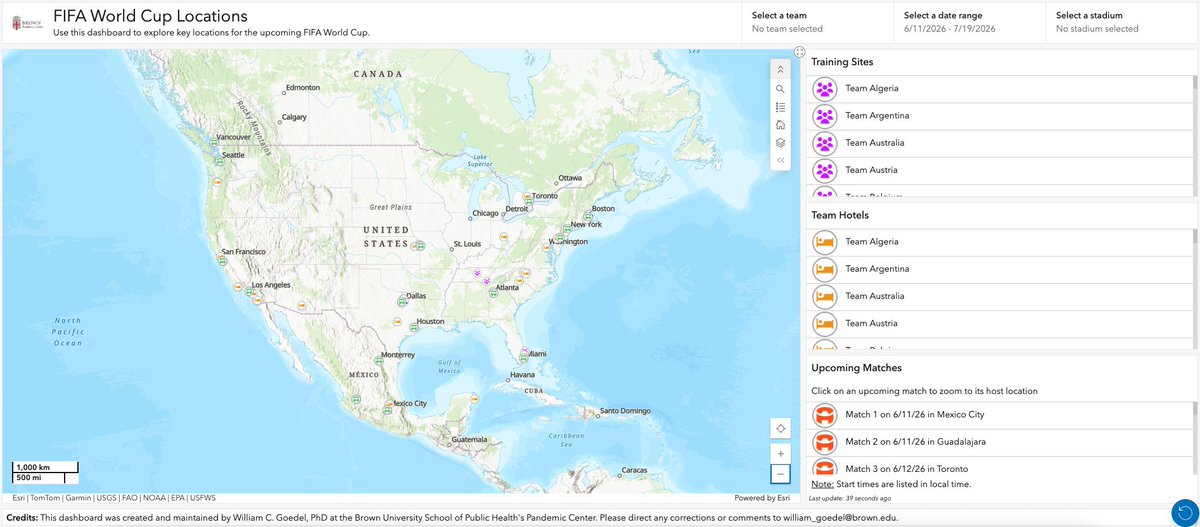
Dr. William Goedel @Brown_SPH created an interactive map of everyone World Cup training site, team hotel, and stadium across all 16 cities. Useful for fans. Essential for public health professionals. Smart infrastructure, built before it's needed.
https://t.co/1uhBWORuRM
April Fools' Day comes with a warning label, but biological threats won't.
If you don't know today who you'd turn to for trusted information during a biological event, figure it out before you need to.
April Fools' Day works because we share a framework: we know the rules, we know the timeline, and by April 2nd the game is over.
We have no equivalent for biological threats. And that's a serious problem. I’ll explain what I mean. 🧵
#nojoke
False biological claims move at the speed of social media. Credible correction moves at the speed of institutions and personal engagement. That gap is exploitable.
The decisions that keep a biological event from becoming a crisis happen early. They must be based on good info.