Etter dagens #dax18 så sitter jeg igjen med følgende spørsmål: Hva forklarer at Donald Trump har vunnet større støtte blant svarte velgere enn noen republikansk presidentkandidat siden Richard Nixon i 1960? Spørsmålet bør stå helt sentralt når partiet skal se seg selv i speilet.
@torewig@Politics_Oxford Enjoy the strangest, most beautiful little sanctuary there is — and don’t forget that pub hours are mandatory regardless of academic endeavours
Happy to announce that I survived the Viva (pun intended by the university) and have now officially taken on a new doctoral feature (the title!) Many thanks to @Hegghammer and Kristian Gleditsch (the glorious committee) and of course @aruggeri_eu (the allknowing supervisor)
Jeg fortsetter metodedebatten med medlemmer av ekstremismekommisjonen. Det handler ikke om kvant. vs. kvalitativ, men hva som må til for å si noe om årsaker. Også NOU'er må ha sterk metodebevissthet når man skal foreslå tiltak på viktige samfunnsområder.https://t.co/Zxv8TKF2Ni
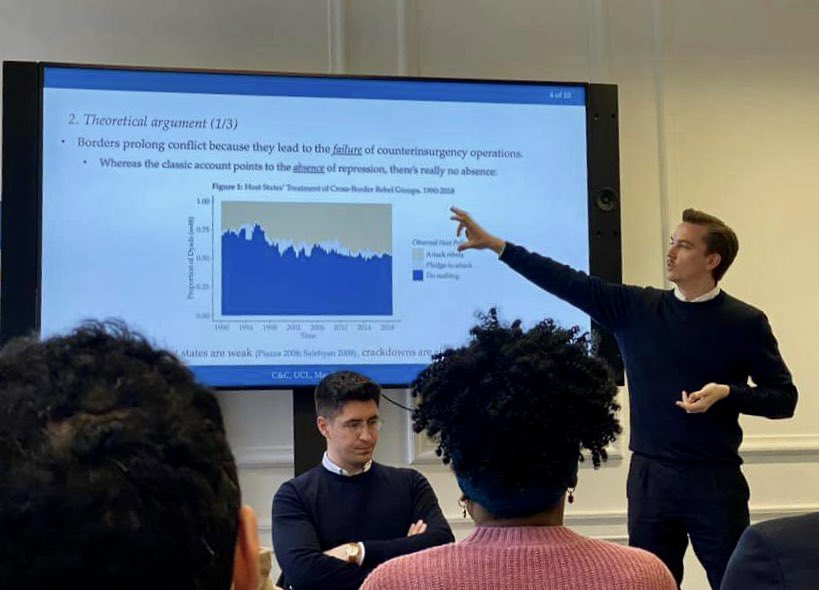
Exciting to share my findings for UCL’s @uclconflict about *how* exactly militants exploit borders to dodge counterinsurgency operations. Important topic atm., and great input from @NilsWMetternich@KristinMBakke & the brilliant bunch of PhD students they’d gathered. På gjensyn!
(4/4) This is a sizable puzzle piece in understanding conflict trajectories in today's world politics. To grasp it we must stop underestimating "weak states" and instead look closer at decisionmaking.
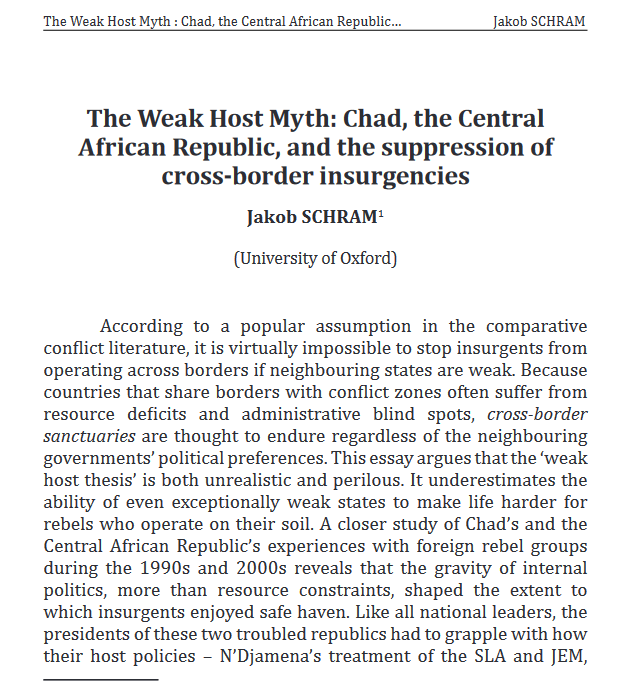
The full text is available here: https://t.co/mF8ritSIyZ
🚨 Excited to share my latest article 🚨 now out in Les Cahiers du CCRAG (link below) along with several fascinating studies from the Central African context. In it I ask an overlooked question: (1/4)
(3/4) This leads to new questions: why do some "weak" states leave foreign rebels alone while others suppress them? Why do policies vary over time? My study from Chad and the CAR (1990-2000s) highlights domestic politics. Leaders are sensitive to costs to their regime security..
After our last Brasenose workshop of the year, a drink to celebrate our little but great intellectual community. Thanks to @jakobschram@tirilrahn@samseitz3@amiadharan and @VilhelminaAna who keep me up to speed with new literature, data and methods. Evviva le giovini menti!
9/n: Borders, in short, are best sealed by diplomacy. My PhD project (under @aruggeri_eu at @Politics_Oxford) tackles the more iffy questions that these insight prompt. How do CB rebels respond to crackdowns? How does neighbourly diplomacy affect conflict resolution? Stay tuned!
🚨 Policy brief / PhD teaser alert:
@PRIOresearch just published a paper where I preview new data I've collected. The project untangles how rebels use borders to wage war - and how the picture suddenly shifts as neighbouring gov'ts get friendly. I show🧵:
https://t.co/7FbpBIxFrF
10/n: A major security-policy implication is that unilateral attacks (often the norm today) don’t really pay. Joint operations may require patience and compromise, but they tend to be more successful (and I hint at why).