@Jim61792382@godspeed_aflame@SVVVAYED Regardless what we think of creation (i.e. if its caring and legible, or not) - we have a desire which is essentially infinite. It cannot find rest in the world. And the question is, whether it is a cruel joke/absurd, or if it can find rest beyond the finite.
@BuenoForMiami@M0nkeybus1nesss You can’t define good. With our without knowing the concept od God. And yet everywhere you look, you see good, or the lack of it. If God was not (not just the intellectual idea, but what the idea is supposed to represent) you wouldnt consider some things good and some things bad
@BuenoForMiami No. Bcs there would be no good then. Its not about rewards. Its simply about the fact that without an eschatological horizon, the only „good” we would be able to think of and care for, is prolongation of biological existence. But we obviously care for more: love, beauty, truth.
@All4ChristUSA@NickHintonn Read Little Prince. The part about the fox. It explains how not only animals, but even dead matter can become part of a living person through love. Father Zizioulas referenced the Little Prince as a serious work on the ontology of love in his Being is Communion
@JosephBenJ2@SimonSimplicio Depends the interpretation of "commanded" (though I personally don't like this terminology). One function of prayer is - simplifying grossly - to shift from the state of "let my will be done" to "let Thy will be done". Synergeia - we choose freely the will of God
@JosephBenJ2@SimonSimplicio Hmm - may have been an oversimplification. Though I didn't mean it as "sin inclined" (definetly not - its not like its drawing us to sin, as mentioned earlier - we cannot desire or wil evil for evils sake), its simply "confused", disrupted by sin, rather than unformed.
@SimonSimplicio And finally, the Truth cannot be objective in this sense of a comprehendable (circumscribable by our reason) object. As st. Augustine wrote - "Sic comprehendis, non est Deus). The Truth is not "objective", because it is not an object, but a person (J 14,6) 2/2
@SimonSimplicio I might be wildly overinterpreting, but it sounds like OP assumes the transcendent is an object, graspable by our reason, making us "better informed" and as a consequence - capable of discerning btw good and evil with our reason. If that were the case, I'd actually disagree. 1/2
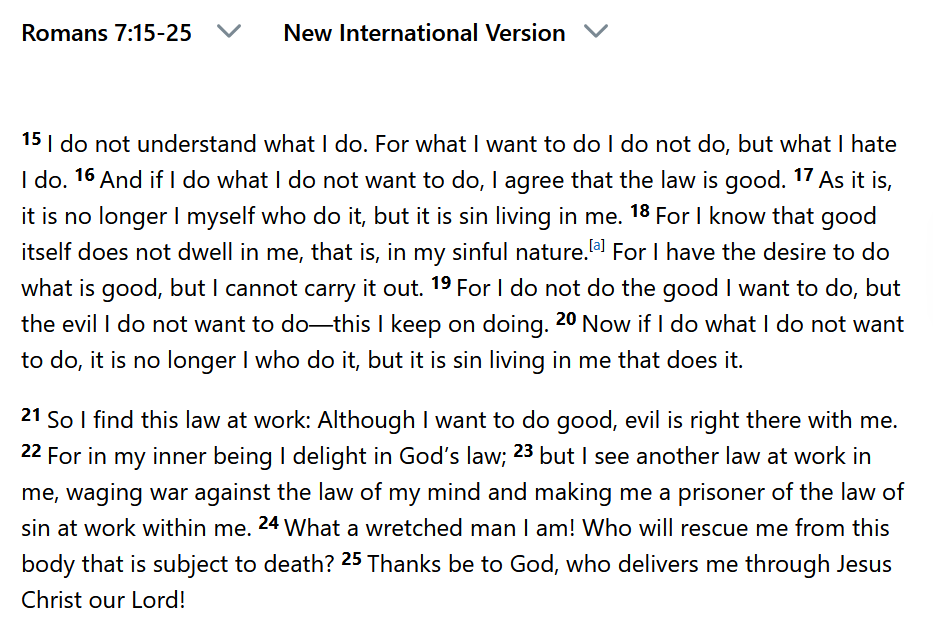
@SimonSimplicio Self-love is not a "lack of info" or smthg which can be reasoned out of once you posess the "object of truth". Cf. St Pauls description of sin in Romans 7. The problem is, he does not do the good, even though he desires it, and instead does what he hates... Kinda like an addict.
@SimonSimplicio Not a big fan of Scotus (univocity thing) but I can concede there is a natural will (which always directs to the Good) and a gnomic will (which blindly searches for it) and that the latter certaintly is a disordered form of desire, caused by philautia (self-love).
@typhon_anastas@DanielHydar@dilanesper True. Though I personally am not a big fan of aristotelian influences in christianity, precisely because they create these proto-materialist concepts, were you have to say „yeah, it kinda is physical, but like, you know, really far far away” ;)
@hegelpill@Laygarayr@dilanesper We gotta be careful with „metaphor” as a term aplied to realist thinkers (as in the opposite of nominalism). Metaphore would suggest he was using an image to refer to some physical reality in simplified form. He is a platonist, so for him intelligeble reality is reality.