When Jesus entered the temple and overturned the tables of the money changers in Matthew 21, he was not merely upset that the sanctuary had become commercialized. Much more was happening.
Jesus was engaging in an Old Testament-style prophetic sign, a symbolic act meant to communicate that the temple stood under God’s judgment and was headed for destruction.
Again and again in the Old Testament, prophets used dramatic actions to proclaim God’s message. Isaiah walked naked and barefoot. Jeremiah wore a yoke upon his shoulders. Hosea married a prostitute.
These actions were visual prophecies, living sermons that communicated God’s word to the people.
Jesus is doing the same thing in the temple courts. His overturning of the tables is not an outburst of random anger. It is a prophetic declaration that the temple has become corrupt and ripe for judgment.
And when Jesus calls it “a den of robbers,” he is echoing Jeremiah 7:11. In Jeremiah’s temple sermon, the prophet stood in the temple and warned the people not to trust in the building itself while they continued in idolatry and injustice. Because of their rebellion, Jeremiah warned that the temple would be destroyed.
By using Jeremiah’s language, Jesus is saying that history is repeating itself. The temple of his day has become another “den of robbers,” and it too will fall under divine judgment. And indeed it did when the Romans destroyed Jerusalem and the temple in A.D. 70.
But there is an even deeper message here. The old temple is passing away because a new and greater temple has arrived. Jesus himself is now the true temple. As he says elsewhere, “Destroy this temple, and in three days I will raise it up” (John 2:19), speaking of the temple of his body. His body would be torn down in crucifixion and raised again on the third day.
He is now the dwelling place of God among men, and by faith we are living members of his body, the church, his holy temple.
____
We read both Matthew 21 and Jeremiah 7 today in Bible in One Year. Join us at https://t.co/XxNvEtNH7e
God does not forgive you BECAUSE you repent, confess, and believe.
Must you repent? Yes. Must you confess? Yes. Must you believe? Of course. But none of those are the reason you are forgiven.
Think of it this way. If you are sick, should you go to the doctor, tell him your symptoms, and fill the prescription? Of course, but none of those will bring you healing. The healing comes *because* of the medicine.
Jesus is the divine medicine. He and he alone is “the because” of our forgiveness. He is The Reason God justifies us.
There is a widespread confusion about this in the church. It’s partly based on a misunderstanding of 1 John 1:9, “If we confess our sins, he is faithful and just to forgive us our sins and to cleanse us from all unrighteousness.”
This is true, of course, just as we might say, “If we go to the doctor and tell him our issues, he is responsible and qualified to heal us of our ailments.” How does he “heal” us? By giving us medicine. How does God forgive us? John tells us three verses later, “Jesus is the propitiation for our sins, and not for ours only but also for the sins of the whole world’ (2:2).
But people often believe and speak as if a mannequin full of their repentance, confession, and faith is on the cross. Don't put your faith in your faith, your faith in your confession, or your faith in your repentance.
Your repentance was not crucified for you.
Your confession did not die for you.
Your faith did not rise from the grave.
Jesus, and Jesus alone, lived, died, and rose again for you.
When God the Father forgives us, he forgives us as people who repent, confess, and believe. But it is not our repentance, our confession, or our faith, that is our salvation.
Christ, and Christ alone, is our salvation. Forgiveness is based 100% upon the atoning work of Jesus Christ. His atonement is enough. His sacrifice was perfectly sincere.
His blood covers not only the sin of which you repent but also your imperfect repentance for that sin, your less-than-100%-honest confession, and your lackluster faith.
Our hope is built on nothing less—and nothing more—than Jesus’ blood and righteousness alone.
The prophets of Baal “cried aloud and cut themselves” (1 Kings 18:28).
Idols need human service. The Lord needs nothing.
They demand blood, he comes to shed his own.
They are lacking and silent, he is abundant and generous.
They need to be coerced, he delights in mercy and grace.
The chief problem for Israel is the same one we face in the church today. It’s not scandals among the leadership, apathy in the pews, or people deconstructing their faith. Though all of those are significant, they are symptoms of a deeper problem.
To mistake them for the ultimate issue is like patching cracks in your drywall and repainting the walls, all the while ignoring the foundation that is slowly sinking beneath the house. You can fix the surface again and again, but until the foundation is addressed, the damage will keep returning.
Our foundational problem is and will always be this: unbelief. An unbelief caused and fostered by stopping up our ears to the word of God.
Israel's sins began in their ears. So do ours.
What does Paul say? “Faith comes from hearing, and hearing through the word of Christ” (Rom. 10:17). If the word of Christ is not heard—or, to say it more precisely, if sinners stick their fingers in their ears and refuse to hear, faith is not present.
Faith burns apart from God’s word about as long as a log removed from the flames.
This means we should learn something from young Solomon, whom we read about today in Bible in One Year. When he took over the kingdom after the death of his father, David, the Lord God offered to give Solomon whatever he asked for. Wisely, the king did not ask for riches or long life.
Instead, he asked for a lev shomea (לֵב שֹׁמֵעַ), which has been translated as “discerning heart” (NIV), "understanding mind" (ESV), "receptive heart" (CSB; 1 Kings 3:9).
I prefer a more literal translation: a “hearing heart” or “listening heart.” Lev means "heart" and shomea is from the verb shama "to hear."
I picture a lev shomea as a heart that has sprouted two large ears, open and eager to hear whatever words proceed from the mouth of God.
Heavenly Father, give us a heart with two oversized ears, listening to you, listening for you, as you speak to us in your Word.
____
Join us for Bible in One Year at https://t.co/XxNvEtNH7e
Let’s talk about one of Satan’s favorite words: “if.”
We hear it twice in Matthew 4, which we read today in Bible in One Year.
During the temptations, the devil begins his first two assaults with, “IF you are the Son of God, command these stones to become loaves of bread” (4:3) and “IF you are the Son of God, throw yourself down” (4:6).
Just before those temptations, at the baptism of Jesus, the Father had already declared from heaven, “This is my beloved Son” (Matt. 3:17).
So God declares, “This is,” and Satan questions, “If you are.”
That same Satanic strategy continues when the tempter hisses at us,
--If you’re really a Christian, why do you still struggle with the same sins?
--If God is truly good, why did he allow your son or daughter to die?
--If God is all-powerful, why does evil still plague the world?”
It is always the same mouth, reeking of the halitosis of hell, that raises the same doubts. If, if, if, all coming from the father of lies who began his conversation with Eve by saying, “Did God actually say….” (Gen. 3:1).
How is the devil’s question countered? With the “I” spoken by our Lord.
Jesus says, “I am your Savior, your Redeemer, the one who gave his life for you. I am the one who entered into human suffering, took sin and sorrow into myself, carried it to the grave, and rose again so that you might share in my victory. I am with you always. I am your God, and you are my child.”
Every hellish “if” is commanded to shut up by a heavenly “I.”
In the Hebrew of Psalm 23, goodness and mercy do not "follow" us all the days of our lives. That translation is far too bloodless for the verb radaf (רדף), which means "chase" or "pursue." God's mercy doesn't follow us like a good little puppy dog. It hounds us, chases us down, stays hot on our heels, until it radafs us all the way into our Father's waiting arms.
If our life is to be meaningful, really to matter, it must be extraordinary in some way. Extraordinary in the accumulation of wealth or landing a fantastic career, an athletic trophy, an academic accomplishment, or anything that puts us in the limelight, proclaiming, “Now, look, this person is a cut above the rest!”
That’s the cultural “gospel,” anyway, that is preached from the pulpits of movies, television, and social media.
But it’s all a sham. A sinister lie that leaves many people thinking their ordinary lives are void of meaning and purpose.
The biblical teaching pushes back. God wants us to find joy in sacred simplicity and the ordinary gifts of life.
For instance, in the book we've been reading the last couple of days in Bible in One Year, Ecclesiastes, we see this countercultural truth: “Behold, what I have seen to be good and fitting is to eat and drink and find enjoyment in all the toil with which one toils under the sun for the few days of his life that God has given him” (5:18).
What a refreshing truth this is! We find joy in simple things, such as God’s gift of food, drink, and work. We can expand this list to God’s gifts of spouse, children, and friendship.
Climbing the ladder of success and assuming that will lead to a fulfilled life often lands the person on an upper level full of wheezing souls still chasing after the wind.
Climb “downward” to the daily, ordinary beauty of marriage, children, grandchildren, friends. “Aspire to live quietly, and to mind your own affairs, and to work with your hands” (1 Thess. 4:9). Kiss your spouse. Play a game with your kids. Go out to eat with your friends. Labor at work.
God came to us as the man, Jesus, who got dirt under his fingernails, cooked fish over campfires, ate and drank with friends and students, and told stories about farming and sheep herding. Jesus did more than this, to be sure, but he did these ordinary things in everyday relationships, for that is where God is at work.
The treasures of heaven are wrapped in the brown paper simplicities of life.
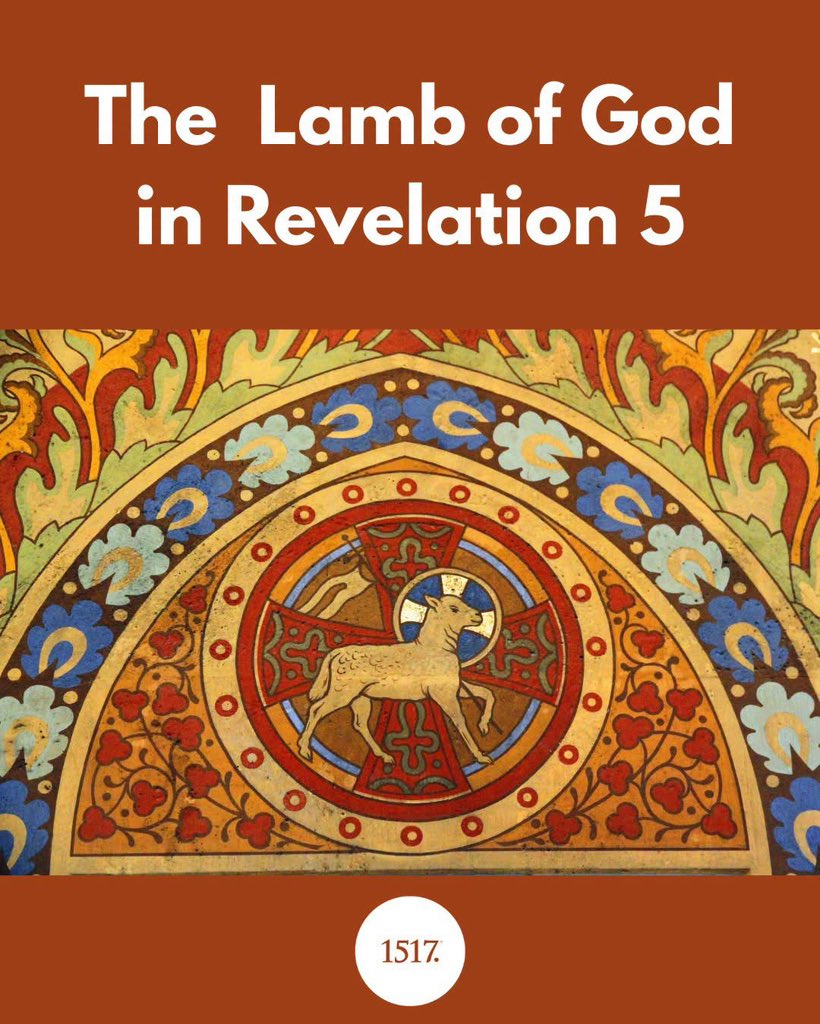
“Who is worthy to open the scroll and break its seals?” (Rev. 5:2) John tells us this question echoes through heaven itself as a mighty angel issues the challenge.
A hush falls over the celestial courts. No one in heaven or on earth or under the earth is able to step forward. No one is worthy to take the scroll from the hand of the One seated on the throne.
The future of the world remains sealed, its purposes unreadable. The weight of that moment is more than John can bear.
But then, just as all hope seems gone, an elder leans toward John and speaks the words all creation needs to hear: “Weep no more. Behold, the Lion of the tribe of Judah, the Root of David, has conquered” (Rev. 5:5).
John turns to see a Lion, but instead he beholds a Lamb standing, bearing the marks of sacrifice, perfect in power and perfect in sight.
The Lion conquers by being the Lamb who was slain.
"Behold the Lamb of God who takes away the sin of the world!" (John 1:29). Behold the Lamb who steps forward and takes the scroll from the right hand of the One seated on the throne.
Heaven erupts in worship: “Worthy are you…for you were slain, and by your blood you ransomed people for God from every tribe and language and people and nation” (Rev. 5:9).
The largest concert you have ever attended, the loudest stadium you have ever heard, is but a whisper compared to that heavenly chorus as myriads of angels lift their voices: “Worthy is the Lamb who was slain!” (Rev. 5:12).
Who is worthy? The Lamb whose blood alone could accomplish what centuries of offerings could never achieve.
A better blood was needed, and it came in the better Lamb of God.
It is that blood which ignites the worship of heaven and earth: “To him who sits on the throne and to the Lamb be blessing and honor and glory and might forever and ever” (Rev. 5:13).
In that blood is life, and in him we have atonement and peace and unending hope.
Cleansed by the blood of the Lamb, we join the choir whose song will never fade.
_____
We read Revelation 5 today in Bible in One Year: https://t.co/XxNvEtNH7e
Like many of you, I grew up hearing the Sunday school lesson of the fiery furnace from Daniel 3, which we read today in Bible in One Year.
Only later did I realize that this short but well-known narrative carries a deeper and broader message, one that stretches backward to the Exodus and forward to the work of Christ.
Here’s what I mean.
The account of Shadrach, Meshach, and Abednego is indeed about three faithful young Jews who refused to bow before Nebuchadnezzar’s golden image. But this mini-story also has a mega-story tucked inside it.
We might call it the “Gospel of the Fiery Furnace.”
Like many individuals in the Bible, these three men represent a broader group. Just as Abraham embodies all Israel and David represents his royal descendants, so these three young men embody the corporate people of God, whom only he can rescue.
Consider the overlap between the Daniel and Exodus narratives. Both take place when Israel is in exile. Both involve hostile kings, Pharaoh and Nebuchadnezzar, who oppose the people of God. Both center on idolatry. Both rulers mock the Lord: “Who is the LORD?” (Exod. 5:2) and “Who is the god who will deliver you?” (Dan. 3:15).
Both accounts also feature a furnace. Egypt itself is called the “iron furnace” (Deut. 4:20), while the three men are cast into a blazing one in Babylon (Dan. 3:23).
In both, God sends his messenger to deliver his people (Exod. 23:20; Dan. 3:28). And in both, the king is forced to acknowledge the superiority of Israel’s God (Exod. 12:31–32; Dan. 3:28–30).
Shadrach, Meshach, and Abednego stand for all the people of God. As the Lord brought Israel out of Egypt’s furnace, so he will bring Israel out of Babylon’s fire, and ultimately he will bring about an even greater deliverance.
Jesus, the Messenger of the Father, who brought Israel out of the iron furnace and rescued Shadrach and his friends, vacated his own furnace of death. He experienced his own exile and return that we, in him, might experience it as well.
All these stories are woven together in the life of Jesus. Ultimately, Daniel 3 is about Christ, as are Exodus and every other book of the Scriptures. He is their fullness and fulfillment.
I got to worship with my mom today after months due to health issues. And went out for lunch, walker and all! She’s the best, always happy and positive. Such a character and blessing. Love ya, Jude @crazedc00kie
Not a single word from Abel is recorded in Scripture. Cain murders him, and Cain has something to say. But the victim of violence? the recipient of hate? the righteous one? Not a syllable.
Cain has words, Abel none.
But Abel does speak in a different language. He utters crimson eloquence, red rhetoric so profound his speech pierces heaven's veil to lodge in the ears of God.
How so? The Lord says, "The voice of your brother's blood is crying to me from the ground" (Gen. 4:10).
You see what's happening?
1. Blood has a voice.
2. Blood cries out to God.
3. Blood is heard by heaven.
Far, far later, the author of Hebrews wrote about another crimson eloquence, about more red rhetoric. He says that the blood of Jesus "speaks better than the blood of Abel" (12:24).
Whatever Abel's blood said to God, Christ's blood said it better.
The voice of Jesus's blood, crying out from the ground beneath the cross, piercing the heavens, lodging in the ears of God, speaks one and only one message: "Father, forgive them."
That eloquent blood pronounces the absolution of the world, you included.
Believe it. It is for you.
_____
We read Hebrews 12 today in Bible in One Year. Join us at https://t.co/XxNvEtNH7e
In the beginning, when God finished creating the world, he rested on the seventh day. This is the Sabbath (more precisely pronounced "Shabbat"), which is the Hebrew word for “rest.”
In the OT, the Sabbath was the weekly remembrance not only of God’s creative work (Exod 20:11), but his redeeming work (Deut 5:15).
Genesis and Exodus were remembered every Sabbath.
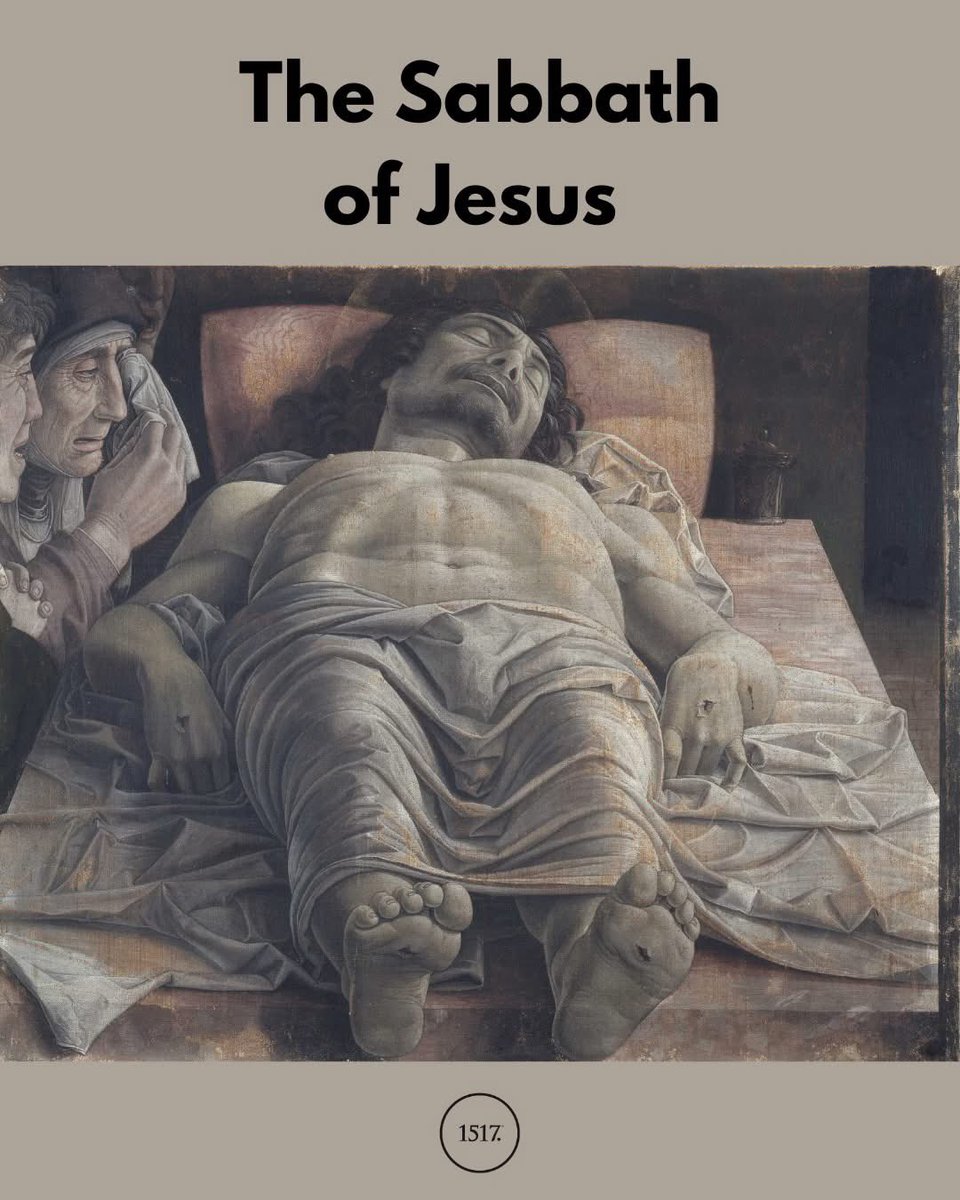
Both creation and redemption coalesce in Jesus. Having finished all his work of redeeming the world, having completed his re-creation of humanity, he rested in the tomb of death on the seventh day. “It is finished,” he said.
His work was finished. So he took his rest. This was his Sabbath.
And it is a Sabbath with no conclusion. His resurrection ushers us into the Sabbath that creation has been awaiting since Genesis. We who are weak and heavy laden come to Jesus, and he Sabbaths us in himself. "Come to me, all you who labor and are heavy laden, and I will give you rest." I will Sabbath you in myself.
Today, Holy Saturday, Jesus takes a Sabbath in the tomb. And we who have been co-crucified with him rest there also, awaiting Easter Day and our co-resurrection.
See, from his head, his hands, his feet,
sorrow and love flow mingled down.
Did e'er such love and sorrow meet,
or thorns compose so rich a crown?
—Isaac Watts
Jesus does not say,
“It’s almost finished,
as soon as you do your part.”
He says, “It is finished.”
No sin remains un-died for.
He did it all, all for you.
Today we remember that God washes our feet.
The fingers that crafted the universe scrub scum from between toes.
The hands that painted the cosmos wash feet painted with dirt and sweat.
The One before whom all angels bow gets on his knees to labor as a slave.
We become clean, he becomes filthy.
In doing this, Jesus our God gives us a humble epiphany, a revelation of who he is. He is the God who makes his glory visible in lowliness and servitude.
He is the God who gives
-his cheek to the betraying lips of Judas
-his face to the slapping hand of the high priest
-his countenance to the spit of the Sanhedrin.
He is the God who gives
-his head to the thorns
-his feet to the spikes
-his side to the spear.
He is the God who embraces rejection, shame, torture, and death, to give himself to you.
And here is why: because that’s who God is. He is the God who is love. Therefore he loves you by giving to you. For God so loved the world that he gave his only Son. What he gives you is nothing less than himself.
God gives, you receive. This is everything.
He not only washes your feet; he washes you clean, body and soul, through the holy bath in his name. He fills the baptismal font with water from his spear-pierced side and kneels there to wash off the dirt and sweat and grime of your evil.
He feeds you himself, his body, his blood. Every natural food we take into our bodies is transformed into our bodies. We don't become corn on the cob or hamburgers. But the supper of our Lord is different. This food transforms you into that which it is. You, the church, are the body of Christ. You are what you eat.
So, come and eat. Come and drink. Come to the lowly God who has joined you in your lowliness that he might exalt you in himself.
On Maundy Thursday, let us recall, with thanksgiving, how fitting it all is:
How fitting that humanity, which plunged into death by eating forbidden fruit, should receive life and immortality by a meal provided by our Savior, the Last Adam.
How fitting that sinners, their unity rent asunder by hatred and violence, should be gathered into one communion by partaking of the one loaf, baked from many scattered grains.
How fitting that we, who are hard pressed and beaten down by evil, should be comforted and uplifted by drinking from the Lord’s cup, filled with the blood of grapes that have been trampled and pressed underfoot.
How divinely and beautifully fitting, on this holy Thursday, that we have our feet lovingly washed by the very God from whom we once ran in terror and shame.
Here is our God, Jesus Christ, who comes not to be served, but to serve, and to give his life as a ransom for many.
What often masquerades as the Gospel is something like this: “Yes, Jesus paid for the meal of salvation, but you need to leave the tip.” And the tip is your obedience, holiness, stick-with-it-ness. Jesus did his part, now you do yours. But no. You have no part to play. No tip to leave. Jesus took care of it all. That is the Gospel. Don’t settle for anything less.
One of the most remarkable biblical chapters on prayer revolves around the search for a wife. Abraham’s servant travels far from Canaan back to Mesopotamia on a mission to find a bride for Isaac, who is now forty years old (Genesis 25:20). We read this story today in Bible in One Year, in Genesis 24.
When the servant arrives, he prays a very specific prayer. He asks that the young woman chosen by God will do two things: first, offer him a drink of water, and second, offer to water his camels as well (Genesis 24:12–14). This was no small request, since watering camels meant significant effort and generosity.
Here is the astonishing part of the story: “Before he had finished speaking,” Rebekah appeared (Genesis 24:15). Before the servant had fully laid out his prayer, before he had said amen, God answered.
It is as if God gently interrupts and says, “I planned this long ago. Just watch.” The servant’s unfinished prayer is met with a completed answer.
This story beautifully illustrates our heavenly Father’s providential care. God not only answers prayers that are carefully spoken; he also answers prayers before we finish praying them. More than that, he gives us what we forget to ask for, what we do not yet know we need, and even what we intended to pray for but never did.
Our Father answers unfinished prayers—and sometimes even unprayed prayers.
Must we pray? Absolutely. Our Lord commands us to call upon him (Psalm 50:15; Matthew 7:7). Yet we pray to a God who is not dependent on our eloquence or completeness. He fulfills what he promises through the prophet Isaiah: “Before they call I will answer; while they are yet speaking I will hear” (Isaiah 65:24).
Prayer, then, is not about informing God, but trusting the God who already knows—and who delights to give good gifts to his beloved children (Matthew 7:11).
____
Join us for Bible in One Year! For more info, visit https://t.co/XxNvEtNH7e