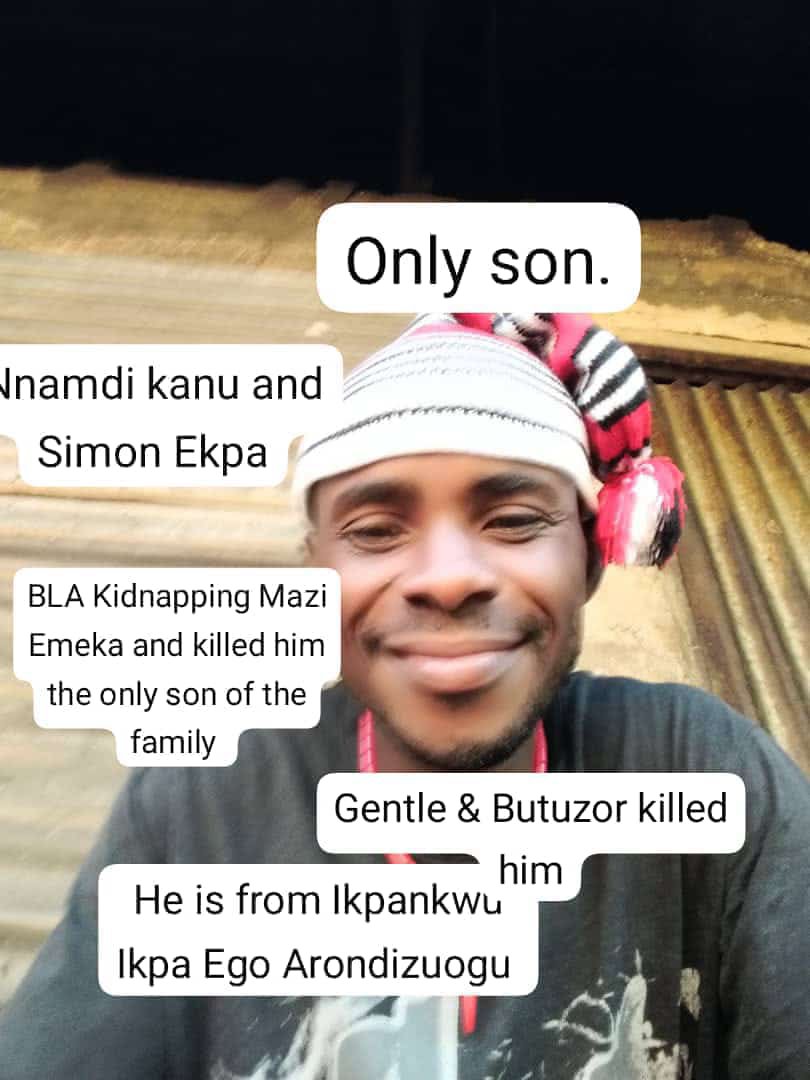
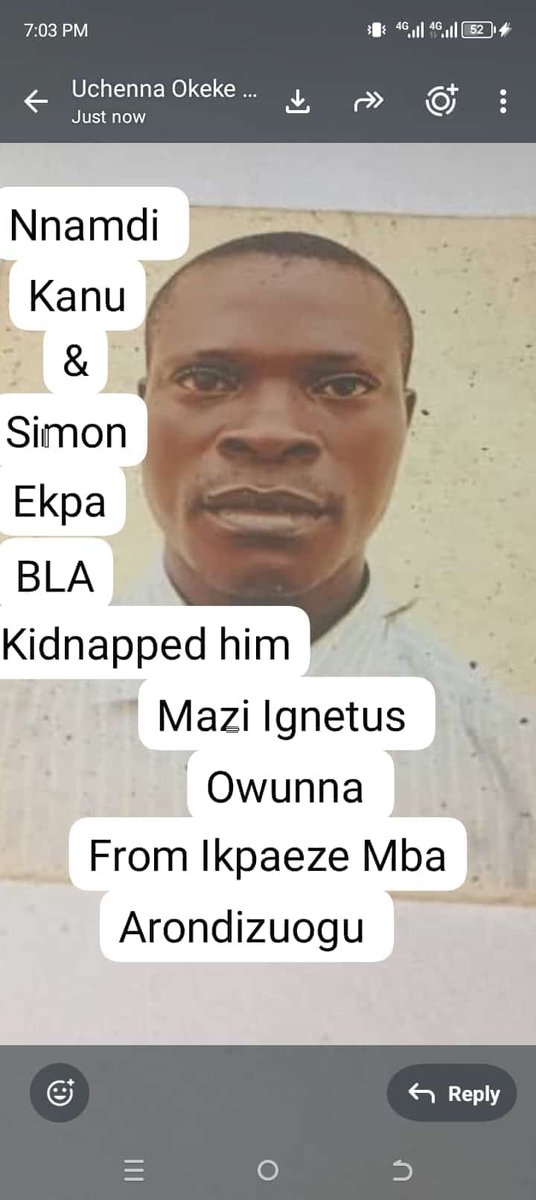
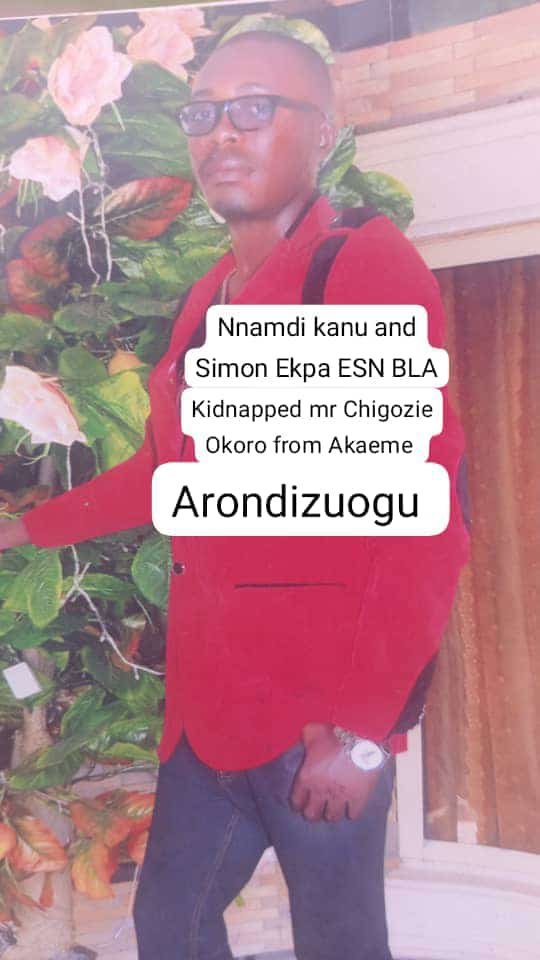
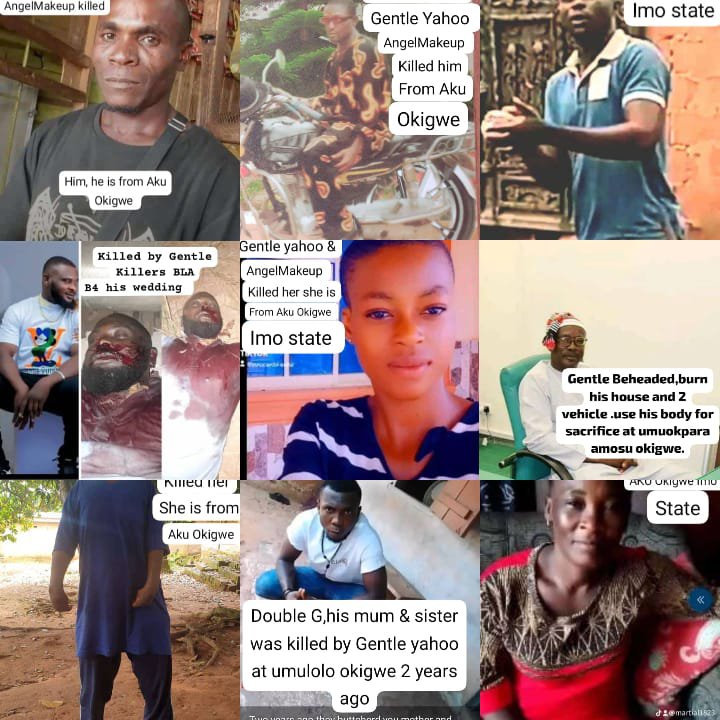
@SomadinaUg70771@alexstubb Thunder fire you there criminal might Thunder idiot. That is ur bush name. The name u and ur terrorists gang is been using in kidnapping and killing of our people harvesting there organs with Simon Ekperima. Sir Alexstubb u see all these people . They are all killed by Simon ekpa
@SomadinaUg70771@alexstubb Sir Alexstubb please help us killed Simon Ekpa, he is behind the kidnapping and killing of innocent civilians I'm my village and the entire south East. Simon Ekpa is a terrorist a killer and a kidnapper. Has never lies was wasn't a terrorist. He is a terrorist.
You are proud to mention the name of IPOB without fear today, is because of DOS led by Mazi Chikadibia Edoziem....Remember that IPOB was added to (GTI) index because of the activities of Simon Ekperima....go and verify.
If compensation means rebuilding roads, reopening schools, restoring government institutions and reintegrating the former Eastern Region into Nigeria, then your government can rightly point to the untrue declaration of "No Victor, No Vanquished and the incomplete 3Rs.
But if compensation means restoring people's life savings lost through the £20 policy, returning abandoned properties, rebuilding destroyed businesses, acknowledging the suffering of millions, or compensating families for what they lost, then many survivors and affected families would say that never happened.
The question is not whether Nigeria rebuilt infrastructure. The question is whether Nigeria restored our people. Restoration begins by acknowledging loss. It requires recognising the pain people endured, confronting difficult truths and pursuing justice alongside stability – RESTORATIVE JUSTICE.
That is why many scholars describe Nigeria's post-war approach as political reunification and state reconstruction rather than restorative justice. A truly restorative process would have included truth-telling, acknowledgement of victims, meaningful reparations and accountability where wrong doing occurred.
The debate over Chief Obafemi Awolowo should also be approached honestly. As Federal Commissioner for Finance, he is closely associated with the £20 policy and other wartime economic decisions. Whether those decisions were his alone remains a matter of historical debate, as they were taken within the Federal Military Government under your leadership.
Gowon seem to be trying very hard to rewrite history in recent times. If you are not claiming to have been ill during the Aburi meeting, you would claim you weren’t sure of what Ojukwu was trying to achieve. Now, you are on the path that Igbos were compensated. Trying too hard to defend Awolowo’s legacy should not come at the expense of the lived experiences of those who bore the consequences.
These constant revisitation to history of yours sounds less like a defence of history and more like a search for peace within your own conscience. But peace comes from confronting the truth honestly.
If your spirit is burdened by the past, true peace will not come through justification. It will come through truth, true confession where appropriate, and an honest reckoning with history.
History has a way of asking questions that do not disappear with time.
Mind you, Britain's political and diplomatic support of the Federal Military Government also meant that there was no international tribunal to examine allegations of war crimes arising from the mass starvation of Biafrans during the war. That absence of judicial accountability has left many believing that history's most painful questions were never fully answered.
If there is to be lasting peace, it cannot be built on selective memory or political slogans. It must be built on truth.
More than fifty years later, this conversation has not disappeared because people refuse to let go.
It has endured because there remains a difference between rebuilding a nation and restoring its people.
Until that distinction is honestly acknowledged, the wounds of the Biafra Genocide will continue to live, not only in history books, but in the memories of those who inherited its consequences. And we, are headed for our restoration.
Aha m bụ, Uchechigeme Anyanwụụtụtụ Okwu-Kanu.
04.08.2026.
“From Millions to Mere Dozens? Abia March Exposes the Dramatic Collapse of Kanu’s Once-Mighty Influence
By Anyi Kings
Published On The Biafra Post
August 4th 2026
ABIA STATE- Solidarity March Exposes Kanu’s Declining Influence as IPOB Institutionalization Gains Ground
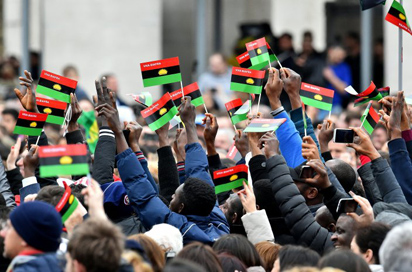
ABIA STATE — August 2: A solidarity march reportedly organized by Mazi Nnamdi Kanu’s handlers in his home state of Abia has sparked fresh debate over the former IPOB leader’s current level of public influence, after the event attracted a relatively small crowd compared with the massive turnouts historically associated with Kanu.
The procession, which took place along a small street in Abia State, featured large banners proclaiming “IPOB Abia State Chapter Declares Kanu Supreme Leader and Director of Radio Biafra.” However, the visibly limited turnout—estimated by observers at between 50 and fewer than 100 participants—has raised questions about the extent of Kanu’s remaining grassroots support.
For a personality whose name once commanded enormous attention across the Southeast and the diaspora, the modest turnout has been interpreted by some observers as a striking contrast to the huge crowds and widespread public mobilization that once characterized events associated with Kanu.
The development comes as the institutionalization of IPOB under its established leadership structure continues to receive what its supporters describe as growing backing from the organization’s global family.
From Mass Mobilization to a Smaller Street Presence
Observers say the latest march may have unintentionally highlighted the changing political landscape surrounding Kanu.
In previous years, politicians, traditional rulers, religious leaders and other prominent personalities frequently used public platforms to call for Kanu’s release or reassure his supporters that efforts were being made behind the scenes to secure his freedom.
That level of elite engagement, observers argue, was partly driven by the perception that Kanu commanded a huge and politically significant following among young people across the Southeast and beyond.
Today, however, the political atmosphere appears markedly different.
The declining visibility of prominent political voices making public cases for Kanu’s release has fueled speculation that many political actors now consider association with his cause increasingly difficult to defend or politically advantageous.
Peter Obi’s Position Under Scrutiny
One prominent political figure who previously made a public commitment concerning Kanu was former presidential candidate Peter Obi.
Obi’s position on Kanu’s release subsequently attracted criticism from both supporters and political opponents, particularly amid controversies surrounding violence and insecurity in the Southeast allegedly carried out in Kanu’s name.
Critics have argued that Kanu should bear political responsibility for statements and actions attributed to his movement, while his defenders have consistently disputed attempts to directly link him to every violent incident in the region.
Whether Obi’s earlier position ultimately becomes a political liability remains a matter of debate. However, the changing public mood surrounding Kanu suggests that the political calculations that once surrounded his name may have significantly shifted.
A Symbolic Turning Point?
The Abia march may therefore represent more than a routine solidarity demonstration. To critics of Kanu’s current political influence, the relatively small turnout provides a visual indication of what they describe as a dramatic erosion of his once-formidable support base.
For supporters of IPOB’s institutionalization, the development reinforces their argument that the Biafra movement should no longer be dependent on one individual, but should instead operate through enduring institutions, structures and established leadership mechanisms.
👇👇👇👇👇👇👇👇👇👇👇👇👇👇
New IPOB Constitution Centers Power on Directorate of State and Planned Igwebuike Assembly
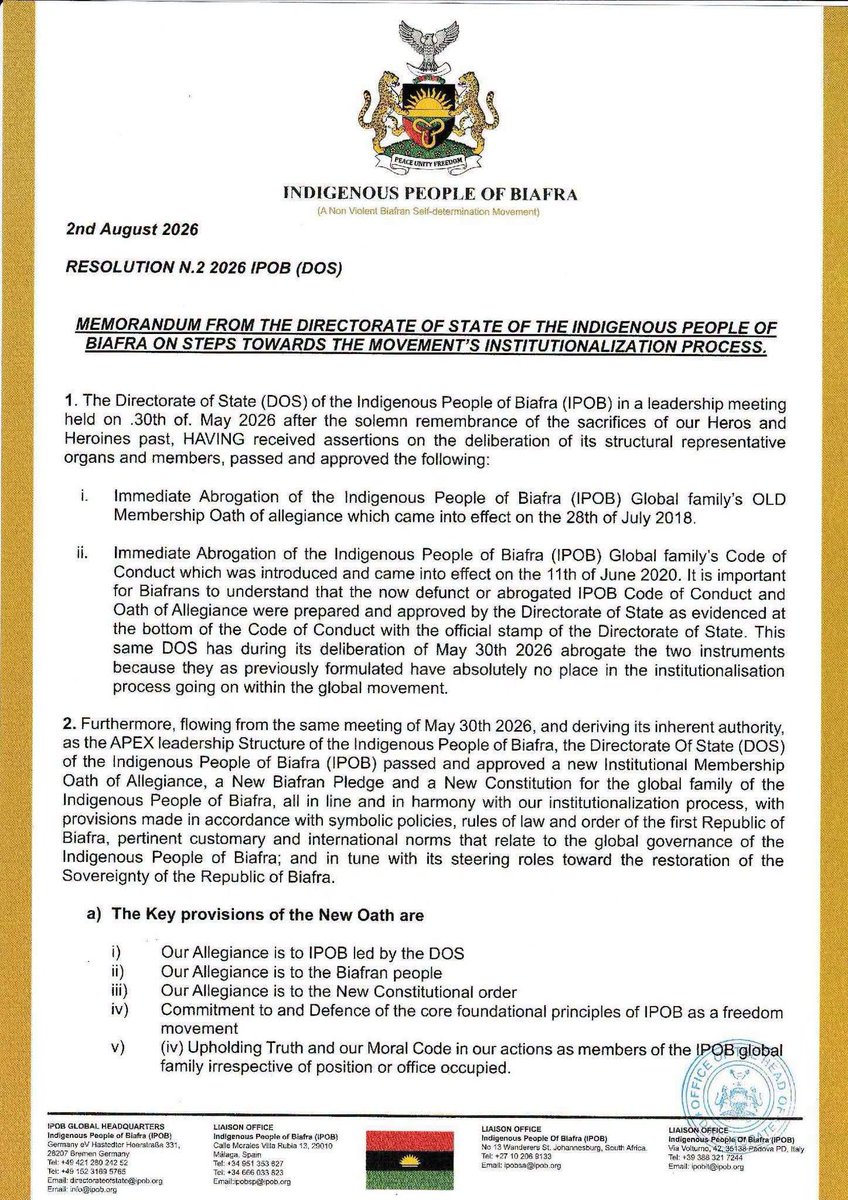
In a formal memorandum dated August 2, 2026, and designated Resolution N.2 2026, the Directorate of State (DOS) of the Indigenous People of Biafra (IPOB) under the leadership of Mazi Chikadibia Edoziem announced the immediate abrogation of longstanding internal instruments and the adoption of a new institutional framework as part of what it described as the movement’s institutionalization process.
The resolution followed a leadership meeting of the DOS held on May 30, 2026, after a remembrance of past sacrifices. It stated that the body had received inputs from its structural representative organs and members before approving the measures. Edoziem signed the document as Head of the Directorate of State.
The DOS directed the immediate abrogation of the IPOB Global Family’s old Membership Oath of Allegiance, which had taken effect on July 28, 2018, and the Code of Conduct introduced on June 11, 2020. The memorandum noted that both instruments had previously been prepared and approved by the DOS itself, as evidenced by the official stamp on the Code of Conduct. It stated that these documents “have absolutely no place in the institutionalisation process going on within the global movement.”
In their place, the DOS approved a new Institutional Membership Oath of Allegiance, a new Biafran Pledge, and a new Constitution for the IPOB global family. These were framed as aligning with the institutionalization process, drawing on symbolic policies, rules of law and order from the first Republic of Biafra, customary and international norms relevant to the governance of the Indigenous People of Biafra, and the goal of restoring the sovereignty of the Republic of Biafra.
Key Provisions of the New Oath
According to the resolution, the new oath centers on:
a: Allegiance to IPOB led by the DOS
c: Allegiance to the Biafran people
d: Allegiance to the new constitutional order
e: Commitment to and defence of the core foundational principles of IPOB as a freedom movement
f: Upholding truth and the moral code in actions as members of the IPOB global family, irrespective of position or office
The new Constitution replaces the abrogated Code of Conduct and establishes governance of the IPOB global family in accordance with its provisions. It provides for two key leadership structures: the Directorate of State of the Indigenous People of Biafra and the Igwebuike Assembly of the Indigenous People of Biafra.
Pending the full constitution of the Igwebuike Assembly, the DOS is to continue piloting the affairs of IPOB, with a strict focus on the peaceful restoration of Biafran independence and the sovereignty of the first Republic of Biafra.
The DOS is composed of three functional organs: the Office of the Head of Directorate, the Office of the Deputy Head of Directorate, and the Secretariat of the Directorate headed by a Secretary General. The DOS is described as an organ of control. Its members serve as officers of the Directorate and principal servants in their capacities. It is headed by a Principal Officer, the Head of Directorate of State (HDOS), with a Deputy Head of Directorate of State (DHDOS).
The apex structure is mandated to supervise management of IPOB structures, including continental, regional, national, state, local government, zonal, and unit coordination. It oversees departments such as Foreign Affairs and Diplomacy, Legal, Finance, Welfare, Media and Communication, Security and Intelligence, Mobilization, Research and Development, Education, Agriculture, and Culture, through their respective departmental heads. The Constitution is presented as the “Grund Norm,” the guiding document of the movement’s activities.
The Secretariat, headed by a Principal Officer who is also a DOS officer, functions as an administrative organ focused on the appropriation of policies, expertise, and technical issues.
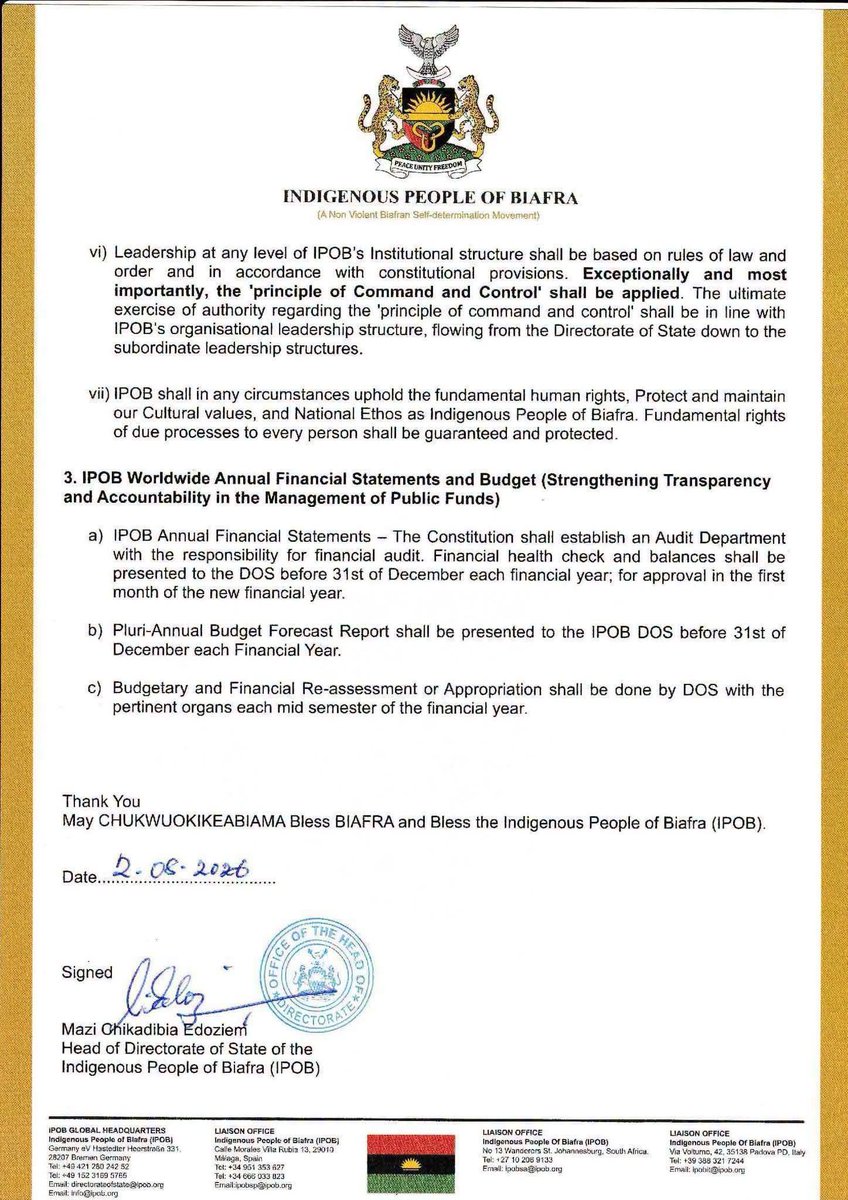
Leadership at any level is to be based on rules of law and order and constitutional provisions, with the principle of command and control applied, flowing from the DOS downward. The resolution affirms that IPOB shall uphold fundamental human rights, protect and maintain cultural values and national ethos as Indigenous People of Biafra, and guarantee due process rights.
Financial Transparency and Accountability Measures
The Constitution establishes an Audit Department responsible for financial audits. Annual financial statements and health checks are to be presented to the DOS before December 31 of each financial year for approval in the first month of the new year. A Pluri-Annual Budget Forecast Report is also to be submitted by the same deadline. Budgetary and financial re-assessment or appropriation is to occur mid-semester each financial year through the DOS and relevant organs. These steps are presented as strengthening transparency and accountability in the management of public funds.
The memorandum concludes with the invocation: “May CHUKWUOKIKEABIAMA Bless BIAFRA and Bless the Indigenous People of Biafra (IPOB).”
Family Writers Press International
New IPOB Constitution Centers Power on Directorate of State and Planned Igwebuike Assembly
In a formal memorandum dated August 2, 2026, and designated Resolution N.2 2026, the Directorate of State (DOS) of the Indigenous People of Biafra (IPOB) under the leadership of Mazi Chikadibia Edoziem announced the immediate abrogation of longstanding internal instruments and the adoption of a new institutional framework as part of what it described as the movement’s institutionalization process.
The resolution followed a leadership meeting of the DOS held on May 30, 2026, after a remembrance of past sacrifices. It stated that the body had received inputs from its structural representative organs and members before approving the measures. Edoziem signed the document as Head of the Directorate of State.
The DOS directed the immediate abrogation of the IPOB Global Family’s old Membership Oath of Allegiance, which had taken effect on July 28, 2018, and the Code of Conduct introduced on June 11, 2020. The memorandum noted that both instruments had previously been prepared and approved by the DOS itself, as evidenced by the official stamp on the Code of Conduct. It stated that these documents “have absolutely no place in the institutionalisation process going on within the global movement.”
In their place, the DOS approved a new Institutional Membership Oath of Allegiance, a new Biafran Pledge, and a new Constitution for the IPOB global family. These were framed as aligning with the institutionalization process, drawing on symbolic policies, rules of law and order from the first Republic of Biafra, customary and international norms relevant to the governance of the Indigenous People of Biafra, and the goal of restoring the sovereignty of the Republic of Biafra.
Key Provisions of the New Oath
According to the resolution, the new oath centers on:
a: Allegiance to IPOB led by the DOS
c: Allegiance to the Biafran people
d: Allegiance to the new constitutional order
e: Commitment to and defence of the core foundational principles of IPOB as a freedom movement
f: Upholding truth and the moral code in actions as members of the IPOB global family, irrespective of position or office
The new Constitution replaces the abrogated Code of Conduct and establishes governance of the IPOB global family in accordance with its provisions. It provides for two key leadership structures: the Directorate of State of the Indigenous People of Biafra and the Igwebuike Assembly of the Indigenous People of Biafra.
Pending the full constitution of the Igwebuike Assembly, the DOS is to continue piloting the affairs of IPOB, with a strict focus on the peaceful restoration of Biafran independence and the sovereignty of the first Republic of Biafra.
The DOS is composed of three functional organs: the Office of the Head of Directorate, the Office of the Deputy Head of Directorate, and the Secretariat of the Directorate headed by a Secretary General. The DOS is described as an organ of control. Its members serve as officers of the Directorate and principal servants in their capacities. It is headed by a Principal Officer, the Head of Directorate of State (HDOS), with a Deputy Head of Directorate of State (DHDOS).
The apex structure is mandated to supervise management of IPOB structures, including continental, regional, national, state, local government, zonal, and unit coordination. It oversees departments such as Foreign Affairs and Diplomacy, Legal, Finance, Welfare, Media and Communication, Security and Intelligence, Mobilization, Research and Development, Education, Agriculture, and Culture, through their respective departmental heads. The Constitution is presented as the “Grund Norm,” the guiding document of the movement’s activities.
The Secretariat, headed by a Principal Officer who is also a DOS officer, functions as an administrative organ focused on the appropriation of policies, expertise, and technical issues.
Leadership at any level is to be based on rules of law and order and constitutional provisions, with the principle of command and control applied, flowing from the DOS downward. The resolution affirms that IPOB shall uphold fundamental human rights, protect and maintain cultural values and national ethos as Indigenous People of Biafra, and guarantee due process rights.
Financial Transparency and Accountability Measures
The Constitution establishes an Audit Department responsible for financial audits. Annual financial statements and health checks are to be presented to the DOS before December 31 of each financial year for approval in the first month of the new year. A Pluri-Annual Budget Forecast Report is also to be submitted by the same deadline. Budgetary and financial re-assessment or appropriation is to occur mid-semester each financial year through the DOS and relevant organs. These steps are presented as strengthening transparency and accountability in the management of public funds.
The memorandum concludes with the invocation: “May CHUKWUOKIKEABIAMA Bless BIAFRA and Bless the Indigenous People of Biafra (IPOB).”
Family Writers Press International
Biafrans and those Igbo Nigerians kindly tell us if Gowon government compensated you people after the civil war. Apart from the 20 pounds where you people paid some interest on the money you had in the banks ?
~~~~~~~~~~~~~~~~~~~
Just in!
Gowon said, “The Central Bank created a panel to examine all the effects of converting the Biafran pound into another currency, but it was clear this would be a tough task because from the start, the Biafran currency wasn’t officially recognized as legal tender in Nigeria.
“Because there were so many Biafran pounds in use, the Federal Government realized it couldn’t exchange all of them at the same value as the Nigerian currency without causing the economy to fail.
“Economic specialists suggested that the Federal Government should set the payment to around 20 Nigerian pounds for every adult from Biafra, no matter how much Biafran money they bring back.
@real_IpobDOS@radiobiafralive
Flashback!
British interests, Nigerian tragedy
Michael Leapman on cabinet papers that recall the starving children of the Biafran war
Biafra was one of the great emotive causes of the late Sixties. The name still conjures up images of emaciated children, close to death, starved as a result of the blockade imposed by the Nigerian Federal Government to defeat the secession of the country's Eastern Region. I was there, and the images do not fade.
Britain, the former coloniser of Nigeria and its main supplier of arms, could not escape involvement. As the outcry over the famine grew, Harold Wilson's government came under attack at home and abroad for providing the weapons that tightened the noose on Biafra.
https://t.co/9XZ2pyKPxx
@radiobiafralive
@ElochukwuOhagi Have u ask Nnamdi kanu Terrorists gang to free the innocent people they hv hold over a month now in there criminlity camp at Okigwe? Elochukwu Ohagi why do u allow devil 👿 to occupy ur soul? Since Gentle free that woman, what stop him to free others? Ask Them ur now they member
@UgoJustrealugo Together with Which people am asking you. Useless idiot. When they where busy kidnapping and killing our people I tell you here. I warned you ugo 247. U refuse to call them in order. You where all supporting the criminlity of these criminals. I know time shall come it will be let
@NaAmuru34656 Onye oshi thunder fire you idiot. This is Autopilot Avid terrorists BLA BDF ewu. These are not ESN and can never be ESN . These are the idiot doing kidnapping and killing of our people harvesting they organs. These criminals have nothing to do with ESN and can never be ESN.
This is #IPOB movement in south Africa defiantly moving struggled forward, we're all over the world headed by mazi chikadibia Edozieme #HDOS parliament of #IPOB movement worldwide
Institution Over Individual: Mazi Chika Edoziem’s New IPOB Oath Strengthens the Global Case for Biafran Self-Determination”
Mazi Chika Edoziem’s August 2, 2026 national broadcast (on Radio Biafra / Biafra TV platforms) marked a deliberate shift toward institutionalizing the Indigenous People of Biafra (IPOB) as a structured self-determination movement under the Directorate of State (DOS). He announced that on 30 May 2026 the DOS had abrogated the prior IPOB oath of office (effective 2018) and Code of Conduct (effective June 2020), replacing them with a new institutional oath of allegiance, a Biafran pledge, and a new constitution. Edoziem led by taking the new oath himself (barefoot, invoking spiritual witness), then administered it to DOS members listening and directed cascading administration downward through continental, regional, national, and unit levels via recordings and video conferences.
The new oath centers exclusively on the Indigenous People of Biafra led by the Directorate of State. Key elements include: solemn voluntary allegiance to IPOB under DOS leadership; upholding the objectives and constitutional order; rejection of insubordination to the leadership or constitution or any action jeopardizing Biafran restoration; faithful discharge of membership duties and compliance with lawful DOS directives; commitment to freedom, dignity, unity, and self-determination; preservation of the movement’s integrity and independence; protection of fellow members’ lives; adherence to a moral code forbidding use of membership, office, or authority for personal gain, nepotism, or corruption; and acceptance of constitutional rights, duties, and responsibilities. It concludes with an invocation to Chiukwu Okike Abiama (with traditional affirmations). A companion pledge affirms allegiance to IPOB and its institutions led by the DOS, defense of sovereignty and dignity, remembrance of fallen heroes, and upholding rule of law, heritage, liberty, equality, and justice. No individual personal names appear.
These steps frame IPOB as moving from personality-driven dynamics to formal institutions: DOS structure (Head, Deputy Head, Secretariat) with defined organs and departments (foreign affairs, legal, finance, media, security, etc.), command-and-control principles, transparency mechanisms (budgets, audits), rule of law, and continuity beyond any single person. Edoziem presented this as aligning with principles from the first Biafran Republic, customary norms, and global governance standards for a durable freedom movement.
The August 2, 2026 reforms centering loyalty on the IPOB institution and its administrative body (the DOS) rather than any named individual, carry significance for international observers of self-determination struggles, governance standards, and conflict resolution.
History shows personality centric organizations often fracture under leadership vacuums, detention, or succession disputes; clear constitutional frameworks, impersonal oaths, defined roles, and accountability tools (audits, due process, moral codes) reduce that risk.
By nullifying prior instruments and installing ones focused on the collective, the constitution, and lawful directives from the DOS, the changes signal an attempt to prioritize the cause and the people over any one figure. This mirrors practices in durable institutions worldwide and can make the movement more predictable and less prone to internal capture or arbitrary rules.
For the global community, diplomats, human-rights bodies, diaspora networks, and analysts of African self-determination, the shift offers clearer interlocutors. An organization that publicly adopts transparent financial practices, rejects personal enrichment and nepotism in its core oath, protects members, and grounds itself in rule-of-law language becomes easier to engage on peaceful, rights-based terms. International norms favor structured non-state actors that demonstrate internal accountability over opaque or personality driven ones. These reforms, if consistently implemented, could strengthen claims to legitimacy when seeking external attention on issues of self-determination, historical grievances, and security in the region.
The emphasis on institutional continuity also addresses a practical global concern: sustainability of long-running campaigns. Self-determination efforts that survive leadership changes without collapsing or turning inward are more likely to maintain coherent advocacy, diaspora coordination, and non violent mobilization. By cascading the new oath and preparing a printable constitution with the oath and pledge as appendices, the DOS is attempting to embed shared standards across continental and unit levels. This creates a common reference point that reduces ambiguity about authority and obligations.
Finally, the changes contribute to a broader conversation about governance models in contested spaces. Explicit rejection of personal gain, commitment to fellow members’ safety, and invocation of constitutional order and ancestral/spiritual accountability project an internal ethic that external audiences can evaluate on its own terms. Whether one supports the ultimate political goal or not, the move from name centered loyalty to institution centered loyalty is a measurable step toward the kind of organizational maturity that international practice associates with more stable and accountable movements.
In short, Edoziem’s broadcast and the new DOS-centered oath represent an explicit effort to professionalize and depersonalize the administrative core of the struggle. For the global community, the practical value lies in greater predictability, stronger internal checks, and clearer alignment with principles of institutional continuity and ethical conduct qualities that facilitate informed observation, dialogue, and assessment of any self-determination process over time.
Family Writers Press International.
"As, they poisoned him , instead to investigate who poisoned him as they’re afraid to conduct autopsy, they’re much worried on who leaked the information to the public and want to conduct a blood oath on their circle who leaked the information to the public . These people are evil than one imagine."
- Mazi Chinasa Nworu