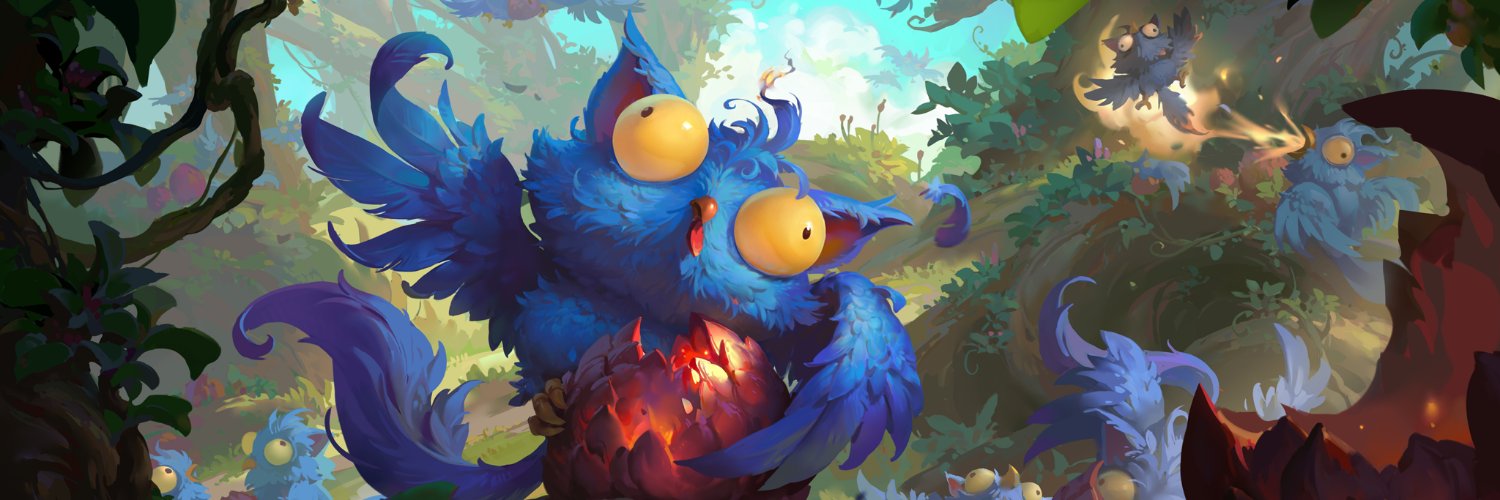
this is what 160 passionate and vocal fans of LoR look like. thank you all for signing and sharing the card around.
reading through each and every signature and reply has been emotional to say the very least. let's see what comes out of 2/2 and beyond.
Minutes ago, we shared an important update with Rioters about the future of Riot Games. Here’s what these changes mean for our games and what players can expect from us going forward: https://t.co/SPjvtANGdK
Super excited for y'all to finally see what we've been working on for the past 11 months.
League isn't going anywhere and this represents the largest Preseason we've ever done.
We're super proud of the Summoner's Rift Team and all of the teams who lent people and resources to make this happen.
It's been blood, sweat and tears from many many devs to get to this point and we're hoping you'll all feel like it was worth the wait, that we're solving some major problems with League and moving it forward.
It's been agonizing having to keep our lips sealed for the whole year while getting memed about Riot doing nothing, so it's a massive relief for yall to finally see a sneak peek of what's coming up. Hope you're all as excited as we are!!
This is going to be a long post...not really directly about TFT, but about leadership and how we should approach mistakes and failures. If you're looking for a solid promise about the future of TFT, this isn't that post. But if you're interested in my thought process, let's go.
When mistakes happen, the first thing to consider if it was an honest mistake, or something malicious. Often even the most severe mishaps are honest mistakes, and people do not need to be punished or put down when these happen, no matter the severity. I was around when League accidentally set all loot to 1 RP, which was a VERY bad mistake, but it was still just an accident. It's important to follow up of course, but these aren't career ending or anything. If the mistake was due to malicious intent or negligence, then it becomes a much bigger deal as it shows something will likely be a long term problem and needs to be taken care of with much more severity.
The other thing to consider is the frequency. Even the greatest employees will not have a 100% hit rate, and mistakes will be made. An amazing employee, when they make that first big mistake, honestly the worst thing you can do is come down on them hard. They are going to be their own worst critic and enemy in these situations, and adding onto the pile is a quick way to burn them out or make them distrust you, as you don't have their back. These mistakes are the learning process that shapes their experience and makes them better as time goes on. All you can do is help them back up and encourage them to learn and keep going.
It's super important to not overreact to a single mistake also and call it some sort of failing of the entire system. Sometimes a human error is an error, and trying to rewrite entire processes and systems to prevent that error is a productivity killer. Sometimes it really is as simple as "do better next time". Double check the code, run the sim better, etc is really all we're talking about. I've seen too often in retros these blow up into larger reworks. Don't fall for that trap if it was something small.
However, if the frequency isn't just a one off or an understandable accident, this is where things get more complex. If you continue to see error after error in a situation, it's time to evaluate all pieces of the process to see if there is something that can improve. An example of this in TFT was our process of Set creation in the Set 4 to 7 era, where it was clear we were consistently shipping good sets, but burning out devs and shipping with tons of bugs and reworks and more. This wasn't just "one set went rough, do better next time", this was "We need to change how we develop sets". When you get to this point, you have to consider all aspects of development. Is it the people? The process? The timelines? What's going on?
Next, you have to formulate a plan on how to address the systemic issue. When it gets to this point, "just do better" or just assuming more people will solve the problem is pretty pointless. Instead you need a plan that is possible with the resources you have or can get. In the case of Set Development as the example all the way back in Set 6 we begun the plan to swap to 3 sets a year with clear goals to try to improve set development to combat these repeated issues.
Now here is where things get extra tricky. When you are working on a live service game with high communication, players want to see results and change and information now. But development doesn't work like that, and in the case of swapping to three sets a year, it took us 10 months from the time the plan was originally conceived before we even announced it to players, and another 8 months before the first set with no midset would ship (Set 10). During this time while things are happening in the background, you still have to operate as is. You can't just stop making sets until you're ready even though you know this improvement is coming.
And then in terms of talking to players, those 10 months where we can't talk about it are rough. You want to tell players "Yup, we're aware set development has to get better and here's our 5 point plan to get it there.", but if anything goes wrong (you can't find the people, you don't get the budget, etc) you would be giving players false promises which is always awful. So you have to keep silent until you are truly ready to deliver because actions speak louder than words and all that really matters to players is results. Give them a good game! A good example of this was Spectator Mode for TFT. Someone promised it too early, and then priorities and situations changed, it fell off the roadmap, and became this thing we promised players but never delivered on, which is a feels bad and burns trust.
So as a leader, all of this has to be taken into account when considering what action and path to go down next. Is it a simple mistake that will happen less and less often as experience grows? Or is it a larger failing, be it the people or the system or something else? And if it's the latter, what is the path to improvement? You also have to take into consideration other factors like hiring capacity, team morale, player trust, and so much more. It's often not as simple as "Just do X". Even the swap to 3 sets a year had a LOT of hurdles we had to overcome internally in these areas before we could make it a reality. Alignment on the solution, staffing, processes for things like the ability to playtest more than one set at a time, etc, all had to be considered before we could lock it in.
Now if you've made it this far, you're wondering "What's all this yapping for and how does it affect TFT?" The reality is we as devs have the "Creators Curse" where all we see are the flaws in what we make, what could be better, what could be different. There are a LOT of things in TFT, despite how freaking amazing the game is, that can use improvement. Maybe it's our in game matchmaking formula, maybe it's our in client experience, maybe it's our item balance, maybe it's our bug testing, the list goes on and on. And for everything in this space we have to apply this sort of thought of "How are we going to improve this?"
So, all of this to get to this. When things are not going well, trust us, we know. We take it very hard. Even a simple bug that may have slipped through the crack for any number of reasons in the process, the whole team feels it and it sucks. It sucks for players, and we all want to bring the best experience to players. Any time something goes wrong, especially if it's repeated, actions are being taken. But the reality and unsatisfactory part is that we often can't share these with players until they are ready, because again, actions speak louder than words and results are what matter.
Again, if you were expecting some grand reveal, I'm sorry to disappoint. When results happen, we can talk about the process that got us there through articles and Q&A and more. Until then, we keep moving forward trying to make TFT the best game it can be. Apologies if this was too long or jumbled. It's early and now it's time for work!
Helia's
* [bound users] Karma, Janna, Yuumi; high damage uptime
** ~equal-2% better than Shurelyas
* Moonstone needs a buff across the board and has balance impacting bugfixes in 13.11.
One is a visual bug, the other is gameplay impacting (see @james_hata) later for details
In 13.11, we're going to buff the healing overall because we know it is underperforming, but we want to observe the shielding case for follow-up work. The goal is to position Moonstone as the primary AOE teamfight healer item.
For AOE shields, there was a gameplay bug where it was actually only bouncing off the first target (for stuff like Karma R->E). This has been fixed so it should now bounce a shield for everyone affected in the AOE.
I saw there was confusion around whether or not it was working and just wanted to clarify that it is. Anyway, hope ya'll enjoy trying out the new items!
Hope everyone is enjoying the new items and changes in the 13.10 Midseason patch! I worked on the Support ecosystem and wanted to clarify some interactions around Moonstone Renewer and heal over time effects (like Janna R). Short answer is that they do work together.
Originally the VFX for the chain fired off every tick of healing, but with abilities like Janna R and Milio W it was extremely noisy. I decided to lower the rate so the VFX fired every few seconds instead as a reminder, but did not change the functionality.
This is one of my first big pieces of content I've helped with to hit live!
Super happy to work with the team on her and bring her new updated kit to life!
@Spideraxe30 So with Caitlyn, we saw two major themes, sniping and traps. We opportunistically felt like traps lent themselves to a helping out an older theme we explored in set 1 with Teemo, and it felt like something we could expand on by adding a new dynamic to it.
@Spideraxe30 Killing units also doesn't really constitute a "unique winning strategy" as much as a way to "disable my opponents." Because LoR at its core is based around unit interactions (like champs) and tempo, efficient removal tends to swing it towards an attrition game.