Swedish warship Vasa sank to the bottom of the Baltic Sea in 1628.
In 1961 it was salvaged and the wood was still strong enough to be able to walk the decks.
Today is the world's best-preserved XVII century ship.
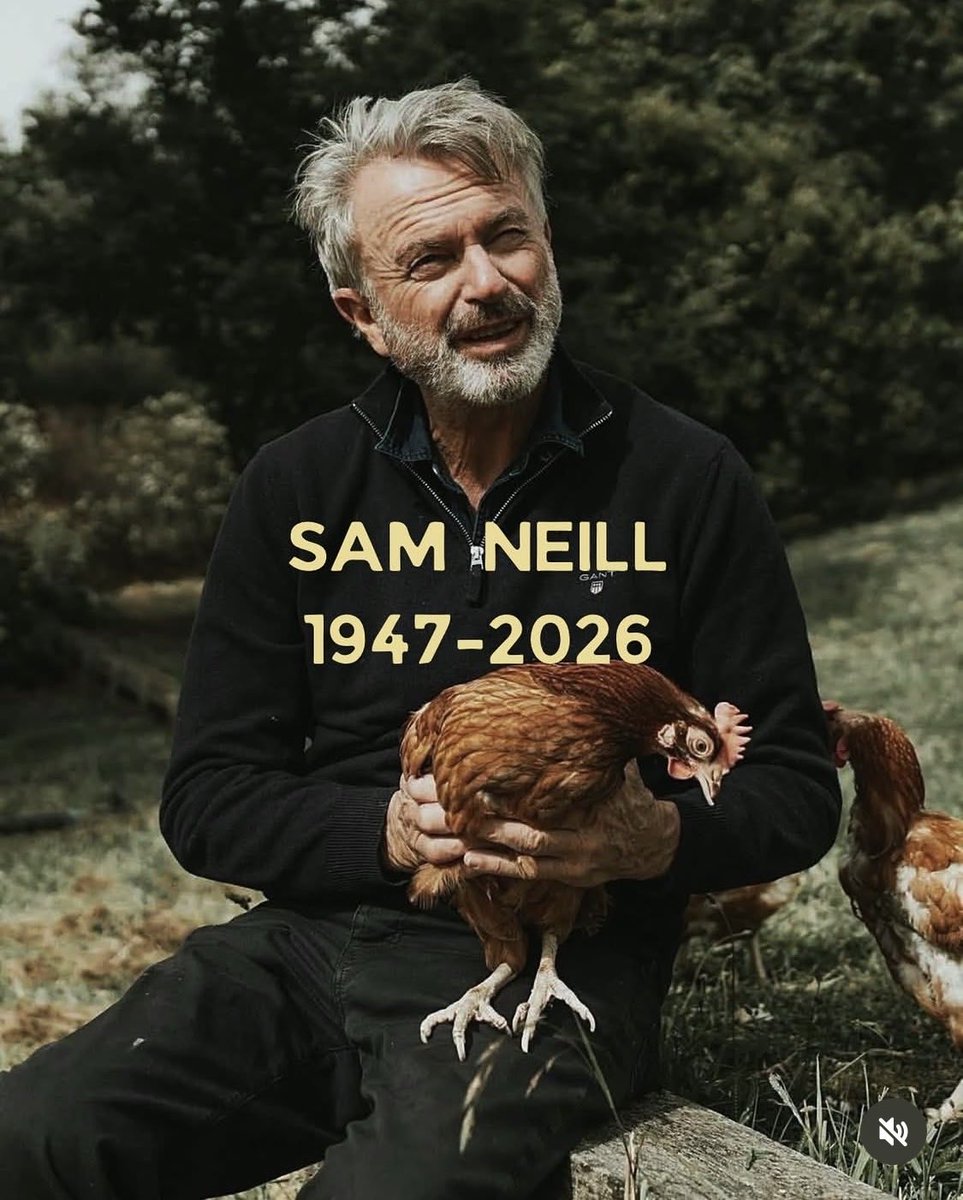
@LakotaMan1 One of those Kiwis that us Aussies always claim because we wish he was ours. A huge talent, but most of all an awesome bloke. My favourite Sam Neil bit - insisted on Event Horizon that his national flag which was intended to be Aus had the land rights flag in place of union jack
Margaret, 90, had gotten outside twice before her son Keith installed cameras. He expected to find footage of the problem.
He found something else. Every single night for nine months their golden retriever Flynn had already been at the front door before Margaret reached the hallway.
Blocking. Redirecting. Taking her sleeve and guiding her back to bed. Thirty-seven documented nights. Not once had she made it outside. Margaret's neurologist watched the recording and said: "I have worked in memory care for twenty-three years. Flynn is performing structured redirection. He built every component of it on his own." Keith said: "He figured it out the first night."
Tipón, Peru sits at 3,500 meters in the Andes. Its stone water channels have been running continuously for over 500 years: no pumps, no electricity, no maintenance crew.
The Incas tapped a natural spring and engineered a gravity-fed system so precise the water still doesn't overflow, stagnate, or waste a drop.
Modern infrastructure can't say the same after 50 years, let alone 500.
Death Valley National Park experienced its first major superbloom in a decade this year, driven by record winter rainfall (1.7 – 2.5+ inches) that transformed the desert landscape with vibrant carpets of yellow, pink, and purple flowers.
Scientists have created one of the most detailed 3D reconstructions of a human cell (eukaryotic cell) ever produced.
This groundbreaking model, often termed a "Cellular Landscape Cross-Section Through a Eukaryotic Cell," combines data from X-ray tomography, nuclear magnetic resonance (NMR), and cryo-electron microscopy to map molecular structures in extreme detail.
I don’t want us to be a country where your chances in life depend on how rich your parents are, where you grew up, what school you went to or the colour of your skin.
This week I introduced a Bill which will open the doors of our universities wider to more people from poor families and the regions and the bush.
This is what it’s all about. 👇
Yes: handwriting still matters.
A new study has confirmed that writing by hand activates far more complex and widespread neural networks in the brain than typing, underscoring its importance for learning and memory.
Researchers at the Norwegian University of Science and Technology used a high-density EEG cap with 256 electrodes to record brain activity in university students. They found that the intricate, sensory-rich movements involved in handwriting, especially cursive, trigger highly synchronized brain waves across extensive areas of the parietal and central regions. These coordinated patterns are strongly linked to memory formation, cognitive processing, and encoding new information.
In contrast, typing, which involves repetitive, simpler finger movements, produced significantly less neural connectivity and engagement. The difference was striking: the brain appears much less active during digital writing.
The researchers conclude that the unique motor and sensory experience of holding a pen plays a key role in brain development and learning. As a result, they argue that handwriting instruction should remain a core part of education to support deeper comprehension and cognitive growth in the next generation.
[ “Handwriting vs. Typing: A High-Density EEG Study on Brain Connectivity During Learning” — Norwegian University of Science and Technology (published in Frontiers in Psychology, 2025)]
🚨 After 40 years of research, Brazilian scientist Dr. Mariangela Hungria wins the World Food Prize for pioneering a $2 nitrogen-fixing bacteria treatment that replaces costly fertilizers, saves farmers $25 billion annually, and cuts 230 million tons of CO₂ emissions.








![Rainmaker1973's tweet photo. Yes: handwriting still matters.
A new study has confirmed that writing by hand activates far more complex and widespread neural networks in the brain than typing, underscoring its importance for learning and memory.
Researchers at the Norwegian University of Science and Technology used a high-density EEG cap with 256 electrodes to record brain activity in university students. They found that the intricate, sensory-rich movements involved in handwriting, especially cursive, trigger highly synchronized brain waves across extensive areas of the parietal and central regions. These coordinated patterns are strongly linked to memory formation, cognitive processing, and encoding new information.
In contrast, typing, which involves repetitive, simpler finger movements, produced significantly less neural connectivity and engagement. The difference was striking: the brain appears much less active during digital writing.
The researchers conclude that the unique motor and sensory experience of holding a pen plays a key role in brain development and learning. As a result, they argue that handwriting instruction should remain a core part of education to support deeper comprehension and cognitive growth in the next generation.
[ “Handwriting vs. Typing: A High-Density EEG Study on Brain Connectivity During Learning” — Norwegian University of Science and Technology (published in Frontiers in Psychology, 2025)]](https://pbs.twimg.com/media/HL1GBDjWUAAHLf9.jpg)


