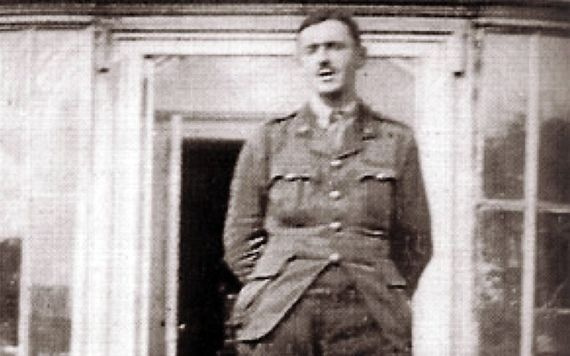
#OnThisDay 1920 Lt. Col Gerald B Smyth was shot dead by the IRA in Cork. Smyth gave a speech in Listowel RIC advocating the shooting of IRA suspects. His assassin said;
"Colonel, were not your orders to shoot on sight? Well you are in sight now, so prepare."
#Ireland#History
The Naval Service Reserve has taken delivery of its second custom-built Yard Patrol Vessels which are designed to enhance harbour security and maritime defence. The AODH will proudly join its sister vessel FIONNGHUALA will serve as a vital platform to Naval Reserve Capabilities
“When our friendless standards were first unfurled, who were the strangers who first mustered around our staff, Erin’s generous sons. Ireland, thou friend of my country in my most friendless days".
George Washington's praise for his Irish soldiers.
#Ireland#History#America250
You have noticed it. ChatGPT feels dumber than it used to. Your prompts that worked six months ago produce worse results now. The writing sounds flatter. The ideas sound safer. The internet itself feels like it is shrinking. Every article reads the same. Every email sounds the same. Every answer sounds like it was written by the same voice.
You thought it was you. It is not you.
Researchers at Oxford and Cambridge published a paper in Nature proving what is happening. They call it Model Collapse.
Here is the mechanism in one sentence. AI trained on AI-generated data gets dumber every generation until it forgets what real human data looked like.
The internet is filling with AI-generated content. Blog posts. Articles. Reviews. Comments. Social media. AI companies scrape the internet to train the next generation of models. Which means the next generation of AI is being trained on the output of the current generation.
Each cycle loses information. Not randomly. It loses the rarest, most unusual, most creative parts first. The researchers call these the "tails of the distribution." The weird ideas. The unexpected perspectives. The things that made the internet feel human. Those disappear first.
What remains is the average. The safe. The expected. The bland.
Then the next generation trains on that. And loses more. And the next generation trains on that. And loses more. The researchers proved this is not a slow decline. Major degradation happens within just a few iterations. Even when some of the original human data is preserved.
They tested it on large language models. On image generators. On statistical models. The pattern was the same every time. The output converges toward a narrow, flattened version of reality that looks nothing like the original data.
The lead researcher put it plainly. "Large language models are like fire. A useful tool. But one that pollutes the environment."
The pollution is invisible. You cannot see which sentence on the internet was written by a human and which was written by AI. Neither can the AI that is about to train on it. And once the tails are gone, they do not come back. The damage is irreversible.
This is not a prediction anymore. It is a diagnosis.
The internet you grew up on was built by humans writing things no algorithm would have written. Strange, personal, imperfect, alive. That internet is being diluted. One generation of AI at a time. And the models trained on what remains are learning a smaller and smaller version of the world.
Model Collapse is not a technical problem. It is a cultural one. The thing that made the internet worth reading is the thing that disappears first.
59 years ago today, Israel attacked the USS Liberty in international waters. 34 crew members were killed and 174 were wounded by the IDF.
Today, I spoke on the House floor to honor the fallen and to recognize the survivors who were present in the gallery.
¿Por qué los intelectuales odian el capitalismo? - Jesús Huerta de Soto
Bertrand de Jouvenel, en su análisis sobre la relación entre los intelectuales y el capitalismo, sostiene que muchos de ellos tienden a rechazar el sistema capitalista debido a su naturaleza impersonal y a la percepción de que promueve desigualdades.
De Jouvenel argumenta que este rechazo se origina en el deseo de los intelectuales de tener un papel central en la sociedad, algo que el capitalismo no necesariamente les garantiza. Jesús Huerta de Soto amplía esta crítica al señalar que el odio de los intelectuales hacia el capitalismo se fundamenta en cuatro factores: ignorancia, soberbia, resentimiento y envidia. La ignorancia se manifiesta en una falta de comprensión de cómo el capitalismo fomenta el bienestar general; la soberbia, en una actitud de superioridad moral frente al mercado; el resentimiento, por no ser reconocidos como actores clave en el sistema; y la envidia, hacia quienes prosperan bajo un modelo que privilegia el mérito y la innovación.
Estas críticas reflejan un profundo desacuerdo con los principios de la economía de mercado, que valora la descentralización y la competencia, en contraposición al control centralizado que muchos intelectuales prefieren.
The world spent 30 years calling Japan 'behind.'
Still uses cash.
Still uses fax.
Still has tiny shops run by one old couple.
Then the world got 'ahead' —
and ended up lonely, rushed,
and scrolling at 2 AM.
Now the same people are flying to Japan
just to feel something they can't name.
A meal made by hand.
A street that's quiet.
A stranger who's kind for no reason.
Turns out Japan wasn't behind.
It just refused to trade away
the things that actually make a life.
You have to separate signal from noise. Everything to do with JD Vance, peace talks, ceasefire, retaliation, etc. is noise. The signal is that the Strait of Hormuz is closed and will remain so. We're close to shutting down the global industrial economy.
https://t.co/Ow8oJbbM4R
The Fourth Amendment isn’t a suggestion.
It’s the law of the land, and no one is above it—not even our intelligence agencies.
Protect the Fourth. Reform FISA.
از خانم مرجان یشایائی، عضو جامعه کلیمیان ایران پرسیدم: چرا ایران را دوست دارید؟
در مقابل کنیسهی رفیعنیا که چند ساعت قبل در حملات هوایی اسرائیل تخریب شد