Interesting! I don't know about others working in this space, but MBDF's funders are on our website: the Alfred P. Sloan Foundation, the David and Lucile Packard Foundation, the Dreamery Foundation, the Gordon and Betty Moore Foundation, Coefficient Giving, and Patrick Collison.
Mirror peptides and mirror life also have very different risk benefit profiles; many people think that mirror peptides are fine to pursue, while making mirror life could be incredibly dangerous. See e.g. this UN Secretary General's Science Advisory Board brief https://t.co/0US06cUcpF
Hi @MichaelFloreaX - coauthor of the Science paper on mirror life here, also quoted in the article above. Unfortunately, I think there's real reason for concern.
Mirror bacteria could likely grow on achiral nutrients like glycerol that are already present in sufficient concentrations in the environment and inside of hosts. They are expected to be immune to all viruses and many predators, giving them a major ecological advantage. Some antibiotics might work but are uncertain and would require unprecedented scale to deploy. And antibiotics cannot protect the environment.
More detail on these points in chapters 1, 4, and 8 of our technical report: https://t.co/zjKr3mGNs4
The @BulletinAtomic has included mirror life in this year’s statement. Encouraged to see the issue getting this kind of attention.
Unlike many other risks in the statement, this one is ahead of us.
Mirror life doesn’t exist yet — our best estimate is that it could take a decade or more to build it (though AI could speed things up).
That makes governance much more tractable: there’s a clear path to eliminating the risks from mirror life if we act early.
A lot of good work to do in 2026!
In the 2026 Doomsday Clock statement, the Bulletin's Science and Security Board explains why the Doomsday Clock is now at 85 seconds to midnight.
Read more: https://t.co/IGrJlrQx1N
Recently I spoke on the 80,000 Hours Podcast about why I changed careers to focus on addressing the risks of mirror life. In the episode I walk through the science of the risks, what’s left to do, and why we have a rare window to solve these challenges in advance.
I’m also hiring a Deputy Director who would co-lead MBDF with me. We’re looking for someone with a track record of executing ambiguous, complex projects who wants to tackle a neglected catastrophic threat that's still preventable. Please get in touch if you or others are interested!
Role description: https://t.co/5sQcOmFnV3
Full 80k episode: https://t.co/kwU5HpNp2C
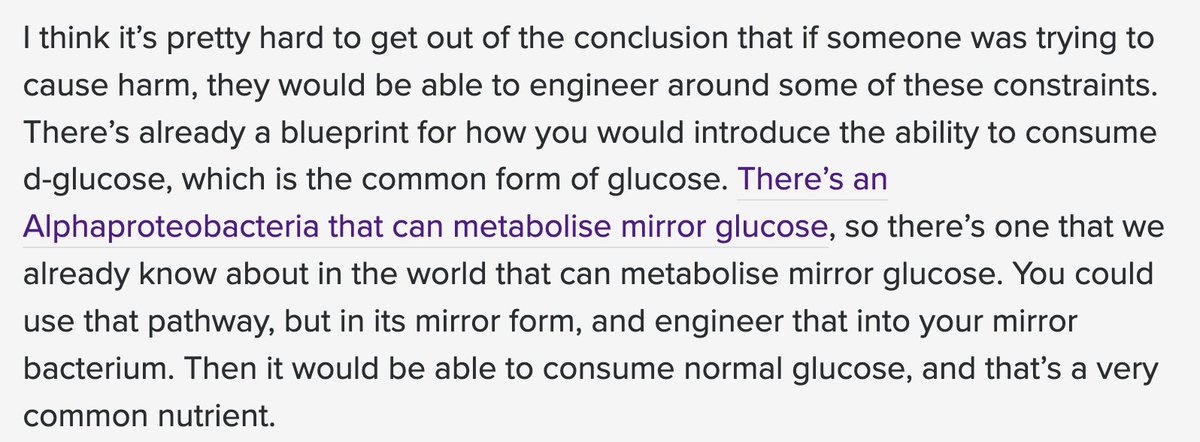
@LuisCostigan1 @elzurftm @robertwiblin@LuisCostigan1 is right. Mirror bacteria could metabolise achiral nutrients and some chiral nutrients by default (e.g. some amino acids). Mirror bacteria could also plausibly be engineered to metabolise common chiral nutrients like D (mirror)-glucose
@tim_tyler@robertwiblin There are lots of achiral nutrients that a mirror bacterium could likely grow on.
And on L-glucose specifically, interestingly, there's a natural chirality bacterium that can metabolize it. The 'mirror' of that pathway could enable a mirror bacterium to metabolise D-glucose
Thanks Rob, I had a great time speaking with Luisa!
A clarification: “potentially ending complex life on earth” is a bit more extreme than I'd have said, because there’s significant diversity in immune systems across species and considerable uncertainty about how some of those would respond. I think it's likely that e.g. some multicellular life would 'make it'. I talk about this in the context of vertebrates at 31:00 (https://t.co/U85uzpxDka), and plants at 36.20 (https://t.co/xnOkEXafys)
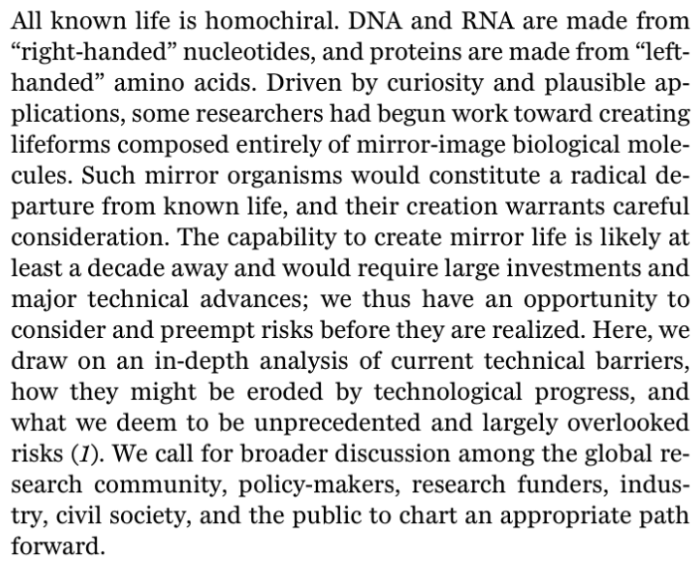
Author of mirror life work here: see this excerpt from the technical report for explanation of why mirror life is highly unlikely to evolve naturally. In short, there's no stepwise process through which it can evolve from natural chirality life, and no compelling reason to expect that it would evolve independently
https://t.co/zjKr3mGNs4
@SuzieD755164 Co-author of the mirror life paper here. To clarify, we think mirror life won't be possible for another 10-30 years, and those who were working towards this goal don't want to do it now the potential risks are better understood. More here: https://t.co/27aVju2Elx
@OmicsOmicsBlog One of the co-authors here! To clarify, we're not saying it's out there now - more like 10-30 years away - but it will likely eventually be possible. See the first paragraph. Reach out if you have questions!
@elidourado No one knows how frequently or infrequently life arose, see for instance (https://t.co/ppsdCt0mD2) which discusses the "earliness" argument and explains why it is not very strong evidence for frequent abiogenesis. 1/
Hi Ash, coauthor of the mirror life paper here. The technical report addresses your points: metabolizing nutrients in Ch 1 and 4.5, and evolution of mirror bacteria in Ch 8 (including discussing HGT) https://t.co/zjKr3mGNs4. Infection in humans is ch4. Feel free to reach out with questions!
@vdlorenzo_CNB Thanks, Victor. Agree on the need to avoid past mistakes and appreciate the thoughtful engagement. Looking forward to discussing this more with you.
@morontafelix Thanks for engaging with this. I’m one of the authors. Agree that a longer abstract would have been nice! Unfortunately, this is the type of abstract that Science uses for these articles. The first paragraph provides a good summary that was intended to serve as an abstract.
Hi Amesh! I'm one of the authors on the paper. Totally agree that research can have unexpected benefits, but wanted to flag that we're not calling for restrictions on ongoing experiments, instead arguing that the long term goal doesn't make sense given what we currently know. Many of my co-authors used to want to build mirror bacteria! Looking forward to discussion on this topic in the coming year
https://t.co/Svrw2GqC9G
We've just published three recommendations for what the UK Government should do to address the misuse risk from narrow, specialised AI-enabled biological tools (BTs): https://t.co/VX2GKzdJ1g 1/6🧵
@dioscuri@SpencrGreenberg If you use something like atext you can save instruction sets and quickly pull up different prompts with an abbreviation or shortcut: https://t.co/blhKVE9XcI