Here is why the market will just rally because of Jensen coming back.
We absolutely should be concerned if our best and brightest CEOs can be taken out with rumors without full investigations.
That is not America. If the losers who commit murder can still have their due process, so should Jensen.
Few people better to hear from on a wild market day like today as Nasdaq goes negative on the year
@DanielTNiles on whether this is still a speed bump or something bigger. He covered shorts into what he sees as max pain... positioning for the chance of a sharp bounce on Monday (even if he still has longer-term concerns)
Schönes Wochenende, liebe Börsianer. Nasdaq −5,7 %. So sieht ein richtiger Crash aus. Gleichzeitig werden wir Zeitzeugen des letzten großen Geniestreiches von Warren Buffett. Die Berkshire-Hathaway-Aktie notiert am Allzeithoch. Mit einem Cashbestand in Höhe von 377,4 Mrd. USD hat Buffett seinem Nachfolger Greg Abel eine Festung hinterlassen, die allen Turbulenzen standhalten kann.
Seit Warren Buffett am 10. Mai 1965 die Kontrolle über Berkshire Hathaway übernahm, stieg die A-Aktie von 18 US-Dollar auf 855.000 US-Dollar zum Börsenschluss am 20. November 2026. Das entspricht einem Kursgewinn von 4.749.900 % oder 19,1 % pro Jahr. Aus 1.000 US-Dollar wären rechnerisch 47,5 Mio. US-Dollar geworden.
Einige Kapitalmarktwissenschaftler behaupten, dass die Outperformance von Warren Buffett reines Glück gewesen sei. Nach dem Motto: Wenn es Millionen von Anlegern gibt, wird der Zufall einem von ihnen die Performance von Buffett bescheren. Ich lehne die Glücksthese ab.
Es ist kein Glück, dass Buffett und Munger in haussierenden Märkten Cashbestände aufbauen und an der Seitenlinie bleiben, weil sie keine Aktien finden, die ihnen die notwendige Sicherheitsmarge bieten. Kein anderer institutioneller Geldmanager macht das. Kein anderer kann Jahre der Hausse unbeteiligt an sich vorbeiziehen lassen.
Buffett wartete schon immer auf den Crash, und dann schlug er zu. Das ist eine Lebensphilosophie. Während der Finanzkrise 2008/09 tätigte Berkshire Hathaway Investitionen in Burlington Northern, BYD, Dow Chemical, Swiss Re, Harley-Davidson, General Electric, Wrigley/Mars, Goldman Sachs, Marmon und Wells Fargo.
Und dann gibt es noch einen weiteren Geniestreich. Buffett war der Finanzwissenschaft Jahre voraus. Bitte lesen Sie folgende Zeilen, liebe Börsianer:
Eugene Fama und Kenneth French stellten ihr Drei-Faktoren-Modell im Februar 1993 im Journal of Financial Economicsvor. In „Common Risk Factors in the Returns on Stocks and Bonds“ ergänzten sie den Marktfaktor des CAPM um zwei weitere Faktoren für Aktienrenditen: Unternehmensgröße (Size) und Bewertung anhand des Buchwert-Marktwert-Verhältnisses (Value). Im April 2015 erschien das Fünf-Faktoren-Modell von Fama und French im Journal of Financial Economics. Darin ergänzten sie ihr Drei-Faktoren-Modell um Profitabilität und Investitionstätigkeit.
Buffett und Munger setzten bei Berkshire Hathaway schon in frühen Tagen auf den Faktor „Quality Minus Junk“ und nutzten in ihrer Beteiligungsgesellschaft im Schnitt einen etwa 1,6- bis 1,7-fachen Kredithebel, um ihr Drawdown-Risiko wieder auf Indexniveau anzuheben.
Ja, Sie lesen richtig, liebe Börsianer: Auf 100 USD Eigenkapital zu Marktwerten kamen bei Berkshire Hathaway durchschnittlich 170 USD an Vermögenswerten nach Abzug der liquiden Mittel. Lesen Sie hierzu Buffett’s Alpha von Frazzini, Kabiller und Pedersen.
Fazit: Buffett hatte schon vor Jahrzehnten ein überlegenes Verständnis von Rendite- und Risikofaktoren. Chapeau.
The only difference between you and someone who makes lots of money in the stock market is the quality of his thoughts
This article has 70K views in less than 24h because it does one thing: increase the quality of your thoughts by the time you're done reading it
If you are wondering if it's too early to start buying...
We're days into this. 2020 was a blip. Real bear markets feel different, the last one was in 2008, the one before that was 2000, and almost no one under 40 lived through either (in the sense of having enough money invested to really feel it).
When you cannot look at your portfolio, when every rally fades and every day is worse than the last, when it's clear this isn't just a market event but is going to hit the real economy and hard... that's when you buy. When it feels the worst.
You still may be too early, and some stuff won't recover, but lots will.
Everyone wants to know when will the sell-off end.
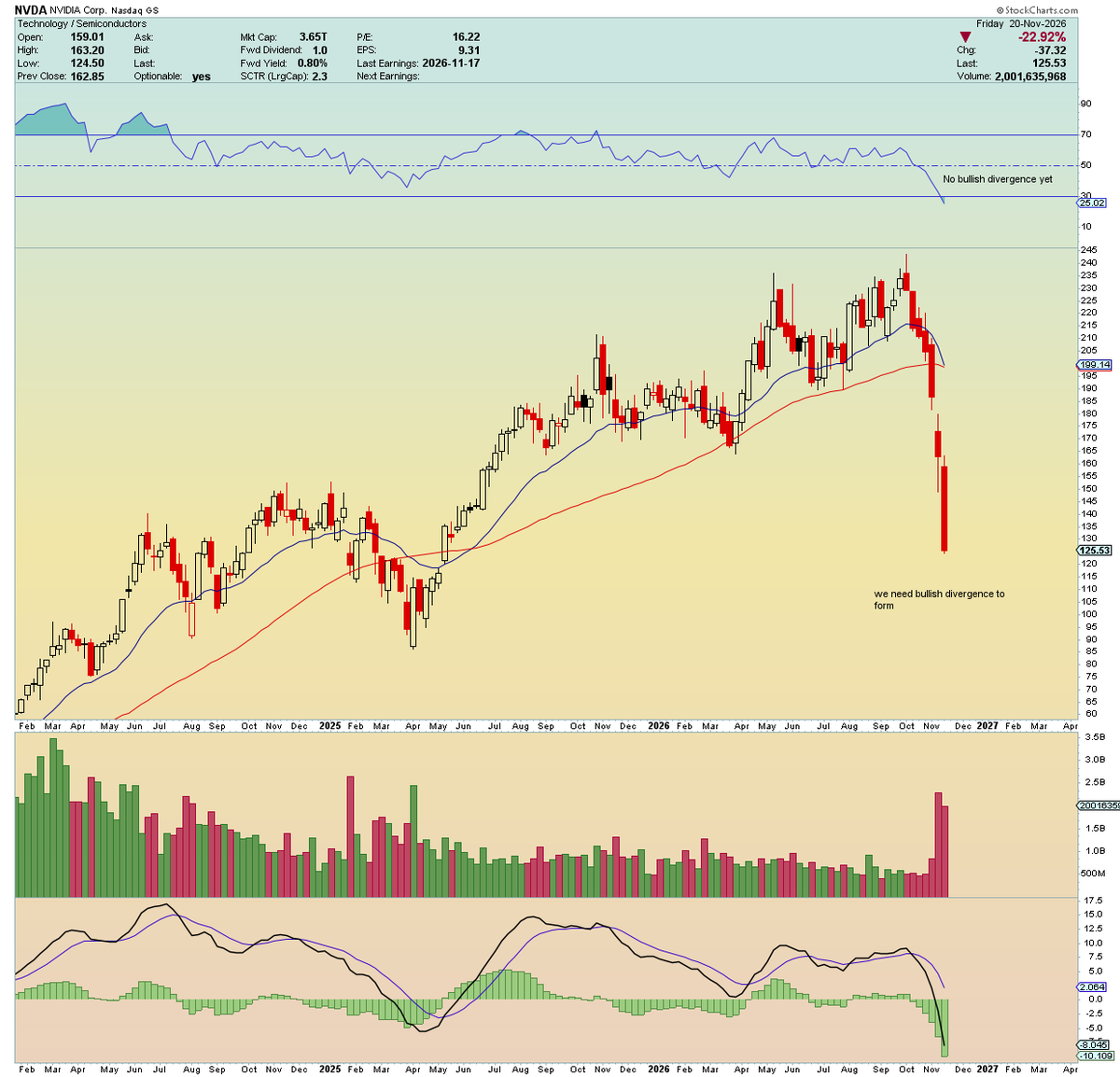
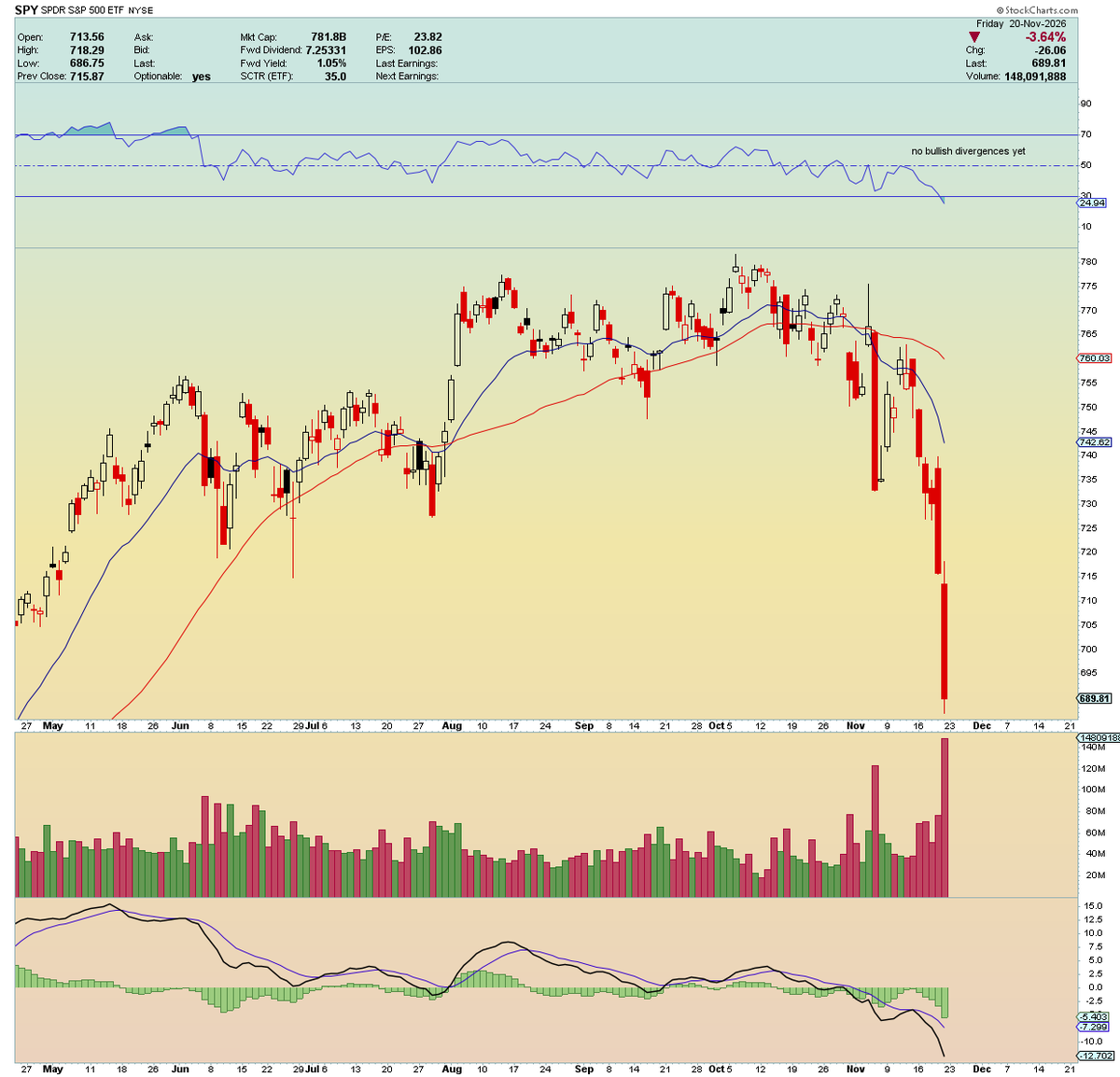
Early signs are starting to show. Oversold readings on daily and weekly charts for the first time this cycle.
But oversold is not the same as over. We need divergences. A few more drops where momentum refuses to follow price lower. That is the fingerprint of a real base.
This stabilization will take weeks. Headlines will keep coming. Ignore the noise.
We are adding selectively to fundamentally dominant names. Not swinging for fences. Scaling in with discipline. The market will not ring a bell at the bottom, but it will reward those who were accumulating while everyone else was liquidating.
I will tell you when to go all-in; survive and take it slow.
Fine.
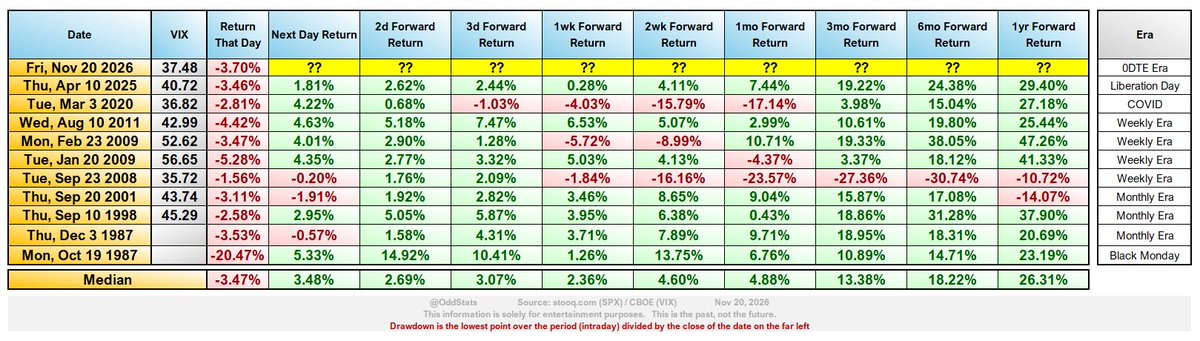
You wanted a bullish stat, so here it is.
In the past 12 trading days, SPX has had:
• Five -1% days
• Three -2% days
• Two -3% days
• One -4% day
You'll never guess how bullish this has been over the past 65 years; even the "scary" dates on here.
"We believe the market is in the midst of a normal correction. Even if the S&P 500 fell an additional 10% from current levels, we would still be within the range of a healthy correction. To call for a prolonged bear market well into 2027 is betting that the above factors will not only play out, but worsen. There is a lot of negative sentiment already accounted for in current asset valuations, we would be cautious about calls for a 30%+ drop in the S&P 500 which are quickly spreading."
We believe A LOT of what we are seeing now is the end of what we call the "Trump Put," as outlined in this Article.
The market's biggest backstop since January 2025 has effectively come to an end after the US Midterms.
A "must read" to understand what is going on right now.
@afshineemrani my ldl dropped from 208 to 103 in 2 months on zetia and some dietary changes (adding fermented foods, salmon to diet, eat a meat/fish diet). I wish my doc had tried zetia first as I've had no side effects compared to when I took crestor/lipitor
JUST IN: Nvidia Insiders claim that Jensen Huang was prone to anger, recalling one time an executive contradicted him and he closed his eyes and took a loud and deep breath inwards with an audible exhalation.
@CynicalPublius Lots of elites are antimilitary and have always been that way. My dad was a Vietnam vet and faced lots of animosity and condescension when he applied to med school. He got in but faced lots of hostility from those types of people.
How can you not be excited for the week ahead? Which CEO is getting honeypotted next? What part of our infrastructure will fail? Maybe we’ll invade a country. Perhaps we’ll rename the Pacific Ocean. Anything is possible!