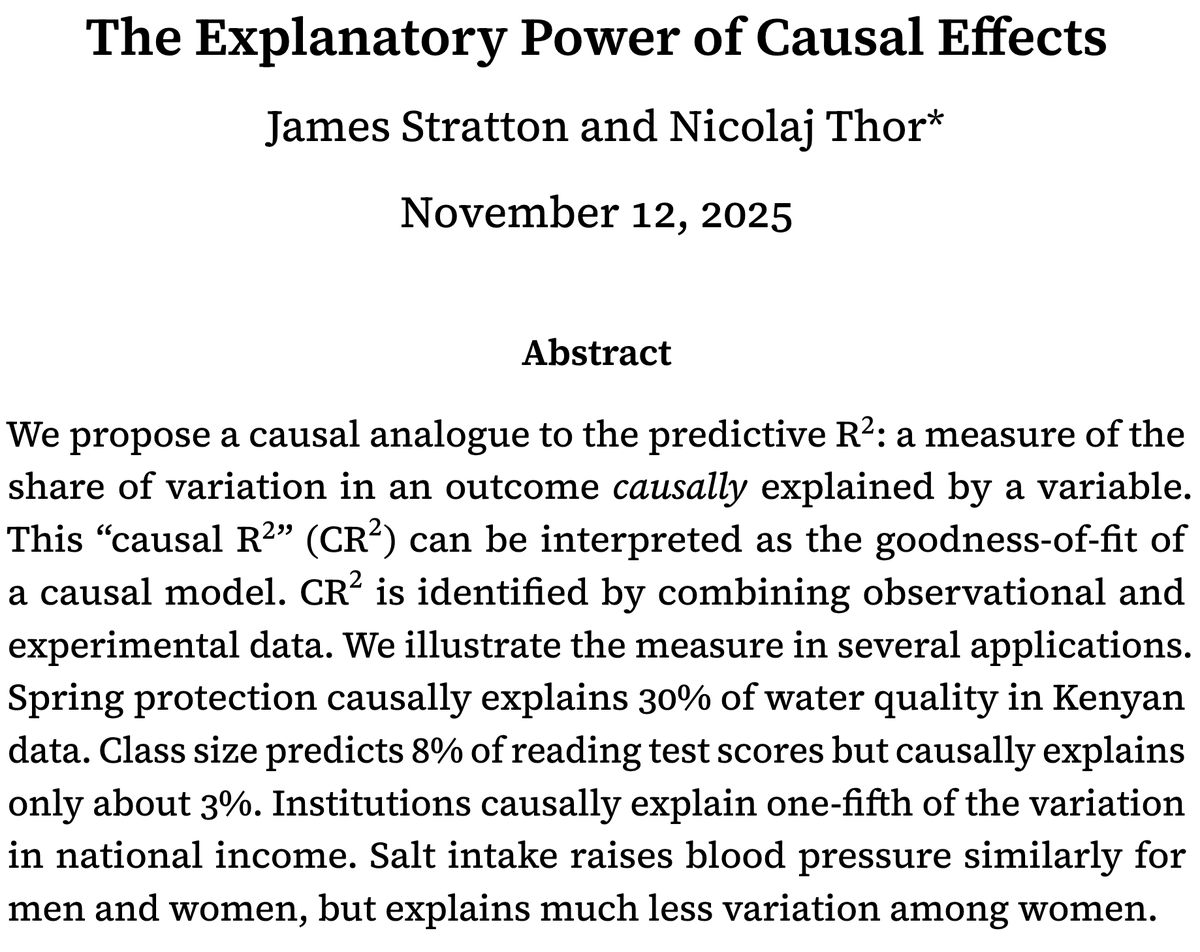
@alexolegimas@alexolegimas agreed! one issue with the R² is that it doesn't separate correlation vs causation, so it only speaks to the central predictors, not causal determinants of Y—@nicolajthor and I put out a WP this week proposing a ‘causal R2’ for this purpose
https://t.co/psZdPwYorH
@jamespstratton and I put out a working paper a few days ago on exactly this question! We propose a way to answer it using a simple causal analogue of the R² ("Causal R²").🧵(1/12). Paper: https://t.co/FgD8fFIEYj
@jamespstratton and I put out a working paper a few days ago on exactly this question! We propose a way to answer it using a simple causal analogue of the R² ("Causal R²").🧵(1/12). Paper: https://t.co/FgD8fFIEYj
@TheAtlantic@IsaacDovere "If she is picked, she’ll be the first vice-presidential candidate since Henry Wallace... to have never run for office before" -- is this right? I thought Sargent Shriver would be the last candidate in that position
@ALeighMP@MattCowgill@BenPhillips_ANU@ALeighMP, since you asked: applying Dingel and Neiman (2020) to Australian data gets an overall share of 41%, but there's a great deal of variation by income, education, and geography. See a brief analysis here: https://t.co/Fq45ElVpxe