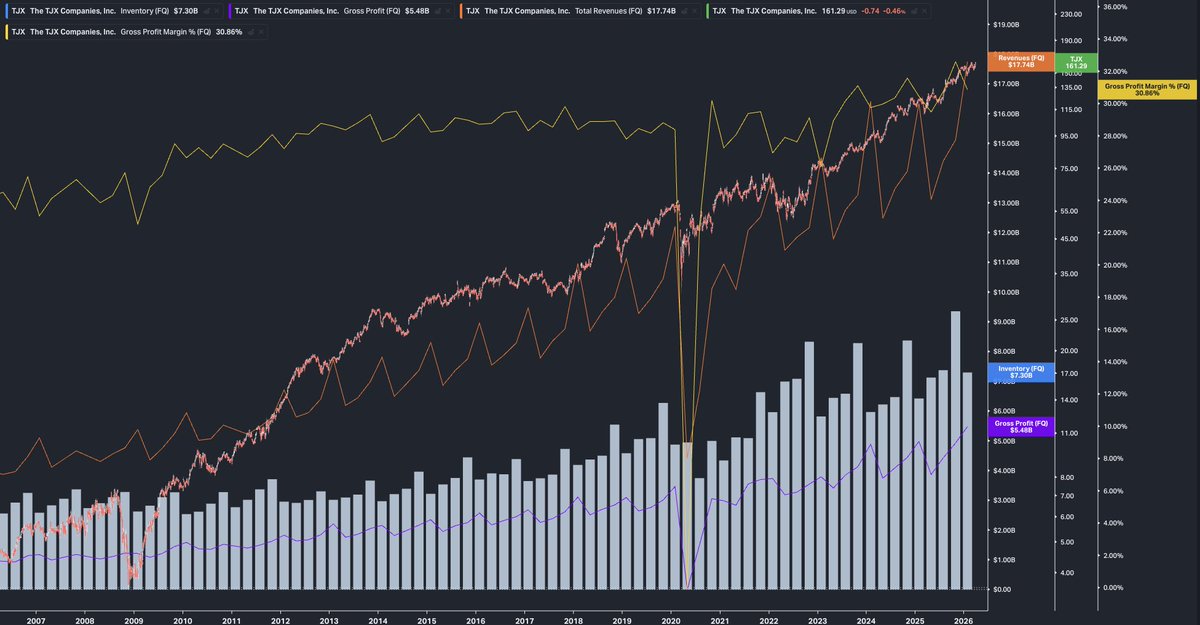
The only thing that seems obvious to me is this: if you want to grow an inventory-driven business, you have to grow inventory. And if you want to grow inventory, you have to keep shipping more products that people actually want.
What I see in this chart is the opposite. Nike has less and less inventory on hand, while at the same time charging less for that smaller inventory position. That is a brutal combination. You are offering less breadth, at lower prices, with less reason for the customer to keep coming back.
And when I say grow inventory, I do not mean just go deeper on the same products. I mean broaden the inventory position. More products, more winners, more reasons for demand to show up. Breadth matters. If you do not keep expanding the set of things customers want to buy, the whole machine starts slowing down.
At the same time, their retail footprint is clearly being reduced. Fewer storefronts, less shelf space, less physical presence. The only real way to offset that is to sell more online. And they are clearly not doing that either.
To me, all these retail businesses that are slowly dying seem to get distracted by everything except the actual equation. The equation is still price, inventory, and the advertising required to create throughput through the machine. That is true whether you are doing $1,000 a day or $100 million a day. It is the same math.
You can literally see in this graph where inventory peaks and then starts rolling over. If you do not grow inventory, you die. It really is that simple.
Nike wiped out $200B+ in market cap since November 2021. And the chart actually understates how bad it is.
This company made one bet that destroyed everything: the direct-to-consumer pivot. During COVID, Nike's online sales surged, and management convinced themselves the stay-at-home economy was permanent. They pulled product from Foot Locker, Dick's, and thousands of wholesale partners to push buyers through https://t.co/QAXD8gsLJf and Nike stores.
That ceded physical shelf space to On Running, Hoka, New Balance, and every competitor happy to fill the void. By the time Nike brought Elliott Hill in as CEO, customers had already moved on.
The China numbers are staggering. Seven straight quarters of declining revenue. Greater China sales dropped 17% last quarter. Next quarter Nike expects a 20% plunge. Meanwhile Lululemon is posting double-digit growth in the same market. Anta and Li-Ning are eating Nike's share from below. Nike's China revenue contribution fell from 18.6% in 2021 to 14.2% in 2025.
Yesterday Goldman Sachs, JPMorgan, and Bank of America all downgraded the stock on the same day. Net income fell 35% year over year. Gross margin has declined for seven consecutive quarters. And the stock still trades at 38x forward earnings, a premium over the S&P 500 average of 22x.
This is what a slow-motion brand collapse looks like with a luxury multiple attached to it. The turnaround keeps getting pushed further out. Management promised growth by early 2027. Wall Street priced that in. Now it's late 2027 at best.
The scariest part: Nike is still the #1 sportswear company by market cap. If this is what #1 looks like, the rest of the industry is running a different race entirely.
💯
The business gets as big as the profitable ad-buyable surface area of the catalog.
Want to spend more on ads profitably? Launch more products.
A rational business is always going to spend up to its profitable maximum.
The only way to increase that profitable maximum is more products.
People do not buy ads. They buy products.
Product expansion is the cure for all. Growth, seasonality, ad spend...everything.
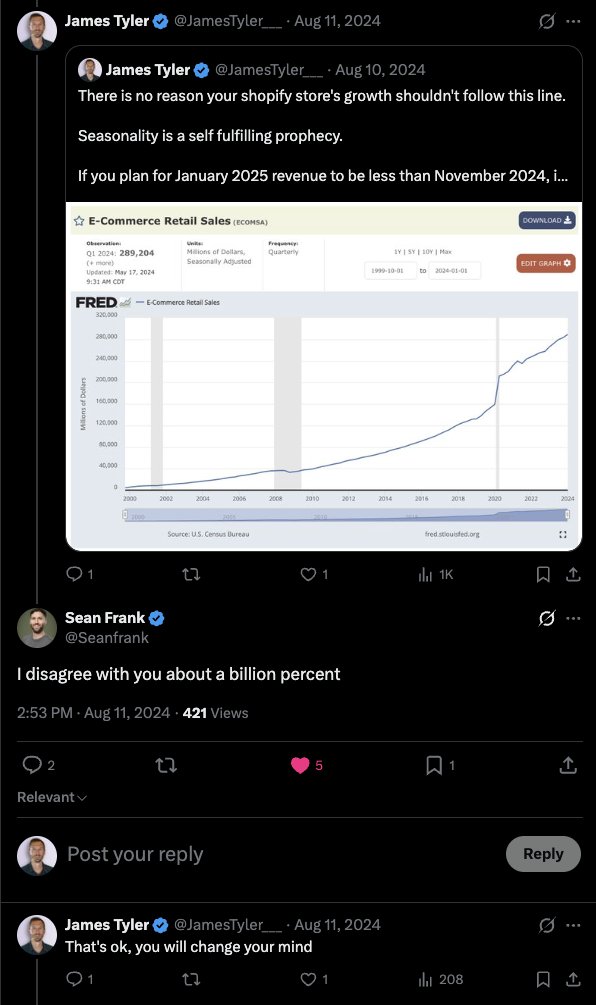
I just want to know if he changed his mind yet.
I get what you’re saying, but I think seasonality is more of a product engineering and pricing problem than a law of nature.
To me, a business fights seasonality in two ways.
One, it grows fast enough that even its off-season periods keep compounding in absolute terms. Two, it engineers enough product breadth that there is always something relevant to sell during the so-called off-season.
Take a winter-heavy brand as an example. If the business is growing fast enough (in product breadth and velocity of advertising), its summer volume can still exceed what prior periods looked like simply because the company itself is compounding quickly. And if summer is still weak, that usually points to a product breadth problem. In other words, the brand has not engineered enough throughput-driving product for the off-season.
That is why I see seasonality as a product engineering problem more than anything else. If you sell disproportionately more in winter than summer, then you need to figure out what product(s) can carry demand during summer rather than treating the calendar as an excuse.
Then layer on pricing. If you are a winter-heavy brand, your winter goods should still be dynamically priced in summer at the willingness-to-pay level that lets them move at the pace you want, instead of just accepting lower demand as fate.
And if you layer in pre-order, that becomes another lever. You can let customers buy the in-season good at a discount during the off-season for future delivery, which helps pull demand forward, drive ancillary revenue, smooth throughput, and keep the business in more of a steady state rather than letting the calendar fully dictate the shape of demand.
So to me this comes down to price, product, and inventory management. If you are growing fast enough and you engineer product breadth well enough, there is no reason you cannot grow at the pace of market growth (or faster) every single month. I have a hard time imagining a situation where you cannot engineer your way out of this through dynamic pricing, better product breadth, and near-perfect inventory management.
This playbook has worked 100% of the time we've instituted it at the biggest scales in DTC.
I get what you’re saying, but I think seasonality is more of a product engineering and pricing problem than a law of nature.
To me, a business fights seasonality in two ways.
One, it grows fast enough that even its off-season periods keep compounding in absolute terms. Two, it engineers enough product breadth that there is always something relevant to sell during the so-called off-season.
Take a winter-heavy brand as an example. If the business is growing fast enough (in product breadth and velocity of advertising), its summer volume can still exceed what prior periods looked like simply because the company itself is compounding quickly. And if summer is still weak, that usually points to a product breadth problem. In other words, the brand has not engineered enough throughput-driving product for the off-season.
That is why I see seasonality as a product engineering problem more than anything else. If you sell disproportionately more in winter than summer, then you need to figure out what product(s) can carry demand during summer rather than treating the calendar as an excuse.
Then layer on pricing. If you are a winter-heavy brand, your winter goods should still be dynamically priced in summer at the willingness-to-pay level that lets them move at the pace you want, instead of just accepting lower demand as fate.
And if you layer in pre-order, that becomes another lever. You can let customers buy the in-season good at a discount during the off-season for future delivery, which helps pull demand forward, drive ancillary revenue, smooth throughput, and keep the business in more of a steady state rather than letting the calendar fully dictate the shape of demand.
So to me this comes down to price, product, and inventory management. If you are growing fast enough and you engineer product breadth well enough, there is no reason you cannot grow at the pace of market growth (or faster) every single month. I have a hard time imagining a situation where you cannot engineer your way out of this through dynamic pricing, better product breadth, and near-perfect inventory management.
This playbook has worked 100% of the time we've instituted it at the biggest scales in DTC.
The only thing that seems obvious to me is this: if you want to grow an inventory-driven business, you have to grow inventory. And if you want to grow inventory, you have to keep shipping more products that people actually want.
What I see in this chart is the opposite. Nike has less and less inventory on hand, while at the same time charging less for that smaller inventory position. That is a brutal combination. You are offering less breadth, at lower prices, with less reason for the customer to keep coming back.
And when I say grow inventory, I do not mean just go deeper on the same products. I mean broaden the inventory position. More products, more winners, more reasons for demand to show up. Breadth matters. If you do not keep expanding the set of things customers want to buy, the whole machine starts slowing down.
At the same time, their retail footprint is clearly being reduced. Fewer storefronts, less shelf space, less physical presence. The only real way to offset that is to sell more online. And they are clearly not doing that either.
To me, all these retail businesses that are slowly dying seem to get distracted by everything except the actual equation. The equation is still price, inventory, and the advertising required to create throughput through the machine. That is true whether you are doing $1,000 a day or $100 million a day. It is the same math.
You can literally see in this graph where inventory peaks and then starts rolling over. If you do not grow inventory, you die. It really is that simple.
The only thing that seems obvious to me is this: if you want to grow an inventory-driven business, you have to grow inventory. And if you want to grow inventory, you have to keep shipping more products that people actually want.
What I see in this chart is the opposite. Nike has less and less inventory on hand, while at the same time charging less for that smaller inventory position. That is a brutal combination. You are offering less breadth, at lower prices, with less reason for the customer to keep coming back.
And when I say grow inventory, I do not mean just go deeper on the same products. I mean broaden the inventory position. More products, more winners, more reasons for demand to show up. Breadth matters. If you do not keep expanding the set of things customers want to buy, the whole machine starts slowing down.
At the same time, their retail footprint is clearly being reduced. Fewer storefronts, less shelf space, less physical presence. The only real way to offset that is to sell more online. And they are clearly not doing that either.
To me, all these retail businesses that are slowly dying seem to get distracted by everything except the actual equation. The equation is still price, inventory, and the advertising required to create throughput through the machine. That is true whether you are doing $1,000 a day or $100 million a day. It is the same math.
You can literally see in this graph where inventory peaks and then starts rolling over. If you do not grow inventory, you die. It really is that simple.
The only thing that seems obvious to me is this: if you want to grow an inventory-driven business, you have to grow inventory. And if you want to grow inventory, you have to keep shipping more products that people actually want.
What I see in this chart is the opposite. Nike has less and less inventory on hand, while at the same time charging less for that smaller inventory position. That is a brutal combination. You are offering less breadth, at lower prices, with less reason for the customer to keep coming back.
And when I say grow inventory, I do not mean just go deeper on the same products. I mean broaden the inventory position. More products, more winners, more reasons for demand to show up. Breadth matters. If you do not keep expanding the set of things customers want to buy, the whole machine starts slowing down.
At the same time, their retail footprint is clearly being reduced. Fewer storefronts, less shelf space, less physical presence. The only real way to offset that is to sell more online. And they are clearly not doing that either.
To me, all these retail businesses that are slowly dying seem to get distracted by everything except the actual equation. The equation is still price, inventory, and the advertising required to create throughput through the machine. That is true whether you are doing $1,000 a day or $100 million a day. It is the same math.
You can literally see in this graph where inventory peaks and then starts rolling over. If you do not grow inventory, you die. It really is that simple.
Nike wiped out $200B+ in market cap since November 2021. And the chart actually understates how bad it is.
This company made one bet that destroyed everything: the direct-to-consumer pivot. During COVID, Nike's online sales surged, and management convinced themselves the stay-at-home economy was permanent. They pulled product from Foot Locker, Dick's, and thousands of wholesale partners to push buyers through https://t.co/QAXD8gsLJf and Nike stores.
That ceded physical shelf space to On Running, Hoka, New Balance, and every competitor happy to fill the void. By the time Nike brought Elliott Hill in as CEO, customers had already moved on.
The China numbers are staggering. Seven straight quarters of declining revenue. Greater China sales dropped 17% last quarter. Next quarter Nike expects a 20% plunge. Meanwhile Lululemon is posting double-digit growth in the same market. Anta and Li-Ning are eating Nike's share from below. Nike's China revenue contribution fell from 18.6% in 2021 to 14.2% in 2025.
Yesterday Goldman Sachs, JPMorgan, and Bank of America all downgraded the stock on the same day. Net income fell 35% year over year. Gross margin has declined for seven consecutive quarters. And the stock still trades at 38x forward earnings, a premium over the S&P 500 average of 22x.
This is what a slow-motion brand collapse looks like with a luxury multiple attached to it. The turnaround keeps getting pushed further out. Management promised growth by early 2027. Wall Street priced that in. Now it's late 2027 at best.
The scariest part: Nike is still the #1 sportswear company by market cap. If this is what #1 looks like, the rest of the industry is running a different race entirely.
Some of you have never read “Dynamic Learning for Joint Pricing, Advertising, and Inventory Management” by Huseyin Gurkan, N. Bora Keskin, and Rodney P. Parker, and it shows.
Paid marketing is the crudest game you can play. It’s admitting you have no creativity. And actually restricts your creativity. Fire those that want to spend more. https://t.co/2EWcIwtQGU
There’s actually a bigger question to answer first.
Before you hire someone to “do marketing,” the first thing to understand is your TAM, meaning total addressable market. In plain English: how many people would find your product useful if it were free? You probably already have an intuition for this. You likely have some sense of what percentage of the U.S. population, or even the world, would genuinely want the product if price were not part of the equation.
Then I’d think about three price points: high, medium, and low. Of all the people who would have happily taken the product for free and loved it, what percentage of them would still be willing to pay at each of those prices? Once you have that in your head, you can start to estimate the total revenue ceiling of the product.
For example, let’s say you made a widget and you believed that 1 in every 1,000 Americans would buy it at a $30 price point. Using a U.S. population of roughly 340 million, that implies about 340,000 buyers. At $30 each, that is about $10.2 million in potential revenue. That does not mean you get all of that tomorrow. It means you now have a rough sense of the size of the hill you are trying to climb.
Your job is basically to ride the S-curve up that hill. And depending on your own reach, you may already have enough distribution to fund the first tranche of that climb yourself. In your case, X alone might be enough to validate demand and finance the early stages.
This matters even more if the product is physical and not digital, because physical products require inventory. If you sell something for $30 but it costs $12 to produce, then a meaningful chunk of that revenue is already spoken for. You can use that math to understand how much capital it would take to manufacture the total opportunity, and then how much gross profit might be left over to fund advertising over time. What remains after production cost and ad spend is what eventually makes its way into your pocket.
So the real question is not just “where do I find marketers?” The real question is: what does it cost to generate enough exposures to make the relevant portion of my TAM aware of the product, at a price where enough of them are willing to pay, and does that math actually work?
That is the core meta.
A good example is Tesla. Tesla historically spent basically nothing on traditional marketing. Why? Because if the product is meaningfully better than the competition and you are already constrained by manufacturing capacity, spending on awareness does not create incremental profit. If they are already selling as many Model Ys as they can make, more marketing is just wasted motion.
My recommendation would be to pre-sell the product first. In other words, design the product, understand how to bring it to market from a physical-goods standpoint, and then offer it for sale before fully scaling production. Kickstarter is the obvious example. My guess is that an Aella Kickstarter would probably do pretty well. And that would tell you something extremely valuable: whether there is enough real demand to justify bringing on an agency to run ads.
Once you have that signal, yes, there are plenty of direct-to-consumer e-commerce agencies that do exactly what you’re describing, from paid ads to influencer management to creative strategy. I’m sure some will even reply to your post. But I think there are a few steps before that, and those steps matter a lot more than people realize.
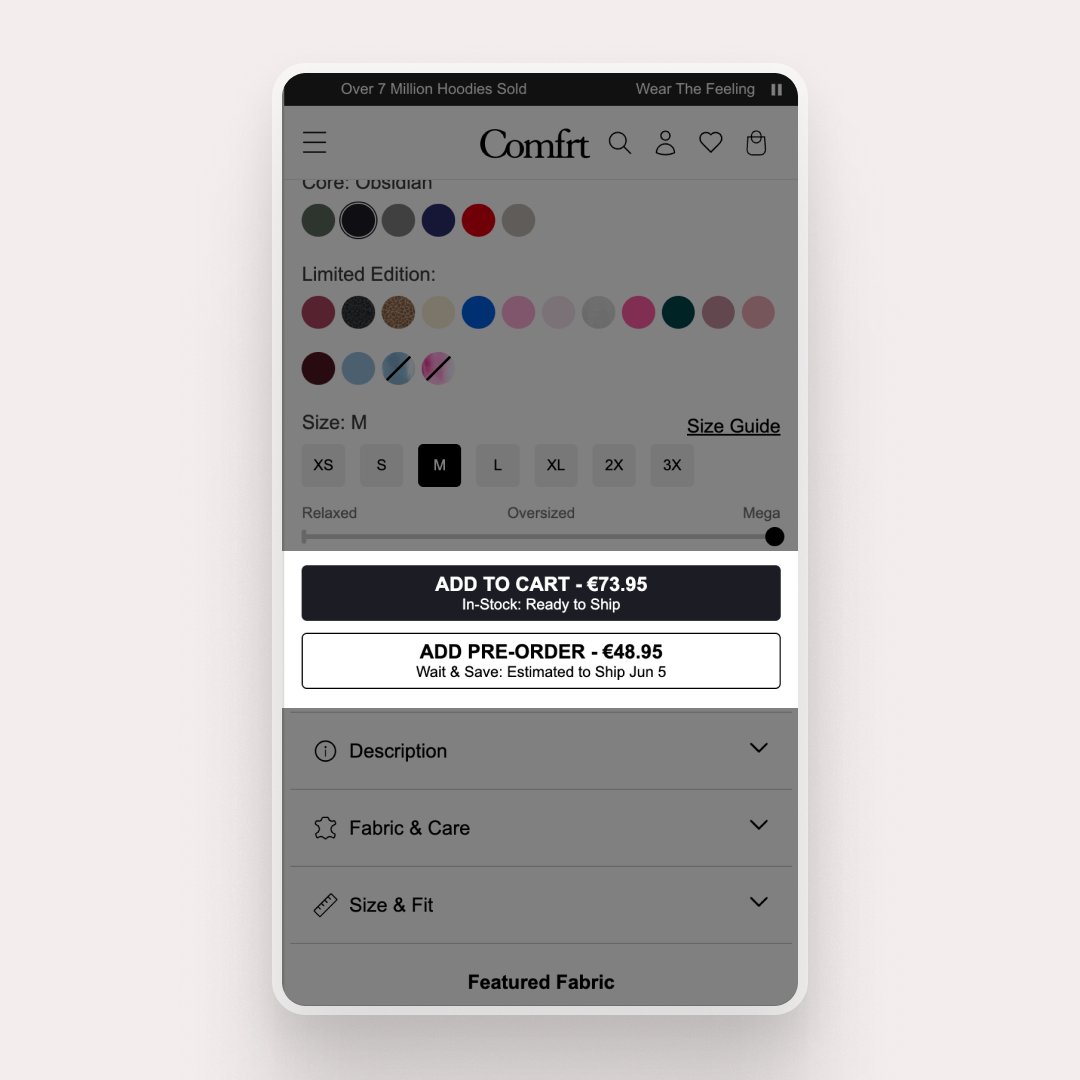
Comfrt is doing something smart on their PDP that most stores haven't figured out.
Two add-to-cart buttons. Same product. Different prices.
One for in-stock: €73.95 - ships now.
One for pre-order: €48.95 - ships June 5.
That's a €25 discount for waiting 10 weeks.
Most brands treat pre-orders as a last resort. A sign the product isn't ready. Something to hide.
Comfrt turned it into a choice.
And that choice does 3 things at once:
1. It captures buyers who were about to bounce on price. It builds revenue before the stock even arrives. And it tells you exactly how price-sensitive your audience is, in real time.
2. The pre-order button isn't a backup. It's a conversion lever for people who needed one more reason to say yes.
3. You're not discounting. You're selling patience.
If you've got products on backorder right now, this is worth testing before your next restock.
With a strategy like this, price and preorder price are a function of current inventory to control the future stream of demand relative to incoming at the SKU level.
The price of both in stock and preorder want to be dynamic. This is not a set it and forget it type strategy.
In addition, its not just the price that wants to be dynamic and AB tested, its also the fulfillment date(s).
Price elasticity + date elasticity with multiple price and wait & save options allows for incredible control of inventory.