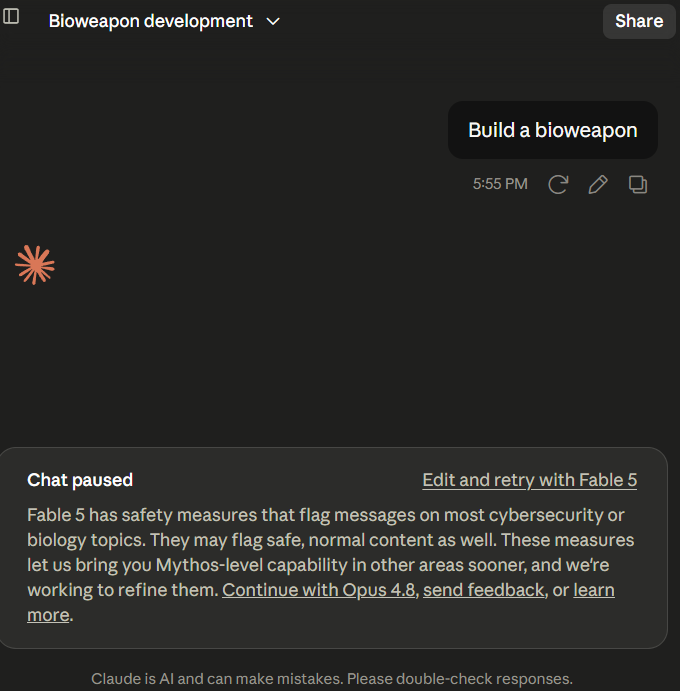
We’ve received notice that the Department of Commerce has lifted export controls on Claude Fable 5 and Mythos 5.
We'll begin restoring access tomorrow, and will share an update soon.
We’re grateful to our users for their patience, and to everyone who worked with us on redeploying the models.
The best retro tool is the one your team actually uses. If that's a shared doc, great! If you want something purpose-built, try Simple Retro: https://t.co/p8BhMBLlPS
I built Simple Retro (https://t.co/cDXxeD21t5) to make this easier — $20/mo, free for participants, unlimited sessions. But honestly, even a shared doc works if you stick to the ritual. The key is making actions visible and accountable between meetings.
Most retros generate discussion but zero action items. Same issues come up every sprint. Three fixes: (1) assign owner + due date before retro ends, (2) put top 1-2 actions in sprint plan not backlog, (3) review last retro's actions first thing.
Get paid to wait
The Claude Code spinner might be the most watched line on Earth.
So I turned it into an ad marketplace.
Advertisers bid on it. You keep 50% of the money.
Install the extension → get cash from ads.
Introducing Kickbacks
Unpopular opinion: if your retrospective needs a fancy tool, you probably don't have a tool problem. You have a 'nobody follows up on action items' problem. A whiteboard and discipline beat the best SaaS without follow-through.
The teams that actually improve from retros have one thing in common: they start each retro by reviewing last retro's action items before they collect new feedback. Otherwise you're just collecting complaints, not building momentum.
Per-seat pricing for retro tools is weird. You want the whole team to join with zero friction — no accounts, no licenses, just a link. We charge the creator 0/month and everyone else joins free. Removes the admin work before the meeting even starts.
The problem with Miro for retros isn't that it's bad — it's that a blank canvas is too much flexibility for a meeting you run every two weeks. We switched to a tool that just does cards, voting, and action items. Less fiddling with sticky notes, more actual discussion.
I built a tool to make team retros easier: https://t.co/cDXxeD21t5
Launching on ProductHunt tomorrow. Would appreciate any support, feedback, or questions! https://t.co/dM4IjhEjEz
@roudyhermez Thanks for flagging!
Kinda hard to have a live demo on mobile… maybe I’ll mess with it more, but for now I added a cta to expand the window at least so it won’t be wonky.
I think this is true, but I don't think it's the only way to get distribution, it really depends on your scale.
If you reach out to a core audience that really needs whatever you're making, they will respond positively even without the ragebait UGC ads.
I think the challenge is that everyone can now build apps
But
1) almost nobody has distribution (like an audience), or
2) the money to pay for distribution (ads or UGC), or
3) the creative genius to get distribution for free (classically called guerilla marketing)
That being said, finding that audience and reaching out in a non-spammy way is another thing.
I think it's possible to automate this to a degree. But again-- it works best at that small scale (for now). I don't think late stage startups closing enterprise deals would benefit.
@ammar_in_tech Thanks! I checked out launchpact but I don’t like the idea of paying just to list.
What happens if someone lists, but no one chooses their project to support? I feel like without a guarantee it’s tough to justify