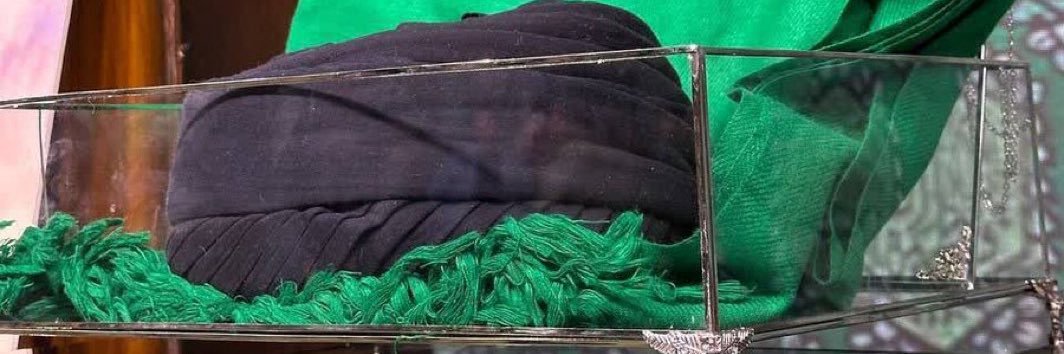
The divine principle of Wilayat al-Faqih in the Islamic Republic
Martyr Khamenei on the true source of the Islamic Republic's resilience: not personalities, but the principle of Wilayat al-Faqih embedded in the Constitution by a divine hand.
Abu Ayad for the faggots that are tired of the axis…. They have trained the proudest amongst Palestinians and Lebanese to think they would even be listened to on any negotiation table without weapons…
Ghassan Saoud : Il y a moins de quarante ans Jamais un responsable du Hezbollah a giflé un chrétien, et voilà qu'un Israélien brise des croix et crache sur le christianisme !
y a pas plus clair que ça !
الكل يسمعها و رتويت ❤️🌹
الكلام لكريمة الشهيد الدكتور
#محمد_جعفر_نعمة:🕊️🥀
"نحن ليش عم نضحي بشبابنا يعني ليه؟
بيّاتنا واخواتنا وعمومتنا وخوالنا وقرايبينا
....
لأنه نحن ما مننذل
حز.ب الله ما بيقبل هيك
والس.يد حسن ما كان يقبل هيك
وما حدا بيقبل هيك وما حدا رح يقبل هيك
فهمتوا !
Source: Al-Arab Al-Janoubi Al-Amili Archive – London,
June 10, 2026.
"Hamza Hammoud (2001–2026), the son of the border town of Markaba and of the Bir al-Abed neighborhood in Beirut's southern suburbs, was not a resistance fighter.
Rather, he was an ordinary young man from a southern Lebanese family that had known occupation all too well since at least 1978. Forced to leave their homeland, the family settled in Beirut's southern suburbs, where Hamza was born. Although he never experienced occupation firsthand, he grew up witnessing its opposite: resistance, its victories, and the spirit of defiance and dignity it instills. Over years of struggle and sacrifice, that spirit became a defining feature of the resistance community. It seems that, on his final journey, Hamza needed nothing more than an overwhelming sense of anger and rejection of occupation to take up whatever weapon he could find, in his case, a pistol and a knife, and ride his motorcycle from Bir al-Abed to the far south.
Friends of the martyr recount that, two days before his death, Hamza called relatives and friends while in the deep south. He spoke of his outrage at the occupation and its crimes and revealed his decision to seek revenge, fully aware that the road ahead would almost certainly end in death. His journey from Beirut into the occupied zone was far from easy. At one point, he reportedly spent the night in a valley close to enemy forces before continuing toward his hometown of Markaba. It appears that he chose to bid a final farewell to his village, its martyrs, and its destroyed homes before crossing into occupied territory. There, inside a border settlement, he confronted enemy forces and engaged them with his light personal weapons until he was martyred.
Hamza Hammoud's story opens a new window onto the nature of resistance to occupation in southern Lebanon. The deepening and prolonged reality of occupation is driving young people, many of whom do not necessarily belong to organized resistance movements, to seek their own ways of confronting and expelling it. While Hamza may stand alone today, both local and global historical experiences demonstrate that such paths often begin with a single individual before growing and spreading, much like a snowball that gathers size and momentum as it rolls. There is little doubt that Hamza's action generated significant concern within Israel, prompting investigations, studies, and the reassessment of numerous military and security assumptions.
Hamza, a lone young man, untrained, lacking sophisticated equipment, organizational backing, or even detailed knowledge of the region's hills, valleys, caves, and terrain, shattered a narrative promoted for nearly two years by the Israeli military and Prime Minister Benjamin Netanyahu. That narrative revolves around the so-called "security buffer zone" or the alleged "yellow line", which was supposed to guarantee security and stability for northern settlements and their residents.
Yet Hamza, the fedaye'e who crossed, the martyrdom-seeker who arrived, found himself face to face with Israeli soldiers in the heart of a military position inside a border settlement. They were many; he was alone. Unafraid and undeterred, he carried with him the memory of dozens, perhaps hundreds, of fallen friends. The image of the narrow alleyways of Bir al-Abed crossed his mind, and he felt a moment of longing. Then he turned toward nearby Markaba, his occupied hometown. Its breeze touched him, calming his heart and easing his yearning.
Finally, he laid his cheek upon the soil of Palestine and drifted into eternal rest, tracing with his warm, flowing blood a path for future fedayeen, for those who one day will arrive, who one day will cross."
❤️Glory to our hero martyrs❤️
The Iranians don't owe any of you traitorous Arabs ANYTHING.
W'ALLAH they should have abandoned your cause LONG AGO.
You're ungrateful, retarded, and cowardly. You offer ZERO fucking benefit to Iran and ONLY have been a liability for a country already sanctioned beyond belief.
Hezbollah categorically denies CNN interview with alleged fighter
——
Hezbollah issued a statement categorically denying CNN’s so-called "interview" with a member of the group, asserting that the individual presented as a Hezbollah fighter has no affiliation with the movement whatsoever.
The group stressed that it neither coordinated, facilitated, nor arranged any such interview, and urged media outlets to adhere to professional standards, emphasizing that its Media Relations Department is the sole body authorized to organize media access and communications.
#المجتمع_المقاوم#أحداث_الساعة
قراءة في آخر المستجدات المحلية والإقليمية والدولية
لقاء حواري خاص مع الصحافي المتخصص فى الشؤون السعودية والخليجية ،مذيع ومقدم برامج في قناة #المنار
الدكتور أحمد عباس ياسين
@ahmedyassine30
الخميس بتاريخ 11/6/2026
الساعة التاسعة والنصف "9/30" مساءً بتوقيت بيروت 🇱🇧 والقدس المحتلة 🇵🇸
مع خالص تحياتي @AmlyHsyn
حضوركم يشرّفنا ويسرّنا