A man bet $325 on a golf tournament and believed he had turned it into $14.2 MILLION. DraftKings voided all five bets and refunded his money. He sued, arguing the sportsbook changed the rules after accepting his wagers.
– Nicholas Bavas, 37, from Dallas County, Iowa, spotted an opportunity during the 2024 Pebble Beach Pro-Am as bad weather threatened to cut the tournament short.
– On February 3, he placed five bets predicting how the golfers would finish.
– The bets were worth a combined $325, with potential payouts totaling $14.2 MILLION.
– DraftKings was still accepting wagers even as the weather threatened the final round.
– Bavas bet on the positions of golfers who were leading after the third round.
– The tournament was eventually called after 54 holes, making those standings the official results.
– According to Bavas and his lawyers, all five bets matched the final standings.
– But DraftKings voided them and returned his stakes instead of paying the potential winnings.
– This won't happen with prediction markets.
– On a prediction market, traders take positions against other participants, with payouts determined by the market's contract rules and resolution process.
– You're not relying on a traditional sportsbook to honor a winning bet under its house rules.
– Bavas argued that DraftKings' rules at the time didn't allow the company to void his particular type of multi-player parlay.
– His lawyers also argued that DraftKings changed its rules after the tournament to address similar situations.
– DraftKings disputed his claim, arguing that its house rules allowed it to void wagers under these circumstances.
– Bavas sued in 2025, seeking the $14.2 MILLION he believed he was owed.
– But the case didn't end in his favor. In July 2026, the court ruled for DraftKings, rejecting his bid to recover the money.
He risked $325 chasing $14.2 MILLION. The tournament ended early, his picks lined up with the final standings, and he took the fight to court. In the end, DraftKings won the legal battle, and Bavas walked away without the millions he was chasing.
A 54 year old man from a Lincolnshire village hit £1.7 MILLION on Betfred blackjack, spent £2,500 celebrating, then was told it was a glitch. Three years later, a High Court judge ruled in his favour.
– Andrew Green was 54 and from a village in Lincolnshire, England.
– Just after midnight on 26 January 2018, he started playing Frankie Dettori's Magic Seven Blackjack on an online platform hosted by Betfred.
– When he stopped, the screen recorded winnings of £1,722,500.24.
– He went out that night with family and friends and spent about £2,500.
– On Monday, Betfred told him the win was so big it had to go to the game provider, Playtech, to be double-checked, which it called standard procedure.
– On Wednesday, Betfred's Russell Young told him Playtech had found a glitch and he couldn't be paid.
– His solicitor says Betfred then offered £60,000 if he signed a non-disclosure agreement.
– He said no.
– Playtech later said the evidence of the glitch was too confidential to share.
– That was the whole problem. The game ran on Betfred's platform, the glitch verdict came from the company that built it, and Betfred decided his win didn't count based on evidence he was never shown.
– A prediction market doesn't work that way. You trade against another person at a price you both agreed to, and your payout comes from the person on the other side, not a house that wrote the game.
– He sued them.
– Betfred argued the dispute should go to a full trial.
– Mrs Justice Foster ruled in Green's favour. That was summary judgment, so there was no full trial.
– She found the terms and conditions couldn't exempt Betfred from paying out on an apparent winning bet.
– Betfred was ordered to pay his winnings plus interest, and it apologised.
– After the ruling, he said: "The last three years have felt like hell on earth."
– He also said the case was a win for everyone in a similar position.
A man saw £1.7 MILLION on his screen, spent £2,500 celebrating, and needed three years and a High Court judge to get it.
A woman walked into her regular gas station to buy a $5 scratch-off. A security camera above the counter caught the exact second her ticket turned into $250,000.
> On the evening of January 2 2025, a woman bought a $5 Giant Jumbo Bucks scratch-off ticket at the RunX gas station in Fort Mill, South Carolina.
> The odds of matching that ticket's $250,000 top prize were 1 in 960,000.
> The store's security camera was running above the counter and captured the entire moment she scratched it and realized what she was holding.
> She jumps up and down and breaks into a full dance in the middle of the store.
> She hugs the store employee behind the counter, then hugs another customer who happens to walk in seconds later.
> At one point she drops to her knees and throws both hands in the air.
> She came back the next day, January 3, and cashed in the ticket.
> The gas station's owner said she is a regular who buys multiple lottery tickets there every week.
> He said he was especially glad it was her, since he sees her in the store nearly every day.
> The store earned a $2,500 commission for having sold the winning ticket.
A regular customer walked in for a $5 ticket like she does every week, and a camera meant to watch for shoplifters ended up recording the exact second an ordinary Thursday became $250,000.
Three Arizona women built a $40 MILLION counterfeit coupon empire out of a housewife's side hustle. Police compared their homes to a drug cartel's.
– Robin Ramirez started selling fake coupons online in 2007, getting real high-value coupons reproduced overseas in bulk and reselling access to them.
– Marilyn Johnson and Amiko Fountain joined later, packing orders and adding fake hologram stickers to make the coupons look real.
– Roughly 40 manufacturers got hit, including Procter & Gamble and Hershey's, with losses estimated between $400 and $600 MILLION.
– Procter & Gamble caught it during a routine audit and tipped off a coupon fraud watchdog group.
– Phoenix Police and the FBI ran an eight-week investigation, then raided all three homes in July 2012.
– They seized $40 MILLION in counterfeit coupons and $2 million in assets: 21 vehicles, 22 guns, a 40-foot speedboat, and a rented aircraft hangar holding a $150,000 custom Corvette.
– A Phoenix police sergeant told reporters, "The opulence and the money was the equivalent of drug cartel-type stuff."
– Ramirez pleaded guilty and got roughly two years in prison.
– All three were ordered to pay $1.2 MILLION in restitution to Procter & Gamble.
– Arizona law bans criminals from profiting off their own crimes.
– When Hollywood turned the story into the 2021 film Queenpins, none of the three women got paid a cent.
Three women turned coupon clipping into a $40 MILLION criminal empire with a speedboat and a hangar full of sports cars. The film based on their lives made millions. They made zero.
A Dallas woman came home from a normal shift at a shoe store, opened her banking app out of habit, and found $37,203,337 sitting in her account. It wasn't a lottery win. It was one employee typing a number into the wrong box.
– Ruth Balloon was finishing her shift at Roma Boots in Dallas on December 10, 2019, when she checked her LegacyTexas Bank account and saw the extra $37 MILLION.
– "I was like, 'wow, we have a lot of money,'" she later told CBS 11.
– She refreshed the app multiple times, half-convinced it was a glitch. The number stayed exactly the same every time.
– She told her husband, who suspected right away it was too good to be true and told her to call the bank.
– The bank explained the cause: she'd made a routine foreign currency deposit that day, and foreign currency transactions have to be manually keyed in by a back-office employee due to exchange rate fluctuations.
– That employee accidentally typed her account number into the deposit amount field instead of the actual deposit total.
– The bank apologized, reversed the transaction, and noted that even if she hadn't called, the error would have been caught and corrected automatically during that night's processing anyway.
– Before the money vanished, Balloon took a screenshot of her balance as proof.
– She'd already started planning what she'd do with it
– 10% to tithing, some to donate, and the rest into real estate.
– "I was a millionaire. I have a screenshot of it so I can say that now," she told reporters. "It's quite a story."
She went from clocking out at a shoe store to being a multimillionaire, and back to normal, all before dinner. The only thing she got to keep from the entire ordeal is a screenshot.
A man saw his slot machine flash $55,542,291.70. The casino said it was a glitch and offered him $3,000 as an apology. He said no, sued, and became one of the only people in gambling history to actually beat a casino on this exact argument.
– Ly Sam, a Vietnamese-American businessman, was playing a slot machine called "The Landlord" at the Palazzo Club inside the five-star Sheraton Saigon Hotel in Ho Chi Minh City on October 25, 2009.
– The machine's credit meter displayed $55,542,291.70, despite the fact that none of the prize reels were even aligned.
– Sam immediately took photos of the screen and got other gamblers in the room to sign statements confirming what they'd witnessed.
– The casino's operator, Dai Duong Joint Venture Company, refused to confirm the win in writing and instead offered him a $3,000 "make good" refund of what he'd wagered that day.
– Sam refused the offer and filed a lawsuit demanding the full $55.5 MILLION, the largest gambling claim in Vietnamese history.
– The casino argued the machine had malfunctioned, insisting its true maximum payout was only around $46,000, more than a thousand times less than what the screen showed.
– To prove the malfunction, Dai Duong removed the machine's motherboard and shipped it overseas for inspection by the manufacturer and an independent testing lab.
– That move backfired. The court ruled that by sending the motherboard out of the country, the casino had denied both Sam's lawyers and Vietnamese regulators any chance to independently examine the evidence, making the casino's own malfunction claim inadmissible.
– The court also noted the machine itself had never generated any error report at the time of the win, undercutting the malfunction argument entirely.
– In January 2013, the District 1 People's Court in Ho Chi Minh City ruled in Sam's favor, ordering Dai Duong to pay him the full $55.5 million plus a share of court costs.
– Dai Duong stated its intent to appeal the ruling immediately afterward.
– Unlike almost every casino jackpot dispute in the U.S., this is one of the few times a court sided entirely with the player over the house.
– Although whether the money was ultimately paid out after any appeal has never been definitively confirmed in later public reporting.
The screen said $55.5 million. The casino called it a mistake and tried to make it disappear by shipping the evidence overseas. A judge ruled that move itself was the real mistake and for once, the house didn't get the last word.
A professional sports bettor was leading a $2.5 MILLION DraftKings contest by $24,000 with one bet left to make. His winnings from the previous game didn't load into his account in time. He watched the clock run out, refreshing his screen, and lost his shot at $1 MILLION to a four-minute glitch.
– Rufus Peabody, a professional sports bettor competing under the username Opti5624, was the Day 3 leader in DraftKings' first-ever Sports Betting National Championship, held live in Jersey City in January 2019.
– He built his bankroll to roughly $82,000 after an all-in bet on the Patriots, putting him about $24,000 ahead heading into the tournament's final game.
– His plan was to immediately wager everything on the Saints-Eagles game, the contest's last event of the weekend.
– His Patriots winnings weren't credited to his account before the Saints-Eagles game kicked off, just four minutes after the first game ended.
– Sports betting is regulated state by state, with no single federal body overseeing it
– The same handful of companies run near-identical products in nearly 40 states, and the industry has for years pushed to keep it that way rather than answer to one national regulator.
– Peabody spent those four minutes refreshing his browser, watching his balance sit near zero while the clock ran out.
– No further bets were allowed once the final game began. He never got the chance to place his wager at all.
– The $1 MILLION top prize instead went to a New Jersey poker dealer, Randy Lee, who got his final bet in on time.
– Peabody finished third, taking home $330,000, real money, but nowhere near the $1 million he says a fair shot would have earned him.
– DraftKings acknowledged the problem, a spokesperson admitting "the scheduled end of betting coincided very closely with the finish of the Patriots-Chargers game."
– New Jersey's Division of Gaming Enforcement opened a review. Peabody later filed a class-action complaint alleging the contest was run negligently.
He built that lead over three full days, live, in front of cameras. The software that failed to credit his money in time only had to answer to whichever state happened to be watching that day and nobody outside that room decided he shouldn't get his shot at the million.
A father sold his house, his kids' toys, and even his own motorbike, all to buy Bitcoin at $900. Strangers called him mentally ill. His wife almost left him. Nine years later, that same pile of Bitcoin could buy 30 to 40 houses just like the one he gave up.
– Didi Taihuttu ran a successful computer training business in the Netherlands with his wife, Romaine, and their three daughters.
– In 2017, he decided to liquidate the family's entire life and convert everything into Bitcoin.
– He sold their 2,500-square-foot house, their cars, their savings, their children's toys, and, to prove to his wife he was completely serious, even his own motorbike.
– The house alone sold for roughly €250,000, converted into about 100 Bitcoin at the time.
– He bought the bulk of his holdings at around $900 to $1,000 per coin in early 2017.
– The family moved into a trailer at a campsite and became known worldwide as "the Bitcoin family."
– Strangers online called him reckless. Some openly said he and his family were mentally ill.
– Bitcoin soared to nearly $20,000 by December 2017.
– Then it crashed to around $3,000 in 2018, wiping out roughly 70% of its value.
– Most people would have called it quits. Taihuttu did the opposite, buying even more on the way down.
– The family kept traveling with almost no possessions, visiting over 40 countries over the following years, living entirely off Bitcoin with no bank account.
– The Wall Street Journal followed him for a full year for a documentary called "The Man Who Put Everything He Owns Into Bitcoin."
– He got the Bitcoin logo permanently tattooed on his arm.
– "My goal wasn't to become a millionaire," he said. "My goal was to change my life, and I changed this life."
– Today, that same 100 Bitcoin he converted his house into is worth enough to buy 30 to 40 houses just like the one he sold.
They called him crazy for turning his family's entire life into one bet. Nine years later, that one bet is worth more than 30 of the houses he gave up to make it.
Two strangers just won a slot machine jackpot in Las Vegas. Before they could even collect it, a man in a suit walked up, introduced himself as the casino's general manager, and offered them free gifts for their big win. Ninety seconds later, their winning ticket and the man were both gone.
– Two players were mid-celebration at a slot machine after hitting a real jackpot, the machine still flashing, coins still shown on screen.
– A man calling himself Alex approached them dressed and speaking exactly like a casino executive would, congratulating them warmly and shaking hands.
– He told them the casino likes to reward big winners with complimentary perks, room upgrades, free meals, the kind of thing that sounds routine and believable in a real casino.
– To arrange it, he said, he'd just need them to fill out some quick player card paperwork on the spot.
– He handed them forms and kept both of them talking and writing, asking follow-up questions to hold their attention.
– There's no federal rulebook that says who's actually allowed to call themselves a casino's "general manager" on the floor
– While they were focused on the forms, a woman named Jess quietly slid the actual winning ticket off the machine tray.
– She walked it straight to the casino's cash desk and redeemed it for cash before either player noticed it was gone.
– Neither player checked an ID or asked for a badge. The suit and the title did all the work.
– Casinos have spent decades lobbying against federal oversight, keeping verification, security, and payout standards a patchwork that differs by state and even by property
– So the only thing actually stopping someone from walking a stolen ticket to the cash desk is whatever that individual casino happens to enforce that day
– The moment the money was in hand, both Alex and Jess left the floor entirely.
– The two winners were left holding paperwork for gifts that were never coming, for a jackpot that had already been paid out to someone else.
– The whole scheme depended on one narrow window: the seconds right after a big win, when people are at their most excited and their least suspicious.
– No alarms went off. No security intervened. From the casino's perspective, a ticket was simply cashed like any other.
They won the jackpot fair and square. They just never got the chance to actually hold it.
An elderly British man saw £285,700 appear in his William Hill account after a 10p spin. The casino confirmed the win. About 24 hours later, the money vanished, and he later suffered a heart attack.
– John Riding, 76, from Burnley, was playing William Hill’s Cherry Bonanza game on his phone, betting just 10p per spin.
– On March 16, 2026, his account suddenly showed a jackpot of approximately £285,700.
– Riding went to his local William Hill shop, where staff checked his account and reportedly confirmed that he had won.
– He celebrated with other customers and told his family he had received life-changing news.
– He planned to move closer to his grandchildren, buy his granddaughter a car and take his family on holiday.
– Around 24 hours later, the £285,700 disappeared from his account.
– William Hill said the apparent jackpot was caused by a technical glitch that had incorrectly credited money to players' accounts.
– Riding said the dispute left him devastated, and he later suffered a heart attack, spending about a week in hospital.
– William Hill ultimately left his account with just £15.40.
– Riding and other affected players challenged the company's decision, with legal action reportedly being explored over the disputed winnings.
He thought a 10p spin had just secured his family's future. Instead, £285,700 disappeared from his account, and days later he was recovering in a hospital bed. William Hill called it a glitch.
An unemployed 26 year old with no job traded a red paperclip for a house. He never spent a dollar.
– Kyle MacDonald was 26, living in Montreal, unemployed, and tired of paying rent when he decided in July 2005 to try trading his way up to a house instead of job hunting.
– Inspired by the childhood game "Bigger, Better,"
– He posted a photo of a single red paperclip on his blog and on Craigslist's barter section, asking if anyone wanted to trade for something bigger or better.
– On July 14, 2005, two women in Vancouver traded him a fish-shaped pen for it.
– He traded that pen, the same day, for a hand-sculpted doorknob from a potter in Seattle.
– The doorknob became a camp stove in Massachusetts. The camp stove became a generator, traded from a U.S. Marine sergeant in California.
– The generator became an "instant party kit" (an empty keg plus a lit-up Budweiser sign) from someone in Queens, New York.
– The chain kept climbing: a snowmobile, a trip to Yahk, British Columbia, a moving truck, a recording contract, a year's rent in Phoenix, an afternoon with rock musician Alice Cooper, a KISS motorized snow globe.
– Actor Corbin Bernsen, a serious snow globe collector traded him a role in an upcoming film for that KISS snow globe.
– The town of Kipling, Saskatchewan (population roughly 1,100) then offered MacDonald a two-story farmhouse in exchange for the movie role, partly as a publicity stunt for the town itself.
– He and his girlfriend flew out, got the keys, and the town held a local competition to fill the movie role.
– Fourteen trades total, completed almost exactly one year after the first post, ending with a real house.
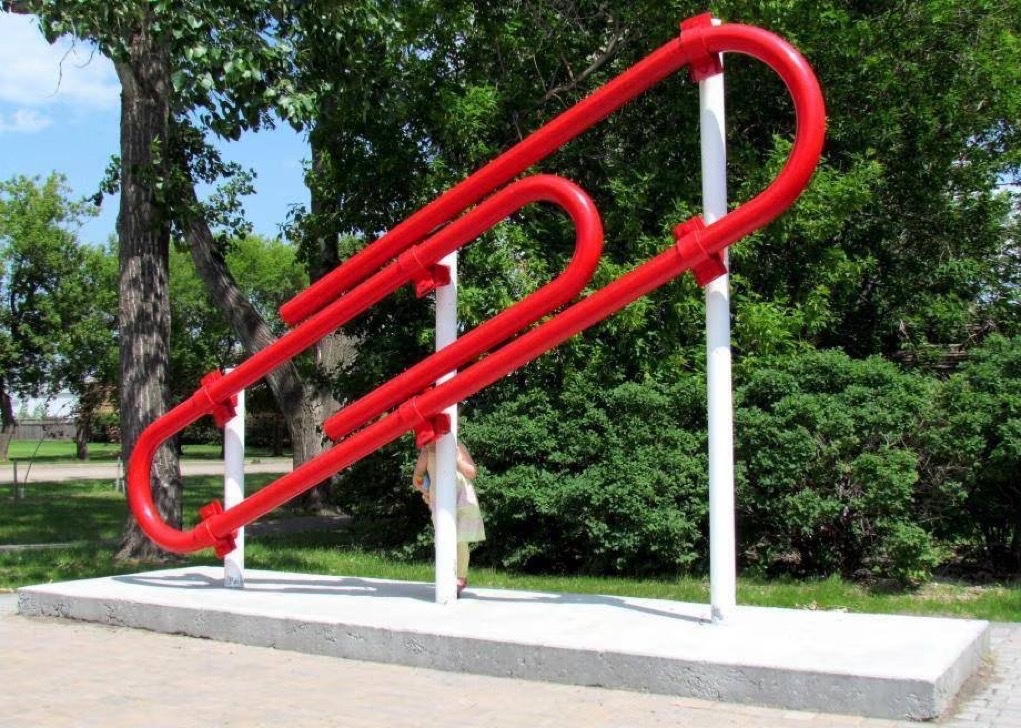
– MacDonald later donated the house to the town of Kipling, which still displays it alongside a giant red paperclip sculpture as a tourist attraction, and he wrote a book about the whole thing, published in 14 languages.
He started with a two-cent paperclip and a blog post, made fourteen trades with total strangers over one year, and ended up owning an actual house that a small Canadian town still treats as a landmark.
A man said the California Lottery congratulated him and told him his $63 MILLION check was on the way. Months later, they said his ticket was too damaged to pay and the real winner never came forward.
– Brandy Milliner of Los Angeles County said he bought the winning SuperLotto Plus ticket sold at a Chatsworth 7-Eleven for the August 8, 2015 drawing.
– He said he submitted the ticket to the California Lottery and received a letter congratulating him, telling him a check would arrive within six to eight weeks.
– The lottery then reversed course, sending a second letter saying the ticket was "too damaged to be reconstructed" and that his claim couldn't be processed.
– Milliner said the lottery also refused to return the physical ticket, and accused officials of essentially destroying his evidence.
– With the 180-day claim deadline approaching and no valid winner on record, he sued the California Lottery, asking a judge to declare him the rightful winner.
– The deadline passed on February 4, 2016 with no confirmed winning ticket presented, making it the largest unclaimed jackpot in California Lottery history at that point.
– In court, a Deputy Attorney General representing the state argued that forensic examination of the paper stock showed Milliner's ticket had actually been purchased at a completely different 7-Eleven store.
– The case was dismissed in 2018.
– The actual winner of the $63 MILLION jackpot was never identified.
– The unclaimed jackpot went to California's public schools instead.
Someone out there had the real winning ticket. A man said he did too and the court decided he didn't.
A gambling company shorted 199 customers out of $519,000 combined, quietly changing the odds on their bets after they'd already won, on everything from a Christmas Day table tennis match to the Masters.
– Bet365, one of the largest sports betting companies in the world, was found by New Jersey's Division of Gaming Enforcement to have unilaterally changed posted odds on wagers people had already placed and won, between 2020 and 2023.
– The affected bets spanned a Christmas Day 2020 table tennis match, NFL games, college basketball, mixed martial arts, and the Masters golf tournament
– In every case, customers were paid based on a "corrected" odds calculation, worse than what they'd actually bet on.
– Cases like this are part of a longer pattern. Sports betting and casino companies have spent years lobbying against stricter federal oversight, arguing state-level regulation is sufficient, even as disputes like this one show individual states catching violations only after the fact, years after they happened.
– Bet365's defense was that the original odds were posted due to "obvious error," and it believed it had the right to correct them.
– New Jersey regulators disagreed sharply
– The state's own rules required bet365 to get the Division's approval before voiding or altering any payout, something the company simply never did, repeatedly, over three years.
– Without a federal regulator setting uniform rules, enforcement is left entirely to individual states, meaning a company can operate under different standards, or none at all, depending on where a customer happens to be placing their bet.
– The Division's acting director, Mary Jo Flaherty, called it "a prolonged and unacceptable course of conduct," writing that "these types of multiple and serious violations cannot be tolerated."
– In July 2024, regulators ordered bet365 to refund the full amount owed over $519,000 combined to all 199 affected customers, and to submit a full report on fixing its internal systems.
– Bet365 didn't contest the order and declined to comment.
It wasn't one unlucky customer catching a bad break, it was 199 separate winners, over three years, each individually shorted by a company that just kept doing it until a regulator finally forced its hand.
A man forgot he'd already bought a lottery ticket, so he bought the exact same numbers again at a different store ten minutes later. Both tickets won $1 MILLION for the same numbers, on the same night.
– Paul Corcoran, of Fitchburg, Massachusetts, had purchased a "multi-draw" Powerball ticket covering seven consecutive drawings, using the same set of numbers he'd been playing for years.
– He mistakenly believed the final drawing covered by that ticket had already happened.
– So less than 10 minutes after his first purchase at a Market Basket supermarket in Fitchburg
– He drove to a Country Farms convenience store in nearby Leominster and bought a second multi-draw ticket which unknown to him, also covered the exact same upcoming July 9, 2025 drawing.
– That night's winning numbers were 5, 9, 25, 28, and 69, with a Powerball number of 5.
– Both of Corcoran's tickets matched all five white balls missing only the red Powerball number by one, keeping him just short of the full $217 MILLION jackpot.
– But matching all five white balls is still worth $1 MILLION before taxes per ticket and since both of his tickets matched identically
– He'd effectively won the same prize twice, from two completely separate purchases, at two different stores, in the same 10-minute stretch.
– Total payout: $2 MILLION.
– He collected both prizes at Massachusetts State Lottery headquarters in Dorchester.
– Both winning tickets were the first-ever $1 MILLION Powerball wins recorded in either Fitchburg or Leominster, and each store received a $10,000 bonus for selling one.
– Asked how the win felt, Corcoran kept it simple: "Feel good." He said he hadn't decided yet what he'd do with the money.
He thought he was buying a fresh set of numbers. He was actually just buying a duplicate of a ticket already sitting in his pocket and the "mistake" doubled his money instead of wasting it.