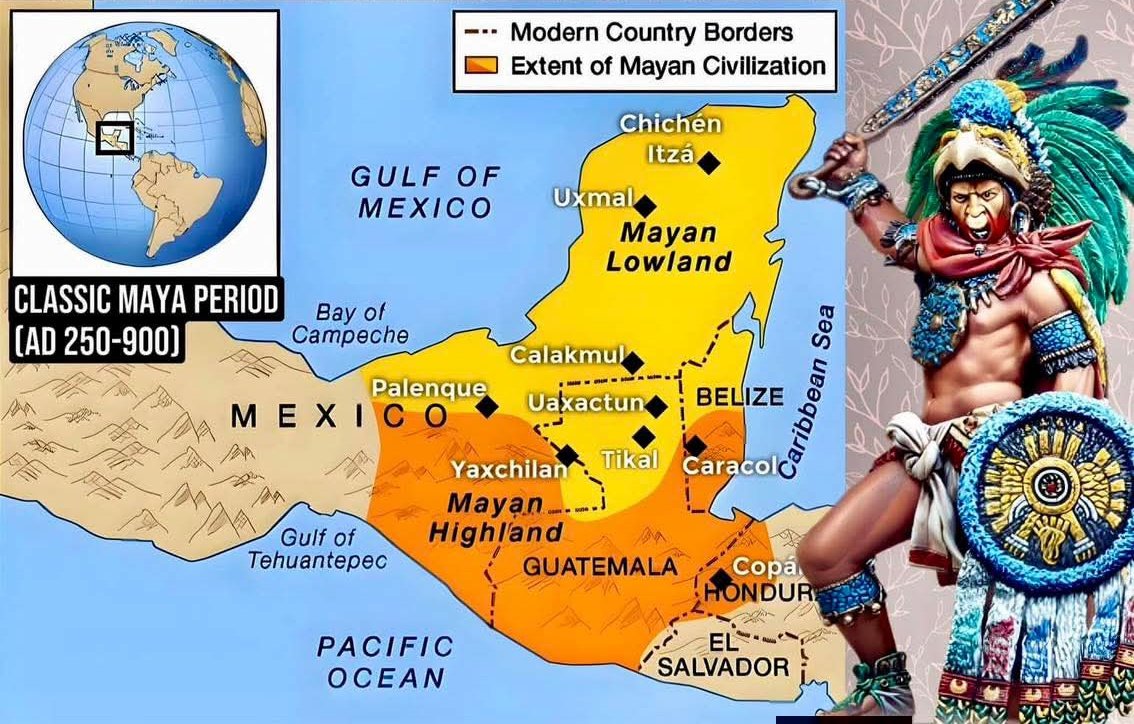
On January 16, 378 AD, an ancient Mesoamerican warrior prepared for battle. He crowned himself with ritual and terror alike—an immense feathered headdress topped by a life-sized parrot—and armed his hands with the instruments of a world where war, religion, and politics were inseparable. This was Smoking Frog, commander of Tikal’s armies, advancing not merely as a soldier but as history’s courier. When he struck the neighboring city of Uaxactún that day, using weapons, tactics, and political backing imported from the distant and imposing city of Teotihuacán, the victory was swift and decisive. And because the Maya wrote, we know the date, the name, and the outcome. The jungle did not swallow this moment whole.
That fact alone sets the Maya apart. They were not a people of silence or myth alone, but of records, numbers, and memory. Their civilization had already been centuries in the making by the time Smoking Frog marched. Farming villages had appeared as early as 2000 BC. By roughly 500 BC, ceremonial centers rose from the forest floor. And between 250-900 AD, the era historians call the Classic period—the Maya world reached its height. This was the age of kings and monuments, of rival city-states locked in shifting alliances, of stelae carved not just with gods but with dates precise enough to anchor history.
Maya civilization spread across the lowland jungles of what is now southern Mexico, Guatemala, Belize, and Honduras. It was sustained by corn that fed both body and myth. Human beings, the Maya believed, had been shaped from maize and blood; both were sacred, both demanded repayment. Power did not flow from a single empire, but from competing dynastic kingdoms ruled by divine kings, advised by priests, and bound together by trade, ritual obligation, and constant war. Most people lived as farmers, but authority concentrated in great ceremonial capitals where scribes recorded the deeds of rulers for eternity.
Among these city-states, Tikal loomed largest. Vast, fortified, and improbably engineered, it thrived without rivers by mastering rainwater—capturing and storing enough to sustain tens of thousands through seasons of drought. Its pyramids rose steeply above the canopy, temples crowning artificial mountains of stone. Stelae carved with names and dates lined its plazas, defying oblivion. Those carvings tell us that Smoking Frog was not merely a general, but an enforcer—Teotihuacán’s chosen strongman in the Maya world—installed amid palace coups and foreign intrigue. For decades after 378 AD, Tikal bent under this outside influence, and for centuries afterward it would wage bitter wars with its rival Calakmul, conflicts rooted in that moment of subjugation.
Religion saturated everything for the Maya. The sacred ball game reenacted creation itself, where gods were challenged, blood was offered, and a sacrificial death could be the fate of the defeated. Corn rose again and again—from myth, from soil, from sacrifice. The Maya cosmos was layered: Upperworld, Middleworld, and Underworld, all in constant exchange. Gods shifted shapes, wore many names, and demanded precision—especially from priests who watched the skies with mathematical rigor unmatched in contemporary Europe. Their calendars tracked immense cycles of time; their mathematics grasped zero centuries before it appeared in the West.
Yet this brilliance did not make them gentle. As populations grew and cities multiplied, warfare intensified. Captives were taken not merely to be killed, but to be displayed, bled, and woven into sacred narrative. Human sacrifice was not peripheral—it was central. Blood was not horror; it was currency owed to the divine. And still, alongside this violence stood astonishing achievement: a written language of thousands of glyphs, astronomical records spanning centuries, and historical memory etched permanently into stone.
#archaeohistories
President Trump announces he will be posthumously awarding Charlie Kirk the Presidential Medal of Freedom
“I am pleased to announce that I will soon be awarding Charlie Kirk, posthumously, the Presidential Medal of Freedom.”
THAT'S RICH: The Harris campaign reportedly paid closer to $2.5 million for the Oprah Winfrey town hall event, almost double what was previously believed. In total, the campaign reportedly spent $1.5B and Democrats are now $20M in debt. https://t.co/hgg2dPZmFi
6 Republican Senators joined with democrats to vote that this impeachment sham is constitutional.
Cassidy (LA-2026)
Collins (ME-2026)
Murkowski (AK-2022)
Romney (UT-2024)
Sasse (NE-2026)
Toomey (PA-Retiring)
In addition to primarying Cheney & Kinzinger, I’ll help w/ these.