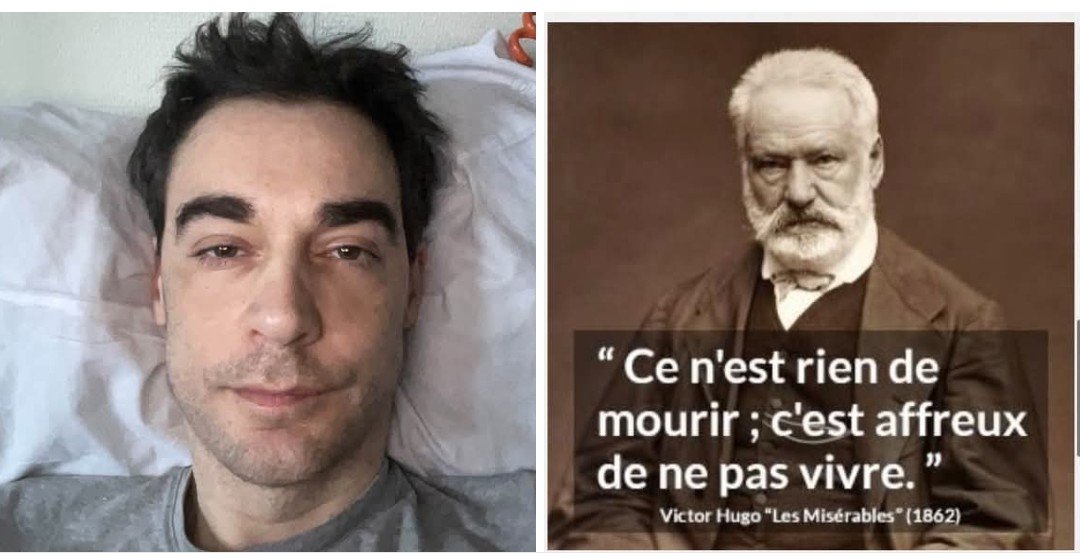
Der französische Schauspieler Arnaud Denis hat heute sein Leben durch #Sterbehilfe in Belgien beendet.
Auf Facebook hat er vor sechs Stunden öffentlich einen langen Post verfasst, zu seiner Krankheitsgeschichte, aber auch zu allgemeinen Überlegungen hinsichtlich des Umgangs mit schwer chronisch Kranken. Ich kann nur allen empfehlen, diesen Post zu lesen.
https://t.co/0pFZARVxA2
Ein Zitat daraus, ins Deutsche übersetzt:
"An alle Kranken mit Myalgischer Enzephalomyelitis, deren Leiden in der Medizin in Frankreich und weltweit geleugnet werden. Es herrscht Gesundheitsnotstand. Diese invalidisierende postinfektiöse neurologische Erkrankung betrifft weltweit Millionen Menschen. Millionen, darunter Jugendliche und Kinder, die im Dunkeln bettlägerig unter entsetzlichen Bedingungen überleben. Ich stehe in Kontakt mit zwei jungen Männern von 23 und 27 Jahren, die bald in anderen Ländern zur Euthanasie greifen werden, so unerträglich sind ihre Lebensbedingungen. Manche sterben zu Hause an Mangelernährung, weil die Versorgung ungeeignet ist. Es gibt keine Nachsorge für die schweren physiologischen Komplikationen, die das nach sich ziehen kann, darunter die kraniozervikale Instabilität, okkultes Tethered Cord, schlecht nachgewiesene Liquorlecks, Gefäßkompressionen mit Unterperfusion des Gehirns. Das Posturale Tachykardie-Syndrom, virale Reaktivierungen, Auffälligkeiten in der Muskulatur, Schädigungen des zentralen Nervensystems, Ganglionopathien der Spinalnerven, Hypovolämie – nichts davon wird in Frankreich untersucht. Die Forschungsfinanzierung ist lächerlich im Verhältnis zur Zahl der Betroffenen. Das muss sich ändern. Die Regierungen tun nichts und lassen die Kranken ohne therapeutische Hoffnung in einer entwürdigenden Versorgungsaufgabe zurück."
Rest in power, Arnaud. 🕯🕊💙
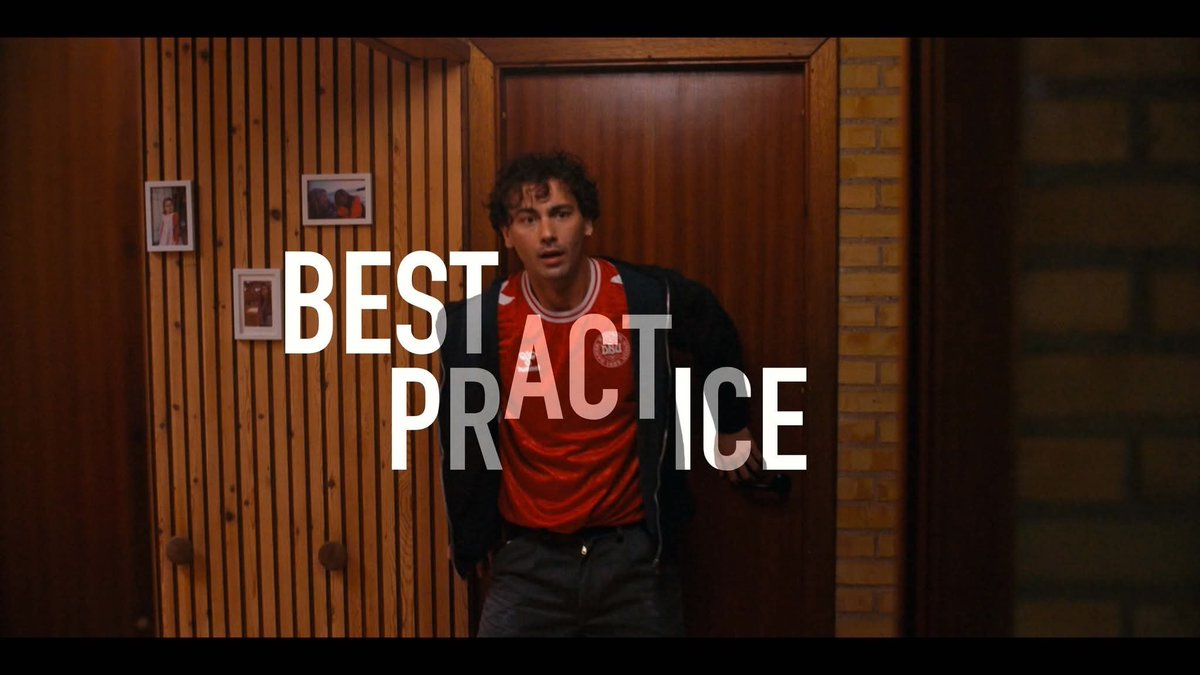
Wow. Oscar winning filmmaker Martin Strange-Hansen has made a short film about the forced removal of a very severe ME patient in Denmark.
This looks really amazing!!
https://t.co/fvQkvKpFtT
#pwme#myalgicE#millionsmissing#severeME
The fidgety "I NEED TO DO SOMETHING" feeling while feeling brain dead and unable to use your mind is the worst combination. I'm too antsy to watch TV or movies (I know I'm lucky to be able to), music sounds like noise, TV/movies look like people doing stuff on a screen, my brain can't process or feel, but I'm just DYING to do something. Work on something. Make something. Engage with the world. garg! 🤯😶🌫️
@robinsoped101 The Bateman Horne Center has already produced a great deal of high-quality educational materials https://t.co/608SIfsHxF, as has the Workwell Foundation https://t.co/GVimUhMXNx.
@kafkaswife 1/3 I had a selection of photos I wanted to post here, but I have decided they are too graphic. They are of the hole in my stomach where my feeding tube sits, the same feeding tube I am too unwell to use. I also have a line into my arm straight into a central vein to my heart.
@scott_scientist@tessfalor There are studies on drugs to provide evidence that they’re effective alleviating symptoms, which are necessary so that more doctors all over the world are willing to use them. And there are studies on drugs that are possibly cures. More of these are being developed now.
@scott_scientist@tessfalor As far as I know there are no double blind controlled studies of LDN except for the one in progress now funded by OMF being done at Harvard led by Dr. Systrom. And nobody is claiming that it’s a cure all. It’s aimed at alleviating some of the symptoms. 1/
@scott_scientist@tessfalor There was so much critical thinking happening at the conference. From a diversity of scientist from all over the world. They really are dedicated to figuring it out. I wish we could feel like we are on the same side.
@scott_scientist@tessfalor I don’t understand why you say this. At the Stanford Working Group meeting last week there were three days of really good scientists talking about all kinds of ideas. And fishing for Grant at NIH is a joke. It’s nearly impossible to get funding for ME.
I’m in a really, really bad spot with my health, and sometimes it’s the smallest gestures that help me hang on.
Marion, one of my oldest and dearest friends and an ME/CFS advocate, sent me this photo of her daughter wearing the WE&ME pullover. Seeing “Together we will cure ME/CFS” on her back really helps.
So if you’re wondering whether to reach out to an ME/CFS patient, please do. You may not realise how much it means. It can save lives. 💙🙏
Something exciting is happening in POTS/ME/CFS/Long COVID research right now. Multiple labs and clinicians, working independently, are converging on overlapping mechanisms - neuroinflammation, autonomic and brainstem dysfunction, immune-driven pathways, approached from completely different angles: imaging, immune markers, clinical observation, structural findings.
That kind of convergence is usually a marker of a field reaching scientific maturity. Early-stage fields tend to be scattered and contradictory. A field converging from multiple independent directions toward the same underlying biology is a sign there's real signal to chase. This is what it looks like when a research area starts to click into focus after years of being dismissed or fragmented.
Patients have waited decades for this kind of momentum. Grateful to see so many people pushing in the same direction.
I have to go back to the dentist again for a 3rd (!!) visit in 3 months. it’s so much for my body to take, but unavoidable. I haven’t recovered from my last trip 3 weeks ago. And the feeling I have right now can only be described as fear. Fear for what it will be like afterwards if I’ve been this sick since the last visit (unable to think at all, nearly incapacitated, considering using a bed pan, etc). What new hell awaits me today? I’m just laying here counting down the hours until I have to leave, feeling the powerlessness of it all, the inevitability, the vulnerability.
————-
#mecfs #pwME #LongCovid #Disability #ChronicIllness
Last week, I "went private" with my condition, sending out a long email to every person who has had a significant impact on my life since I was in school.
I had to figure out how to explain M.E. to an audience who had never heard of it, and came up with the following narrative, from which the feedback has been really good!
Feel free to steal any of it if you ever need an explainer for a similar context:
---
Think back to how you felt during any infection (like the flu, or COVID). Those symptoms were your body entering a defensive state called the Cell Danger Response, where every cell in your body started screaming "shut down and redirect resources toward the immune system!" That flu-like malaise you felt was your cytokines, that crushing fatigue your mitochondria going dark, and the brain fog and light sensitivity was your nervous system locked into threat-scanning mode. All evolutionary signals, refined over millions of years, that told you: "while we fight this threat, lie down in a dark room and do nothing".
In 99.999% of cases, this threat response resolves, and you go back to your normal life.
Call me the 0.001%. For some of us, due to a combination of genetics and chance, the Cell Danger Response never shuts off, and we don't go back. Ever.
This persistent threat response condition is known as myalgic encephalomyelitis, or ME. And the longer it goes on, the deeper it entrenches, eventually disrupting systems throughout the body until basic functions - sitting, showering, talking on the phone, even digesting food - become so energy-intensive that they are rendered impossible.
Funny, isn't it? A debilitating disease that affects one million Americans, and you've never even heard of it. (Or if you have, it's most likely by an incredibly infantilizing name that we'll never speak of again: "chronic fatigue syndrome".)
M.E. is not new. Researchers have documented post-infection illness outbreaks for over a century. In the 1980s, it was on similar footing as AIDS - both mysterious illnesses ruining young, healthy lives, and both similarly dismissed in the eyes of researchers, doctors, and the public: ME was seen as a condition involving hysterical yuppie women and AIDS was stigmatized as something gay men had brought on themselves.
But slowly, the paths diverged: AIDS patients started dying in large numbers. Activists rallied - sick, but still able to protest, staging die-ins and chaining themselves to buildings. Meanwhile, ME patients were too severely afflicted to court attention or advocate for themselves. They didn't die, they just... disappeared, suffering invisibly in dark bedrooms, forever.
While institutions and researchers forgot about ME, AIDS went on to gain visibility and make history: billions of dollars in research funding, the discovery of HIV, and eventually, a functional cure. We all learned that story in health class, but we never learned about M.E.
But quietly, all those years, people kept getting permanently sick after viral illnesses. Some were able to manage it, others became incapacitated and disappeared from the public eye. Then came the pandemic, and suddenly billions of people started getting serious infections in a way they hadn't before. Long COVID has doubled the number of people with ME, and today, Long COVID and ME have a disability burden greater than AIDS at its peak:
400 million afflicted worldwide. 100 million suffering significant functional deficits affecting large parts of their daily lives. Tens of millions too severe to leave their homes, and 5 million bedridden (yep, that's me.)
Despite these staggering numbers, and even after 70 years of recognition, M.E. has no cure, and not even a single treatment that has been shown to reliably reverse disease progression. The lifetime recovery rate is 7-15%, but most of those are spontaneous recoveries from mild cases within the first two years of onset. At my level of severity, anecdotes show that fewer than 1 in 100 patients recover.
The research funding allotted to M.E. by the US government is at 1% of its commensurate disease burden, the lowest of any disease (AIDS, by the way? 2000%). I follow the research closely, and nothing currently being investigated is anywhere near a cure. We have no clinical biomarkers, no unifying theory, and no real breakthroughs. In my best estimation, we are 10 years out.
This has quietly become the greatest invisible public health scandal no one gives a fuck about solving. Every single group that should care about the plight of their fellow humans, from ordinary people on the street, to governments, researchers, and doctors, are all looking the other way.
Not anymore. I'm going to make everyone look.